

Thesis Statement Generators: How to Use One Without Getting a Generic Thesis
Use a thesis generator for a draft - not a final claim. Supply 4 inputs: the assignment, a narrow topic, a tentative position, and 2–3 reasons supported by sources. Ask for 2 thesis options, then choose the one the paper can defend.
Before using the result:
- Check the claim: It should answer the assignment and give readers something to debate - not just name a topic.
- Check the sources: Cut unsupported points, and don’t turn a link between two things into a cause-and-effect claim.
- Polish without changing the meaning: Use Yomu AI to edit wording, then check citations, borrowed material, and course rules on using AI writing aids.
The goal is a clear, focused argument - not just a smoother sentence.
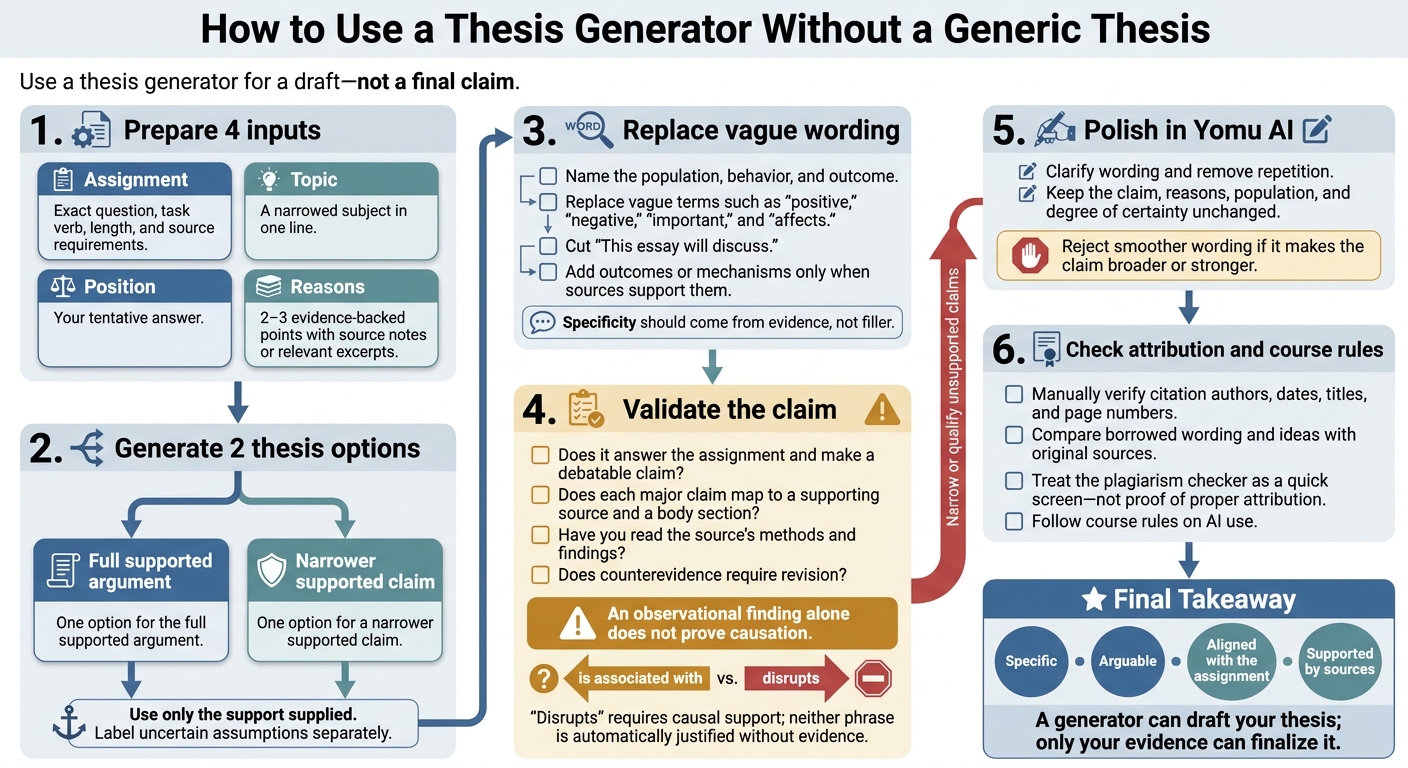
How to Use a Thesis Generator Without a Generic Thesis
Step 1: Prepare 4 Inputs and Generate Thesis Options
Label Your Assignment, Topic, Position, and Reasons
Use the checklist from the previous section to turn your narrowed topic into four prompt inputs: Assignment, Topic, Position, and Reasons.
Under Assignment, paste the exact question, including its task verb and any length or source requirements. Keep instructions such as compare or evaluate: they shape the argument you need to make.
Under Topic, narrow the subject in one line. Under Position, give your tentative answer. Under Reasons, provide 2 or 3 evidence-backed points, along with the support for each.
These inputs help the generator produce a specific claim you can defend - not a generic statement about your topic.
Ask for Specific Claims Your Sources Can Support
Fill in the four fields below, then use the prompt to request thesis options. Each option should match what your sources actually show.
Assignment: Paste the exact assignment question and requirements.
Topic: Specify the narrowed subject.
Position: State your tentative answer.
Reasons: Give 2 or 3 reasons, with source notes or relevant excerpts.Generate 2 concise, arguable thesis options that answer the assignment directly. Use one option for the full supported argument and one for a narrower supported claim. Use only the support supplied here. Do not write “This essay will” or summarize the whole paper. Label any uncertain assumptions separately. Avoid vague wording and unsupported claims. If the sources establish association rather than causation, preserve that distinction.
Try the Prompt on an Undergraduate Sleep Example
Here’s a filled-in practice example:
Practice scenario:
Assignment: Analyze how social media affects undergraduates’ sleep.
Topic: Late-night social media use among undergraduates and sleep.
Position: Late-night use harms sleep quality.
Reasons: Delayed bedtime, nighttime notifications, and difficulty disengaging.
Evidence limit: Use only claims the sources support.
Before generating thesis options, replace these research leads with findings your sources support. If the sources link nighttime use with poorer sleep but don’t examine notifications, leave notifications out. If they show association rather than causation, use wording such as “is associated with” or “may contribute to.”
sbb-itb-1831901
Step 2: Turn a Generic Thesis Into a Focused Claim
Compare the Generic and Focused Drafts
Treat the generator’s draft as a starting point. Revise it in stages, moving from a broad statement to a claim you can defend. Each change should add meaning - not just words.
Draft thesis Problem Revision move Focused thesis “Social media affects students.” The population, behavior, and outcome are unclear. Name who, which behavior, and what outcome. “Late-night social media use affects undergraduates’ sleep.” “Late-night social media use affects undergraduates’ sleep.” “Affects” does not explain whether the effect is harmful or how it happens. Replace the vague verb with a specific, debatable claim. “Among undergraduates, late-night social media use disrupts sleep.” “Among undergraduates, late-night social media use disrupts sleep.” The claim needs specific, supported outcomes without assuming causation. Add mechanisms only when sources support them. Among undergraduates, late-night social media use is associated with poorer sleep, delayed bedtimes, and difficulty disengaging.
The final draft gives you a specific claim to defend - if your evidence supports it. It’s debatable because readers can challenge the associations. By contrast, “disrupts” in the earlier draft makes a causal claim and needs causal support. In the next step, test the final draft against your assignment and sources.
Replace Vague Words With Specific Effects
Look for “positive,” “negative,” “important,” and “affects.” Check whether your sources support what each word claims. For this topic, name sleep duration, sleep quality, or bedtime instead of “negative effects.” Keep those outcomes separate: evidence about sleep duration does not automatically support a claim about poorer sleep quality.
Cut announcement phrases such as “This essay will discuss,” and remove reasons your sources don’t support. Your thesis doesn’t need three mechanisms - or any mechanism the evidence can’t establish. Don’t add an exact bedtime, age range, or effect size just to sound precise. Specificity should come from evidence, not filler.
Thesis Info & Using a Generator - Working Thesis Statements
Step 3: Check Your Thesis and Revise It in Yomu AI
After narrowing your thesis in Step 2, check that the claim still fits the assignment and the evidence.
Check Assignment Fit and Source Support
Before polishing the wording, compare your thesis with the assignment’s task, scope, length, source requirements, and formatting. Make sure it makes a debatable claim.
Map each major claim to a supporting source and a body section. Read the source’s methods and findings - not just its title or abstract. If your thesis uses causal language, check whether the study rules out other explanations. An observational finding alone does not prove causation. Narrow or qualify any claim that goes beyond the evidence.
Each body section should help answer the assignment and leave enough room for evidence and explanation. If well-supported counterevidence weakens your position, revise the thesis before working on sentence structure.
Polish the Thesis in Your Yomu AI Draft
Place your thesis beside the introduction and body outline in Yomu AI. Use sentence-level editing to clarify the wording and remove repetition. Tell the editor to keep the claim, reasons, population, and degree of certainty unchanged. The goal is a sharper sentence, not a broader argument. Reject smoother wording if it makes the claim broader or stronger.
Use citation tools to apply the required style, then manually check authors, dates, titles, and page numbers. Treat the plagiarism checker as a quick screen - not proof of proper attribution. Compare borrowed wording and ideas with the original source, and follow your course rules on AI use.
Conclusion: Use Only a Thesis You Can Defend
Once you’ve drafted and revised your thesis, check that it’s specific, arguable, aligned with the assignment, and supported by your sources.
Then test the claim against the evidence. If the evidence changes, revise your thesis. Narrow the claim when your sources don’t support its full scope. A generator can draft your thesis; only your evidence can finalize it.
FAQs
Can I use a thesis generator before researching?
Yes, but a thesis generator works best after you’ve done some initial research, when you have a claim to refine. A strong thesis needs evidence - not just opinion. Research helps you spot gaps and develop a hypothesis. The generator can then sharpen it into a specific, arguable claim. Without that research, the output is often vague, generic, and unsupported by evidence.
How narrow should my thesis be for a short paper?
Keep your thesis focused enough to support with a thorough argument within your word limit. Aim for one or two clear, concise sentences that make a specific claim someone could debate - not a broad or generic statement.
To narrow your topic, focus on a demographic group, location, time frame, or specific causes. Make sure your evidence directly supports your claim.
Should my thesis address counterarguments?
Yes, addressing counterarguments in your thesis can strengthen your argument. It shows you’ve considered other perspectives and can defend your position.
Try this structure:
“Although [counterargument], [your stance] because [reasons].”
Words like “although,” “however,” and “unless” let you recognize complexity without oversimplifying your argument or weakening your position.