

How to Turn a Topic into a Strong Persuasive Thesis
Crafting a persuasive thesis starts with narrowing a broad topic into a clear, debatable statement that reflects your stance. A strong thesis is specific, invites disagreement, and serves as a roadmap for your argument. Here’s how you can do it:
- Start with brainstorming: Use tools like mind mapping to explore connections and refine your focus.
- Ask targeted questions: Break down your topic with "What", "Why", and "How" to make it more specific and manageable.
- Take a stance: Ensure your thesis is debatable and not a mere statement of fact.
- Test and revise: Check if your thesis is specific, clear, and appropriately scoped for your paper.
- Polish for clarity: Use precise language and active verbs to make your argument stand out.
For example, instead of saying, "Pollution is bad", argue, "25% of the federal budget should target pollution control." This approach sharpens your claim and invites discussion. Tools like Yomu AI can help refine your thesis by suggesting precise language and testing for clarity. A well-crafted thesis is the foundation of a persuasive argument.
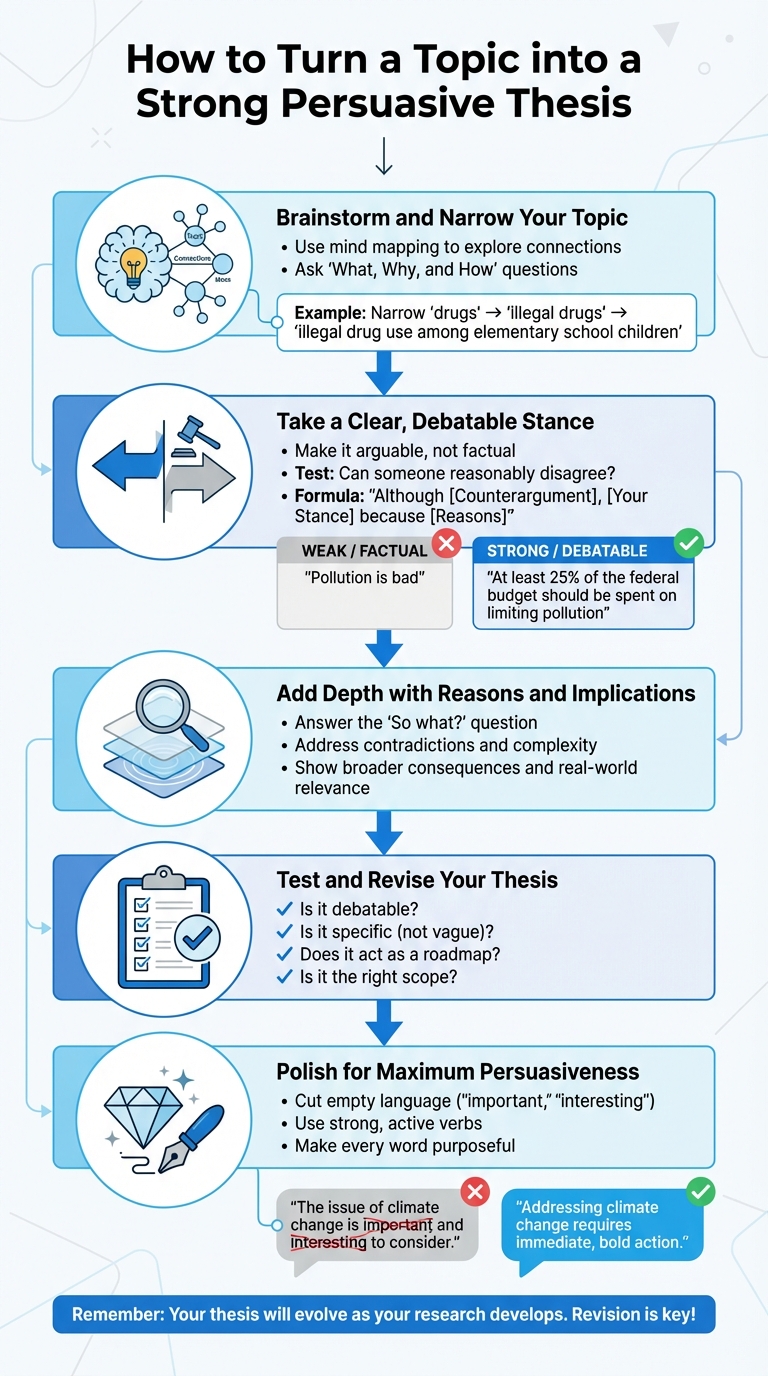
5-Step Process to Craft a Strong Persuasive Thesis Statement
Beginners Guide To Crafting STRONG Thesis Statements
sbb-itb-1831901
Step 1: Brainstorm and Narrow Your Topic
To craft a strong argument, start by narrowing a broad subject into a focused claim. Brainstorming techniques can help you explore the topic's nuances and identify where your argument truly lies.
Use Mind Mapping to Generate Ideas
Mind mapping is a visual tool that helps uncover connections between ideas and potential angles for your thesis. Begin by placing your broad topic at the center of a page, then branch out with related facts, questions, or observations. This process can reveal patterns, contrasts, or similarities that point to deeper relationships. For instance, if your topic is "drug use", you might identify links between illegal drug use, gang violence, and specific groups like elementary school children.
As you identify these connections, ask yourself the "So what?" question to uncover the broader significance of these relationships. What larger issue does this reveal? How does it challenge conventional thinking? Use these insights to refine your topic and focus on specific details that can strengthen your argument.
Ask 'What, Why, and How' Questions
Building on your mind map, targeted questions can help sharpen your thesis further. These questions guide you in narrowing a broad topic into a clear, debatable claim. Start with "What?" to define the specifics of your topic. For example, instead of the general term "drugs", narrow it to "illegal drugs." Similarly, replace "society" with "elementary school children." This specificity ensures your argument doesn’t become too scattered.
Next, ask "Why?" to explore the reasons behind your stance. This step helps transform a broad statement into a claim you can defend. For instance, "Drug use is detrimental to society" is too vague, but "Illegal drug use is detrimental because it encourages gang violence" provides a clear reason to argue. Finally, ask "How?" to dig into the mechanisms or consequences of your argument. If your thesis still leaves room for "how?" or "why?" questions, it likely needs more precision.
"The broader your claim is, the more evidence you will need to convince readers that your position is right."
These questions ensure your thesis aligns with the depth required for academic writing.
Use Yomu AI for Brainstorming
Yomu AI can be a helpful tool for brainstorming. Its autocomplete and suggestion features allow you to quickly expand on your initial thoughts. As you type, the AI provides related ideas you might not have considered, helping you explore your topic more thoroughly. This makes it easier to pinpoint the most compelling direction for your argument.
Step 2: Take a Clear, Debatable Stance
Once you’ve refined your topic, it’s time to take a position that sparks discussion. A persuasive thesis should invite disagreement, not simply state a fact. For example, saying "Pollution is bad for the environment" is just stating the obvious. On the other hand, asserting that "at least 25 percent of the federal budget should be spent on limiting pollution" encourages debate, as others might argue that education or healthcare deserves that funding instead. The key is to craft a claim that others can reasonably challenge.
To test your thesis, try imagining its opposite. If you can’t think of a credible counterargument, your stance might be too obvious or factual. A strong thesis should also be narrow enough to defend effectively. For instance, "Drug use is detrimental to society" is too broad to tackle in a single paper. A more focused version, such as "Illegal drug use is harmful because it encourages gang violence", is easier to argue and support with evidence. This approach keeps your argument precise and aligned with your academic goals.
Build Your Thesis with 'Although, Stance, Because' Structure
A clear structure helps you organize your argument. One effective formula for crafting a persuasive thesis is:
"Although [Counterargument], [Your Stance] because [Reasons]."
This format shows you’ve considered opposing views while clearly presenting your position and reasons. Take this example:
"Although some argue that social media isolates individuals, it actually serves as a vital tool for political mobilization by enabling marginalized groups to organize and share information rapidly."
This thesis doesn’t just sit on the fence by saying "social media has both positive and negative aspects." Instead, it makes a specific, defensible claim with supporting reasoning. Words like "because", "although", and "however" are great for connecting your stance to the evidence you’ll provide.
Strengthen Arguments with Yomu AI
Yomu AI can help fine-tune your thesis for maximum clarity and impact. Its paraphrasing tool can replace vague terms with precise language, while the sentence autocomplete feature suggests ways to tighten your wording. These tools ensure your thesis is assertive and avoids weak phrases like "I think" or "in my opinion", making your argument more compelling and professional.
Step 3: Add Depth with Reasons and Implications
Once you've sharpened your stance, the next step is to dig deeper - exploring the "why" and "how" behind your argument. This added depth not only strengthens your thesis but also makes it more compelling.
Expand the 'So What?' Factor
A thesis without a clear "So what?" leaves readers wondering why they should care. To make your argument resonate, think beyond the surface. For example, if your thesis is "social media affects communication", stop and ask yourself, "Why does this matter?" A stronger angle could be: "Unreliable voices on social media have pushed people to become more critical consumers of information, ultimately leading to more informed voters." By tying your thesis to broader consequences, you show its relevance in the real world.
"If a reader's first response is likely to be 'So what?' then you need to clarify, to forge a relationship, or to connect to a larger issue." - The Writing Center, University of North Carolina at Chapel Hill
Don't just state facts - interpret them. For instance, instead of saying, "Braille was invented in the 19th century", explain how its success hinged on acceptance by sighted teachers and the ongoing debates about the role of disabled people in society. This shift transforms a simple observation into a meaningful argument. Action verbs can also help you craft more dynamic and persuasive statements.
Once you've tackled the "So what?" question, it's time to embrace the complexities and contradictions within your topic.
Address Contradictions and Complexity
Acknowledging opposing views doesn't weaken your argument - it strengthens it. A persuasive thesis considers alternative perspectives and explains why your interpretation holds up. For example, a thesis on eating disorders among college-aged men becomes more impactful when it states: "Lack of attention to eating disorders among college-aged men not only leaves this group untreated but also intensifies the isolation they often feel". This approach shows you've thought through the issue and its broader consequences.
Phrases like "Despite [Counterpoint], [Stance] because [Reason]" can help you address contradictions naturally. Words such as although, however, and unless signal that you're engaging with the nuances of the topic rather than oversimplifying it. And remember, a thesis should take a stand on a debatable issue. If your argument is something universally accepted - like "pollution is harmful" - it won't spark meaningful discussion.
Refine Complexity with Yomu AI
As you add depth and tackle counterarguments, your thesis might become more layered. To keep it clear and concise, tools like Yomu AI can help. Its paraphrasing and summarization features simplify dense arguments without stripping away their complexity. This ensures your thesis stays focused and accessible while maintaining the depth needed to establish credibility.
Step 4: Test and Revise Your Thesis
Your first draft is rarely the final version. As you dig deeper into your research, your argument will likely shift and grow. The trick is to test your thesis against specific benchmarks before you fully commit to it. A well-crafted thesis should be debatable, specific, and grounded in evidence.
Here’s how to refine your thesis and make it stronger.
Checklist for a Strong Thesis Statement
Use these criteria to evaluate your thesis:
- Is it debatable? Ask yourself: Could someone reasonably disagree with this statement? For instance, saying "Pollution is bad for the environment" is a fact, not an argument. A debatable thesis might be, "Government subsidies for renewable energy are essential to reducing pollution levels in urban areas."
- Is it too vague? Avoid broad or generic terms like "good", "successful", or "important." Instead, be precise about what you mean. For example, instead of "Social media is important to modern communication", try: "Social media has reshaped political discourse by allowing candidates to communicate directly with voters, bypassing traditional media outlets." This not only sharpens your argument but also sets clear points to address in your paper.
"If your thesis contains words like 'good' or 'successful,' see if you could be more specific: why is something 'good'; what specifically makes something 'successful'?" - University of North Carolina at Chapel Hill
- Does it act as a roadmap? A strong thesis gives your reader a sense of where your paper is headed. It should hint at the structure of your argument. If someone reads your thesis and still wonders "how?" or "why?", it may need more clarity.
- Is it the right scope? Ensure your claim matches the length and depth of your assignment. For example, a broad statement like "Drug use is detrimental to society" might be too much for a short paper. Narrow it down to something manageable, such as: "Illegal drug use contributes to gang violence, creating significant public safety concerns in urban communities." This keeps your argument focused and achievable.
Use Yomu AI for Revision and Originality
Once your thesis meets these criteria, it’s time to ensure it’s both original and polished. Yomu AI’s plagiarism checker helps confirm that your argument is authentically yours and properly cited. Its citation tool also makes formatting references a breeze, saving you time and ensuring academic integrity. These tools can help you refine your thesis into a clear, compelling statement that sets the tone for your entire paper.
Step 5: Polish for Maximum Persuasiveness
Now that you've tested your thesis and confirmed it's debatable, specific, and well-scoped, it's time to fine-tune your language. This step is all about making your thesis as clear, concise, and impactful as possible. The difference between a decent thesis and a standout one often lies in word choice and sentence structure. Every word should serve a purpose - vague adjectives or passive phrasing can weaken your argument.
Start by cutting out empty language. Words like "important", "interesting", or "successful" might sound meaningful but don’t add much substance. For example, instead of saying, "Social media is important to modern communication", explain why and how: "Social media has transformed political discourse by enabling candidates to bypass traditional media and speak directly to voters." This version is much more specific and gives readers a clear sense of your argument.
Next, pay close attention to your verbs. Strong, active verbs create energy and authority in your writing. Avoid overusing "to be" verbs (is, are, was, were) and opt for more dynamic alternatives. Use subordinating conjunctions like "because", "although", and "since" to show the logical connections between your claim and its reasoning. As the Vanderbilt University Writing Studio puts it:
"For your reader, a thesis functions like the case a lawyer has to make to the judge and jury in a courtroom".
Keep refining your thesis until every word contributes to its strength.
Examples of Weak vs. Strong Thesis Statements
To understand what a polished thesis looks like, compare these weak and strong examples. Notice how revisions make the statements more specific and persuasive:
| Weak Thesis | Weakness | Strong Revision | Improvement |
|---|---|---|---|
| Pollution is bad for the environment. | Too general; states a widely accepted fact. | At least 25 percent of the federal budget should be spent on limiting pollution. | Takes a specific, debatable stance that invites discussion. |
| Drug use is detrimental to society. | Overly broad; "drugs" and "society" are vague. | Illegal drug use is detrimental because it encourages gang violence. | Focuses on a specific type of drug and its societal impact. |
| There are some negative and positive aspects to the Banana Herb Tea Supplement. | Vague and lacks a clear position. | Because Banana Herb Tea Supplement promotes rapid weight loss that results in the loss of muscle mass, it poses a potential danger to customers. | States a precise argument supported by evidence. |
| Marge Simpson is important to the plot of The Simpsons. | Obvious and lacks an argument. | Despite her role as a seemingly submissive housewife, Marge Simpson functions as a subversive force against middle-class values. | Offers a bold interpretation that requires evidence to support. |
In these examples, the strong revisions replace generalities with specific claims that clearly outline the argument. They use precise language, take definitive positions, and include logical connections to explain the "why" behind the thesis. This level of precision transforms a simple observation into a compelling argument.
Finalize with Yomu AI
To perfect your thesis, Yomu AI's tools can help ensure every word is purposeful. The paraphrasing tool suggests concise and impactful alternatives, while the summarization feature checks if your thesis captures your core argument in the most efficient way possible. These tools, combined with your own attention to detail, can help you craft a thesis that is both sharp and persuasive, providing a solid foundation for your paper.
Conclusion and Key Takeaways
Turning a broad topic into a convincing thesis doesn't have to feel like an uphill battle. It’s all about following a clear process: brainstorming ideas, narrowing your focus, crafting a stance that invites debate, strengthening your reasoning, and fine-tuning your language. Each step builds on the previous one, guiding you from a rough concept to a sharp, well-defined argument that forms the backbone of your paper.
This method not only organizes your thoughts but also helps refine your thesis as you go. And remember, a thesis is never set in stone. As the Vanderbilt University Writing Studio explains:
"Honing and tweaking a thesis statement during the revision process is ultimately more important than having it exact and precise during the drafting process".
Your thesis will naturally evolve as your ideas develop, so don’t hesitate to revisit and refine it throughout the writing process.
Tools like Yomu AI can make this journey even smoother. Whether you’re brainstorming specific angles, testing the strength of your argument, or polishing your language, Yomu AI’s features help you identify gaps and sharpen your thesis. It’s like having a writing assistant that ensures your argument is clear, debatable, and academically sound.
A strong thesis does more than just introduce your essay - it keeps your writing focused, shapes the evidence you include, and signals the direction of your argument. With these steps - and the support of Yomu AI - you can craft thesis statements that not only meet academic expectations but also provide a rock-solid foundation for your entire paper.
FAQs
How narrow should my thesis be for my assignment length?
When crafting your thesis, aim for a balance between focus and depth. For shorter papers, keep your argument clear and specific, ensuring it can be fully explored within the word count. A strong thesis provides enough detail to allow for thorough development while avoiding topics so narrow that they feel insignificant or unsupported by evidence.
What’s the fastest way to tell if my thesis is debatable?
To determine if your thesis is debatable, ask yourself if it makes a specific claim that someone could reasonably disagree with. A debatable thesis puts forward an argument or interpretation, rather than stating a fact or something widely accepted. If your claim sparks potential disagreement or needs evidence to back it up, you’re likely on the right track. On the other hand, broad facts or universally agreed-upon statements won’t lead to debate.
How can I make my thesis more specific without adding extra sentences?
To sharpen your thesis without adding more sentences, concentrate on clarifying your main argument and tightening the focus. Replace vague or overly broad language with precise, assertive claims that underline your position and unique perspective. Cut out any ambiguity, ensuring your thesis directly addresses a specific question, presents a clear stance, and hones in on one distinct aspect of your topic.