

30 Thesis Statement Examples by Essay Type
Crafting a strong thesis statement is essential for clear and effective writing. A thesis acts as the backbone of your essay, summarizing its main idea and guiding the reader through your argument or analysis. Here’s a quick breakdown of thesis statements by essay type:
- Argumentative: Takes a stance on a debatable issue and supports it with evidence.
- Analytical: Breaks a topic into parts and evaluates them to offer insight.
- Expository: Explains a topic or process with factual details, avoiding personal opinions.
- Narrative: Shares a personal story with a clear lesson or purpose.
Each type requires a unique approach to match the essay's purpose. Below are examples tailored to these essay styles, along with practical tips to refine your thesis for clarity and focus. Whether you're writing to persuade, analyze, inform, or narrate, these examples can help you create a clear roadmap for your essay.
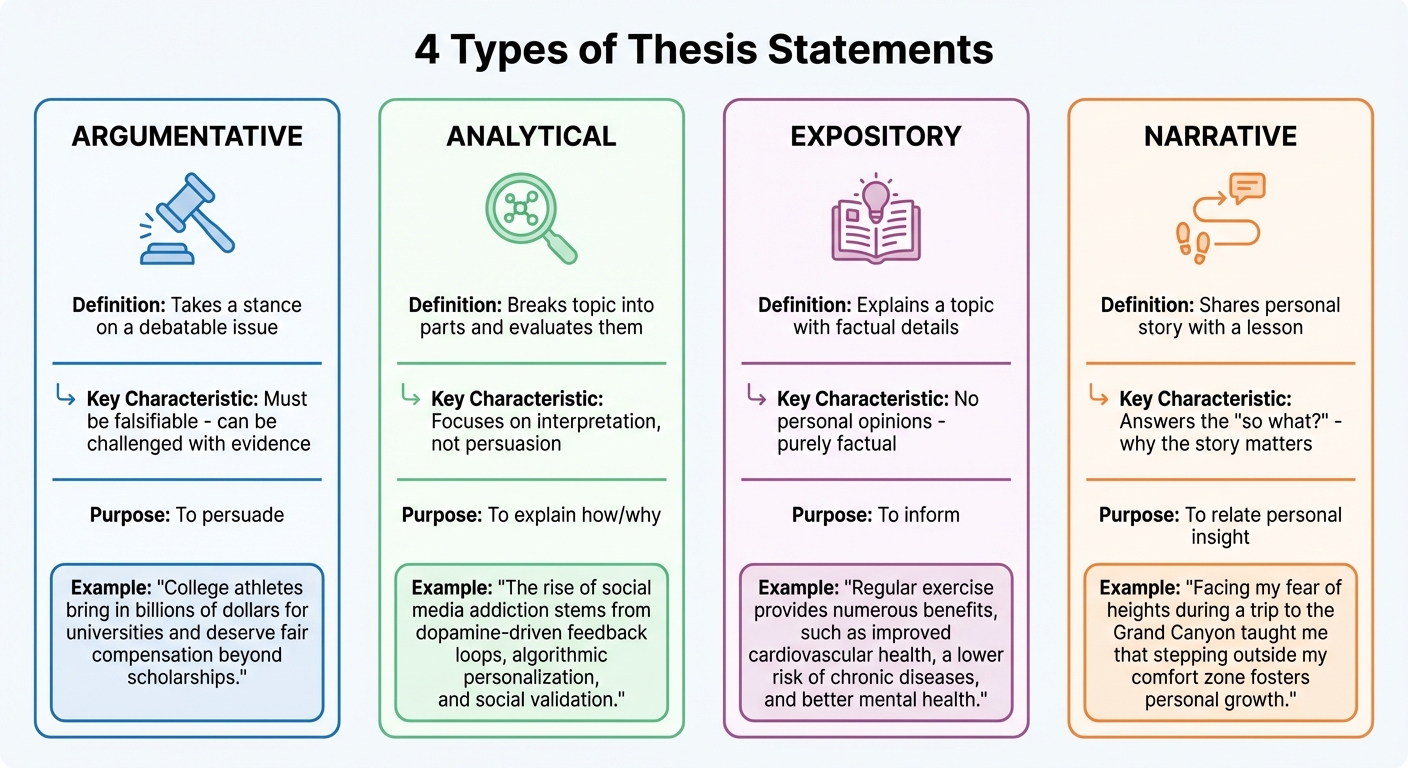
4 Types of Thesis Statements: Key Characteristics and Examples
How to Write a CLEAR THESIS Statement: Examples of a Thesis Statement
sbb-itb-1831901
1. Argumentative
Argumentative thesis statements take a stance on a debatable issue. As Chris Drew, PhD, points out:
A thesis statement in an argumentative essay needs to present a point of view.
The idea is to make a claim that could reasonably be challenged or disproven with evidence.
A solid argumentative thesis must meet the falsifiability test - if no evidence could contradict it, the claim becomes a fact rather than a position. It should also address broader issues and steer clear of vague phrases like "has positive and negative effects." Here are eight clear examples of argumentative thesis statements tackling controversial subjects:
- School Uniforms and Student Expression: Mandatory school uniforms violate students' constitutional right to freedom of expression. Schools should replace them with reasonable dress codes that balance individuality with appropriate standards.
- Compensating College Athletes: College athletes bring in billions of dollars for universities and deserve fair compensation beyond scholarships. The current system exploits their labor while administrators and coaches earn large salaries.
- Universal Healthcare Access: Healthcare is a basic human right that the U.S. government should ensure through a universal healthcare system.
- Death Penalty Abolition: The death penalty should be eliminated nationwide as it violates constitutional protections against cruel and unusual punishment and has not proven effective in deterring violent crime.
- Social Media Age Restrictions: Social media platforms should be legally restricted for children under 16, given the growing evidence tying early exposure to higher rates of anxiety, depression, and body image issues among teens.
- Minimum Wage Increases: Raising the federal minimum wage to $15 per hour is essential to provide workers with a living wage and boost economic growth, even with concerns from small business owners.
- Animal Testing in Research: The use of animals in testing for cosmetics and household products should be banned immediately since effective alternatives are already available.
- Affirmative Action Policies: Affirmative action programs are still crucial for addressing historical inequalities and fostering diversity in education and employment, as systemic barriers continue to disadvantage minority groups despite legal equality.
2. Analytical
Analytical thesis statements take complex topics, break them into smaller parts, and explain how these parts interact. An analytical paper digs into an issue or concept, evaluates its components, and shares these insights with the audience.
Unlike argumentative statements, analytical theses focus on interpretation rather than trying to persuade. They tackle questions like "how" or "why" something works the way it does, steering clear of advocating for specific policy changes or taking a strong stance. As Chris Drew, PhD, explains, an analytical thesis is about offering interpretation, not persuasion.
A well-crafted analytical thesis clearly lays out the elements to be examined and the order in which they’ll be addressed. It should be precise enough to define the scope of your analysis. Below are examples that highlight various analytical approaches:
- Social Media Addiction Analysis: The rise of social media addiction stems from dopamine-driven feedback loops, algorithmic personalization, and social validation, which collectively influence user behavior and mental health outcomes.
- Literary Symbolism in Twain: By contrasting river and shore scenes, Twain's Huckleberry Finn suggests that true American democratic ideals are found away from "civilized" society and closer to nature.
- Feminist Movement Evolution: Changes in law, shifts in societal norms, and media representation have shaped the evolution of feminist movements in Western society.
- Climate Change Contributors: An analysis of environmental degradation shows how industrialization, policy shortcomings, and consumer habits contribute to climate change.
- Voting Behavior Factors: Social identity, economic status, and media influence all play key roles in shaping voting behavior and its impact on election outcomes.
- Global Trade Dynamics: Breaking down global trade agreements reveals how economic dependency, labor exploitation, and diplomatic relations drive international markets.
- Mental Illness in Film: The portrayal of mental illness in movies sheds light on the effects of stigma, public perception, and healthcare accessibility.
- Barn Owl Flight Patterns: Studying barn owl flight behavior uncovers two distinct patterns: those linked to hunting prey and those related to courtship.
3. Expository
Expository thesis statements focus on explaining a topic through factual details, clear descriptions, and logical structure - without inserting personal opinions. As Purdue OWL explains:
The expository essay is a genre of essay that requires the student to investigate an idea, evaluate evidence, expound on the idea, and set forth an argument concerning that idea in a clear and concise manner.
These thesis statements typically appear at the end of an introduction, providing a clear roadmap for what the essay will cover in its body paragraphs.
A well-crafted expository thesis identifies the topic and outlines the main points or steps that guide the discussion. Thesaurus.com highlights that explanatory theses rely entirely on factual information.
Here are eight examples of concise expository thesis statements:
- Health Benefits of Exercise: Regular exercise provides numerous benefits, such as improved cardiovascular health, a lower risk of chronic diseases, and better mental health.
- PTSD Health Impacts: Post-traumatic stress disorder (PTSD) is associated with serious physical health risks, including a higher likelihood of stroke and arterial fibrillation.
- Professional Cake Baking: Creating a professional-quality cake involves three key steps: precise ingredient measurements, maintaining the correct baking temperature, and mastering specific frosting techniques.
- Online Learning Evolution: Online learning has reshaped education by increasing accessibility for remote students and offering more flexible scheduling options.
- Social Media Information Literacy: As not all information on social media is reliable, users are becoming more critical of the content they consume, fostering a more informed public.
- College Athletics Funding: The current funding model for college athletics creates an uneven distribution of scholarship resources, particularly impacting non-revenue sports.
- U.S. Military Spending: The United States allocates more to its military budget than the combined spending of all other industrialized nations, reflecting its unique security priorities.
- Barn Owl Life Cycle: The life cycle of barn owls includes distinct stages such as hunting for prey, constructing secure nests, and raising their offspring.
These examples lay the groundwork for discussing narrative thesis statements in the next section.
4. Narrative
Narrative thesis statements focus on personal experiences and the lessons they teach. As Examples.com explains:
A narrative essay thesis statement is a concise summary of your personal story... it sets the tone for the narrative and provides a glimpse into the lesson, theme, or insight the story intends to convey.
When crafting your narrative, it’s crucial to identify the "so what?" - why your story matters to the audience. Purdue OWL underscores this idea:
The essay should have a purpose. Make a point! Think of this as the thesis of your story. If there is no point to what you are narrating, why narrate it at all?
Here are six examples of narrative thesis statements that effectively combine personal experiences with meaningful takeaways:
- Overcoming Fear: Facing my fear of heights during a trip to the Grand Canyon taught me that stepping outside my comfort zone fosters personal growth.
- Resilience through Change: Moving to a new city pushed me to confront my fear of the unknown and showed me the importance of resilience.
- Persistence through Failure: Dealing with rejection taught me that persistence can turn failure into unexpected opportunities.
- Self-Reliance: My first solo trip abroad tested my independence and taught me invaluable lessons about self-reliance and understanding others.
- Embracing Imperfection: Learning to dance wasn’t just about mastering steps - it was about embracing imperfections and finding harmony in chaos.
- Inner Strength: Battling an illness was more than a physical challenge; it was a journey of confronting fears, holding onto hope, and discovering inner strength.
Each of these examples pairs a personal experience with a clear, relatable lesson, giving the narrative both context and purpose.
Conclusion
A strong thesis statement is the foundation of any effective essay - it shapes your argument and guides the reader through your ideas. Without a clear and focused thesis tailored to the specific type of essay you're writing, your message can lose direction, leaving your audience uncertain about your purpose.
The examples provided here highlight how aligning your thesis with the essay type can transform your writing. Whether you're crafting an argumentative thesis that takes a stand, an analytical thesis that dissects a topic, an expository thesis that explains, or a narrative thesis that reveals personal insights, each requires a unique structure and focus. As the Writing Center at the University of North Carolina at Chapel Hill puts it:
is a road map for the paper; in other words, it tells the reader what to expect from the rest of the paper.
To refine your thesis, start by identifying your essay type and aligning your statement with its purpose. Ask yourself questions like "So what?" and "How and why?" to ensure your thesis isn't just factual but offers meaningful insight.
For additional support, tools like Yomu AI can be a game-changer. With features like AI-powered autocomplete and text enhancement, it simplifies the process of crafting clear, concise thesis statements. Having the right resources at hand can make even the most challenging thesis easier to tackle.
The secret lies in practice and refinement. Use these examples as a guide, experiment with your approach, and keep enhancing your productivity to create thesis statements that resonate and drive your essays forward.
FAQs
How do I know which essay type I’m writing?
To figure out what type of essay you're working on, think about its main goal:
- If you're breaking down aspects of an issue, it's analytical.
- If you're explaining a topic or how something works, it's expository.
- If you're taking a stance and trying to convince others, it's argumentative.
- If you're highlighting similarities and differences, it's a compare-and-contrast essay.
Understanding these purposes makes it easier to shape a thesis that fits your essay style.
What makes a thesis statement too broad or too vague?
A thesis statement becomes ineffective when it's too broad or vague, as it fails to provide a clear, specific focus. This can leave readers unsure about the essay's main argument or purpose. For instance, saying "Global warming is a serious issue" lacks precision - it doesn't clarify what specific aspect of global warming will be addressed or the writer's perspective on the matter. A strong thesis statement should be precise, open to debate, and offer a clear roadmap for the essay.
Can I revise my thesis after writing body paragraphs?
It's completely normal to revise your thesis after drafting the body paragraphs. Think of your thesis as a working statement - a foundation that can shift as your ideas develop. Refining it ensures it perfectly matches the content and intent of your essay.