

How to Write a Thesis for Compare-and-Contrast Essays
Crafting a thesis for a compare-and-contrast essay is essential for organizing your ideas and guiding readers through your argument. A strong thesis not only identifies the subjects being compared but also highlights key similarities, differences, and the reason for the comparison. Here's what you need to know:
- Start with a clear structure: Choose between a block structure (discuss one subject fully, then the other) or a point-by-point structure (compare both subjects side by side on specific criteria).
- Focus on meaningful comparisons: Avoid surface-level details and prioritize points that reveal deeper insights about the subjects.
- Write a precise thesis: Mention both subjects, specify similarities or differences, and explain why the comparison matters.
- Use templates for clarity: Examples include "Although X and Y share A, they differ in B and C" or "While X and Y are similar in A, they differ significantly in B."
A well-crafted thesis ensures your essay remains focused and analytical, helping readers understand the purpose and value of your comparison.
Comparison/Contrast Thesis Statements and Introductions
sbb-itb-1831901
Compare-and-Contrast Essay Structures Explained
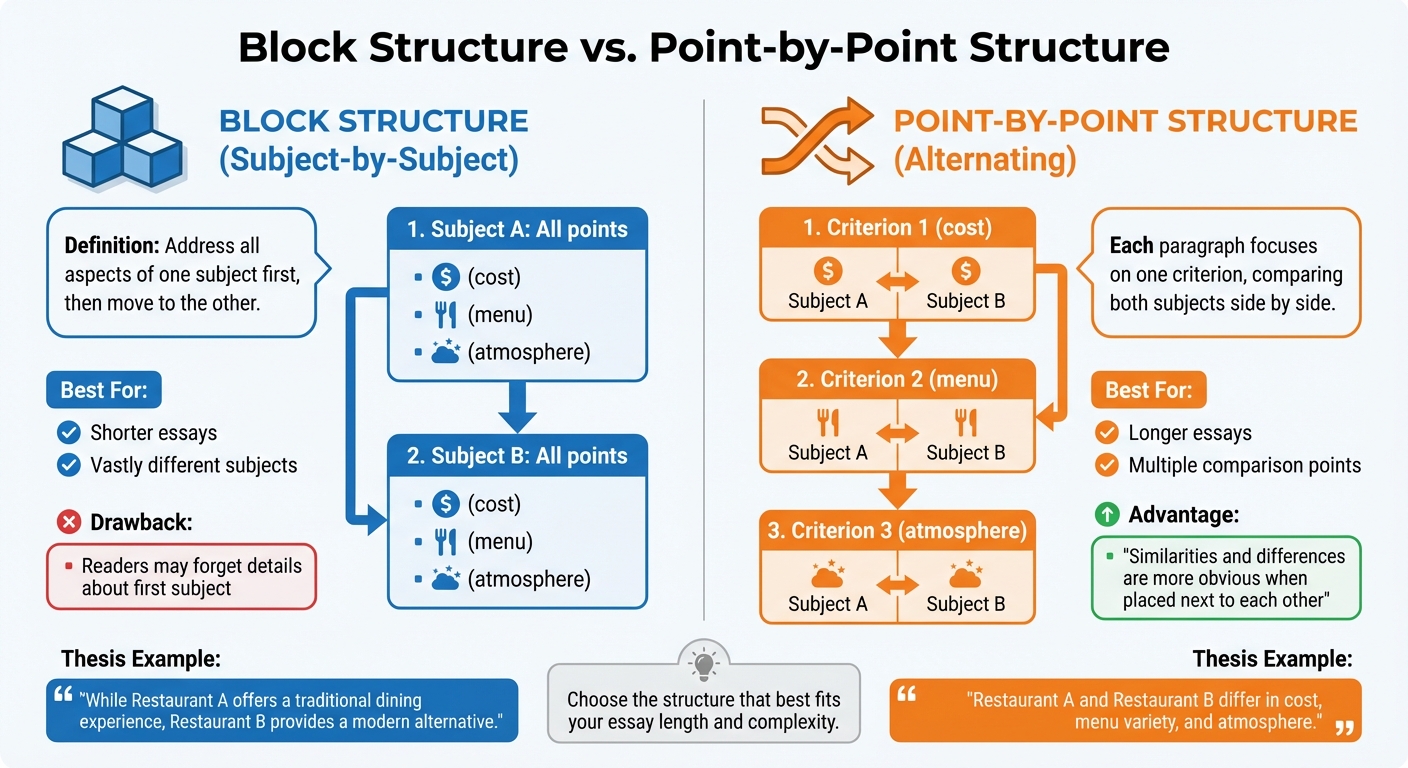
Block vs Point-by-Point Essay Structure Comparison
Before diving into your thesis, it's crucial to understand the structure of your essay. The structure you select determines how you'll present your thesis statement and shapes the overall flow of your argument. Let’s break down the two main approaches to structuring a compare-and-contrast essay.
Block Structure vs. Point-by-Point Structure
Block structure, also known as subject-by-subject, organizes your essay by addressing all aspects of one subject first, followed by the other. For instance, if you're comparing two restaurants, you'd dedicate one section to discussing Restaurant A's cost, menu, and atmosphere, then move on to cover the same aspects of Restaurant B. This method works best for shorter essays or when the two subjects are vastly different. However, one potential drawback is that readers might struggle to remember details about the first subject by the time they reach the second.
Point-by-point structure, or alternating structure, takes a different approach. Here, each paragraph focuses on a single criterion, comparing both subjects side by side. Using the restaurant example, one paragraph might compare the cost of both restaurants, the next their menus, and another their atmosphere. According to the Studio for Teaching & Learning:
"This method [Point-by-Point] is often easier for a reader to follow because similarities and differences are more obvious when placed next to each other".
This format is especially effective for longer essays with multiple points of comparison, as it keeps the discussion balanced and easier to follow.
When using the point-by-point structure, your thesis should clearly outline the specific criteria you'll be comparing. For example: "Restaurant A and Restaurant B differ in cost, menu variety, and atmosphere." For the block structure, your thesis might focus on the overall contrast between the two subjects, such as: "While Restaurant A offers a traditional dining experience, Restaurant B provides a modern alternative." Either way, your thesis should act as a clear guide, connecting the essay's structure to your analysis and helping readers navigate your argument.
How to Identify Key Similarities and Differences
The backbone of a strong thesis is built on meaningful points of comparison - those that highlight important distinctions. As The Writing Center at the University of North Carolina at Chapel Hill explains:
"When you reflect on similarities and differences, you gain a deeper understanding of the items you are comparing, their relationship to each other, and what is most important about them."
It's essential to look beyond surface-level details. For instance, if you're comparing two novels, pointing out that both use the same font is irrelevant - unless your analysis focuses on typography. Instead, focus on aspects like narrative structure, character development, or overarching themes. Use the "So What?" test to evaluate each potential comparison point. Ask yourself: Does this point meaningfully support my argument or align with the goals of the assignment? Once you've identified relevant points, consider how to select and visualize them effectively.
Selecting Relevant Comparison Points
Start by ensuring your subjects belong to the same category, such as two historical figures, scientific theories, or marketing strategies. This shared foundation helps you build a cohesive analysis. Then, narrow your focus to two or three major points that are substantial enough to support your thesis, rather than cataloging every minor detail.
The most compelling comparisons often uncover the unexpected. As the Baruch College Writing Center puts it:
"The strongest arguments introduce something potentially surprising about their topics, taking a position other readers/writers/critics might not have noticed at first."
If your subjects seem very similar, emphasize a key difference. Conversely, if they appear vastly different, highlight an unexpected similarity. Whatever points you choose, make sure they apply equally to both subjects to maintain balance and fairness in your analysis.
Brainstorming with Venn Diagrams and Other Techniques
Venn diagrams are a classic and effective way to visualize relationships. Draw two overlapping circles, listing shared traits in the center and unique characteristics in the outer sections. This simple snapshot helps you decide whether to focus on surprising similarities or major differences.
For comparisons involving three or more subjects, a comparison chart works well. Create a grid with criteria like cost, effectiveness, or historical impact along one axis and the subjects along the other. This format provides a clear, objective overview and can also reveal gaps in your research.
Another approach is clustering or mapping, where you write your subjects in separate circles and draw lines connecting related ideas. This method often reveals connections you might miss with a traditional outline. Additionally, asking reporter's questions - Who, What, Where, When, Why, and How - about each subject can help you identify meaningful points. Once you've brainstormed, focus on the points that directly support your thesis and set aside anything that's merely descriptive or obvious.
How to Write an Effective Thesis Statement
Once you've identified your key comparison points, the next step is to create a strong thesis statement. This statement is the backbone of your essay, as it outlines the main argument and sets the tone for the analysis. Susan M. Inez, a Professor of English, puts it perfectly:
"The thesis statement provides a roadmap to the rest of your essay, so it's important that you take the time to craft a thesis statement that tells readers the focus of your paper."
Your thesis should clearly mention both subjects, state whether you're focusing on their similarities, differences, or both, and explain why the comparison matters. Avoid vague statements like "both are fruits." Instead, acknowledge the shared trait and explain its relevance or highlight the key differences.
Place your thesis at the end of your introduction to guide readers into your essay. Keep it concise - ideally one sentence - and maintain a clear structure. Using parallel phrasing is especially helpful. For example, if you describe one subject’s trait, follow the same structure when discussing the other. Transition words like "although", "while", "whereas", or "on the other hand" can further clarify the relationship between the subjects, making your thesis more precise and easy to follow.
Characteristics of a Strong Compare-and-Contrast Thesis
An effective thesis should be specific, balanced, and clearly outline the criteria you’ll analyze - whether it’s style, cost, or impact. Use straightforward language and avoid unnecessary jargon. A strong thesis acknowledges both strengths and weaknesses of the subjects instead of favoring one over the other. Additionally, using similar grammatical structures when describing each subject ensures a smooth, polished tone.
Thesis Statement Templates for Different Essay Types
Here are some useful templates to help you craft a thesis tailored to your essay’s purpose:
| Template Type | Formula | Best For |
|---|---|---|
| The "Although" Formula | "Although topics X and Y are similar because of A and B, topic X is [argument] because of C and D." | Balanced analysis with a clear stance |
| The "While" Template | "While [Subject A] and [Subject B] share [Similarity], they differ significantly in [Difference 1] and [Difference 2]." | Emphasizing contrasts |
| The "Direct Contrast" Template | "[Subject A] and [Subject B] both [Common Theme], but [Subject A] focuses on [Point 1] while [Subject B] emphasizes [Point 2]." | Highlighting different approaches to a theme |
Pick the template that best fits your essay’s goals. For explanatory essays, focus on describing similarities and differences without bias. For evaluation essays, take a clear stance and argue why one subject might be superior. It’s a good idea to draft multiple thesis versions to find the one that best captures your argument and tone.
Examples of Effective and Ineffective Thesis Statements
Here are some examples to show how a well-crafted thesis can elevate your essay:
For an education comparison, consider this strong thesis:
"While there are a number of differences between high school and college, one of the most important is the level of emotional maturity required for success."
This works because it highlights a specific, arguable point while acknowledging broader differences.
For a parenting comparison:
"While authoritative and permissive parenting appear to be opposites, they share one key similarity: parents who practice both styles encourage their children to make their own decisions."
This thesis is effective because it balances similarities and differences while presenting a clear argument.
In literary analysis, specificity is crucial. Compare these two approaches to dystopian fiction:
Weak Thesis:
"1984 and Brave New World are both dystopian novels that are different."
Strong Thesis:
"Despite both being dystopian novels, George Orwell's 1984 and Aldous Huxley's Brave New World present contrasting visions of oppressive societal control, with 1984 emphasizing totalitarianism and surveillance, while Brave New World focuses on hedonism and psychological manipulation."
The strong thesis not only identifies specific points of comparison but also provides a clear direction for the analysis to follow.
Improving Your Thesis with Yomu AI
Creating a strong thesis can be a challenging process, but Yomu AI simplifies brainstorming, drafting, and refining. Its academic writing tools are designed to help you craft a clear and focused argument efficiently.
Generating Thesis Ideas with Yomu AI
Yomu AI's Thesis Statement Generator takes your topic and key points, turning them into a concise, debatable thesis statement. For instance, if you input a topic like "organic vs. conventional vegetables", the tool might suggest: "Organic vegetables may cost more than conventional ones, but they are worth it due to superior nutrition". Similarly, for a comparison like "The Voice" versus "American Idol", the generator could propose: "The Voice and American Idol are both singing competitions, but American Idol remains superior due to its originality and format". Even for broader topics such as "high school vs. college", focusing on aspects like workload and social life, it might produce: "While both high school and college demand academic effort, college requires greater emotional maturity". Once you have a draft, Yomu AI’s tools can help refine it for maximum clarity and precision.
Refining Clarity and Precision with Yomu AI
After generating a thesis idea, Yomu AI helps you fine-tune its clarity and tone. The platform’s grammar checker, style analyzer, and conciseness editor work together to identify vague language and suggest revisions. For example, a sentence like "There are differences between apples and oranges" could be transformed into "While apples and oranges share fruity appeal, oranges provide superior vitamin C". Similarly, redundant phrasing such as "There are many similarities and differences that exist between X and Y" might be revised to "Although X and Y share traits, Y outperforms in key areas".
As Yomu AI explains:
"Yomu instantly converts your topic and main ideas into a focused, arguable thesis statement that provides a clear direction for your entire essay, eliminating uncertainty and confusion".
Maintaining Academic Integrity with Yomu AI Tools
Yomu AI also prioritizes academic integrity. Its advanced plagiarism checker scans your draft for matches exceeding 5% and provides originality scores. For example, a custom thesis comparing "Wal-Mart vs. Target" could receive a 98% originality score. Additionally, Yomu AI includes integrated citation tools that automatically format references in APA, MLA, or Chicago styles. Whether you're citing nutritional studies or other sources, the platform ensures proper in-text citations are suggested.
This combination of plagiarism detection and citation management supports the creation of original, well-referenced work. As Vugar Ibrahimov, a lawyer, highlights:
"The features Yomu offers are useful ones for students and many others. When used ethically could be of huge assistance".
Conclusion
A well-crafted thesis is the backbone of any compare-and-contrast essay. It provides a clear direction for your analysis and serves as a roadmap for your readers. By zeroing in on the most important similarities and differences, you can create a thesis that not only organizes your essay but also deepens the discussion.
As Daniel Felix from Yomu AI puts it:
"A thesis statement isn't just any sentence - it forms the core of your argument, acting as both the anchor for your writing and the signpost for your readers."
Take the time to implement the strategies discussed earlier to develop a thesis that is both focused and strong. Writing is a process, so don’t hesitate to refine your thesis until it’s concise and impactful.
Yomu AI's tools can assist throughout this process by helping you generate ideas, improve clarity, and maintain academic integrity. Whether you're comparing organic versus conventional produce or examining the differences between high school and college, these tools ensure your thesis is polished and ready to guide your essay effectively.
With a clear understanding of your subjects and the right resources at your disposal, you’ll be well-prepared to craft a thesis that drives meaningful analysis.
FAQs
How do I choose between block and point-by-point structure?
To choose between the block method and the point-by-point method for a compare-and-contrast essay, think about how detailed and lengthy your essay needs to be:
- The block method is straightforward and better suited for shorter essays. It addresses one subject entirely before moving on to the next.
- The point-by-point method switches between subjects for each specific comparison, making it a better fit for longer essays that require more depth and detail.
What makes a comparison point “meaningful” in a thesis?
A meaningful comparison point in a thesis highlights the most relevant similarities or differences between the subjects being analyzed. These points should directly reinforce the essay's main argument, offering clarity and depth to the discussion. By focusing on these aspects, the comparison becomes more insightful and contributes to a well-rounded analysis.
How can I make my thesis more arguable, not just descriptive?
To craft a more engaging thesis, aim for a claim that sparks debate rather than merely stating facts. A strong thesis takes a clear position and opens the door for discussion. Instead of just pointing out similarities or differences, offer an interpretation or opinion that others could question. For example: "Subject A outperforms Subject B because of X, Y, and Z." This strategy helps create a thesis that drives a more persuasive argument.