
How to Fix a Weak Thesis Statement in 10 Minutes
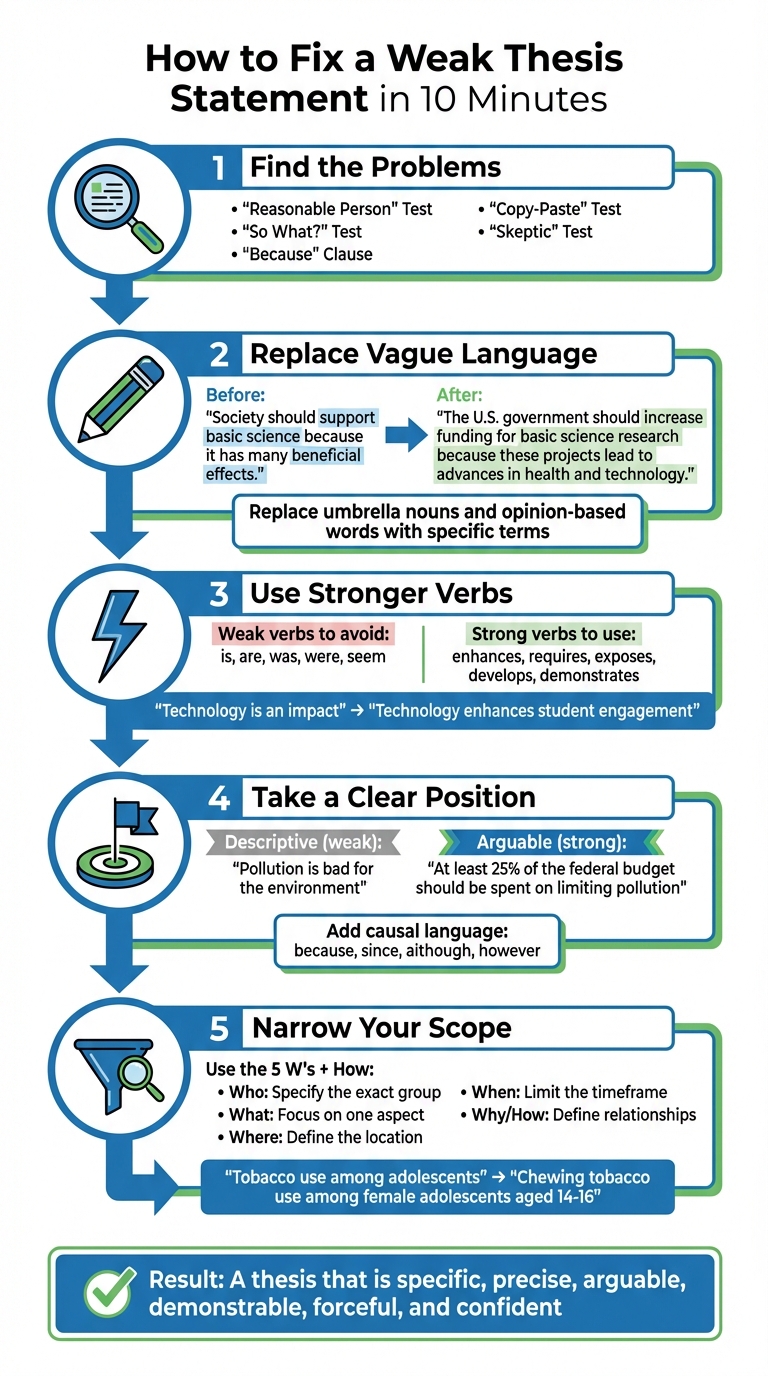
Your thesis statement is the foundation of your paper, but weak ones often miss the mark by being vague, overly broad, or lacking a clear stance. The good news? You can fix these issues in just 10 minutes by following five simple steps:
- Spot Problems: Identify weaknesses like vague language, obvious facts, or lack of argument.
- Be Specific: Replace broad terms with precise details to clarify your argument.
- Use Strong Verbs: Choose action-oriented verbs over passive ones for a more direct thesis.
- Take a Position: Ensure your thesis makes a clear, debatable claim.
- Narrow the Scope: Adjust your thesis to fit the length and focus of your paper.
A strong thesis is clear, specific, and arguable. By revising weak statements with these steps, you’ll create a solid foundation for structuring your argument and writing. Let’s dive into how you can apply these techniques.
5-Step Process to Fix a Weak Thesis Statement in 10 Minutes
How To Fix A Weak Thesis Statement?
sbb-itb-1831901
Step 1: Find the Problems in Your Thesis Statement
To strengthen your thesis, you first need to identify its weaknesses. Many thesis statements fall short because they either state the obvious, rely on clichés, use vague language, lack a clear argument, or try to tackle too many ideas at once.
What a Weak Thesis Statement Looks Like
A weak thesis often reads like a mere observation rather than an argument. For instance, "Social media affects communication" might sound like a thesis, but it doesn't take a stance - it’s just a statement of fact. Similarly, "My family is an extended family" describes a situation without offering any analysis or argument.
Another issue is the use of vague or non-specific language. Take this example: "There are some negative and positive aspects to the Banana Herb Tea Supplement." While it hints at a discussion, it fails to clarify which negative aspects are worth examining or why the positive ones matter. Without specifics, the reader is left guessing about the actual argument.
"A weak thesis statement is vague (identifies a topic but does not specify an argument), offers plot summary or is a statement of fact, is un-provable, or does not give the reader a sense of why the argument is important."
– Vanderbilt University Writing Studio
The first step in fixing a weak thesis is to pinpoint where it falters. Use targeted tests to uncover these flaws.
Quick Checklist for Finding Problems
Here are five simple tests to evaluate your thesis. If it fails even one, you'll know it needs revision:
- The "Reasonable Person" Test: Can someone reasonably disagree with your claim? If not, you're likely stating a fact instead of presenting an argument.
- The "So What?" Test: Does your thesis explain why your argument is meaningful? If the importance isn’t clear, you need to provide more context.
- The "Because" Clause: Can you add "because…" to your thesis and complete the sentence with a clear reason? If not, your thesis might be too vague.
- The "Copy-Paste" Test: Could your thesis work in another essay with only minor tweaks? If yes, it’s too general and lacks specificity.
- The "Skeptic" Test: Imagine a reader saying, "I’m not convinced." If your statement is universally accepted, there’s no real argument to debate.
Step 2: Replace Vague Language with Specific Terms
Once you've pinpointed issues in your thesis, the next step is swapping out vague words for precise, meaningful ones. This change sharpens your thesis, turning it into a clear, focused argument. Let’s explore how specific language can cut through ambiguity and bring clarity.
Why Specific Language Matters
Broad words like "society", "people", "important", or "beneficial" often fail to communicate a strong point. For instance, saying "Society should support basic science because it has many beneficial effects" offers a general statement but lacks a clear argument or direction.
Using specific language acts like a guide, showing exactly who or what you're addressing, the action you're proposing, and why it matters. Precision removes uncertainty, making your argument both clearer and more defensible. For example, instead of "society", you could specify "the U.S. government." Instead of "beneficial effects", you could mention "advances in health and technology." These changes not only clarify your argument but also give your readers confidence in your paper's direction.
"The writer takes care in the thesis statement to articulate a paper's argument as precisely as possible, and this precision clarifies and focuses the direction of the paper."
– Moore and Cassel, Authors of Techniques for College Writing
To quickly identify vague language, look for "umbrella" nouns like "things", "life", or "everything", and opinion-based words like "good", "bad", or "interesting" that lack clear criteria. If your thesis includes phrases like "many believe" or "some argue", it might suggest you're relying on vague attributions rather than taking a firm stance.
Before and After Examples
Let’s see how specific language transforms weak theses into strong, compelling arguments.
Take this vague thesis: "Sugar consumption is a problem." While it identifies a topic, it doesn’t provide an argument or direction. Now compare it to this revised version:
"Because half of American elementary school children consume nine times the daily allowance of sugar, schools should replace soda machine beverages with healthy alternatives."
The revised thesis specifies who (elementary school children), what the problem is (excessive sugar consumption), and what action is needed (replace soda machine beverages). It’s clear, actionable, and defensible.
Here’s another example. The vague statement "School uniforms are beneficial" doesn’t explain the benefits or who it applies to. A more precise version would be:
"Mandatory school uniforms foster a sense of unity, minimize peer pressure, and improve student concentration."
This revision not only identifies the benefits but also provides a clear structure for the argument.
| Vague Thesis Statement | Precise Thesis Statement |
|---|---|
| Society should support basic science because it has many beneficial effects. | The U.S. government should increase funding for basic science research because these projects lead to advances in health and technology. |
| Some TV programs are bad for children. | Violent television programs numb children's sensitivity to real-life acts of violence. |
| The welfare system is a joke. | The welfare system discourages employment among lower-income individuals by offering unearned income instead of skill-building programs. |
When revising your thesis, apply the "Who" and "What" filters. Replace vague terms like "society" with specific entities such as "the U.S. Congress" or "high school administrators." Substitute generic verbs like "support" or "help" with clear actions like "increase federal funding" or "implement mandatory training." These small but impactful changes make your thesis more precise, persuasive, and easy to follow.
Step 3: Use Stronger Verbs to Make Your Thesis More Direct
Once you've nailed down specific language, the next step is to refine your thesis by choosing strong, action-oriented verbs. Why? Because swapping weak verbs for more dynamic ones not only sharpens your argument but also grabs the reader's attention. Let’s break down how verb selection can transform your thesis.
How Linking Verbs Weaken Your Thesis
Linking verbs like "is", "are", "was", "were", or "seem" describe a state of being rather than an action. For instance, "Technology is an impact on education" merely states that something exists without explaining its significance or how it works.
"Linking verbs often make thesis statements weaker because they do not express action. ... You should ask yourself questions in order to replace the linking verb with an action verb, thus forming a stronger thesis statement – one that takes a more definitive stance on the issue."
– The Scholarship of Writing in Nursing Education
The problem with linking verbs is that they create a passive tone, failing to show cause-and-effect relationships. Readers might find the argument vague or incomplete. On the other hand, action verbs compel you to clarify "how" and "why", resulting in a more assertive and specific thesis.
Let’s move on to see how action verbs can elevate your writing.
Action Verb Replacements
Start by reviewing your thesis and identifying all the verbs. If you find an overuse of forms of "to be" (am, is, are, was, were, be, being, been) or "to have", it’s time to replace them with verbs that highlight actions, outcomes, or processes.
"Starting a thesis sentence with a verb can add a dynamic, assertive tone to your writing. This approach emphasizes action and outcomes, making your thesis stand out."
– Daniel Felix, Author, Yomu.ai
For analytical papers, verbs like "analyzing", "examining", "investigating", or "revealing" add depth. For argumentative papers, try "challenging", "proving", "demonstrating", or "advocating" to clearly outline your stance and intent.
Here’s how action verbs can transform weak thesis statements into stronger ones:
| Weak Thesis (Linking Verb) | Stronger Thesis (Action Verb) |
|---|---|
| Technology is an impact on education. | Incorporating interactive technology enhances student engagement and improves learning outcomes. |
| Climate change is a problem. | Addressing climate change requires global collaboration to reduce emissions and protect vulnerable ecosystems. |
| Social media is a source of misinformation. | Analyzing social media algorithms exposes their role in spreading misinformation. |
| Books are important for learning. | Reading classic literature develops critical thinking skills and broadens perspectives. |
Also, watch out for wordy phrases that hide weak verbs. For example, replace "is a consequence of" with "results from", or streamline "make the announcement" to simply "announced".
Step 4: Make Sure Your Thesis Takes a Clear Position
Once you've fine-tuned your language and verbs, the next step is to ensure your thesis boldly takes a stance. Avoid vague, descriptive statements that sound academic but lack an argument. A thesis that merely describes or states an obvious fact won't spark interest or give your reader a reason to keep reading.
The Difference Between Descriptions and Arguments
The key distinction here is that descriptions present facts, while arguments take a position that can be debated. In academic writing, you're expected to go beyond summarizing ideas - you need to interpret, analyze, or challenge them.
"A thesis statement makes a claim that others might dispute."
– The Writing Center, University of North Carolina at Chapel Hill
If no one could reasonably argue against your thesis, then it's likely just stating a fact. For example, "Pollution is bad for the environment" is a fact that most people accept. On the other hand, "At least 25 percent of the federal budget should be spent on limiting pollution" is a clear argument - it invites discussion and debate over government spending priorities.
Here's a side-by-side comparison to show the difference:
| Weak (Descriptive) | Strong (Arguable) |
|---|---|
| Mark Twain's Huckleberry Finn is a great American novel. | Through its contrasting river and shore scenes, Twain's Huckleberry Finn argues that true American democratic ideals emerge when one leaves "civilized" society and returns to nature. |
| Social media impacts public awareness in both positive and negative ways. | Because not every voice on social media is reliable, people have become much more critical consumers of information, and thus, more informed voters. |
Notice how the stronger examples interpret the topic and encourage debate, rather than simply stating a fact.
How to Make Your Thesis Arguable
Now that you know what makes a thesis debatable, it's time to refine yours. Incorporate causal language - words like "because", "since", "so", "although", and "however" - to build a case instead of making a simple observation.
"A great many clear and engaging thesis statements contain words like because, since, so, although, unless, and however."
– Indiana University Writing Tutorial Services
A good way to test your thesis is the "Opposition Test." Ask yourself: could someone reasonably argue against this? For instance, "Reducing sugar consumption by elementary school children" is just a topic. But, "Because half of all American elementary school children consume nine times the recommended daily allowance of sugar, schools should be required to replace the beverages in soda machines with healthy alternatives" takes a clear, debatable stance.
You can also use templates like "While critics argue [X], I argue [Y] because [Z]." This format helps you acknowledge opposing viewpoints while clearly stating your argument. For example, Vanderbilt University provided a great example in 2009 with a thesis about The Simpsons. The weak version read, "Marge Simpson is important to the plot of The Simpsons." The revised version became: "Despite her role as a seemingly submissive housewife and mother, Marge Simpson comes to function for the audience of The Simpsons as a subversive force against 'middle class' values". This improved thesis not only takes a stand but also invites a deeper, evidence-based discussion.
Step 5: Narrow Your Scope to Match Your Paper's Length
Once you've refined your argument and polished your language, the next step is to adjust your thesis to fit the length of your paper. Even if your thesis is arguable, trying to cover too much can lead to a shallow and unfocused argument.
Why Scope Matters
The length of your paper determines how specific your thesis needs to be. For instance, a 7-page research paper cannot effectively tackle a massive topic like world hunger, which could easily fill an entire book series.
"The broader your claim is, the more evidence you will need to convince readers that your position is right."
– Purdue OWL
A thesis that's too broad can overwhelm you with conflicting ideas, excessive sources, and arguments that lack cohesion. On the other hand, a well-defined scope allows you to explore your topic in depth, creating a more meaningful and well-supported argument. For example:
- Too broad: "World hunger has many causes and effects."
- Focused: "Climate change policies should prioritize renewable energy investments because they reduce emissions while creating economic opportunities."
Using the 5 W's and How to Narrow Your Scope
To sharpen your thesis, the 5 W's and How - Who, What, Where, When, Why, and How - can be incredibly useful. These questions help eliminate vagueness and pinpoint a specific angle [4, 25, 28].
- Who (Type): Instead of "adolescents", specify "female adolescents aged 14–16" [25, 28].
- Where (Place): Narrow "trade in North America" to "trade between Mexico and the U.S." [25, 28].
- When (Time): Focus on a specific period, such as "1880–1890" instead of the entire "Victorian Era" [25, 28].
- What (Aspect): Focus on one component, like "chewing tobacco" instead of "tobacco use" [25, 28].
- Why/How (Relationship): Define the relationship, such as cause and effect or problem and solution [25, 28].
For example, the University of Southern California demonstrates how the broad topic "tobacco use among adolescents" can be refined to "chewing tobacco use among female adolescents aged 14–16." Similarly, Agnes Scott College showcases how "The reactions of the Indian people to colonialism during the Victorian Era" can be narrowed to "The effects of English educational practices on Indian universities in the Victorian Era." This refinement is achieved by focusing on "reactions" as educational effects and limiting the scope to academics.
Replace vague terms like "society", "people", or "life" with precise identifiers [3, 4, 26]. For instance, instead of saying "society", specify "a particular religious sect in a specific time and place." This level of detail turns a general observation into a focused argument that fits within your paper's constraints.
Conclusion
Turning a weak thesis into a strong one doesn't require hours of work - just a focused 10-minute review. By identifying issues, using precise language, choosing strong verbs, taking a clear stance, and narrowing your scope, you can craft a thesis that serves as a solid foundation for your paper. Replace vague terms with clarity, opt for action verbs instead of linking ones, and ensure your thesis is both clear and debatable. Adjusting the scope to fit your paper’s length by addressing the five Ws (Who, What, Where, When, Why) and How can make all the difference.
Keep in mind that your thesis is not set in stone - it’s a living statement that evolves as your writing progresses. Pulitzer Prize-winning author James Michener once said, "I have never thought of myself as a very good writer . . . but I'm one of the world's great rewriters". This mindset is key: treat your thesis as a guide that adapts as your argument develops. Revisiting and refining it during your final revisions ensures it aligns with the paper’s direction.
Revision is non-negotiable. A strong thesis needs to be specific, precise, arguable, demonstrable, forceful, and confident. If your statement reads more like a fact than an argument, it’s time to revise. A thesis should invite reasonable disagreement, pushing readers to engage with your perspective.
FAQs
How do I know if my thesis is arguable?
An arguable thesis is one that presents a claim open to debate, rather than simply stating a fact or a widely accepted idea. It sparks discussion and demands evidence to back it up or challenge it. To fine-tune your thesis, try asking yourself "how" or "why" questions about your topic. This approach helps you craft a clear, specific stance that invites deeper analysis and thoughtful conversation.
What’s the fastest way to make my thesis more specific?
To refine your thesis and make it more specific, start by clearly defining three key elements: the subject, your position, and the scope of your argument. Narrow your focus to a particular aspect of your topic, ensuring your thesis highlights your main idea along with supporting points. This approach makes your thesis sharper, more focused, and easier to structure into a strong, debatable argument.
How narrow should my thesis be for my paper length?
Your thesis should be specific enough to clearly communicate your main argument within the constraints of your paper. For shorter essays, keep it to one or two clear and concise sentences. If you're working on a longer paper, you might need a more detailed thesis. However, it should always stay focused and directly relevant to your topic and the scope of your work.