
ZeroGPT Review: How Reliable Is It for Essays?
ZeroGPT can flag possible AI writing, but it cannot prove who wrote an essay. A flagged score should prompt a review of drafts, notes, and revision history - not a misconduct finding.
The research cited in this review reports false-positive rates of 0.24%–18% and detection accuracy as low as 42% for edited or paraphrased AI text. Those figures come from different test conditions, so they do not establish one accuracy rate for essays.
This review covers human-written, AI-generated, and AI-edited essays, explains how to test them under the same rules, and outlines how students and educators should handle scores. It summarizes outside research; it does not report a completed essay test.
ZeroGPT AI Detector Review
sbb-itb-1831901
Study Design: Essay Samples and Testing Rules
How to Test ZeroGPT on Essays Fairly
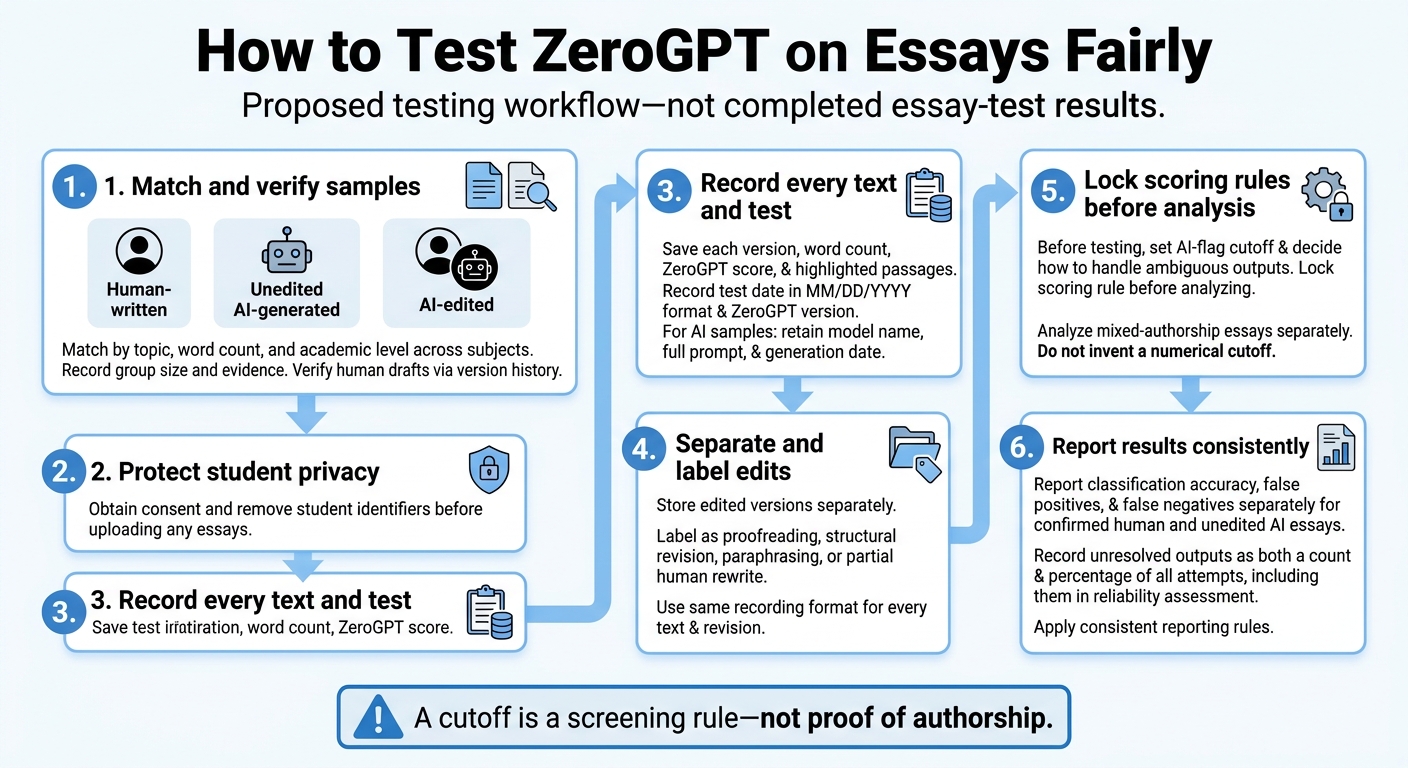
Compare matched human-written, unedited AI-generated, and AI-edited essays under the same rules to test whether ZeroGPT’s scores consistently distinguish between these source types. Define how to match samples, record scores, and apply a fixed cutoff.
Select Matched Essay Groups
Match essay groups by topic, word count, and academic level across subjects. This helps control for assignment difficulty and length when comparing authorship groups. Record each group’s size and evidence of authorship, and use version history to verify human drafts. Obtain consent and remove student identifiers before uploading any essays.
Use the same format to record every text and revision.
Record Texts, Scores, and Edits
Save each version, its word count, its ZeroGPT score, and any highlighted passages. Record the test date in MM/DD/YYYY format and the ZeroGPT version. For AI samples, keep the model name, full prompt, and generation date.
Store edited versions separately. Label each as proofreading, structural revision, paraphrasing, or partial human rewrite. Once the records are complete, lock the scoring rule before analyzing results.
Set Thresholds and Define Accuracy
Before testing, set the AI-flag cutoff and decide how to handle ambiguous outputs. Treat the cutoff as a screening rule, not proof of authorship, and analyze mixed-authorship essays separately.
Report classification accuracy, false positives, and false negatives separately for confirmed human essays and unedited AI essays. Record unresolved outputs as both a count and a percentage of all attempts, and include them in the reliability assessment. Apply the same reporting rules across human, AI, and edited samples so the results remain comparable.
Results: Human-Written and Unedited AI Essays
The available records lack essay IDs, word counts, ZeroGPT scores, classifications, and a fixed cutoff. This section therefore summarizes external benchmarks, not results for individual essays.
Human Essays: False Positives
Published research reports ZeroGPT false-positive rates ranging from 0.24% to 18%. The records don't include the test conditions behind that range, so they can't show which rate applies to academic essays.
AI Essays: Detections and Misses
ZeroGPT reportedly identifies AI-generated text with about 95% accuracy. But that figure doesn't establish how well it performs on academic essays. A high score is a screening signal, not proof of authorship.
How Results Compare With Published Research
Detector performance on academic essays varies by dataset and test conditions. A Stanford study found that seven detectors misclassified over 61% of essays by non-native English speakers as AI-generated. That finding concerns detectors generally, not ZeroGPT alone.
The next section examines whether proofreading, paraphrasing, and revision change detection outcomes.
Results: How Editing Changes Detection
After baseline testing, the next step is to check whether editing disrupts the patterns ZeroGPT uses to flag AI text. Accuracy dropped from over 70% on raw AI text to as low as 42% on edited or paraphrased versions.
The table below compares the reported results before and after editing. The summary does not report separate results for proofreading, paraphrasing, or human revision.
| Essay condition | Score change | Accuracy | False negatives | Inconclusive |
|---|---|---|---|---|
| Unedited AI-generated | Baseline | Over 70% | Not reported | Not reported |
| Edited or paraphrased AI text | Not reported | As low as 42% | Not reported | Not reported |
Compare Proofreading, Paraphrasing, and Revision
Proofreading fixes mechanics, paraphrasing changes wording, and revision reshapes structure. The summary does not separate their effects, so it cannot show how much each type of editing affects detection.
Why Mixed Authorship Complicates Detection
Human editing can add varied sentence rhythms and less predictable word choices, disrupting detection signals. Scores for mixed-authorship drafts can also change depending on which sections were rewritten, making edited essays the hardest cases to classify.
If a submission is flagged, compare drafts, outlines, and version history rather than relying on a single score.
Conclusion: A Screening Signal, Not Proof
ZeroGPT detects 73%–82% of raw AI text, but that’s a screening signal - not proof of authorship. False positives and edited AI drafts that evade detection mean the score alone can’t establish who wrote a text.
How Students and Educators Should Use Scores
Use the score only as a reason to review the work. Educators should consider drafts, revision history, citations, prior writing, and the student’s explanation together. A flagged score should prompt manual review, an oral explanation, or in-class writing.
Students should keep records of their writing process and disclose permitted AI assistance as course policies require. An academic plagiarism check and an AI score answer different questions.
Review Limits and Retesting
Results vary with sample size, prompt, text length, language background, and scoring threshold. Findings from controlled tests may not carry over to classroom submissions. ZeroGPT’s reliability can also change as writing tools and detector software evolve.
Record the test date and detector version, and retest after major updates.
FAQs
Does a high ZeroGPT score mean most of my essay is AI-written?
No. A high ZeroGPT score isn’t proof that most of your essay was AI-written. It means the tool found statistical patterns that resemble AI-generated text. That’s a reason to look more closely - not a verdict.
ZeroGPT can mistakenly flag structured, formal, or non-native English writing as AI-generated. Its scores should never be the only basis for judging authorship or academic integrity.
How can I appeal an AI-writing accusation?
If you’re falsely accused, stay calm and ask for written details from your instructor: the detector used, your score, and the passages it flagged. Check your institution’s academic integrity policy to see whether detector scores alone can establish misconduct.
Gather evidence of your writing process, including version history, outlines, notes, research materials, and past writing samples. Respond professionally, explain that you followed the policy, and offer to discuss your work. If you need help, contact student advocacy, academic advising, or student legal support.
Can grammar edits make my essay look AI-generated?
Yes. Grammar edits and rewriting can affect AI detection scores. Detectors look for predictable, uniform writing patterns. Editing, paraphrasing, or mixing AI-generated text with your own writing can change those patterns and make detection less accurate.
But errors go both ways. Formal, structured, or polished human writing may be wrongly flagged as AI-generated - a common issue for non-native English speakers.