

Walter Writes AI Detector Review: Accuracy Test Results
My take: Walter Writes looks useful as a first-pass AI screen, but it is not strong enough to decide authorship on its own.
I’d boil the article down like this: the tool appears to do best on raw AI text, but its hit rate can drop hard once text is edited, paraphrased, mixed with human writing, or translated. At the same time, human academic writing can still get flagged, with false positive ranges in the article sitting around 8% to 15% across major detectors, and non-native English writers facing more risk.
If you only need the short version, here it is:
- Claimed benchmark: AUC 0.961
- Best case: pure AI text, with reported detection around 77% to 98%
- Weak spots: edited, hybrid, paraphrased, and translated AI text
- Risk area: formal academic prose can look AI-like
- Bottom line: use the score as a warning sign, not proof
Quick Comparison
| Text type | What I’d expect from the detector |
|---|---|
| Pure AI text | Usually easiest to flag |
| Human academic writing | Some risk of false positives |
| Lightly edited AI text | Less stable results |
| Heavily paraphrased AI text | Often hard to catch |
| Translated AI text | Lowest reliability in the article |
So if you’re a student, teacher, or academic writer, the main point is simple: keep drafts, notes, and version history, and don’t treat one detector score as the final word.
AI Detectors Explained & Tested (Winston AI Accuracy, False Positives & How AI Detection Works)
sbb-itb-1831901
Walter Writes AI Detector: Claims, Metrics, and Test Method
Walter Writes AI Detector is a writing tool that aims to tell whether a passage came from an AI model or a human writer. The company says the tool reached an AUC of 0.961 on the RAID benchmark. Under the hood, it leans on statistical pattern analysis and stylometric cues in the writing. That point matters most in academic work, where even a small mistake can carry serious fallout.
What the Reported AUC of 0.961 Actually Means
AUC stands for Area Under the Curve. It shows how well a detector separates AI text from human text across different score thresholds. Put simply, AUC is about average performance across many samples, not a guarantee about any one document. That gap is where things get interesting. The results below show when that metric lines up with practice and when it starts to fall apart.
How This Article Summarizes Existing Tests
The next section looks at those limits through pure AI essays, human academic paragraphs, and rewritten passages. Each one is meant to stress a different weak spot. Rewritten and mixed text tends to be the toughest case, because even light editing can blur the signals these detectors depend on.
Accuracy Test Results by Text Type
Walter Writes AI Detector Accuracy by Text Type
Pure AI Essays and Academic Paragraphs
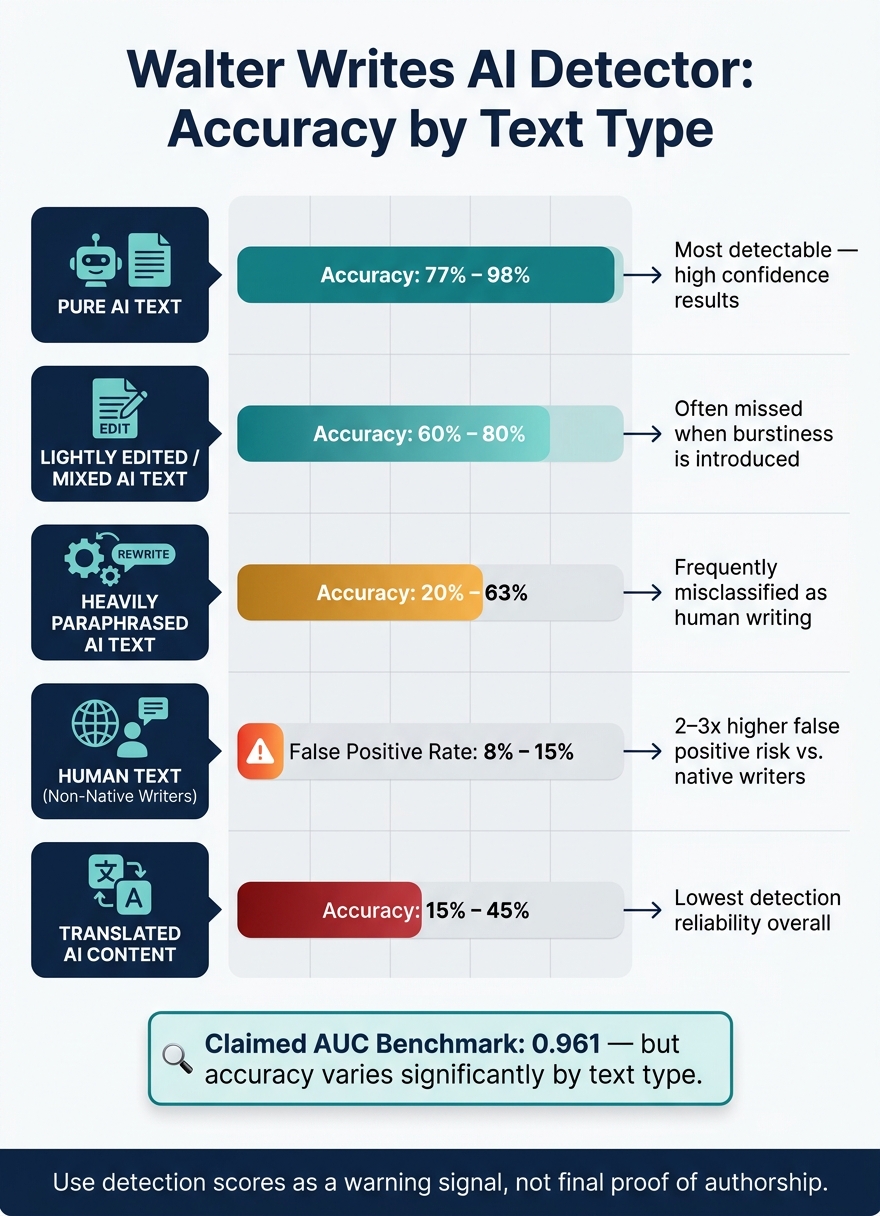
Walter Writes AI Detector tends to do best with fully AI-generated text. For unedited AI writing, reported accuracy ranges from 77% to 98%.
Human-Written Text and False Positive Risk
This is where things get messy. The bigger problem shows up with human writing.
Across major AI detectors, false positive rates usually land between 8% and 15%. One of the biggest triggers is highly formal, tightly structured academic writing. If a student writes in a steady, polished style - the kind you’d expect in a thesis introduction or a research methods section - the detector may read that consistency as AI-like. The same issue can happen with properly formatted citations and standard academic phrasing.
Non-native English writers are 2 to 3 times more likely to have human writing flagged as AI-generated. In many cases, detectors treat that steady structure as a sign of machine-written text.
Rewritten, Mixed, and Humanized Passages
Accuracy drops even more once AI text gets edited, blended, or paraphrased. That’s where many detectors start to lose their grip.
Light human editing can push detection rates from 95% to below 50%. With heavier paraphrasing, accuracy falls further, down to 20% to 63%. Translated AI content performs worst of all, with detection reliability falling to just 15% to 45%.
The pattern is pretty clear: the more a passage moves away from raw AI output, the harder it becomes to flag with confidence.
| Content Category | Observed Detection Accuracy | Typical Misclassification |
|---|---|---|
| Pure AI Text | 77% – 98% | High confidence; most detectable text type |
| Lightly Edited or Mixed AI Text | 60% – 80% | Often missed if "burstiness" is introduced |
| Heavily Paraphrased | 20% – 63% | Frequently classified as human |
| Human Text from Non-Native Writers | 8% – 15% false positive rate | Flagged due to formal, structured patterns |
| Translated AI Content | 15% – 45% | Lowest detection reliability overall |
What the Results Mean for Students, Educators, and Academic Writers
The results lead to a simple rule: Walter Writes AI Detector is useful for screening, not for delivering a final judgment. That distinction matters. Once you see where the tool performs well and where it starts to slip, it becomes much easier to use it the right way.
When the Detector Helps and When It Does Not
The pattern is pretty clear. Walter Writes tends to be strongest on raw AI text and weaker once that text has been edited, mixed with human writing, or made to sound more natural.
In plain terms, the tool usually works best on unedited, clearly AI-generated writing - the kind of output copied over straight after generation. In that setting, it can serve as a solid first-pass screen. But once the text becomes edited or hybrid, accuracy drops.
That’s the key takeaway: a flagged result should prompt a closer review, not act as proof.
How to Use Detection Results Responsibly in U.S. Academic Settings
That puts a firm limit on how much weight any detection score should carry in school or university decisions.
For students, the safest move is simple: keep your version history, outlines, notes, and early drafts. If there’s ever a question about how a paper was written, those materials are your strongest evidence.
For educators, a flagged result should start a review process, not end one. That matters because polished academic writing can sometimes be mistaken for AI-generated text. A better approach is to compare the passage with the student’s earlier work and talk through the paper’s main ideas. If the student can explain the argument, sources, and structure with ease, that tells you far more than a detector score alone.
For researchers and academic writers, the clearest path is disclosure. If AI tools played a role, say so upfront and follow the journal’s or institution’s policy. That removes gray areas before a detector even enters the picture.
Using Yomu AI to Support Original Drafting and Integrity Checks
The safest approach is to build a writing process that leaves a clear paper trail before detection becomes an issue.
A transparent draft workflow can cut down on confusion if a submission is later flagged. Yomu AI is built for academic writing workflows. It helps students draft and check for originality with a plagiarism checker with a built-in plagiarism scanner. If a student uses Yomu AI to build a well-cited, properly structured draft - with their own ideas doing the heavy lifting - the stress around whether a detector might flag the work becomes much lower. A clear draft history also makes it easier to separate original writing from text that looks questionable.
Conclusion: Is Walter Writes AI Detector Reliable Enough?
The short answer: good for screening, not final judgment.
Walter Writes tends to do best with raw AI text. Once that text gets edited, paraphrased, or mixed with human writing, its accuracy can drop fast. Research shows that detection accuracy for paraphrased AI content can fall as low as 20% to 63%. On top of that, human-written text still carries a false positive risk of about 4% to 7%. That’s not a small issue. In an academic setting, errors like that can lead to serious consequences.
This same caution shows up in school policy. Some institutions, including Vanderbilt University and UC San Diego, have turned off AI detection features because of reliability concerns. So if a passage gets flagged, that should be a signal to take a closer look, not a reason to make a final call on the spot.
Academic integrity still depends on the basics: transparent drafting, proper citation, plagiarism checks, and human review. Detection scores can help support that process, but they can’t replace it.
FAQs
Can Walter Writes prove authorship?
No. Walter Writes can't prove authorship.
It relies on probabilistic analysis, not hard proof, to judge whether text may have been written by a person or by AI.
That means false positives can happen. This is more common with formal, structured writing and with work from non-native English speakers.
So its output should be treated as just one input in a broader, human-led academic integrity review.
Why do edited or translated AI texts get missed?
AI detectors look for patterns in word choice, sentence structure, and language use. Once a piece of AI text gets translated or edited, those markers can shift or break apart.
That can lower the detector’s score and lead to a false negative. If a passage is heavily reworked or translated, it may also hide the uniform patterns these detection models depend on.
How should schools use a flagged result?
Flagged results should be treated as early signals, not proof of misconduct.
They’re a place to start, nothing more. Teachers still need to look at the full picture: the student’s usual writing style, how hard the assignment was, and whether the tone or quality suddenly shifts.
Schools can also check authorship in simple ways, like reviewing drafts, research notes, and writing timelines. Detection tools should support careful review and honest conversation between educators and students, not take the place of either.