
Pangram AI Detector Review: How Accurate Is It on Student Essays?
My short answer: Pangram is useful for screening student essays, but I would not use it as proof. It does better on fully human and fully AI-written papers, but it gets much less steady on lightly edited or paraphrased AI drafts.
Here’s the whole article in plain English:
- Best case: Pangram does well on clear-cut papers
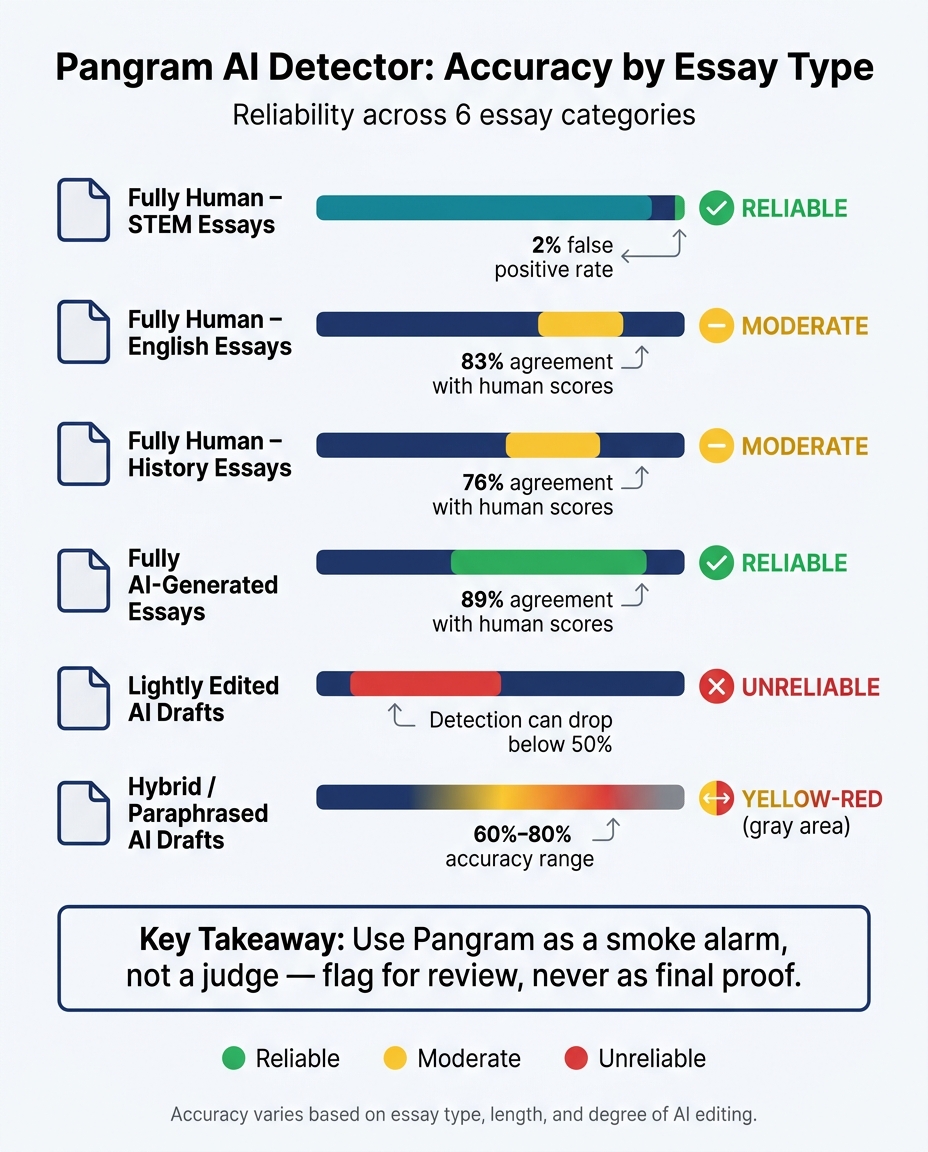
- Fully human STEM essays: about a 2% false positive rate
- Fully AI-written essays: about 89% agreement with human scoring
- Weaker areas: Pangram has more trouble with mixed or revised text
- English essays: 83% agreement
- History essays: 76% agreement
- Lightly edited AI drafts: detection can drop to below 50%
- Hybrid or rewritten AI drafts: often around 60%–80%
- Main risk: a student can be flagged even when they wrote the paper themselves, and edited AI text can also slip by
- Best use: treat the score as a starting point, then check revision history, plagiarism checkers, and speak with the student if needed
Pangram AI Detector Accuracy by Essay Type
Pangram AI: A Free AI Detection Tool for Teachers & Students | Accuracy Tested
sbb-itb-1831901
Quick Comparison
| Essay type | What the review found | What I’d take from it |
|---|---|---|
| Fully human (STEM) | 2% false positive rate | Lower risk of false flags |
| Fully human (English) | 83% agreement | More room for error |
| Fully human (History) | 76% agreement | Less steady than STEM |
| Fully AI-generated | 89% agreement | Good at spotting clear AI use |
| Lightly edited AI | Below 50% in some cases | Easy to miss |
| Paraphrased/hybrid AI | 60%–80% | Gray area; needs review |
Bottom line: if you use Pangram, use it like a smoke alarm, not a judge. Instead, consider using AI writing aids to strengthen your work before submission. It can point you to a paper worth checking, but it should not decide a grade or misconduct case by itself.
2. How the essays were grouped and tested
The test looked at medium- to long-form student essays to see how Pangram performs on actual academic writing.
The four essay categories used in testing
The essays were split into four groups based on how students use AI writing assistants now:
- Fully human-written: Original student writing with no AI use
- Fully AI-generated: Essays produced entirely by AI, with no human edits
- Lightly edited AI drafts: AI drafts with small word or sentence changes
- Paraphrased AI drafts: AI drafts rewritten or paraphrased across large sections
Which Pangram outputs were reviewed
For each essay, the review tracked Pangram's AI likelihood score, section-level analysis, and AI model identification. Those results were then checked against the known source of each essay to measure true positives, true negatives, false positives, and false negatives. True positives and true negatives mean Pangram made the right call. False positives label human writing as AI-generated, while false negatives let AI-generated text slip through.
With the test setup in place, the next section looks at where Pangram correctly flags human essays and where it misses AI-written text.
3. Results by essay type: where Pangram works and where it falls short
The results break into three clear groups: clean human essays, clean AI essays, and mixed drafts.
Fully human essays: how often does Pangram flag them incorrectly?
Pangram is fairly reliable on student writing that appears to be fully human. It does best on clean STEM essays, where false positives are rare and the chance of wrongly accusing a student is low.
It gets less steady in humanities essays. Pangram matches human judgments 83% of the time for English and 76% for history. That drop matters. Writing that sounds highly structured or formulaic, including some work from non-native English speakers, may be more likely to trigger a false positive. In plain terms, a student can write honestly and still get flagged.
The gap grows once the text is fully AI-written or only lightly revised.
Fully AI-generated essays: how consistently does Pangram catch them?
Pangram performs well on fully AI-written essays. Across general essay formats, it matches human judgments 89% of the time. That makes it a useful first pass for spotting obvious AI use.
Still, there’s a catch. Short responses often don’t give Pangram enough text to judge with much confidence. When that happens, AI-written work can slip through, which makes academic integrity checks less steady, especially when compared to using a plagiarism checker for academic papers.
Its weakest showing appears when AI text is edited or mixed with student writing.
Lightly edited and paraphrased essays: the hardest cases to classify
This is where Pangram has the most trouble. Light editing can cut detection from 95% to under 50%. That’s a steep drop.
When an AI draft is heavily rewritten or blended with original student writing, accuracy usually lands in the 60%–80% range. These in-between cases are the main reliability problem. A score alone often isn’t enough, so human review becomes much more important.
Pangram’s segment-level analysis does help here. It can sometimes isolate machine-generated sections inside a longer draft. That doesn’t solve the problem, but it gives reviewers something more concrete to inspect.
The table below shows where Pangram is strongest and where it starts to weaken across essay types.
| Essay Type | Detection Reliability |
|---|---|
| Fully human (STEM) | 2% false positive rate |
| Fully human (English) | 83% agreement with human scores |
| Fully human (History) | 76% agreement with human scores |
| Fully AI-generated (general) | 89% agreement with human scores |
| Lightly edited AI drafts | Detection can drop below 50% |
| Hybrid / modified essays | 60%–80% accuracy range |
4. How reliable is Pangram in practice?
Pangram is a useful signal, not a verdict. Its 89% agreement on general essays is solid, but that confidence drops when the text has been lightly edited or paraphrased. And that matters. A single score doesn't prove misconduct. That's the line between a helpful signal and a bad call.
What false positives and false negatives mean for teachers and students
A false positive can hurt a student's standing even when the writing is honest. A false negative creates a false sense of safety when a lightly edited AI draft slips through with a clean score.
So a clean result on a short essay should not be treated as proof of human authorship. When a score lands in the gray area, the next move is simple: have a follow-up conversation. Ask the student how they drafted the piece, why they chose certain words, or whether they can share earlier versions. Those risks don't look the same in every case. They shift based on the kind of essay you're reviewing.
Pangram's strengths, weaknesses, and what they mean in practice
Pangram's reliability changes depending on how it's used.
| Area | Strength | Weakness | Practical Implication |
|---|---|---|---|
| Section-level detail | Pinpoints specific suspicious passages | May flag common academic phrases in human text | Treat highlights as discussion points, not proof. |
| Short essays | High accuracy on longer, comprehensive essays | Reduced certainty on short responses | Read short-essay scores cautiously. |
| Heavily edited text | Multi-step detection catches some paraphrasing | Heavily revised AI text is significantly harder to classify | Use revision history to investigate borderline cases. |
| Model detection | Can identify the specific AI model used, such as GPT-4 | Evolving AI models may temporarily outpace detection updates | Use model names as supporting evidence, not final proof. |
Pangram's segment-level visibility is one of its most practical features for educators. Instead of reacting to one overall score, teachers can see which parts of an essay triggered flags. That makes follow-up much more focused. You can talk about a paragraph or two, not treat the whole paper like it's under a cloud.
Clear-cut cases may stand on their own. Mixed results or revised drafts need human review before anyone makes a judgment.
5. Verdict: can Pangram be trusted on student essays?
The bottom line is simple: Yes - but as a screening tool, not as proof.
Pangram works well as a first-pass check for student essays, especially when the writing is either fully human-written or fully AI-generated. Where it starts to slip is on lightly edited and paraphrased submissions. And that's the gray area where most classroom cases tend to land.
So yes, Pangram is useful for screening. But it should not be used to prove authorship on its own.
In practice, the smart move is to treat detector output as the start of a review, not the end of one. Use it to flag a paper for a closer look, then check the student's revision history and run one of the best plagiarism checkers for students. That extra step matters.
For the most dependable workflow, pair Pangram's results with a plagiarism check and a review of the student's revision history. A plagiarism check adds a second layer. No detector should be the only basis for disciplinary action.
FAQs
Can Pangram mislabel human essays as AI?
Yes. Pangram can flag human-written essays as AI-generated. These false positives happen because AI detectors look for language patterns that also show up in formal, structured, or plain academic writing.
That can put some writers at a bigger risk than others, including non-native English speakers, neurodiverse students, and people with a distinct writing style. The key point is simple: these results are probabilistic. They can hint that a piece needs human review, but they are not proof of academic misconduct.
Why does Pangram struggle with edited AI drafts?
Pangram has a hard time with edited AI drafts for a simple reason: AI detectors usually look for text patterns that show up a lot in machine-written writing, like low perplexity and low burstiness.
Once a student heavily edits the draft, paraphrases parts of it, or rewrites the structure, those patterns start to break apart. The result is text that looks less uniformly machine-written, which makes it tougher for the detector to flag.
What should teachers check besides Pangram scores?
Teachers shouldn't treat detection scores as final proof of misconduct. It's better to use them as a starting point for a closer look.
Also look for:
- sudden, unexplained shifts in a student's writing style or overall quality
- flagged passages that don't sound like natural prose
- signs of the writing process, such as notes, outlines, research materials, and timestamped drafts