

Open-Ended vs Closed-Ended Questions in Research: When to Use Each
If I need to know why people think or act a certain way, I use open-ended questions. If I need data I can count, compare, or test, I use closed-ended questions.
That’s the whole decision in one line. Open-ended questions give me words, reasons, and detail. Closed-ended questions give me fixed answers, scores, and patterns. In many studies, I use both: one to show the pattern, the other to explain it.
Here’s the short version:
- Open-ended questions work best for explanation, early-stage research, interviews, and small samples.
- Closed-ended questions work best for measurement, surveys, group comparisons, and large samples.
- Mixed-format studies often work well when I need both numbers and comments.
- Bad wording hurts both types, especially vague, leading, and double-barreled questions.
- Pilot testing with 5 to 10 people can catch confusing items before I launch.
About 80% to 90% of survey analysis time can go into cleaning, coding, and reviewing responses when too many free-text items are used in large studies. By contrast, fixed-choice items are much easier to tabulate, chart, and test.
Open Ended vs Closed Ended Questions | 5 Key Differences
sbb-itb-1831901
Quick Comparison
| Criteria | Open-Ended Questions | Closed-Ended Questions |
|---|---|---|
| Main purpose | Explanation | Measurement |
| Response type | Free text | Fixed options |
| Data form | Qualitative | Quantitative |
| Best for | Motives, views, context | Counts, scores, trends |
| Analysis | Coding and themes | Tables, averages, tests |
| Sample size fit | Small to medium | Medium to large |
| Main risk | Slow analysis, uneven answers | Missing detail, weak options |
Put simply: I match the format to the evidence I need. If I want stories and reasons, I ask open questions. If I want clean comparisons, I use closed ones. And if I want both, I build both into the study from the start.
Open-Ended vs Closed-Ended Questions: A Direct Comparison
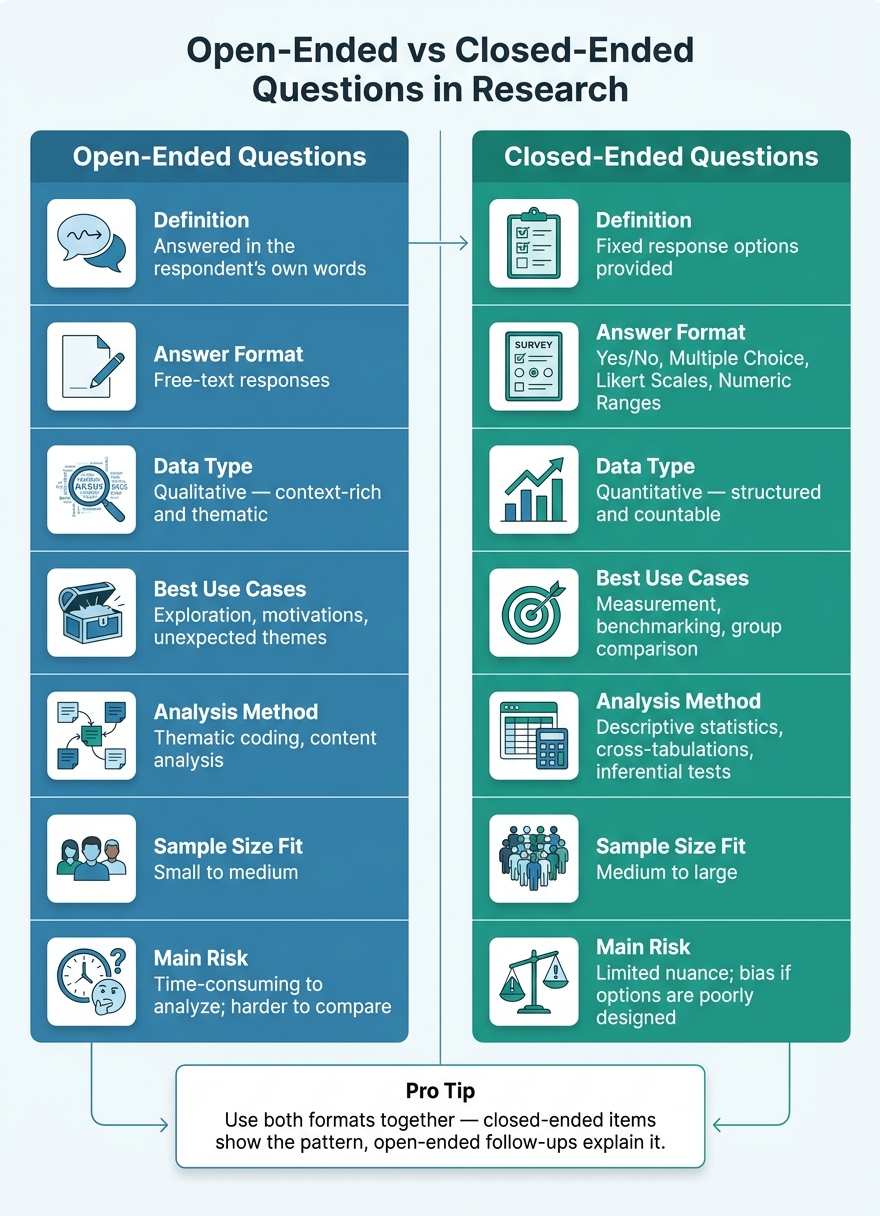
Open-Ended vs Closed-Ended Questions: Key Differences at a Glance
The main difference comes down to the kind of data each one gives you.
Open-ended questions give you narrative data. Closed-ended questions give you standardized data. If your study needs explanation, use open-ended questions. If it needs measurement, use closed-ended questions.
| Aspect | Open-Ended Questions | Closed-Ended Questions |
|---|---|---|
| Definition | Questions answered in the respondent's own words | Questions with fixed response options |
| Answer format | Free-text responses | Yes/no, multiple choice, checkboxes, Likert scales, or numeric ranges |
| Data type | Qualitative - context-rich and thematic | Structured data that can be counted or compared |
| Best use cases | Exploration, motivations, unexpected themes | Measurement, benchmarking, group comparison |
| Analysis method | Thematic coding, content analysis | Descriptive statistics, cross-tabulations, inferential tests |
| Strengths | Depth, nuance, flexibility | Standardization, efficiency, comparability |
| Limitations | Time-consuming to analyze; harder to compare | Limited nuance; bias if the options are poorly designed |
Put simply: the first format works better when you need detail instead of preset answers.
What Open-Ended Questions Are
Open-ended questions are best when you want exploration, nuance, and explanation. They also help when you don't yet know all the possible answers.
They often begin with phrases like "How…?", "Why…?", "In what ways…?", or "Describe…".
For example, a researcher studying online learning might ask: "What aspects of your online courses have been most helpful for your learning, and why?" That one question can bring out themes like flexible deadlines, discussion boards, or video pacing. In other words, it can surface ideas that a fixed answer set might miss.
These questions work well in interviews, focus groups, open-response survey items, and pilot studies.
When you need responses that line up neatly side by side, closed-ended questions are usually the better fit.
What Closed-Ended Questions Are
Closed-ended questions are built for standardization and comparison. Since every respondent answers inside the same response frame, the data is much easier to compare across people.
Take the same online learning topic, but framed in a closed-ended way: "How satisfied are you with the flexibility of deadlines in your online courses? (1 = Very dissatisfied … 5 = Very satisfied)" That kind of response can be averaged, split by group, and tracked over time. Instead of themes, you get scores.
Use closed-ended questions when you need data that is easy to compare across respondents. The tradeoff is simple: if the response options are too narrow, you can miss detail that matters.
That distinction matters most when you're matching the question format to your research goal, timeline, and data needs.
When to Use Each Question Type
Pick the question format based on your research goal, not personal taste. That simple rule makes the choice much easier.
Use Open-Ended Questions for Exploration and Explanation
Use open-ended questions in interviews, reflection essays, and case studies when you need people to explain how they think. These questions help you see themes, motives, and context.
They work best when you don't yet know all the possible answers. Say a student is studying classroom engagement. They might ask: What makes you feel most engaged during class discussions? That kind of prompt can bring out patterns the researcher didn't expect. Open-ended questions are also useful for generating hypotheses that a later, larger study can test.
After those themes start to show up, closed-ended questions can help test them with a larger sample.
Use Closed-Ended Questions for Measurement and Comparison
Use closed-ended questions after your categories are clear. They're a good fit for studies that need to count responses, compare groups, or track change over time. Surveys, experiments, and course evaluations often use this format because the data stays consistent and is fast to process.
Include enough closed-ended items to support tables, graphs, and statistical tests. With large samples, coding open-ended answers can get slow and harder to keep consistent. Closed-ended items such as rating scales, yes/no questions, and multiple-choice questions make analysis easier and let you compare findings across participants.
Use Both Formats in Mixed-Method Research
Use both when you need breadth first and explanation second. Mixed-method studies often follow that pattern. A common approach is to start with closed-ended questions to spot the trend, then add open-ended follow-ups to explain it.
For example, a student satisfaction survey might ask, How satisfied are you with this course? on a 1–5 scale, then follow with, What is the main reason for your rating? The scale gives you a score you can average and compare. The follow-up adds the context behind that number.
This mix works well in program evaluations and capstone projects, where stakeholders want to know both whether outcomes improved and why they did. Each format does a different job, and together they give a fuller picture.
How to Choose the Right Question Format for Your Study
After comparing both formats, use these three checks to pick the right one.
Match the Question Format to Your Research Goal
Start with one simple question: Am I trying to discover something new, or measure something I already understand?
Use open-ended questions when you want discovery and theory building. Use closed-ended questions when you want measurement and comparison. If the topic is still fuzzy, begin with open-ended questions first. Then turn the themes you find into closed-ended items later.
Consider Analysis Time, Respondent Effort, and Data Quality
Open-ended questions take more work to analyze because you need to code the answers. Closed-ended questions are much easier to tabulate, but they can flatten detail and miss the gray areas.
Here’s a side-by-side look at the main tradeoffs to weigh before you lock in your design:
| Factor | Open-Ended | Closed-Ended |
|---|---|---|
| Best for | Exploration, theory building | Measurement, comparison, reporting |
| Respondent effort | Higher | Lower |
| Analysis method | Coding, thematic analysis | Tabulation, statistical tests |
| Best sample size | Small to medium | Large |
| Main data quality risk | Fatigue, missing data if overused | Can oversimplify or miss nuance |
After you choose the format, the next job is wording.
Write Better Questions With Clear Wording and the Right Tools
Once the format is set, wording decides whether your questions are usable or a mess.
The main trouble spots are vague questions, double-barreled questions, and biased response options.
A vague question like "How do you feel about school?" doesn’t give people enough direction. The result? Answers that are all over the place and hard to compare. A double-barreled question like "How satisfied are you with your courses and instructors?" blends two separate constructs into one, so split it into two items. Biased wording, such as "Don't you agree that…" pushes people toward an answer before they’ve even had room to think.
The fix is pretty simple:
- Ask about one construct per question
- Use neutral wording
- Keep response options balanced and mutually exclusive
Before launch, pilot test the draft with 5 to 10 people. That small trial run can help you spot confusing wording, missing options, and cases where people interpret the same question in different ways.
Conclusion: Pick the Format That Fits the Evidence You Need
No question type is best in every case. Open-ended questions work well for discovery and explanation. Closed-ended questions work well for measurement and comparison.
In practice, many studies need both. A closed-ended item can show the pattern, and an open-ended follow-up can explain it.
The next step is to choose the format based on the research goal. Pick the format that matches the evidence your study needs. Plan your analysis before you draft the questions. If you plan to run statistical tests, you need structured, numeric data. If you plan to code themes, you need text. Without that clarity, you can end up with data that doesn't help.
Use open-ended questions with care. The added depth should be worth the extra time it takes for respondents to answer and for you to analyze.
Match the format, the analysis, and the effort you ask from respondents to the study goal. That's the difference between simply collecting data and answering the research question.
FAQs
Can I use both question types in one study?
Yes. Using both open-ended and closed-ended questions in one study is common in mixed-methods research.
This setup lets you collect data you can measure and compare, while also giving people room to share details, opinions, and personal views in their own words.
Put simply, you get numbers and nuance at the same time.
That mix can help offset the limits of relying on just one question type and keep the study tied to its goals.
How many open-ended questions should a survey include?
There’s no fixed number. The right amount of open-ended questions depends on what your study is trying to learn, how much detail you need, and how important it is to keep people engaged from start to finish.
Open-ended questions ask more from participants. They take more time, more thought, and more effort to answer. If you use too many, more people may quit before finishing.
That’s why it helps to balance open-ended questions with closed-ended ones. You get richer responses without making the survey feel long, confusing, or hard to complete.
How do I turn open-ended findings into closed-ended items?
Start by reviewing your open-ended data and spotting the themes that show up again and again. Look for common barriers, repeated opinions, or clear sentiment patterns. Once you see those patterns, turn them into response options you can measure.
For example, if many people mention the same barriers, you can turn those into a multiple-choice list or a Likert scale. That way, detailed comments become structured data you can compare and analyze with statistics.