

How to Choose Qualitative, Quantitative, or Mixed Methods
- Qualitative Research: Best for understanding experiences, behaviors, and "why" questions. Uses interviews, focus groups, or observations. Works with small, detailed samples.
- Quantitative Research: Ideal for testing hypotheses, measuring variables, and identifying patterns. Relies on numerical data, surveys, or experiments. Requires larger sample sizes for generalization.
- Mixed Methods: Combines both approaches to answer complex questions. Offers both numerical insights and context but demands more time and resources.
Quick Comparison
| Criteria | Qualitative | Quantitative | Mixed Methods |
|---|---|---|---|
| Data Type | Non-numerical (text, observations) | Numerical (statistics, measurements) | Both |
| Goal | Understand meaning | Test hypotheses, find patterns | Integrate depth and patterns |
| Sample Size | Small | Large | Varies |
| Time Required | High (analysis-heavy) | Moderate | Very high |
| Use Case | Exploratory questions | Confirmatory questions | Complex questions |
To decide, match your research question with the method. For exploratory topics, use qualitative. For testing relationships, go quantitative. For both, go mixed. Always consider your time, budget, and expertise before choosing.
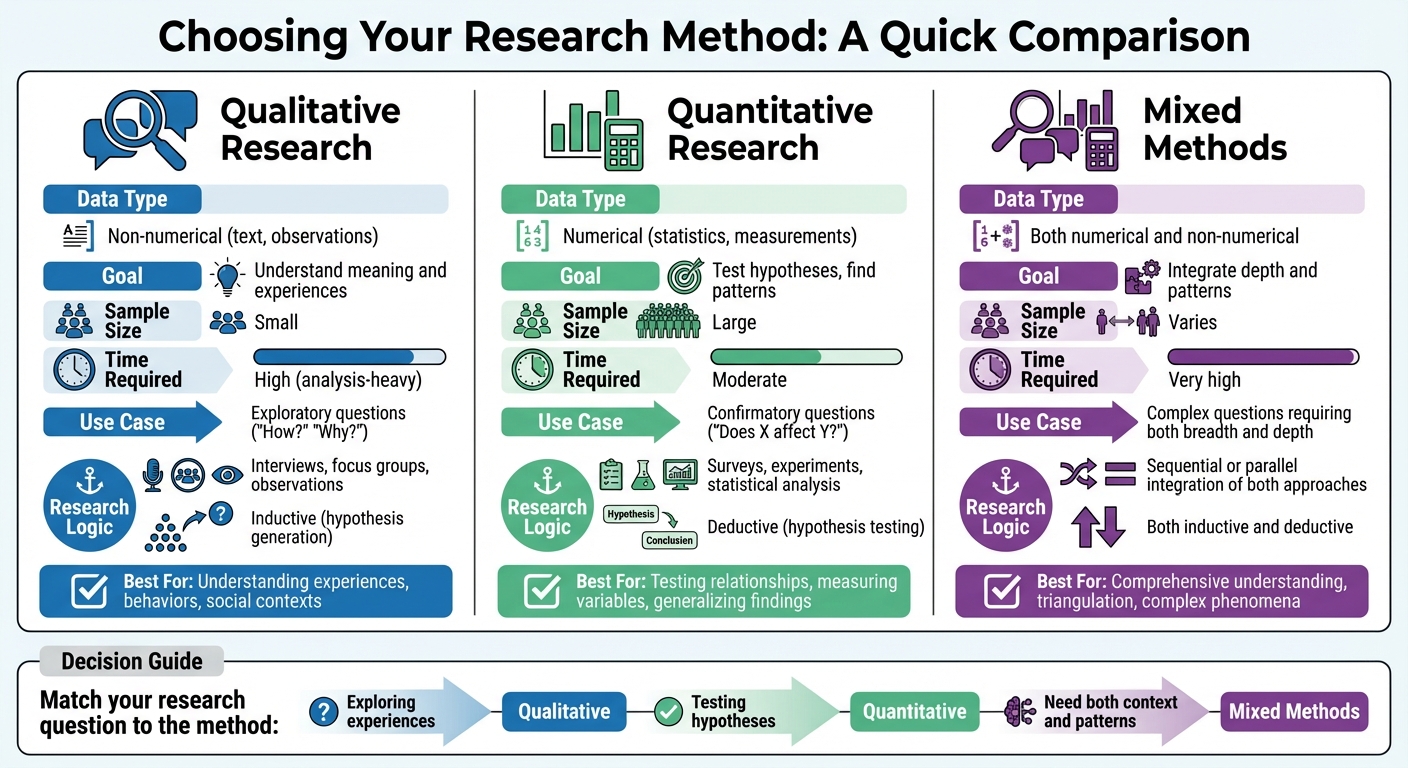
Qualitative vs Quantitative vs Mixed Methods Research Comparison
Qualitative vs Quantitative vs Mixed Methods Research: How To Choose Research Methodology
sbb-itb-1831901
What Is Qualitative Research?
Qualitative research focuses on gathering and analyzing non-numerical data - like text, video, or audio - to delve into concepts, opinions, or lived experiences. Instead of crunching numbers, it seeks to understand the deeper "how" and "why" behind human behavior and social patterns.
This method is especially useful when exploring subjective experiences, tackling topics that lack prior research, or building new theories from scratch. In qualitative studies, the researcher plays a central role, acting as the "instrument" by interpreting observations through their own perspective. This adaptability allows researchers to adjust their approach as new insights emerge, making it perfect for studying real-life scenarios rather than controlled lab settings. Below, we break down the key features that shape how data is collected and analyzed.
Main Features of Qualitative Research
Qualitative research takes a flexible, inductive approach that emphasizes depth over breadth. Researchers usually work with smaller, non-representative samples to gain detailed insights rather than aiming for broad generalizations. Common methods of data collection include:
- One-on-one interviews
- Focus groups (usually 8–12 participants)
- Field observations
- Open-ended survey questions
The analysis process involves organizing the data, creating a coding system, and identifying recurring themes. Popular qualitative approaches include:
- Grounded theory: Building theories from the collected data
- Ethnography: Immersing in and studying a specific group's culture
- Phenomenological research: Exploring individuals' lived experiences
- Narrative research: Analyzing personal stories
- Action research: Connecting theory to practice to drive social change
Examples of Qualitative Research
These methods excel at uncovering insights about human behavior, social norms, and individual experiences. For instance:
- An ethnographic study might involve months of observing a hospital emergency department to understand the unspoken rules and communication styles among staff.
- A phenomenological study could examine how first-generation college students describe the pressures of academics, highlighting their challenges and support systems in their own words.
- A narrative research project might compile the stories of teachers adapting to online instruction during a crisis, uncovering shared struggles and strategies for success.
These examples show how qualitative research goes beyond counting occurrences, offering a window into the meanings people attach to their experiences. By prioritizing depth, it reveals patterns and connections that might otherwise remain hidden.
What Is Quantitative Research?
Quantitative research involves gathering numerical data and using statistical methods to analyze it. It’s designed to explain, predict, or influence various phenomena by focusing on measurable variables - like survey results, metrics, or experimental outcomes.
The main goal is to systematically test hypotheses and establish patterns or principles that can be applied to larger populations. This approach is ideal when you’re looking to generalize findings from a sample group or when testing specific hypotheses rather than forming new ones. The methods used in quantitative research are versatile, making it useful for both confirmatory studies that test existing theories and exploratory analyses using techniques like cluster analysis or principal components analysis.
Main Features of Quantitative Research
Quantitative research relies on structured methods to collect data that can be analyzed statistically. Common techniques include:
- Experiments
- Structured surveys
- Clinical trials
- Analysis of large-scale datasets, such as Big Data, GPS tracking, or social media analytics
Statistical tools are then applied to uncover relationships, test hypotheses, and make predictions. Techniques like regression analysis, time series modeling, path analysis, or growth curve modeling are often used, depending on the study’s focus. Ensuring a sufficient sample size is critical to detect meaningful effects, and conventional statistical testing typically allows for a 5% chance of false positives (Type I errors).
One of the strengths of quantitative research is its ability to generalize findings to larger populations. However, this requires careful planning, rigorous methodology, and clear documentation to ensure the study can be replicated, which is essential for scientific reliability.
Examples of Quantitative Research
Quantitative research is particularly effective for studying relationships between variables and testing specific predictions. For example:
- A pharmaceutical trial with 500 participants might assess whether a new drug reduces blood pressure by at least 10 points compared to a placebo.
- A university could survey 2,000 students using standardized questionnaires to explore the link between weekly study hours and exam performance, applying regression analysis to predict outcomes based on time spent studying.
- A retail chain might analyze sales data from 300 stores nationwide to identify factors - like store size, local demographics, or promotional spending - that most influence monthly revenue, offering insights that extend beyond the immediate dataset.
These examples highlight how quantitative research provides actionable insights by focusing on measurable and testable variables.
What Is Mixed Methods Research?
After exploring qualitative and quantitative methods, let's dive into an approach that combines the two.
Mixed methods research blends qualitative and quantitative approaches to provide a well-rounded understanding of a topic. Quantitative data helps identify measurable patterns - essentially the "what" - while qualitative data explains these patterns by offering context and personal perspectives - the "why." By integrating these methods, researchers achieve both numerical precision and contextual richness.
"Mixed methods research brings together the best of both worlds - objectivity and empathy." - ResearchPal
This integration happens at three key stages: during design (e.g., using qualitative insights to refine survey questions), during analysis (e.g., combining statistical trends with thematic insights), and during interpretation (e.g., discussing how the results complement each other for a fuller understanding).
Mixed methods also enhance research reliability through triangulation. This process uses one method to confirm or refine the findings of the other, strengthening the overall credibility of the study. That said, this approach requires significant time, resources, and expertise to manage both qualitative and quantitative analyses effectively. Let’s look at three common mixed methods designs to see how timing and purpose shape their use.
3 Types of Mixed Methods Designs
Here are the three most common designs for mixed methods research, each with unique timing and goals:
- Convergent Parallel Design: Data from qualitative and quantitative methods is collected simultaneously and then merged to compare results. For example, you might conduct surveys and interviews at the same time to align numerical trends with personal insights.
- Explanatory Sequential Design: This starts with quantitative research to uncover patterns, followed by qualitative research to explain those findings in detail. For instance, you might analyze sales data to identify top-performing stores, then interview managers at those locations to understand what drives their success.
- Exploratory Sequential Design: This flips the sequence, beginning with qualitative exploration to identify key themes. These themes are then tested or measured quantitatively. For example, you might conduct interviews to discover common challenges, then create a survey to assess how widespread those challenges are across a larger group.
When to Use Mixed Methods
Mixed methods research is especially useful for complex questions that require both broad patterns and detailed context. It's ideal when you need to understand both processes and outcomes, when quantitative results need further explanation, or when tackling a topic with many interconnected aspects. For example, if your quantitative data reveals surprising trends, qualitative methods can help uncover the reasons behind them. Similarly, in new or unfamiliar research areas, qualitative insights can guide the development of hypotheses for broader testing.
This approach often involves significant resources and careful planning. A typical mixed methods study might require at least 40 survey participants and 10 interviewees, with enough time allocated between phases. While resource-intensive, mixed methods are perfect for research that demands both depth and breadth, helping you choose the most effective way to answer your research question.
How Qualitative, Quantitative, and Mixed Methods Compare
Now that we've outlined the characteristics of each method, let's dive into how they differ in practice.
The biggest distinction lies in how data is structured and condensed. Judith Schoonenboom, a Professor of Empirical Pedagogy, puts it this way:
"Qualitative and quantitative data are fundamentally different, and this difference is not about words and numbers but about condensation and structure".
In essence, qualitative analysis helps uncover hidden insights within your data, while quantitative analysis focuses on identifying patterns in variables you’ve already pinpointed.
When it comes to time, quantitative research often saves effort during analysis thanks to statistical tools, but it demands meticulous planning before data collection. On the other hand, qualitative research requires more time during and after collection, as coding narratives and identifying themes can be labor-intensive. Mixed methods take the most time overall, as they involve gathering and analyzing both qualitative and quantitative data.
Sample size is another key difference. Qualitative research works with smaller, in-depth samples, while quantitative research relies on larger samples to ensure results can be generalized. Ultimately, the method you choose should align closely with your research goals.
Comparison Table
Here’s a quick breakdown of how these methods stack up:
| Criteria | Qualitative Research | Quantitative Research | Mixed Methods Research |
|---|---|---|---|
| Data Type | Descriptive (words, images, observations) | Numerical (statistics, measurements) | Both words and numbers |
| Primary Goal | Understanding meaning, revealing hidden aspects | Testing hypotheses, finding patterns in variables | Comprehensive understanding through integration |
| Analysis Method | Thematic coding, judgmental synthesis | Statistical analysis (Frequentist or Bayesian) | Integrated qualitative and quantitative results |
| Sample Size | Typically small, focused on depth | Typically large, focused on generalizability | Varies; requires sufficient size for quantitative power |
| Time Requirements | High (especially in analysis and coding phases) | Moderate (high in design, lower in analysis) | Very high (requires two full cycles of data work) |
| Flexibility | High; often exploratory and emergent | Lower; typically structured and confirmatory | Moderate to high; depends on the specific design |
| Research Logic | Inductive (hypothesis generation) | Deductive (hypothesis testing) | Both inductive and deductive |
This table highlights the distinct strengths and challenges of each approach, making it easier to decide which method fits your research needs.
How to Choose the Right Method for Your Research
Choosing the best research method boils down to aligning your approach with your research question. As Jimmie Leppink, Ph.D., from Maastricht University's School of Health Professions Education, explains:
"The choice of methods should be driven by the questions we wish to address as researchers, and the rules should be followed for whichever method is chosen".
Three key factors guide this decision: your research objective, available resources, and team expertise.
Matching Research Questions to Methods
Your research question serves as the foundation for selecting the right method. Think of it as your guide. For instance:
- Exploratory questions like "How do people experience..." or "What does it mean when..." point toward qualitative methods. These focus on understanding experiences and contexts that can't be quantified.
- Confirmatory questions such as "Does intervention X improve Y?" or "What factors predict outcome Z?" are best suited for quantitative methods. These involve measuring, testing, and analyzing relationships between variables.
- Complex questions that blend both, like "How effective is this program, and how do participants perceive it?" require mixed methods. In some cases, quantitative techniques (e.g., principal components analysis) can explore new dimensions, while qualitative methods may validate certain clinical or forensic findings.
Considering Your Resources
Your resources - time, budget, and expertise - play a big role in determining what’s feasible.
-
Time: Qualitative studies, especially small-scale ones, can often be completed faster than quantitative studies that stretch over longer periods. Mixed methods, however, demand double the effort since they combine both approaches. Ira Saiger, Ph.D., a developmental psychologist, offers this practical advice:
"However long you think it's going to take, multiply that by three".
- Budget: Quantitative studies often require larger financial investments for equipment or sizable sample sizes to ensure statistical reliability. On the other hand, qualitative studies generally require fewer resources. That said, quantitative studies with fewer than 20 participants may lack statistical power, potentially missing up to 80% of real effects in significance tests.
- Expertise: Your skills and those of your team are critical. If you’re comfortable with statistics and technical writing, quantitative research aligns with those abilities. If you prefer interviews and narrative writing, qualitative research might be a better fit. Mixed methods should only be attempted if your team has strong skills in both statistical analysis and qualitative coding.
Decision-Making Table
Here’s a quick reference to help you match your research goals and constraints with the right method:
| Research Goal or Constraint | Recommended Method |
|---|---|
| Identifying predictors of a specific outcome | Quantitative |
| Exploring a topic with little existing literature | Qualitative |
| Generalizing findings to a large population while capturing individual voices | Mixed Methods |
| Limited budget and very tight timeline | Single Method (Qualitative or Quantitative) |
| High expertise in statistics and computer programs | Quantitative |
| Desire to advocate for marginalized groups or social justice | Qualitative |
| Exploring lived experiences and social contexts | Qualitative |
| Testing hypotheses and establishing relationships | Quantitative |
| Developing psychometric instruments or measurement tools | Mixed Methods |
This table can serve as a handy guide to ensure your research objectives align with the most suitable method.
Using Yomu AI for Your Research Method

Once you've chosen your research method, the next step is executing it effectively. Yomu AI provides specialized tools designed to simplify the writing and analysis process, whether you're working with qualitative, quantitative, or mixed methods. These tools help turn raw data into clear, actionable insights.
Yomu AI for Qualitative Research
Qualitative research often involves handling large amounts of text, like interview transcripts, field notes, or focus group recordings. Yomu AI’s research paper analysis and summarization features make it easier to identify key themes within these extensive datasets, saving you hours of manual effort.
Additionally, its paraphrasing tools help refine participant quotes and observations, ensuring they’re presented with clarity and professionalism while staying true to the original context.
Yomu AI for Quantitative Research
Presenting numerical findings and statistical data with precision is critical in quantitative studies. Yomu AI offers tools to structure your writing, making it easier to clearly communicate your statistical results.
But it doesn’t stop at the numbers. Yomu AI also assists in crafting narratives that provide context for your findings, ensuring your methodology is well-documented and your interpretations are clearly explained.
Yomu AI for Mixed Methods Research
Mixed methods research often requires blending qualitative insights with quantitative data into a unified analysis. Yomu AI bridges this gap by transforming qualitative themes into numerical data and enriching statistical findings with descriptive narratives. This ensures your analysis is cohesive and tells a complete story.
Conclusion
Selecting the best research method comes down to aligning it with your specific research question. As Jimmie Leppink, Ph.D., from Maastricht University, wisely points out:
"The choice of methods should be driven by the questions we wish to address as researchers, and the rules should be followed for whichever method is chosen".
If your goal is to explore lived experiences or uncover the "how" and "why" behind a phenomenon, qualitative methods are your go-to. On the other hand, if you're testing hypotheses, measuring prevalence, or identifying statistical relationships, quantitative methods are the better fit. Mixed methods can offer a combination of depth and breadth, but they should only be used when your research question truly demands it - mixing approaches for the sake of it doesn’t inherently improve your study.
Thorough documentation is non-negotiable. Every step of your data collection, coding, and analysis must be recorded in detail. This ensures your research is credible and replicable, two cornerstones of scientific integrity. Without this transparency, even the most carefully chosen method loses its impact.
The decision-making framework outlined earlier helps you move beyond guesswork, offering a structured way to choose your method objectively. Once you’ve made your choice, tools like Yomu AI can simplify tasks such as transcript analysis, report structuring, or integrating multiple methods.
Let your research question lead the way, document everything meticulously, and rely on the right tools to streamline your workflow. This approach ensures your research is both effective and reliable.
FAQs
How do I know if my question is exploratory or confirmatory?
To figure out whether your research question is exploratory or confirmatory, think about its main purpose.
- Exploratory questions are designed to dig into new or complex subjects. They often begin with words like "how" or "what" and are typically used in qualitative research. These questions aim to uncover insights or generate ideas.
- Confirmatory questions, on the other hand, are focused on testing specific hypotheses or examining relationships. They often include phrases like "does" or "to what extent" and are commonly found in quantitative research.
The key is to decide whether your goal is to uncover new understanding or to test and verify something specific.
What sample size is “enough” for my study?
Determining the right sample size depends on your research goals and approach. In quantitative research, larger samples generally enhance reliability but demand more resources. On the other hand, qualitative research prioritizes smaller samples to delve deeper and achieve data saturation. For mixed methods, you'll need to balance the requirements of both qualitative and quantitative aspects. The key is to base your sample size on your research questions, chosen methodology, and the resources you have at your disposal.
When is mixed methods worth the extra time and cost?
Mixed methods are a worthwhile investment of time and resources when your research demands the precision of quantitative data alongside the deeper context provided by qualitative insights. This approach shines when you need to tackle both the "what" and the "why" behind a phenomenon, ensure accuracy through triangulation, or blend sequential data for a more in-depth understanding. It becomes especially important when nuanced viewpoints and layered analysis are key to drawing meaningful conclusions.