

Research Design vs Methodology: A Practical Guide
When conducting research, understanding the difference between research design and methodology is key. These terms are often confused but serve distinct purposes:
- Research Design: The plan or blueprint of your study. It defines what steps to take, including the type of study, sampling strategies, and data analysis methods. Think of it as the roadmap to answer your research question.
- Methodology: The reasoning behind your choices. It explains why you chose specific methods, grounded in theoretical and philosophical frameworks. It ensures your approach aligns with your research goals.
Key Takeaways:
- Design focuses on structure, while methodology focuses on rationale.
- Good design ensures relevant data collection; strong methodology ensures validity and reliability.
- Examples of designs: experimental, correlational, descriptive. Examples of methodologies: deductive, inductive, abductive reasoning.
Quick Comparison:
| Aspect | Research Design | Methodology |
|---|---|---|
| Focus | What steps to take | Why those steps are chosen |
| Includes | Study type, variables, sampling, analysis | Theoretical and philosophical foundations |
| Purpose | Structure and clarity | Validity, reliability, and transparency |
| Examples | Experimental, descriptive, correlational | Deductive, inductive, abductive reasoning |
Both elements work together to create a solid foundation for your research. Start by defining your research question, then align your design and methodology to ensure effective and reliable results.
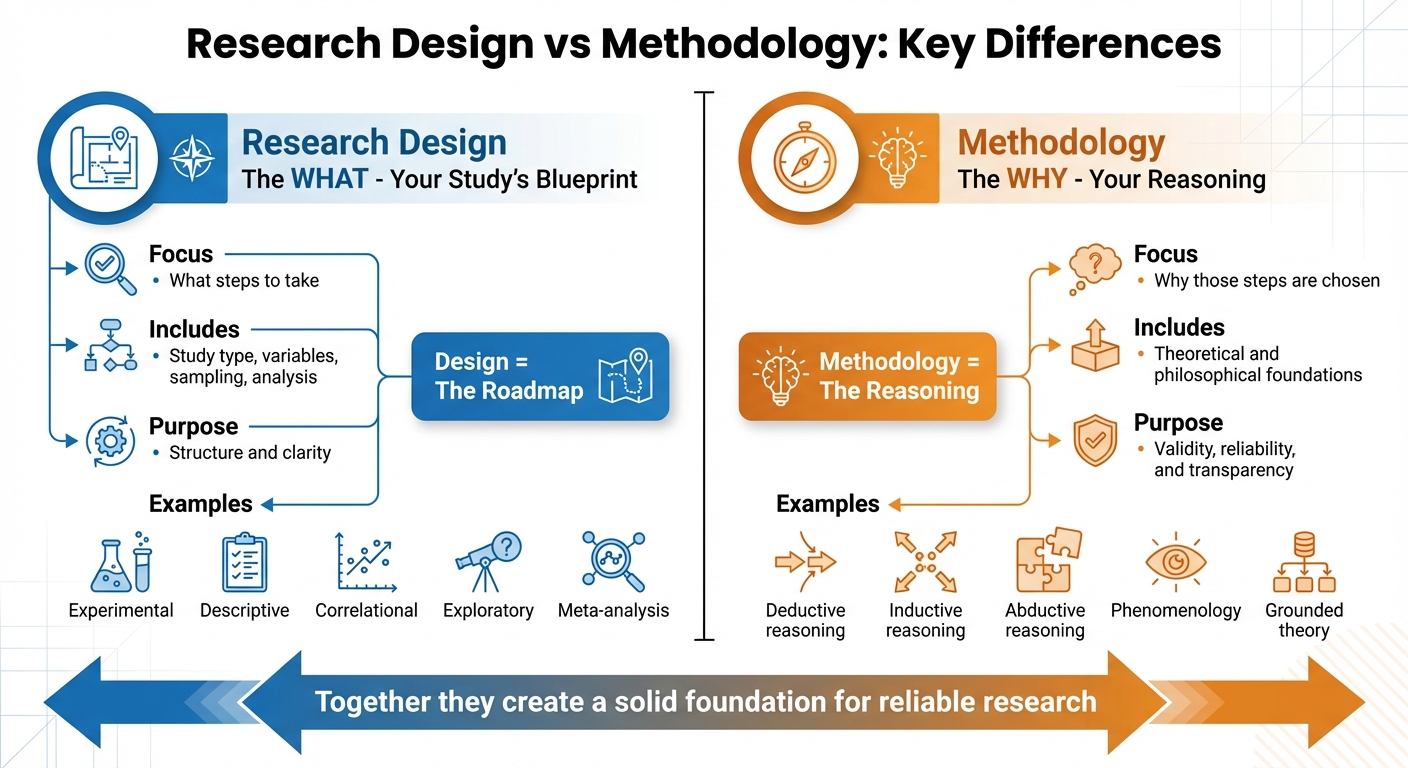
Research Design vs Methodology: Key Differences and Comparison
1. Research Design
Definition
Research design serves as the blueprint for your study, aligning all the components to effectively address your research question. Kerlinger describes it as:
"Research design is a plan, structure, and strategy of investigation conceived to obtain answers to research questions and to control variance."
It's more than just a checklist - it's a logical framework that connects your research problem to the methodologies you'll use. This plan not only provides the overall structure but also defines the specific steps and elements involved.
Scope
A strong research design tackles several essential aspects. It identifies the type of study (e.g., experimental, descriptive, correlational), clarifies research questions or hypotheses, and outlines the variables (independent, dependent, and control). It also lays out the sampling methods, data collection strategies (like surveys, interviews, or observations), and the statistical approach for analyzing the data.
This framework organizes the study by detailing how variables are arranged and how data will be collected and analyzed. Research designs can be fixed - set in advance and driven by theory - or flexible, allowing for adjustments as new information comes to light during the study.
Purpose
The main objective of research design is to ensure the evidence you gather effectively answers your research question. A well-thought-out design enhances validity, reliability, and the efficient use of resources. It also keeps the study focused, avoiding unnecessary diversions that could dilute the results. Research design is about managing variance - maximizing the impact of the independent variable while minimizing errors and external factors. This precision is what distinguishes academic research from casual observation. The clarity it provides allows researchers to choose the most suitable design type for their specific needs.
Examples
Different designs serve different purposes depending on the research field. For example, experimental designs manipulate an independent variable to explore cause-and-effect relationships, making them ideal for clinical trials or psychology experiments. Correlational designs, on the other hand, study relationships between variables without manipulating them, commonly used in fields like sociology or education.
Descriptive designs focus on systematically documenting phenomena or populations, often used in market research to analyze customer demographics. Exploratory designs are useful for investigating unclear problems, such as identifying reasons behind declining customer retention rates. Meanwhile, meta-analysis designs combine data from multiple studies to draw broader conclusions, particularly in areas like healthcare research. Each design type is tailored to address specific research goals effectively.
sbb-itb-1831901
2. Methodology
Definition
Methodology refers to the structured approach you use to collect, analyze, and interpret data in your research. While the research design outlines what your study will look like, methodology focuses on how you'll execute it. Bella Williams from Insight7 explains it well:
"Research design acts as a strategic plan, while methodology serves as the tactical execution."
It doesn't just cover the techniques you'll use - it also includes the theoretical and philosophical reasoning behind those choices. By aligning methods with these foundations, methodology ensures consistency and makes it easier for others to replicate your work.
Scope
Methodology can be broken down into three main layers.
- Philosophical foundation: This is your overarching perspective on knowledge, such as positivism or interpretivism.
- Research strategy: The middle layer connects your research questions to evidence, using approaches like case studies or randomized trials.
- Techniques and tools: This layer includes the specific methods for sampling, coding, and analyzing data.
Another important aspect is your reasoning approach. In deductive reasoning, you start with a theory and test it with data, commonly seen in quantitative research. Inductive reasoning works the other way around, using data to identify patterns and develop theories, which is typical in qualitative studies. Lastly, abductive reasoning combines the two, moving back and forth between data and ideas to find the most plausible explanation.
This layered structure ensures that your methodology aligns with your research goals and questions.
Purpose
The main goal of methodology is to ensure your findings are both valid and reliable. It turns your research design into actionable steps, offering transparency so others can understand and replicate your process.
It also helps you navigate constraints. For example, methodology ensures that your research objectives align with practical factors like time, budget, participant access, and your expertise. If you're working on a large-scale study, surveys might be your best bet for reaching many participants. On the other hand, interviews could be a better fit for exploring detailed, in-depth perspectives.
Examples
Here are a few examples of how methodology is applied:
- Experimental methodology: Used in controlled settings, such as clinical trials, to test cause-and-effect relationships.
- Phenomenology: Focuses on participants' lived experiences to understand how they perceive specific phenomena.
- Grounded theory: Involves analyzing qualitative data to develop new theories from the ground up.
In practice, qualitative researchers often reach "data saturation" after interviewing 10 to 30 participants - when additional interviews no longer add new insights. For quantitative studies, reliability is often assessed using Cronbach's alpha, with scores above 0.70 generally considered acceptable. These benchmarks help researchers plan their data collection and ensure their tools are effective before diving into full-scale studies.
Research Methodology vs Research Methods vs Research Design (Clear & Simple Explanation!) ✅
Pros and Cons
Research design and methodology each bring their own strengths and challenges to the table. Knowing these trade-offs can help you plan better and sidestep common issues when combining both elements.
| Element | Advantages | Disadvantages & Challenges |
|---|---|---|
| Research Design | Offers structure and clarity; enhances reliability and validity; reduces errors and bias; conserves time and resources. | Can become inflexible once finalized; demands extensive upfront planning; prone to sampling and observer biases if not carefully crafted. |
| Methodology | Strengthens the research's credibility; provides a theoretical framework; ensures ethical and philosophical alignment. | May seem overly abstract or confusing; requires a strong grasp of research paradigms (e.g., positivism, constructivism). |
| Combined Application | Together, they ensure research is systematic, credible, and well-supported. | Balancing time constraints with the need for thorough data; ensuring the design and analysis align seamlessly. |
To put it simply, research design serves as the roadmap to answer your research question, as one contributor from Social Work In explains:
"Think of the research design as your roadmap for answering your research question".
Methodology, on the other hand, provides the philosophical reasoning behind why you're taking that particular route.
One of the most common challenges is failing to align your methodology with your design, which can lead to mismatched methods or overly rigid frameworks. Issues like sampling errors, measurement problems, and response biases often stem from poorly executed design choices. Similarly, methodology can become so abstract that it’s hard to translate into practical tools for collecting data.
To overcome these hurdles, start by defining your research question before choosing your design or methodology. Pre-test your instruments to catch any ambiguities, and document the rationale behind every decision. This level of transparency not only builds trust with reviewers but also ensures your methods align with your research goals. Successfully integrating well-thought-out design with the right methodology is key to producing reliable and meaningful results.
Conclusion
Understanding the distinction between research design and methodology is crucial for conducting thorough academic research. Design focuses on what the researcher does, while methodology delves into why those choices align with the study's broader philosophical and conceptual framework. Together, they create a foundation for both practical and theoretical depth in your research.
Start by crafting a clear research question - it should guide your framework and design. Align your approach with your goals: qualitative methods, like case studies, are ideal for exploring "why" and "how", while quantitative designs, such as experiments, are better suited for measuring "what" or "how many."
To strengthen your study, connect your methodological choices to a philosophical paradigm, such as positivism or interpretivism. This transparency not only builds credibility with reviewers but also aids in evaluation and future replication. Additionally, address practical factors - like time, budget, and ethical considerations - early in the planning process to ensure your study remains feasible. By integrating design and methodology thoughtfully, you set the stage for meaningful and reliable research outcomes.
FAQs
Can one study have multiple research designs?
Researchers can absolutely include multiple research designs within a single study. By combining different approaches, they can address various facets of their research questions or incorporate mixed-methods strategies. This approach provides a broader and more in-depth understanding of complex subjects.
How do I choose a methodology for my research question?
To pick the best methodology, start by clearly outlining your research goals and identifying the type of data you need. Depending on your research question, you can opt for qualitative methods (like interviews or observations that focus on non-numerical insights), quantitative methods (which involve numerical data and statistical analysis), or a combination of both through mixed methods.
Make sure your chosen approach matches your objectives, available resources, and any ethical guidelines relevant to your study. Additionally, provide a clear rationale for your data collection and analysis techniques to ensure your research remains consistent and thorough.
What does it mean to align design and methodology?
Aligning design and methodology means making sure your research framework (design) integrates smoothly with the techniques and procedures (methodology) you plan to use. This means selecting a design that shapes your study while applying methods that fit naturally within that framework. When everything aligns, your data collection, sampling, and analysis methods work together to effectively address your research goals. This not only strengthens the overall consistency of your study but also boosts its reliability and credibility.