
How Does Turnitin Detect AI? What the Model Looks For in 2026
Turnitin looks for statistical patterns in writing - not proof of who wrote it. I treat its AI score as a reason to review drafts, sources, and assignment rules, not as a verdict.
Here’s what matters when you read a report:
- Text requirements: It needs 300–30,000 qualifying words of prose. Language and file limits also affect what it can check.
- Detection: The model scores text patterns. No single phrase proves AI use, and English supports more detection features than Spanish or Japanese.
- Scores: The percentage estimates the share of qualifying prose flagged - not the chance of misconduct. Scores from 1%–19% appear as
*%, without passage highlights. - Limits: Human writing can be flagged, and AI writing can be missed. An AI score is also separate from a similarity score.
My rule: <u>check the writing process before drawing conclusions</u>. Drafts, notes, and revision history provide context that a score alone cannot.
Understanding false positives within Turnitin’s AI writing detection capabilities
sbb-itb-1831901
Documented Methods vs. Assumed Writing Signals
Public descriptions of AI-like writing are not a confirmed list of Turnitin’s triggers. Documented measures - perplexity and burstiness - differ from assumed signals, such as formulaic phrasing. Public explanations do not show that any single phrase or style choice determines a detection result.
Predictable Phrases, Repetition, and Vague Claims
Illustrative patterns - not detection rules: A predictable opening such as This essay will discuss the importance of this topic, repeated openings like The study shows, and claims without specific supporting evidence can all sound formulaic. These patterns may resemble low-perplexity writing, but none of them independently establishes AI use.
These patterns appear in both machine-written prose and human academic writing. Treat them as reasons to revise, not proof of AI use. Using AI writing tools can help refine these drafts while maintaining academic integrity.
What Turnitin Has Not Confirmed
Perplexity measures predictability; burstiness measures variation in sentence length and structure. Turnitin has publicly documented both as part of its AI-writing approach. But it has not confirmed that any single phrase, repeated transition, or vague claim acts as an independent trigger.
Statistical text analysis cannot independently establish a writer’s identity, intent, or drafting process. A pattern in the finished text does not reveal who wrote it or how it was developed.
Those signals feed into the percentages and highlights explained next.
What AI-Writing Percentages and Highlights Mean
How to Read Turnitin AI Scores
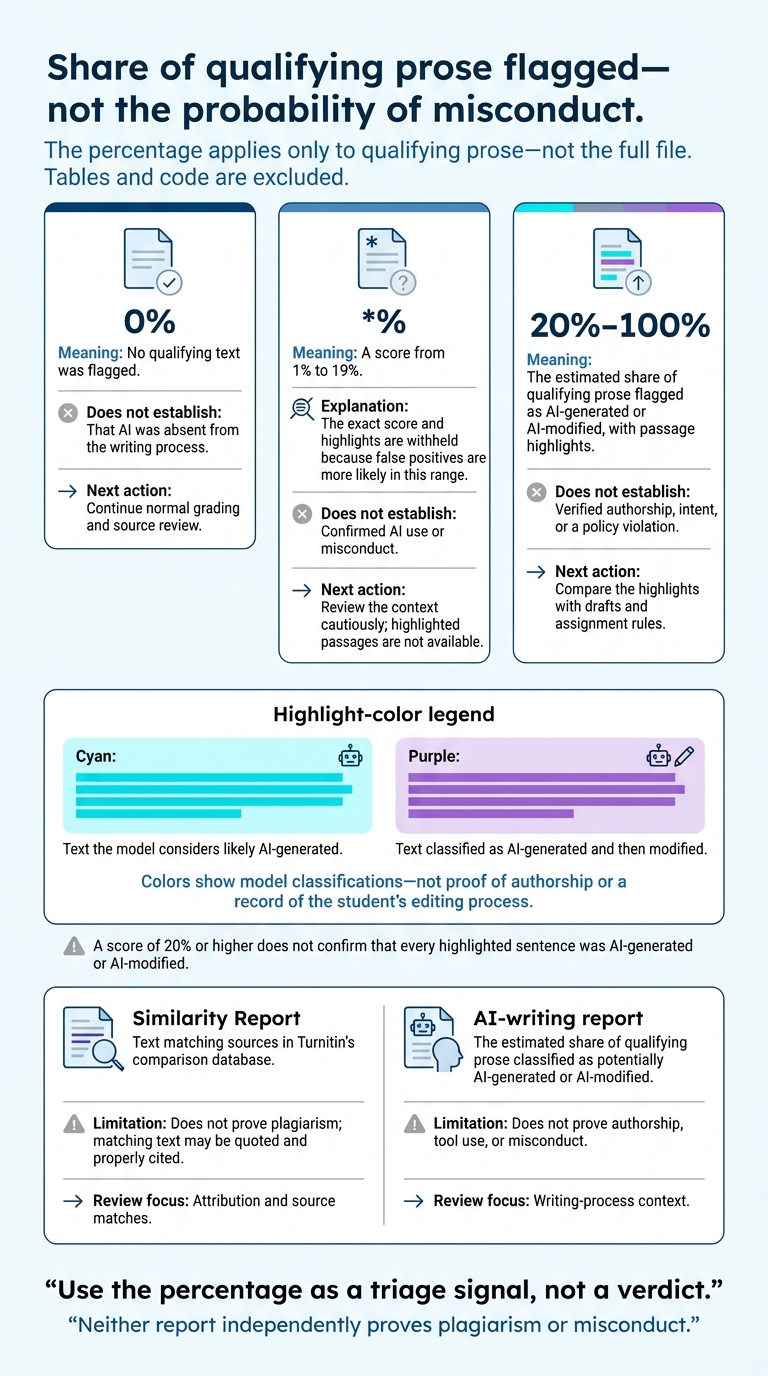
Turnitin’s AI-writing percentage estimates how much qualifying prose its model flags as potentially AI-generated or AI-modified. It is not the probability of AI use, authorship, or misconduct. The percentage applies only to qualifying prose - not the full file. Tables and code are excluded.
Reading 0%, an Asterisk, and 20% or Higher
For processed submissions, read the indicator as follows:
| Indicator display | What it represents | What it does not establish | Appropriate next step |
|---|---|---|---|
| 0% | No qualifying text was flagged. | That AI was absent from the writing process. | Continue normal grading and source review. |
*% |
A score from 1% to 19%. The exact score and highlights are withheld because false positives are more likely in this range. | Confirmed AI use or misconduct. | Review the context cautiously; highlighted passages are not available. |
| 20%–100% | The estimated share of qualifying prose flagged as AI-generated or AI-modified, with passage highlights. | Verified authorship, intent, or a policy violation. | Compare the highlights with drafts and assignment rules. |
Use the percentage as a triage signal, not a verdict.
Cyan marks text the model considers likely AI-generated. Purple marks text it classifies as AI-generated and then modified. These colors show model classifications - not proof of authorship or a record of the student’s editing process. A score of 20% or higher does not confirm that every highlighted sentence was AI-generated or AI-modified.
AI Detection vs. Similarity Scores
Similarity and AI-writing reports answer different questions. One checks for source matches; the other estimates AI-generated or AI-modified writing. Neither report independently proves plagiarism or misconduct.
| Report | What it measures | What it cannot prove |
|---|---|---|
| Similarity Report | Text matching sources in Turnitin’s comparison database. | Plagiarism; matching text may be quoted and properly cited. |
| AI-writing report | The estimated share of qualifying prose classified as potentially AI-generated or AI-modified. | Authorship, tool use, or misconduct. |
Use source matches to review attribution and AI highlights to examine writing-process context. Keep those roles separate when reviewing the false positives and processing limits covered in the next section.
Detection Errors and Processing Limits
Turnitin says its detector can flag human-written text and miss AI-written text. Treat the score as a screening signal, not evidence of misconduct. The main errors are false positives, missed AI text, and submissions that produce no result, which is why understanding academic plagiarism detector essentials is vital for maintaining integrity.
False Positives, Missed AI Text, and Unprocessed Files
| Outcome | Meaning | Review action |
|---|---|---|
| False positive | Human-written text is incorrectly flagged. | Compare drafts and research notes. |
| False negative | AI-written text is missed. | Do not treat a lack of flags as verification. |
| Partial detection | Only some AI-assisted text is flagged. | Do not assume highlights show all AI assistance. |
| Unprocessed submission | No AI-writing result is produced. | Check eligibility, including the requirement for 300 qualifying words. No result does not mean 0%. |
Heavily revised drafts, multilingual passages, and unusual formats can make results harder to interpret. When a draft mixes human and AI writing, the report cannot separate authorship passage by passage. No single trait explains a result on its own.
Published performance claims can help set expectations, but they do not settle individual cases.
How to Read Published Accuracy Claims
Turnitin reports a document-level false-positive rate below 1% for results above 20% under its test conditions. That rate does not tell you whether a particular flag is wrong.
How to Review Flagged Work
Once you’ve interpreted the score, look beyond the model’s output. Check the assignment requirements, the student’s draft history, and any other available evidence before drawing conclusions.
Review Steps for Educators
Start with the report. Read highlighted passages in context, verify citations and factual claims, and compare the flagged text with the student’s drafting trail.
Review prior work alongside dated drafts, research notes, and revision history. Ask the student how they developed their thesis, chose sources, and revised the flagged passages. Document the discussion and apply the course policy.
Base the review on records, not guesswork.
Student Writing Records
Save outlines, notes, drafts, citations, and revision history as you work through the assignment. Submit any required AI-use statement and explain how you used AI writing assistants to support your work.
Final check: Treat the report as one input, not a verdict.
FAQs
How can I challenge an incorrect AI flag?
Treat an incorrect AI flag as a documentation issue, not a writing problem. Promptly ask your instructor for an informal review. Ask which passages prompted concern and which policy applies. Share records of your writing process: dated drafts, document version history, research notes, source PDFs, and brainstorming records.
If the review doesn’t resolve the issue, follow your institution’s formal appeal process. Keep your communications factual, organized, and professional.
Can grammar edits affect my AI score?
Yes, grammar and writing tools may affect your AI score, especially when they rewrite or rephrase your work. Those edits can make wording more predictable or sentence structures more uniform.
But these patterns aren’t confirmed Turnitin detection signals. Treating them that way would be an assumption. They don’t prove AI use, and false positives can happen.
What if my instructor allows AI assistance?
If your instructor allows AI assistance, a Turnitin AI report does not automatically prove misconduct. Its labels reflect model predictions - not whether your AI use followed course rules. Turnitin cannot determine whether you had permission to use AI.
Follow your institution’s policy and your instructor’s assignment guidelines, including any required disclosures. Be ready to explain your writing process and how you kept your AI use within the allowed limits.