Does Turnitin Detect Paraphrased AI
Yes, Turnitin can detect paraphrased AI content as of 2026. The platform now uses advanced AI detection tools to identify text generated or altered by AI, even when paraphrasing tools are applied. Here's how it works:
- Linguistic Patterns: Turnitin analyzes rhythm, syntax, and word choices to flag predictable patterns typical of AI-generated text.
- Color-Coded Reports: Submissions include highlights - cyan for AI-generated text and purple for AI-paraphrased sections.
- Accuracy: It boasts a false positive rate below 1% for documents with over 20% AI content, though individual sentence-level errors still occur.
Key Challenges:
- False Positives: Non-native English speakers and formulaic writing (e.g., lab reports) are more likely to be flagged incorrectly.
- University Pushback: Some institutions, like Curtin University, have stopped using Turnitin's AI detection due to reliability concerns.
To maintain academic integrity, students should focus on ethical AI use, leveraging AI writing tools for brainstorming, proper citation, academic plagiarism checker tools, and personal input in their writing process.
First Ever Review: Turnitin’s Updated AI Detector & AI Paraphrasing Tool in Action
sbb-itb-1831901
How Turnitin Detects Paraphrased AI Content
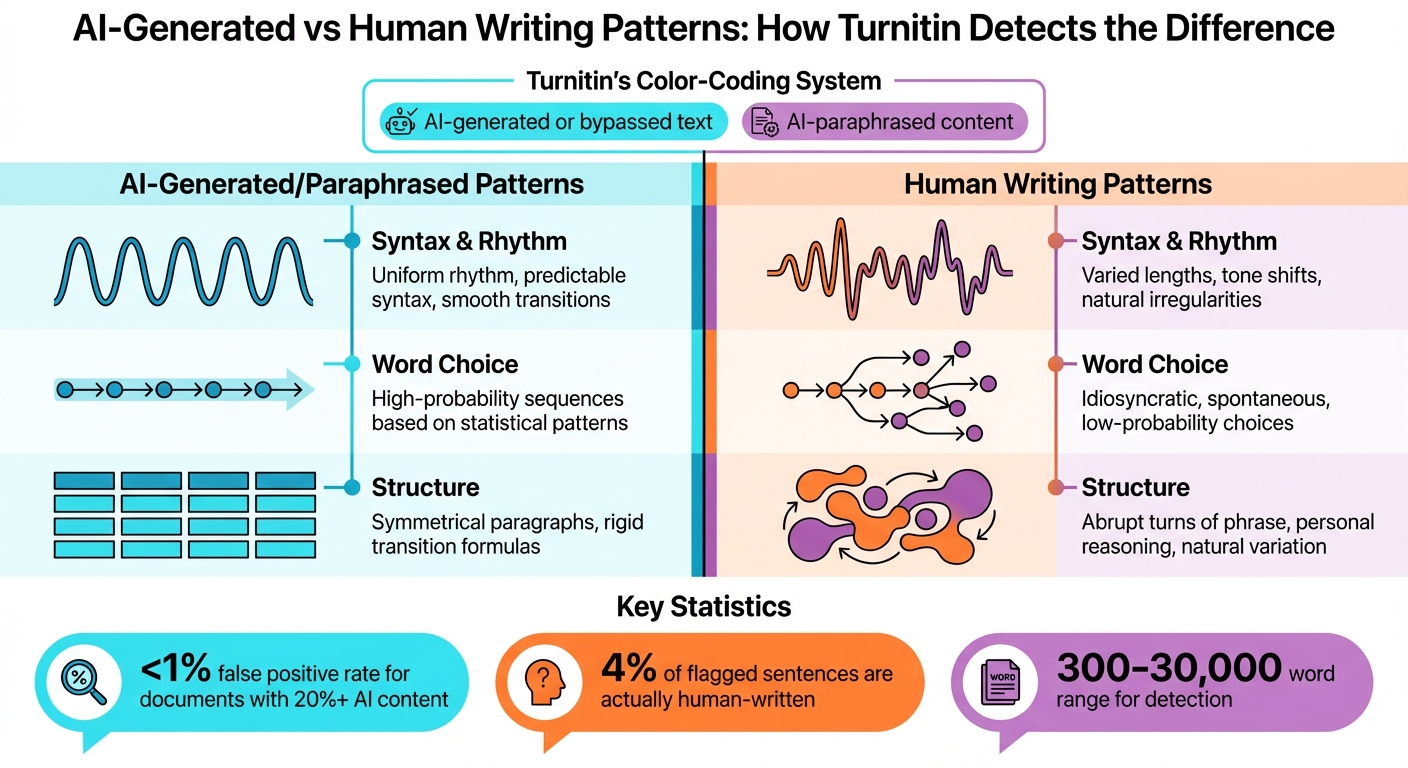
AI-Generated vs Human Writing Patterns: How Turnitin Detects the Difference
Turnitin's AI Detection Technology in 2026
Turnitin's 2026 detection system goes beyond traditional text-matching methods by using a transformer-based deep-learning model. This model is trained on a vast dataset of both genuine student papers and AI-generated content, allowing it to identify the distinct "stylistic signature" of machine-written text. The key to this process lies in word probability analysis. AI models like GPT-4o and GPT-5 tend to choose the next most likely word, resulting in highly predictable patterns. Human writers, on the other hand, tend to make less predictable word choices, creating statistically uncommon patterns.
The system evaluates submissions by dividing them into overlapping segments, analyzing the context of each sentence. Each segment is assigned a score between 0 and 1, where a score of 1 indicates fully AI-generated text. To address evolving methods like "AI bypassers" and text spinners, the 2026 updates detect subtle linguistic patterns left behind by these techniques.
"The unique power of our model arises from the carefully curated data we've used to train the model, leveraging our 20+ years of expertise in authentic student writing." - Turnitin
Turnitin tested its system on 700,000 academic papers, achieving a false positive rate of less than 1% for documents containing more than 20% AI-generated content. To reduce unnecessary alerts, scores for AI detection between 1% and 19% are not displayed. Instead, these instances are marked with an asterisk (*%).
Key Features of Turnitin's AI Detection Tools
Turnitin's platform includes tools designed to make AI analysis straightforward. For example, color-coded highlights help educators quickly identify AI involvement: cyan highlights indicate likely AI-generated or bypassed text, while purple highlights flag AI-paraphrased content. This system simplifies the process of spotting attempts to conceal AI usage.
The detection system is optimized for long-form prose, meaning it works best with standard paragraphs and grammatical sentences. It does not reliably analyze non-prose content such as poetry, computer code, bulleted lists, or annotated bibliographies. Documents must meet certain criteria - a minimum of 300 words and a maximum of 30,000 words - for the AI detector to function effectively.
| Marker | AI-Generated/Paraphrased Pattern | Human Writing Pattern |
|---|---|---|
| Syntax & Rhythm | Uniform rhythm, predictable syntax, smooth transitions | Varied lengths, tone shifts, natural irregularities |
| Word Choice | High-probability sequences based on statistical patterns | Idiosyncratic, spontaneous, low-probability choices |
| Structure | Symmetrical paragraphs, rigid transition formulas | Abrupt turns of phrase, personal reasoning, natural variation |
"Applying AI paraphrasing to AI-generated content is likely a sign that the writer is trying to hide their use of AI, which is the opposite of transparency." - Annie Chechitelli, Chief Product Officer, Turnitin
Challenges and Limitations of Turnitin's AI Detection
False Positives and Their Academic Impact
Turnitin's AI detection technology, while advanced, faces significant challenges, particularly with false positives. Despite the company's assurance of a document-level false positive rate below 1% for papers containing 20% or more AI-generated content, individual sentences tell a different story. About 4% of flagged sentences are actually written by humans. In a 2,000-word essay, this could result in dozens of legitimate sentences being mistakenly marked as AI-generated. Such errors can lead to serious consequences for students, including accusations of academic misconduct, failed assignments, and even disciplinary hearings. For some, these marks on their academic record can have long-lasting repercussions.
Non-native English speakers are particularly vulnerable. Their use of simpler vocabulary and repetitive sentence structures can resemble AI-generated text, making them more likely to be unfairly penalized. Studies have shown that 54% of false-positive sentences occur directly next to actual AI-generated content, suggesting that the detector struggles to differentiate between human and AI-written text in close proximity.
Short documents, like those under 300 words, and formulaic writing - such as lab reports - also present challenges, though AI writing aids are increasingly used to structure such documents. These types of texts often trigger unreliable predictions due to their structured and predictable nature. These inaccuracies have raised broader concerns about the tool's dependability, prompting some institutions to reconsider its use.
Accuracy Concerns Raised by Universities
Universities have started pushing back against Turnitin's AI detection tool, citing reliability and fairness issues. In January 2026, Curtin University decided to disable the tool across all its campuses. The university emphasized the importance of fostering trust and ensuring that assessments remain "secure, fair, relevant and future-ready".
"Kudos to Curtin University for joining the growing list of providers that are abandoning this deeply flawed technology."
– Dr. Mark A. Bassett, Associate Professor and Academic Lead (Artificial Intelligence), Charles Sturt University
Similarly, the University of Queensland stopped using the tool during Semester 2, 2025, advising staff against relying on AI detectors to accuse students of misconduct due to concerns about reliability. Vanderbilt University followed suit, citing a lack of transparency in how scores are generated and the potential harm caused by false accusations.
The core issue lies in the ever-evolving nature of AI models. As these systems become better at mimicking human writing, and as students refine AI-generated drafts with personal touches or structural changes, the patterns that Turnitin's detectors rely on become harder to identify. To address this, Turnitin has deliberately adjusted its model to err on the side of caution, allowing some AI content to go undetected rather than risk flagging legitimate work. This "cat and mouse" game between detection tools and AI advancements underscores the complexity of maintaining accuracy in such systems.
How Yomu AI Supports Ethical and Original Academic Writing
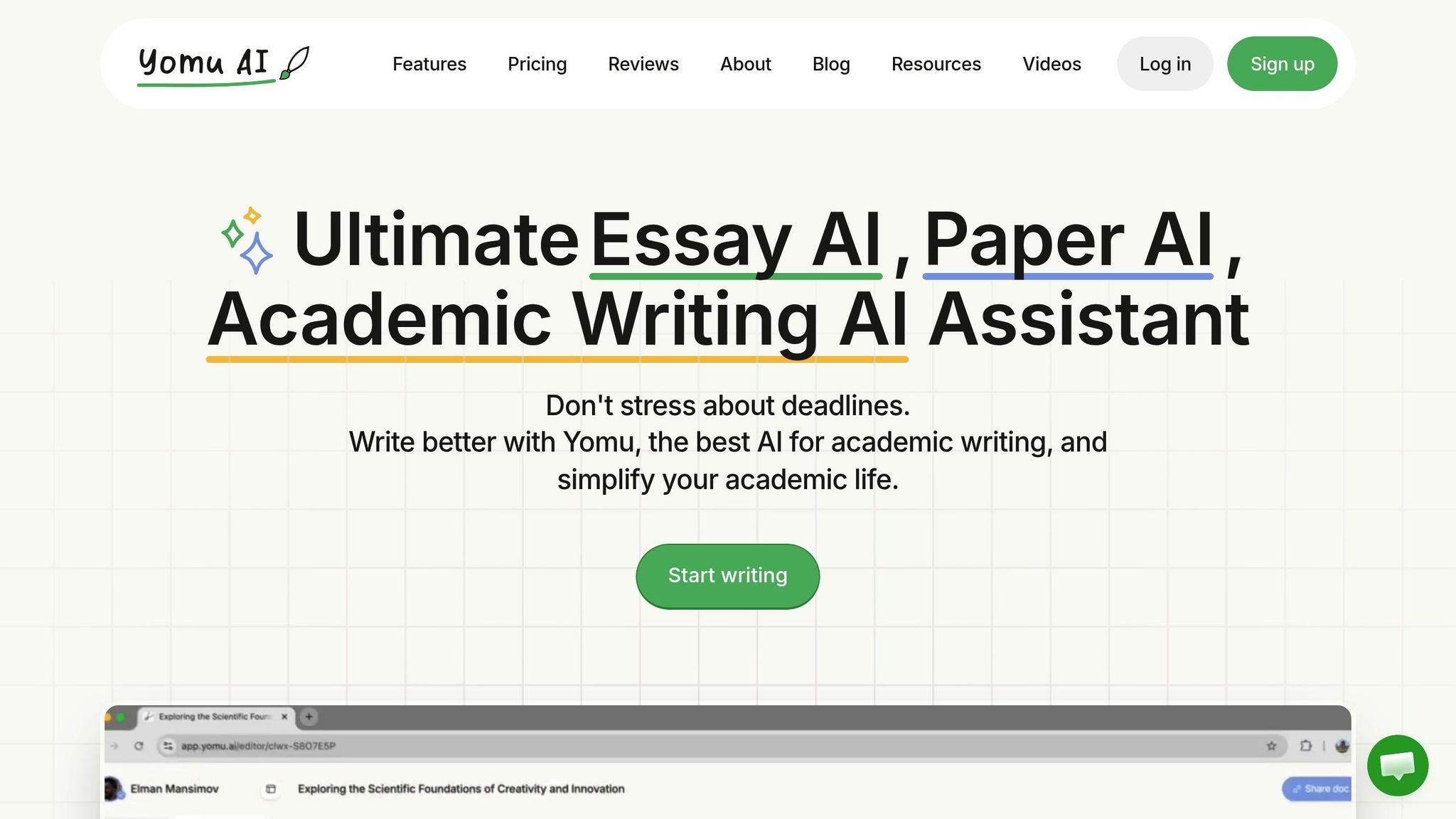
Yomu AI's Paraphrasing and Plagiarism Checker
Yomu AI takes a proactive approach to support academic integrity, working alongside you during the writing process rather than waiting until submission, as tools like Turnitin do. Instead of generating entire sections that could risk compromising originality, Yomu AI offers AI-powered autocomplete suggestions. These suggestions help you expand on your ideas while keeping your personal voice intact.
Its built-in plagiarism checker for academic papers and paraphrasing tools are designed to verify originality before submission. This allows you to refine your work in real-time, ensuring your ideas are expressed clearly while staying true to your analytical framework. Additionally, Yomu AI includes an integrated citation tool to help you properly attribute your sources, a feature that ensures your work adheres to ethical standards without losing your academic voice - something Turnitin doesn't provide.
To further enhance the quality of your work, Yomu AI encourages users to cross-check AI-generated facts and citations with reliable sources. This extra layer of verification helps create more accurate and credible academic content, reducing the risks associated with over-reliance on AI tools.
Integration into Academic Writing Workflows
Yomu AI is designed to seamlessly integrate into your academic writing process. Its document assistance and sentence-level autocomplete features are tools that support, rather than replace, your writing. These features help you develop arguments and structure ideas while ensuring that you remain in control of your work.
The platform also offers tools to refine your text during revisions. By focusing on improving clarity, structure, and proper source attribution, Yomu AI enhances your writing without altering its core substance. This ensures your work aligns with institutional expectations of transparency and original thought, helping you maintain ethical standards throughout your academic journey.
Best Practices for Maintaining Academic Integrity with AI Tools
Combining AI Tools with Human Editing
AI tools like Yomu AI can be fantastic assistants, but they should never replace your own critical thinking and creativity. When using features like autocomplete or paraphrasing, ensure the research, analysis, and conclusions are entirely your own. Think of AI as a brainstorming partner or a way to organize your thoughts - not as a shortcut to complete your work.
Once you've used AI to assist, take the time to revise the output. Add your personal touch by varying sentence structure, incorporating specific examples, and weaving in your own insights. These elements give your writing a natural, human quality that AI often lacks.
It's also a good idea to keep a record of your process. Save drafts, brainstorming notes, and research materials. If your work is ever flagged by tools like Turnitin, these documents can demonstrate your original contributions. By 2026, many universities have shifted their focus from "Did AI write this?" to "How was AI used, and was that use appropriate?"
Finally, be diligent about citing sources and paraphrasing ethically to avoid unintentional plagiarism.
Proper Citation and Ethical Use of Paraphrasing
When AI suggests citations, double-check them against trusted academic sources. Yomu AI's citation tool can help format references, but it's up to you to confirm the sources are accurate and relevant to your work.
Be cautious with paraphrasing tools to avoid creating an overly polished or unnatural tone, often referred to as "uniform smoothing." Using these tools sparingly ensures your writing retains a human rhythm. Always follow your institution's AI disclosure policies and check your syllabus for any department-specific guidelines.
"Turnitin does not make a determination of misconduct; rather, it provides data for the educators to make an informed decision based on their academic and institutional policies." - Laura Young, Content Marketing Lead, Turnitin
Before submitting your work, use Yomu AI's plagiarism checker to catch potential issues. These steps reinforce the idea that AI should enhance your work - not replace your effort - while upholding academic integrity.
Conclusion
As of 2026, Turnitin's AI detection technology has reached new levels of sophistication, capable of identifying both AI-generated and paraphrased content. Importantly, Turnitin's estimates are probabilistic, designed to spark meaningful discussions rather than serve as definitive judgments. Reports show a noticeable rise in AI usage within academic submissions, highlighting the need for thoughtful approaches to integrating technology into education.
This shift has led to a rethinking of academic policies. Universities are increasingly moving away from outright bans on AI tools, instead promoting transparency and responsible use. For example, tools like Yomu AI now assist students by offering real-time originality checks and helping with citation formatting, encouraging ethical practices in writing.
To navigate this landscape, students can use AI for tasks like brainstorming or organizing ideas while ensuring that critical research and analysis remain their own. Keeping drafts and personal notes not only documents the writing process but also reinforces originality. Always cross-check citations with reliable sources to maintain academic credibility and preserve your unique voice.
Academic integrity in the age of AI isn't about avoiding these tools altogether - it’s about using them ethically and responsibly. Treat AI as a helpful assistant, not a replacement for your critical thinking or creativity. With transparent AI tools and strong human oversight, the academic community can maintain high standards while adapting to technological advancements. Striking the right balance between AI assistance and personal effort will shape the future of academic writing.
FAQs
What does Turnitin’s purple highlight mean?
Turnitin’s purple highlight indicates text that its AI writing detection model identifies as likely created or rephrased using AI tools. This feature is designed to flag potential AI-generated content for closer examination.
Can Turnitin flag my writing by mistake?
Yes, Turnitin has the ability to flag writing as AI-generated. However, its detection isn't flawless and can sometimes lead to false positives. This is why it's crucial for any flagged content to be reviewed by a person to ensure fairness and accuracy. Knowing how Turnitin’s algorithms operate can help reduce confusion when it comes to checking originality.
What should I do if my paper is flagged?
If your paper gets flagged, take a close look at the highlighted parts to confirm that your work is both original and correctly cited. You might need to rewrite or rephrase certain sections in your own words to reduce the chances of a false positive. If you're unsure or have questions, it's a good idea to reach out to your instructor or your school's academic integrity office. They can help you address any concerns and guide you on what to do next.