Turnitin AI Score Meaning: What 1%, 20%, and 80% Actually Indicate
Understanding Turnitin's AI Writing Score is crucial for interpreting your submission results. Here's the bottom line:
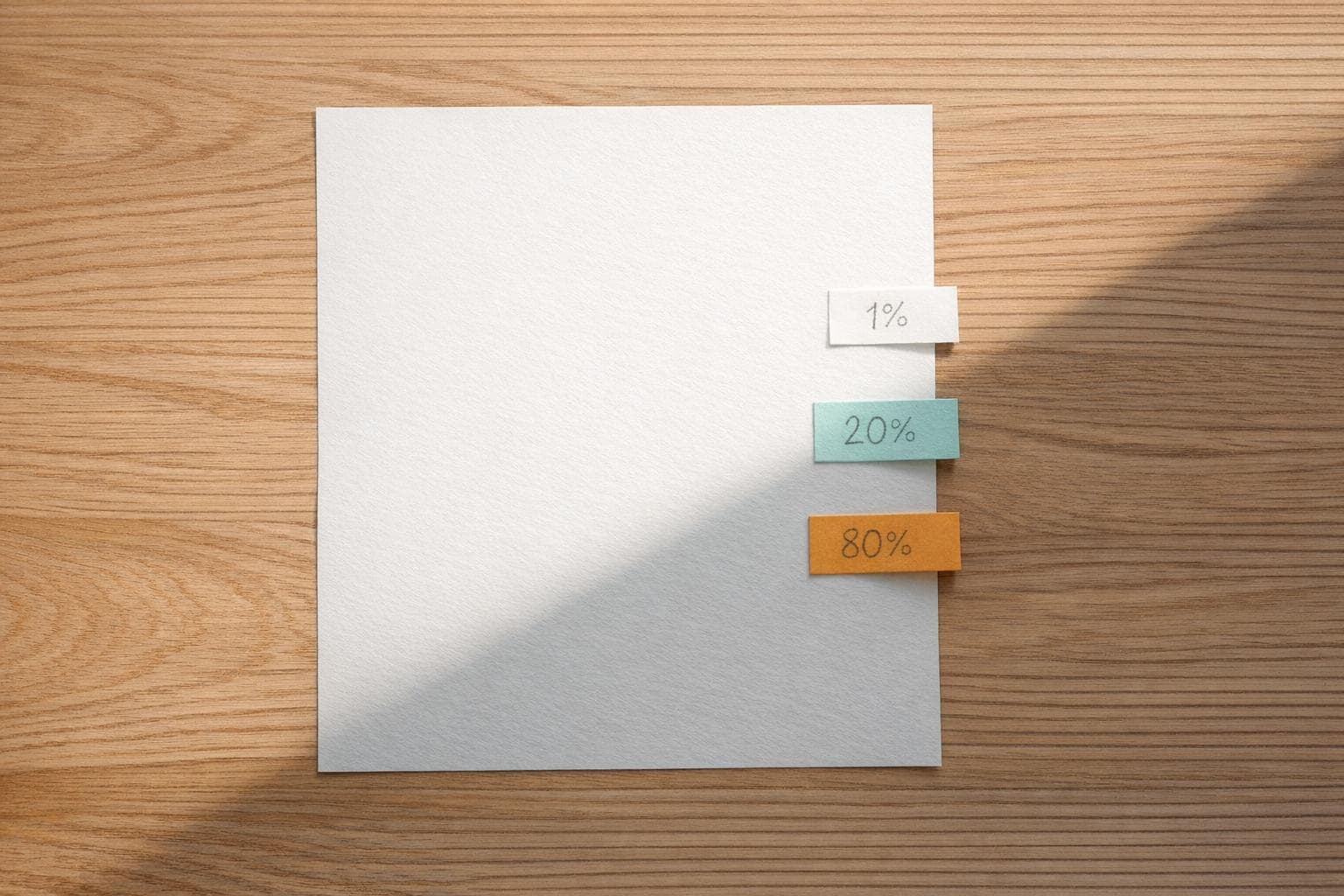
- 1%-19%: Indicates faint AI-like patterns. These scores are flagged as "*% detected as AI" due to potential false positives. A 0% score means no detectable AI patterns were found.
- 20%-50%: Suggests a mix of human and AI-assisted content. This range often reflects formal writing styles or minor AI use, like brainstorming or editing.
- 80%-100%: Likely AI-generated or heavily modified by AI tools. These scores require thorough review but don't automatically confirm misconduct.
Key points to remember:
- The AI Writing Score estimates AI involvement but isn't definitive proof.
- Scores below 20% are hidden to avoid false positives.
- A high score signals the need for revision, not immediate penalties.
To reduce high AI scores:
- Rewrite flagged sections manually.
- Properly cite sources to distinguish original work.
- Limit AI use to brainstorming or outlining with AI writing aids.
Turnitin's AI Writing Score differs from the Similarity Score, which detects text matches in its database. Both should be assessed in context with your assignment and writing style.
Turnitin: AI and Similarity Reports
sbb-itb-1831901
The Problem: Confusion About AI Score Percentages
The core issue with Turnitin's AI scores isn't the technology itself - it’s how people misunderstand them. Students and educators often treat these scores as definitive judgments, leading to undue stress over low scores or misplaced confidence when the results seem clear.
A common source of confusion lies in mixing up the Similarity Score, which identifies exact text matches, with the AI Writing Score, which estimates the likelihood of AI-generated text. For instance, a student might see a score of 25% and assume it’s undeniable proof of AI usage. In reality, this could simply reflect how their formal writing style triggered the detector’s pattern-matching system.
Adding to the complexity is Turnitin’s 20% threshold. Scores between 1% and 19% are not shown numerically; instead, they appear as "*% detected as AI." This decision stems from the high risk of false positives in this range.
"The AI writing score is a seeming gray area... the score cannot stand alone; it is arbitrary and less meaningful without an educator's sense of the assignment, the student, and overall context." - Karen Smith, Senior Teaching and Learning Specialist, Turnitin
It’s also important to note that a 0% AI score doesn’t guarantee originality. It merely means no detectable AI patterns were found. Similarly, a high Similarity Score might not signify plagiarism - it could result from correctly cited quotes or a student resubmitting their earlier draft. Grasping these distinctions is essential for fair and accurate academic assessments.
What Different Turnitin AI Scores Mean
Turnitin AI Score Ranges: What Each Percentage Means
Understanding what Turnitin's AI scores represent can help you better navigate academic submissions and ensure your work demonstrates originality. Here's a closer look at what each score range signifies and how you can interpret them.
Low Scores (1%-19%)
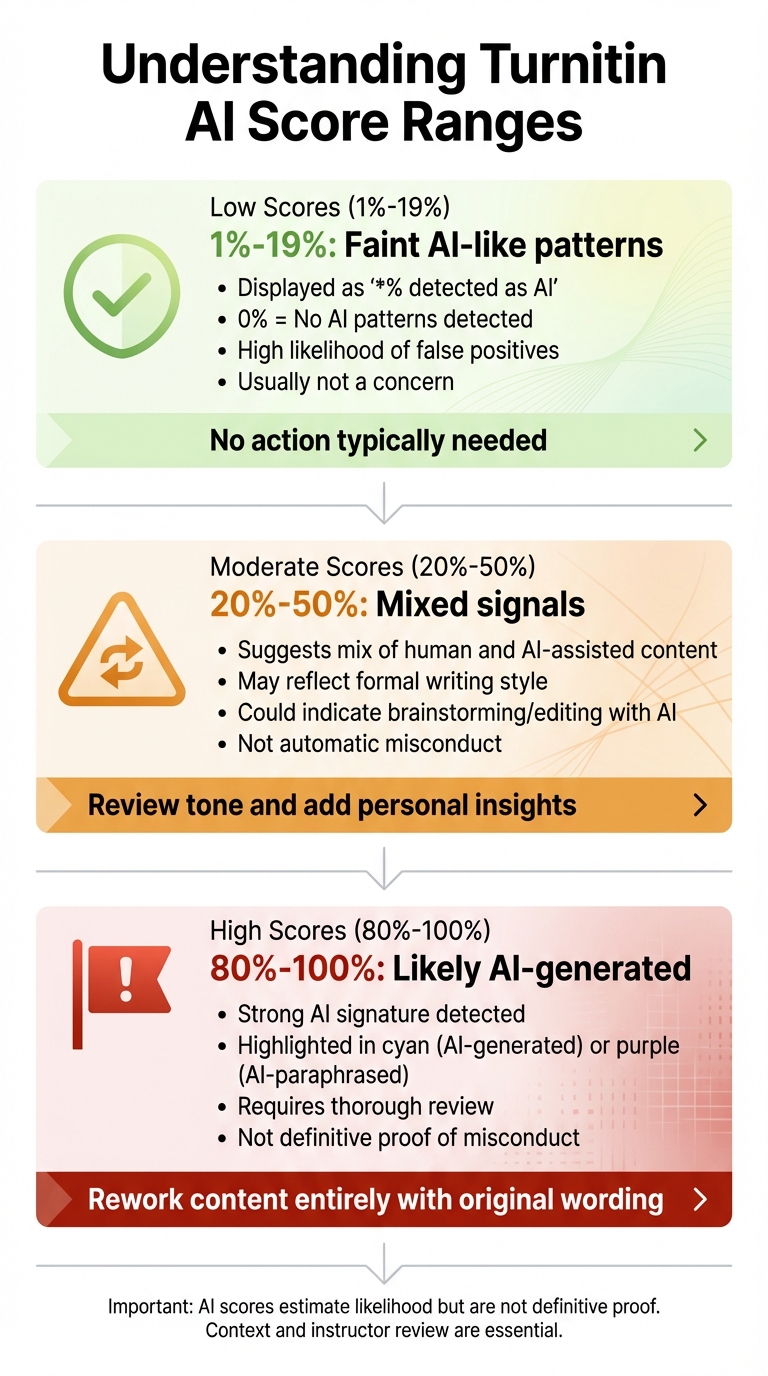
For scores between 1% and 19%, Turnitin doesn't show an exact percentage. Instead, it displays a message like "*% detected as AI", signaling the detection of faint AI-like patterns that aren't strongly quantifiable. A 0% score means no AI patterns were detected at all. These low scores are often false alarms rather than evidence of AI involvement.
"AI detection includes the possibility of false positives. Although some text in this submission is likely AI generated, scores below the 20% threshold are not surfaced because they have a higher likelihood of false positives." - Turnitin Official Disclaimer
Moderate Scores (20%-50%)
Scores in this range indicate "mixed signals." This could suggest a combination of human writing and some AI-generated or heavily edited content. However, it doesn't automatically point to plagiarism or misconduct. It might simply reflect the use of AI tools for brainstorming, outlining, or minor edits - or even result from a formal or technical writing style.
Turnitin's AI detection model isn't perfect. Research shows that non-native English speakers or formulaic writing styles can trigger false positives.
| AI Score Range | Interpretation | Recommended Action |
|---|---|---|
| 20–50% | Suggests a mix of human and AI-assisted content | Review your tone and add personal insights |
| 50–80% | Indicates likely AI-generated or heavily modified content | Rewrite sections to reflect original thinking |
| 80–100% | Strong AI signature; likely AI-generated | Rework content entirely with original wording |
If your score falls into the moderate range, try revisiting your text. Focus on making it more personal by including unique perspectives, specific examples, or personal anecdotes. This can help reduce any AI-like patterns that might be detected. Higher scores, which indicate stronger AI involvement, require a more thorough review - covered in the next section.
High Scores (80%-100%)
A high AI score suggests that most of the text may be AI-generated or significantly modified using AI tools. In Turnitin's Submission Breakdown, these sections are highlighted as either "AI-generated only" (cyan) or "AI-generated text that was AI-paraphrased" (purple).
That said, high scores don't automatically confirm academic misconduct. They might reflect the use of AI for brainstorming, structuring, or even translation, depending on the assignment's requirements. These scores should be seen as flags for further review rather than definitive proof of wrongdoing.
"Our AI writing detection model may not always be accurate (it may misidentify human-written, AI-generated, and AI-generated and AI-paraphrased text), so it should not be used as the sole basis for adverse actions against a student." - Turnitin
Highly structured or formulaic writing, such as research papers, could naturally lead to higher scores, while creative or narrative styles tend to produce lower ones. Ultimately, these scores should open up a discussion about writing style and academic integrity, rather than being treated as absolute evidence.
How to Lower High Turnitin AI Scores
If your Turnitin report shows a high AI score, you'll need to take specific steps to revise and refine your work. Start by identifying the flagged sections and making targeted changes.
Rewrite and Revise Flagged Content
The best way to address high AI scores is through manual revision. Turnitin highlights flagged text in the Submission Breakdown using two colors: cyan for "AI-generated only" and purple for "AI-paraphrased." These visual cues pinpoint the areas that need reworking.
Avoid using AI paraphrasing tools, as they can worsen the issue. Instead, rewrite the flagged sections entirely in your own words. Focus on crafting full sentences and well-structured paragraphs rather than relying on bullet points or tables.
Another key step is ensuring proper citation. When you clearly distinguish your original analysis from sourced material, it becomes easier to demonstrate authenticity in your writing.
Cite Sources Correctly and Limit AI Use
Accurate citations not only strengthen your work but also help reduce AI scores. Properly crediting your sources ensures academic integrity and allows instructors to differentiate between your analysis and referenced material. Direct quotes with correct citations are particularly helpful, as instructors can exclude them from the Similarity Report. Balance these quotes with your unique perspective to maintain your voice throughout the piece.
When using AI, limit it to brainstorming or outlining tasks. Write your final draft manually, as Turnitin has improved its ability to detect AI-generated content and attempts to bypass its detection.
Use Yomu AI to Improve Originality
For an extra layer of support, Yomu AI can help refine your writing before submission. This tool offers features like a plagiarism checker, an AI-powered paraphrasing assistant, and automated citation formatting. Use the plagiarism checker to identify sections that might get flagged, then rewrite those parts in your own voice. The citation tool ensures all sources are properly credited, making it easier for instructors to distinguish between original and sourced material.
Conclusion: Understanding and Managing Turnitin AI Scores
Turnitin AI scores estimate the likelihood that text was generated by AI, but they don’t serve as definitive proof of misconduct. As Karen Smith, Senior Teaching and Learning Specialist at Turnitin, puts it:
"The AI writing score is a seeming gray area... the score cannot stand alone; it is arbitrary and less meaningful without an educator's sense of the assignment, the student, and overall context."
A key point to grasp is the 20% threshold. Turnitin deliberately hides scores between 1% and 19% due to the high risk of false positives in this range. However, scores of 20% or above signal the need for closer scrutiny, as factors like writing style can impact the results.
If your work receives a high AI score, revising flagged sections is essential. Focus on rewriting in your own voice, ensuring proper citations, and using AI tools sparingly - primarily for brainstorming or structuring your ideas. Tools like Yomu AI can help you check for plagiarism using academic plagiarism checker tools, refine paraphrasing, and format citations, all of which reinforce originality and clarity in your writing.
It’s important to understand how AI scores differ from Similarity Scores. While Similarity Scores highlight exact matches to existing content, AI scores analyze text patterns to estimate the likelihood of AI involvement. Both metrics should always be considered within the context of your assignment and your personal writing style.
The main takeaways? Learn the score thresholds, revise thoughtfully, and cite properly. These strategies not only improve your submissions but also help you hone your writing skills. Think of these scores as tools to guide you toward more original analysis, better paraphrasing, and clearer citations - key elements of academic integrity. By understanding and addressing these scores, you can elevate your writing while maintaining the standards of honesty and originality.
FAQs
Can my writing style trigger a false AI score?
Structured and overly formal writing can sometimes trip up AI detection tools, making your work appear machine-generated - even when it’s not. Repetitive patterns and rigid formatting are often the culprits. To avoid this, aim for a more natural flow in your writing. Vary your sentence structure, use conversational tones, and ensure your content feels fresh and original. This approach not only reduces the chance of false AI flags but also makes your writing more engaging for readers.
What should I do if my AI score is 20% or higher?
If your AI score hits 20% or more, take a close look at the report and evaluate the context. Use your own judgment to decide whether the content might have been AI-generated or if it needs further examination. Remember, Turnitin's AI detection tool is designed to assist - not to make final decisions about academic misconduct. The priority should always be ensuring your work meets originality and academic integrity standards.
Will a high AI score automatically get me in trouble?
A high AI score on Turnitin doesn’t necessarily spell trouble right away. That said, if your score hits 50% or higher, it might raise eyebrows - especially if your work is missing citations or lacks your personal voice. On the other hand, scores under 20% are typically considered fine by most educators. To stay on the safe side, take time to review your work, double-check for originality, and ensure all sources are properly credited.