

10 Synthesis Essay Examples With Outlines You Can Copy
Need a synthesis essay fast? I’d boil this guide down to one core idea: don’t organize by source - organize by theme. That’s the difference between a paper that just reports and one that makes a clear claim.
Here’s the short version of what the article gives you:
- 10 essay models you can use as a starting point
- 4 topic groups: education policy, technology and society, public health, and climate action
- 3–5 body points per outline, which fits most college assignments
- Counterargument help in most examples, so you can plan a rebuttal early
- A simple writing rule: group sources by shared ideas, conflict, or lens
The main topics covered are:
- Smartphone rules in schools
- Classroom device policy
- School mental health funding
- AI in education
- Social media and mental health
- Data privacy and surveillance capitalism
- Telemedicine in rural care
- Vaccination outreach in underserved communities
- Social media regulation and teen mental health
- Climate policy, individual behavior, and corporate responsibility
A few patterns stand out right away:
- Most outlines use 3 body sections
- 8 out of 10 include a counterargument
- The strongest thesis lines are clear, limited, and arguable
- The article keeps pushing one move that works: sort evidence by theme, not by author
10 Synthesis Essay Examples: Topics, Thesis Angles & Structures at a Glance
How to Outline a Synthesis Essay for AP Lang | Coach Hall Writes
sbb-itb-1831901
Quick Comparison
| # | Topic | Main claim | Structure |
|---|---|---|---|
| 1 | Smartphone use in schools | Limit phones during class time | Argument + rebuttal |
| 2 | Classroom tech policy | Set device limits by use case | Thematic |
| 3 | School mental health | Fund student help and school systems | Thematic |
| 4 | AI in education | Use AI to support teachers, not replace them | Argumentative synthesis |
| 5 | Social media and mental health | Effects depend on use, content, and peer comparison | Thematic |
| 6 | Data privacy | Weigh convenience against privacy risks | Ethical/thematic |
| 7 | Telemedicine | Improve access, but fix policy and access gaps | Strengths and limits |
| 8 | Vaccination outreach | Local, community-led outreach works better in some areas | Comparative |
| 9 | Teen social media regulation | Rules may help, but must reflect how teens use platforms | Policy synthesis |
| 10 | Climate action | Large-scale policy and energy investment cut more emissions than individual action alone | Comparative by lens |
What I like about this article is that it keeps the advice simple: pick a side, sort your sources into themes, write topic sentences as claims, and end by showing what the sources mean together. That makes the outlines easy to copy, trim, or rewrite for your own prompt.
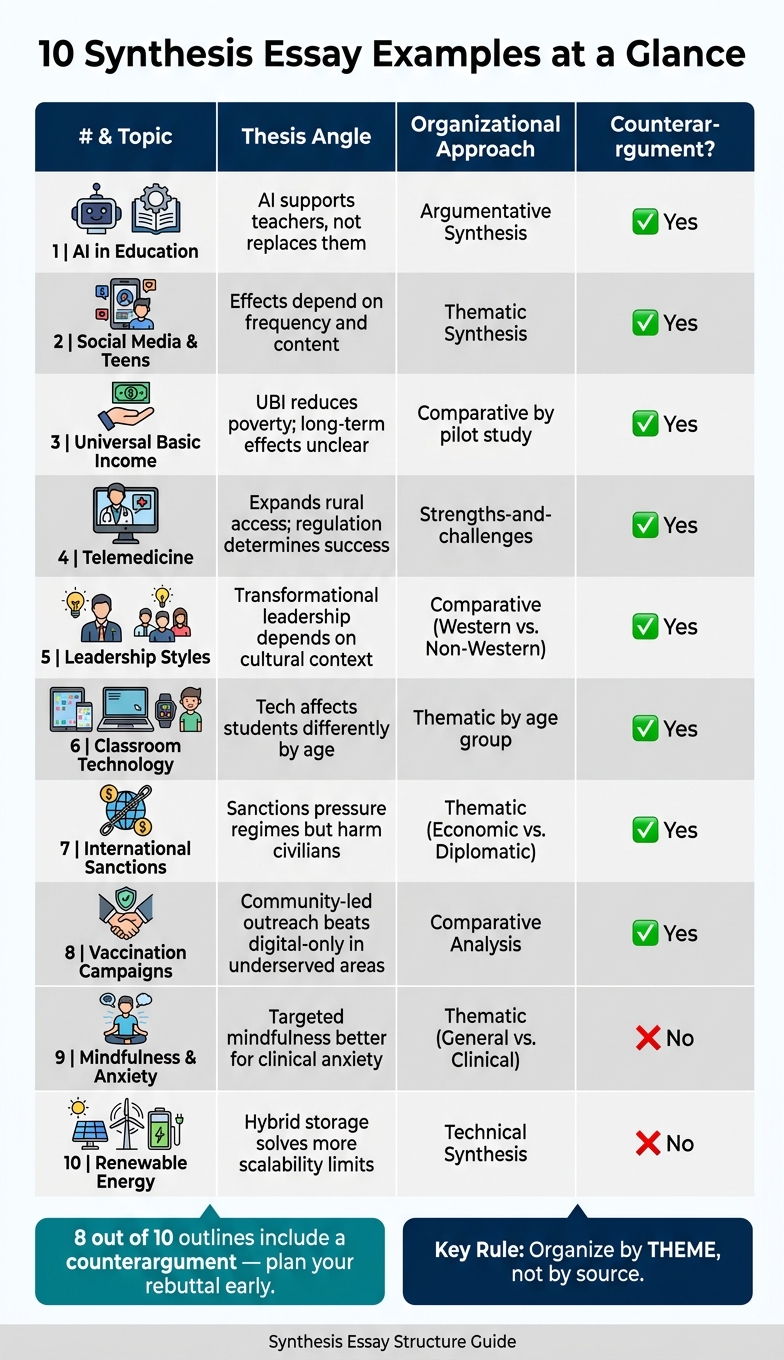
Quick Comparison Table of the 10 Essay Examples
| # | Sample Topic | Thesis Angle | Organizational Approach | Counterargument? |
|---|---|---|---|---|
| 1 | AI in Education | AI should support instruction and personalize learning, not replace teachers. | Argumentative synthesis | ✅ Yes (Rebuttal on cost-savings) |
| 2 | Social Media & Teens | Teen social media effects depend on frequency and content. | Thematic Synthesis | ✅ Yes (Positive vs. Negative outcomes) |
| 3 | Universal Basic Income | UBI reduces immediate poverty, but long-term effects need more study. | Comparative by country or pilot study | ✅ Yes (Inflation & work disincentives) |
| 4 | Telemedicine | Telemedicine expands rural access, but regulation determines success. | Strengths-and-challenges synthesis | ✅ Yes (Privacy & tech barriers) |
| 5 | Leadership Styles | Transformational leadership depends on cultural context. | Comparative (Western vs. Non-Western) | ✅ Yes (Debate on effectiveness) |
| 6 | Classroom Technology | Technology affects students differently by age. | Thematic (by age group) | ✅ Yes (Social interaction limits) |
| 7 | International Sanctions | Sanctions can pressure regimes but harm civilians. | Thematic (Economic vs. Diplomatic) | ✅ Yes (Ethical implications) |
| 8 | Vaccination Campaigns | Community-led outreach works better than digital-only campaigns in underserved areas. | Comparative Analysis | ✅ Yes (Addressing misinformation) |
| 9 | Mindfulness & Anxiety | Targeted mindfulness works better for clinical anxiety than general wellness. | Thematic (General vs. Clinical) | ❌ No (Focus on research gap) |
| 10 | Renewable Energy | Hybrid storage solves more scalability limits than single-tech systems. | Technical Synthesis | ❌ No (Focus on efficiency comparison) |
The Organizational Approach column tells you how to shape the essay: thematic, comparative, or problem-solution. The Counterargument column tells you if you should add a rebuttal paragraph.
Start by matching the structure to your prompt. Then use the full outline that fits your assignment.
1. Education Policy
Education policy gives you strong synthesis topics for one simple reason: the debates are current, and there’s plenty of source material to work with. The three models below are ready-to-use starting points. Each one covers a different kind of school decision, from student behavior to classroom setup to schoolwide support.
1. Smartphone Usage Policies in Schools
This topic lets you use research on attention and peer interaction to make a clear case: schools should limit smartphone use during instructional time.
| Element | Detail |
|---|---|
| Topic | Smartphone use during school hours |
| Thesis Direction | Schools should limit student smartphone use during instructional time because it improves focus, reduces classroom disruption, and supports healthier peer interaction. |
| Body Point 1 | Academic focus and attention |
| Body Point 2 | Classroom disruption |
| Body Point 3 | Peer interaction and social-emotional outcomes |
| Counterargument | Digital literacy and student engagement concerns |
| Rebuttal | Structured tech windows can preserve digital skills without open access |
2. Classroom Technology Policy
Here, the goal is to weigh the upside of classroom tech against the downside of device dependence and weaker social interaction. A smart way to handle this topic is to group sources by idea rather than by author. That makes the policy tradeoffs much easier to see.
| Element | Detail |
|---|---|
| Topic | Device and instructional-use rules in K–12 classrooms |
| Thesis Direction | Schools should set clear device-use policies that protect instructional time while limiting technology dependence. |
| Body Point 1 | Student engagement and learning outcomes |
| Body Point 2 | Teacher adoption and implementation barriers |
| Body Point 3 | Social interaction and developmental risks |
| Counterargument | Blanket restrictions may limit access for under-resourced students |
| Rebuttal | Tiered policies can balance access with instructional limits |
3. Mental Health Resource Allocation in Schools
This one takes the discussion beyond classroom tools and into student support systems. The core argument is that schools need both student-level help and system-level support. Bronfenbrenner's Bioecological Systems Theory is useful here because it shows how school, home, and community factors shape student well-being.
| Element | Detail |
|---|---|
| Topic | Mental health funding and support structures in schools |
| Thesis Direction | Effective school mental health policy requires both individual interventions and systemic supports. |
| Body Point 1 | Student-level supports (counseling, peer programs) |
| Body Point 2 | System-level structures (policy, staffing ratios) |
| Body Point 3 | Community and family factors through a bioecological lens |
| Counterargument | Budget constraints limit full implementation |
| Rebuttal | Phased rollouts and grant funding make dual-level models feasible |
2. Technology and Society
The next group of examples moves beyond school rules and into bigger debates about digital life. That shift matters because technology and society topics tend to bring source conflict right to the surface. And that makes them a good fit for synthesis writing.
4. AI in Education: Assistance vs. Replacement
This topic centers on a clear policy claim: AI should help teachers, not take their place.
| Element | Detail |
|---|---|
| Topic | The integration of AI tools in the classroom |
| Thesis Direction | AI should serve as a supplemental tool for personalized learning rather than a replacement for human educators, because it cannot provide mentorship, judgment, or emotional support. |
| Body Point 1 | AI limitations - lack of empathy and mentorship |
| Body Point 2 | AI benefits - personalized feedback and adaptive learning |
| Body Point 3 | Cost-efficiency vs. educational quality trade-offs |
| Counterargument | AI reduces operational costs and scales access to instruction |
| Rebuttal | Human educators are still needed for mentorship and student development |
Why does this one work so well? Because the tension is plain to see. On one side, AI can tailor feedback and adjust to student needs. On the other, a teacher does far more than deliver information. Mentorship, judgment, and emotional support don't come from a chatbot or grading tool.
From AI tools, it makes sense to move to the platforms students and adults use every day.
5. Social Media and Mental Health
This topic is strong for synthesis because the research does not point in just one direction. Some sources warn about harm. Others show connection and support. The clearest way to handle that mix is to group sources by theme: frequency of use, content type, and peer interaction.
| Element | Detail |
|---|---|
| Topic | Social media use and mental health outcomes |
| Thesis Direction | Social media affects mental health most when heavy use, harmful content, and peer comparison align, while supportive interaction can soften the effects. |
| Body Point 1 | Frequency of use and mental health outcomes |
| Body Point 2 | Content type and emotional effects |
| Body Point 3 | Peer interaction and community-building benefits |
| Counterargument | Social media can provide support and connection |
| Rebuttal | Those benefits depend on usage patterns and do not apply equally in every context |
That structure keeps the paper from slipping into a simple "social media is bad" or "social media is good" argument. A student can instead show how effects change based on how people use a platform, what they see there, and who they interact with.
6. Surveillance Capitalism and Data Privacy
This topic brings in ethics almost right away. Surveillance capitalism is a strong synthesis subject because it treats personal data as a commodity, which opens the door to moral debate as well as policy debate.
| Element | Detail |
|---|---|
| Topic | Data collection practices and digital privacy rights |
| Thesis Direction | Surveillance capitalism turns personal data into a commodity, requiring synthesis to weigh personalization gains against privacy and transparency risks. |
| Body Point 1 | Commodification of personal data |
| Body Point 2 | Algorithmic transparency and user consent |
| Body Point 3 | Ethical frameworks for evaluating data practices |
| Counterargument | Data collection can support personalization and convenience |
| Rebuttal | Privacy and transparency concerns still require careful ethical evaluation |
This is where synthesis can do more than compare facts. It can test ideas through ethical lenses like utilitarianism or deontology. One source may stress convenience and personalization. Another may focus on consent, privacy, or the lack of clear explanation behind data systems. Put together, those tensions give the writer plenty to work with.
These models work because they sort disagreement by theme. That's the heart of synthesis writing. The same theme-first approach also helps when the evidence feels more personal, including in public health topics.
3. Public Health
Public health is a strong match for synthesis writing. In this area, writers often have to pull together research studies, policy briefs, and local community data that don’t always point in the same direction. The clearest papers usually group clinical findings, policy ideas, and community evidence by theme instead of treating each source on its own.
The first model centers on access.
7. Telemedicine and Rural Healthcare Equity
This topic brings together clinical outcomes, access barriers, and policy responses.
| Element | Detail |
|---|---|
| Topic | Telemedicine access in rural communities |
| Thesis Direction | Expanding telemedicine infrastructure in rural areas can improve mental health outcomes, but only if policy addresses technological and geographic barriers too. |
| Body Point 1 | Clinical outcomes - mental health access via telehealth platforms |
| Body Point 2 | Barriers to access - technological and geographic obstacles |
| Body Point 3 | Government policy - initiatives and regulatory frameworks |
| Counterargument | Research on long-term policy impacts is still limited |
| Rebuttal | That gap is exactly why a strong synthesis should look for patterns across multiple sources and point out what still needs study |
The next model moves from access to trust.
8. Vaccination Outreach in Underserved Communities
This topic asks a simple but tough question: does outreach work when trust and access barriers are the deeper issue?
| Element | Detail |
|---|---|
| Topic | Vaccination rates and community-based outreach strategies |
| Thesis Direction | Community-led vaccination efforts can be more effective in underserved populations because they address trust and access barriers that policy alone often misses. |
| Body Point 1 | Public health theory on behavior change and trust |
| Body Point 2 | Socio-cultural barriers to access |
| Body Point 3 | Effectiveness of community-led outreach models |
| Counterargument | A single outreach strategy will not work equally well in every community |
| Rebuttal | That is why the outline should include cultural humility and local adaptation when comparing sources |
The final model in this section shifts from outreach to regulation.
9. Social Media Regulation and Adolescent Mental Health
This topic puts psychological data on youth anxiety next to the role social platforms play in teen social life, then looks at how legislative oversight might affect adolescents.
| Element | Detail |
|---|---|
| Topic | Legislative oversight of social media platforms and teen mental health |
| Thesis Direction | Social-media regulation may reduce adolescent anxiety, but policy must account for teens' use of these platforms for identity and connection. |
| Body Point 1 | Psychological data on youth anxiety |
| Body Point 2 | Platform access - how teens use social media for identity and connection |
| Body Point 3 | Legislative oversight and its practical limitations |
| Counterargument | Oversight can be difficult to apply evenly across different kinds of teen platform use |
| Rebuttal | A stronger synthesis connects regulation to how teens use social media for identity and connection |
Next, use these models to shape your own assignment by adjusting the source themes, thesis direction, and body points to fit your topic.
4. Environmental Action
Sources on this issue often pull in different directions. One focuses on price. Another looks at reach. A third puts the burden on governments, companies, or individual people. That tension is exactly what makes this section worth synthesizing.
10. Climate Policy, Individual Behavior, and Corporate Responsibility
This topic looks at a simple but hard question: what actually cuts emissions most - personal habits, government rules, or pressure on companies?
| Element | Detail |
|---|---|
| Topic | Which climate lever works best: recycling, clean energy investment, or conservation policy? |
| Thesis Direction | Recycling can build personal responsibility, but clean energy investment and conservation policy cut emissions more effectively at scale. |
| Body Point 1 | Cost - compare expense and funding needs |
| Body Point 2 | Impact - compare emissions cuts and ecosystem benefits |
| Body Point 3 | Scale - compare local adoption with large-scale rollout |
| Counterargument | Each solution works differently by region and industry. |
| Rebuttal | Use the same lenses to show where each solution works best. |
A smart way to handle this topic is to organize the paper by cost, impact, and scale instead of walking through each solution one by one. That setup makes comparison much easier. It also helps you avoid a choppy draft where recycling sits in one paragraph, clean energy in another, and conservation policy in a third without much connection between them.
Think of these three lenses as your sorting system:
- Cost: What does each option require in money, public funding, or private investment?
- Impact: Which one cuts emissions more, and which one also helps ecosystems?
- Scale: Can it spread from household action to citywide, national, or industry-level use?
The counterargument matters too. Recycling, clean energy investment, and conservation policy do not work the same way in every place or every industry. A region powered by coal faces one set of limits. A state with strong wind or solar resources faces another. That does not weaken the argument. It gives you a sharper one.
So before you draft, sort your sources through the same three lenses. Once you do that, the comparison usually becomes much clearer.
How to Adapt These Outlines for Your Own Assignment
The outlines in this article are starting points, not fixed templates. Make them fit your assignment.
A good first move is to swap source-by-source paragraphs for theme-based paragraphs. If a paragraph moves one source at a time, you're summarizing. You're not synthesizing.
The easiest way to make that shift is with a source matrix. Think of it as a simple grid: put your sources on one side and your main themes on the other. Then fill in each box with what each source says about that theme.
That gives you a clear map of:
- where sources agree, which can support your body paragraphs
- where sources differ, which can work as counterpoints
That one step often makes your thematic structure clear before you write a single sentence.
After that, match the outline to the length of the assignment. For a shorter essay, use three themes. For a longer paper, use three to five major sections.
Then do a quick stress test: read only the topic sentences. They should sound like a logical argument on their own, without source names doing the heavy lifting. If those sentences sound like mini source summaries, rewrite them as claims first.
When you get to the end, keep the same theme order in the conclusion.
Conclusion Structure
Once the body paragraphs are in place, the conclusion should bring those ideas back to one final claim. A strong synthesis conclusion has one clear task: restate the thesis in new words, then show how the main points fit together. Don't just repeat each point. Show what they mean as a whole. Phrases like "Taken together" or "When considered alongside" can help link the evidence back to the central claim.
After that, shift to the larger meaning of the argument. Explain why the idea matters beyond the assignment and what new understanding the synthesis makes possible.
End with what the essay has already shown: one last insight or implication. In every outline above, the conclusion should reflect the same thesis-led structure used in the body. Use those outlines as models, then keep the conclusion centered on the thesis, the combined insight, and the broader meaning. The aim is not to close with a recap, but with a final synthesis.
FAQs
How do I turn one of these outlines into a full essay?
Treat the outline like a map, not the finished piece. Start by turning each topic sentence into a full paragraph that does some actual work on the page. That means taking the main point, spelling it out, and then backing it up with the evidence you gathered in your notes.
Next, bring in the proof. Add the statistics, examples, and source citations you collected during planning so each paragraph has something solid behind it. A strong claim on its own can sound nice, but a claim with evidence has weight.
As you move from one paragraph to the next, use transition cues to keep the essay easy to follow. The goal is simple: your reader should never feel like the paper jumped tracks. Phrases that show contrast, cause and effect, or continuation can help your ideas flow instead of landing like separate blocks.
You also need to do more than drop in quotes or data. Add your own analysis after each piece of evidence. Explain what the source shows, why it matters, and how it supports your thesis. That step is where the essay becomes your argument instead of a pile of borrowed material.
Once the body is drafted, write the introduction and conclusion to frame the essay. The introduction should set up the topic and point the reader toward your main claim. The conclusion should tie the ideas together and leave the reader with a clear sense of what the argument adds up to.
What if my sources disagree or don’t fit neatly into one theme?
Treat those tensions as part of your analysis, not a problem. They can help explain why findings don’t always line up. In many cases, the gap comes down to research context, method, or sample size.
You can even build the essay around those contradictions. That move helps show where the field still has open questions and where the evidence is still mixed. If some parts seem disconnected, reorder them or tighten the topic sentences so the link between each perspective is clear.
How many sources do I need for a strong synthesis essay?
There’s no set number of sources for a strong synthesis essay. The right number depends on your assignment and how broad or narrow your research question is.
What matters most is how well you bring different perspectives together to back up your argument - not the source count by itself. Before you start drafting, check the prompt and use a source matrix to make sure each main point has enough support.