

How to Write a Synthesis Essay: Step-by-Step Guide for College and AP Lang
A synthesis essay is simple at its core: I take multiple sources, build one clear claim, and show how the sources connect.
If I want this kind of essay to work, I need to do 4 things:
- Read the prompt with care
- Group sources by shared ideas, conflict, or limits
- Write a thesis I can argue
- Build paragraphs around claims, evidence, and my own analysis
The big mistake is easy to spot: listing sources one by one. That turns the paper into summary, not synthesis. In a strong essay, I do not treat sources like separate notes. I put them into a conversation and use that conversation to support my point.
Here’s the full process in plain English:
- Step 1: Read the task word, limits, and source rules
- Step 2: Sort sources into support, counterpoint, and nuance
- Step 3: Make a source map and turn it into a clear thesis
- Step 4: Outline body paragraphs by idea, not by source
- Step 5: Draft paragraphs with claim → evidence → analysis
- Step 6: Revise for source balance, citation, and focus
A good check is this: if I read only my thesis and topic sentences, the essay should still sound like a full argument.
Bottom line: a synthesis essay is not about using the most sources. It is about using sources well, with each paragraph pushing one arguable point.
That is the whole job this guide explains, step by step.
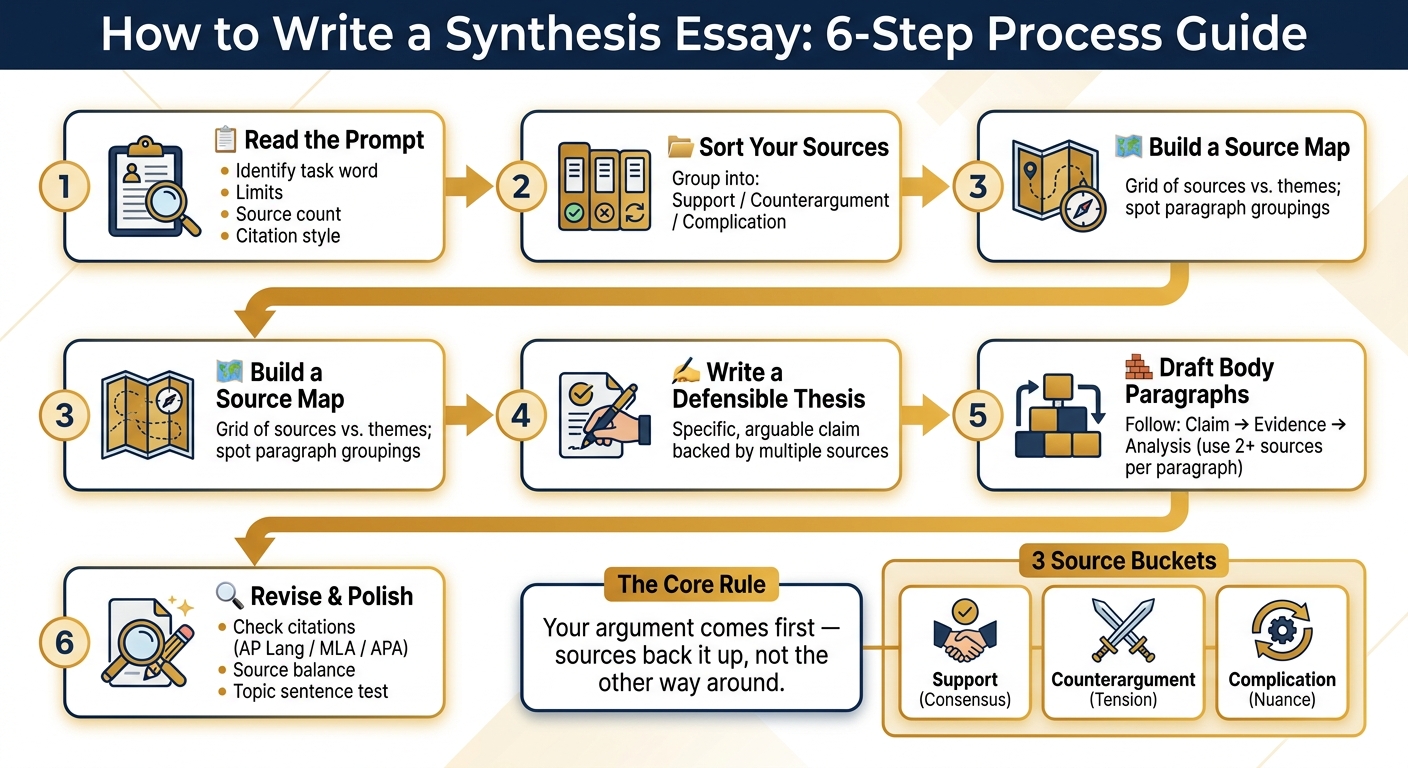
How to Write a Synthesis Essay: 6-Step Process Guide
How to Write a Synthesis Essay | AP Lang Q1 Tips | Coach Hall Writes
sbb-itb-1831901
Step 1: Read the Prompt, Sort the Sources, and Plan Your Position
Start with the prompt. It sets the job, the scope, and the source rules.
Identify the Task, Limits, and Required Source Use
First, underline the task word. Words like analyze, compare, evaluate, discuss, or argue tell you what kind of essay you need to write. If the prompt says evaluate, you need to make a judgment. If it says argue, you need to take a clear position and back it up.
Then look for limits on time, place, topic, source count, word count, and citation style.
| Prompt Component | What to Look For |
|---|---|
| Task word | Words like analyze, evaluate, compare, discuss, or argue |
| Content focus | The specific issue or materials you must address |
| Limits | Time, place, topic, source count, word count, and citation style |
Those limits shape what your thesis can honestly cover. If the prompt narrows the topic, your claim should stay inside those lines.
Group Sources into Support, Counterargument, and Complication
Once you know what the prompt wants, skim the sources with a purpose. If time is tight, start with the abstract, introduction, and conclusion of each source. Those parts usually give you the main claim and key findings.
As you read, place each source into one of three buckets: support (consensus), counterargument (tension), or complication (nuance). That’s the heart of synthesis. You’re not just collecting summaries. You’re showing where sources line up, where they push against each other, and where they add shade to the bigger idea.
This also makes paragraph planning much easier. Sources that speak to the same point should usually appear together.
Build a Quick Source Map Before Writing
A source map can be simple. Make a grid with sources on one side and themes on the other, then fill in each box with key points or evidence. It gives you a fast way to spot which sources fit in the same paragraph.
More than that, the map helps you choose your claim. Say two sources deal with the same theme from different sides. Put them in conversation with each other. Don’t split them into separate paragraphs where they never meet. That’s how a paper turns into a pile of source summaries instead of a real argument.
Once the source map is in place, you’re ready to turn it into a defensible thesis.
Step 2: Write a Defensible Thesis and Build a Source-Based Outline
Now that your source map is set, use it to tighten your argument into a thesis your sources can actually back up. Then build an outline around that claim.
What Makes a Thesis Defensible in College and AP Lang
A defensible thesis is more than a broad topic or a plain fact. It's a specific, arguable claim that needs proof from more than one source. Think of it as the spine of your essay: every body paragraph should link back to it.
Take this line: "Social media has many effects on teenagers." That isn't a thesis. It's too broad, and there's not much to argue with. A stronger version makes a judgment and hints at the reasons behind it: "Social media platforms should be regulated because they undermine adolescent mental health and facilitate cyberbullying." Now you have something you can defend. It needs proof, leaves room for disagreement, and shows the main path of the essay.
AP Lang theses are often tighter because the clock is always ticking. College theses usually have more room to add layers. But both need the same core thing: a clear position with space for nuance.
Choose an Organization Pattern That Fits the Prompt
The wording of the prompt often points you toward the best structure. Still, the structure shouldn't come from the prompt alone. It should also match the way your sources connect.
Persuasive prompts often work best with a reason-based setup, where each paragraph explains a separate reason. Analytical or exploratory prompts usually fit a theme-based setup, where you group sources around shared ideas. If the prompt asks you to deal with other viewpoints, a counterargument-based setup often works best. That gives you room to present the other side fairly and then answer it.
| Structure | Description | Best Use Case |
|---|---|---|
| Reason-Based | Each paragraph is a separate reason supporting the thesis | Standard AP Lang prompts; persuasive college essays |
| Theme-Based | Sources grouped by recurring concepts or ideas | Literature reviews; complex college research papers |
| Counterargument-Based | Dedicated section for the opposing view, followed by a rebuttal | Argumentative essays requiring nuance and defensibility |
| Point-by-Point | Each paragraph compares one feature across multiple subjects | Compare and contrast synthesis tasks |
One trap to avoid: organizing by source. Giving each author their own paragraph is one of the fastest ways to turn a synthesis essay into a stack of summaries.
Once you've picked the structure, shape each body paragraph around a claim that brings sources together instead of treating them one at a time.
Turn Your Thesis into a Paragraph-by-Paragraph Outline
A strong outline gives each body paragraph a clear claim, not just a loose topic. So instead of writing "Paragraph 2 - smartphones in schools," write something like "Paragraph 2 - Limiting smartphones improves classroom focus, as shown by [Source A] and [Source B]." That small shift matters. It pushes you to think about what the paragraph proves, not just what it's about.
Under each claim, note the sources you plan to use and how they work together. Do they support the point? Push against it? Add a wrinkle to it? Also leave room for commentary. That's where you explain what the evidence shows and connect it back to the thesis.
Before you start drafting, do one quick test: read your thesis and then read each topic sentence in order. If they form a full, logical argument on their own, your outline is doing its job.
With the outline in place, you're ready to draft paragraphs that synthesize sources instead of just lining them up.
Step 3: Draft Body Paragraphs That Synthesize Sources
Every synthesis body paragraph should follow a simple flow: claim → evidence → analysis. Start with a topic sentence that makes a clear, debatable claim tied to your thesis. Then bring in evidence from at least two sources. After that, explain what the evidence means and how it backs your point. Each paragraph should pull together the sources you grouped under one theme or claim in your outline.
The key part of synthesis happens in your commentary. That’s where you show how the sources connect. If you just quote or paraphrase two writers one after the other, you don’t have synthesis yet. You have a fact dump. Your sources are there to support your claim, not replace your thinking.
A simple test helps: after your evidence, ask so what? If your answer doesn’t point back to the topic sentence, you need more analysis. That small check can keep a paragraph from drifting off course.
Make Clear Synthesis Moves Across Two or More Sources
A synthesis move is how you connect sources in your commentary. Think of it as the bridge between one piece of evidence and another. Without that bridge, the paragraph can feel choppy, even if the evidence is strong.
Here are four patterns that work well:
| Synthesis Move | What It Does | Sample Sentence Pattern |
|---|---|---|
| Agree and Extend | Shows shared ground, then adds depth. | "Similarly, [Source A] builds on [Source B]'s findings by..." |
| Contrast and Evaluate | Shows disagreement or different methods to add complexity. | "While [Source A] argues that..., [Source B] suggests a different outcome because..." |
| Combine Examples | Brings sources together to show a larger pattern. | "Taken together, the research by [Source A] and [Source B] indicates that..." |
| Qualify a Claim | Uses a dissenting source to narrow the scope of the argument. | "Although [Source A] supports this view, [Source B] provides a necessary qualification regarding..." |
These moves make the relationship between sources easy to see. Phrases like "building on this," "in contrast," and "taken together" do a lot of work. They tell the reader how to read the evidence. Without those signals, even good source use can sound like a list instead of an argument.
Handle Counterarguments Without Weakening Your Essay
A counterargument should sharpen your point, not knock it over. Use an opposing source to narrow, qualify, or test your claim. Don’t just give up the point and move on.
For example, one source may support your position in one setting, while another points out limits in a different one. In that case, adjust the scope of your thesis instead of dropping it. That makes your argument stronger and more honest. It also shows that you can deal with gray areas instead of forcing everything into a neat yes-or-no box.
Graders in both AP Lang and college courses want to see that you can handle complexity without losing control of your main claim.
After you draft, read each paragraph with three checks in mind:
- Does it cite sources clearly?
- Does it balance more than one source?
- Does it stay focused on one claim?
Step 4: Revise for Clarity, Citation, and Source Balance
Revision is where the essay starts to hold together. First, check whether each paragraph still supports the thesis. Then look at your citations and make sure each paragraph draws on more than one source.
A fast way to check structure is the "Topic Sentence Test." Read only the thesis and the topic sentences in order. Skip the evidence. If those lines alone don’t make a clear argument, rewrite the topic sentences so each one makes a debatable claim.
Cite Sources Clearly in AP Lang and College Formats
Once the structure is in place, check attribution. In AP Lang, cite the packet with source labels such as (Source A) or (Source C). In college classes, two common systems are MLA, which uses author and page number (Smith 45), and APA, which uses author and year (Smith, 2023). If two sources back the same point, place both in one parenthetical and separate them with a semicolon - for example, (Brown, 2021; Smith, 2023) in APA or (Brown 12; Smith 45) in MLA.
| Format | In-Text Style | Multiple Sources |
|---|---|---|
| AP Lang | (Source A) | (Source A; Source C) |
| MLA | (Author Page) | (Smith 45; Jones 12) |
| APA | (Author, Year) | (Smith, 2021; Jones, 2022) |
Signal phrases like "According to," "As Source B notes," or "Jones argues that" show the reader who is speaking before the evidence shows up. That matters. It helps readers track which voices are in conversation and how those voices connect. If a claim, structure, or key term comes from a source, cite it even if you paraphrase. And a true paraphrase changes both the wording and the structure.
Fix the Most Common Synthesis Essay Mistakes
Most synthesis essay issues trace back to the same few habits. The table below lays them out and gives a direct fix.
| Common Mistake | Revision Fix |
|---|---|
| Summary-Only Paragraphs | Add analytical commentary explaining how the evidence supports the thesis. |
| Weak Claims | Write debatable topic sentences that preview the paragraph's specific argument. |
| Single-Source Paragraphs | Integrate at least two sources to show a "conversation" between authors. |
| Missing Commentary | Always follow evidence with your own analysis of its implications. |
One issue deserves extra attention: single-source paragraphs. That’s when an entire paragraph leans on just one author. When that happens, find a second source that either supports the idea from another angle or complicates it in a useful way. That one move can shift the paragraph from simple reporting to actual academic discussion.
Use Yomu AI to Plan, Draft, and Check Your Final Essay
After you revise by hand, use the tool to spot weak phrasing and citation gaps. Yomu AI can help you build structured outlines, refine a thesis so it becomes more specific and debatable, suggest other sentence patterns for smoother flow, and check whether your in-text citations and bibliography follow APA, MLA, or Chicago format. Use it to tighten outlines, sharpen thesis language, and flag clunky paraphrases. Then compare every change to the source before you keep it.
Conclusion: A Simple Workflow for Moving from Sources to a Finished Synthesis Essay
After you revise, use this checklist to turn a draft into a finished essay. A synthesis essay usually comes together through four clear moves: analyze the prompt, map your sources, draft claim-driven paragraphs, and revise for citation and clarity.
The table below shows the full workflow at a glance:
| Phase | Key Action |
|---|---|
| Planning | Prompt analysis & source mapping |
| Structuring | Defensible thesis & thematic outline |
| Drafting | Claim-evidence-commentary paragraphs & synthesis moves |
| Polishing | Citation check & sentence-level polish |
Here’s the core rule for every paragraph: your argument comes first, and the sources back it up.
That’s what synthesis is. You’re not just repeating what Source A, Source B, and Source C say. You’re using those sources to build a new line of thought.
Strong synthesis essays don’t win because they use the most sources. They work because every source helps support one defensible argument. That’s the bar for both AP Lang and college synthesis essays.
FAQs
How many sources should I use in a synthesis essay?
There’s no set number. The right amount depends on the assignment, so check the prompt first. It may ask for a specific source count.
Use enough reliable, relevant, and varied sources to support a clear argument, not just a summary. Pick sources that bring in different views or types of evidence and give your main body paragraphs enough support.
Can I use one source in a body paragraph by itself?
Yes - but a paragraph that leans on just one source is not synthesis on its own.
One source can still do useful work in a paragraph. You can use it to back up a claim if you:
- introduce the source
- present the evidence
- explain how that evidence supports your thesis
The catch is this: synthesis means bringing sources into conversation with each other. So if you want to make the paragraph stronger, tie that source to other texts somewhere else in the essay. Show where the sources line up, where they add pressure to each other, or where they disagree.
That’s the move that turns simple source use into synthesis.
How is an AP Lang synthesis essay different from a college synthesis essay?
The main difference comes down to where the evidence comes from and how the assignment is set up.
In AP Lang, the prompt usually gives you a set of sources and asks you to synthesize them into a defensible argument. Your job is to read those materials, figure out how they connect, and use them with purpose.
In a college synthesis essay, you’ll usually do the research yourself and choose your own sources as part of a broader academic discussion. That changes the task in a big way. You’re not just analyzing what’s in front of you. You also need to find, judge, and select sources that fit your argument.
Both kinds of writing call for analysis, not just summary. But college writing adds another layer: source selection and source evaluation.