

Qualitative Research Methodology: Types, Examples, and How to Write It Up
I start with the research question - not the method label. Qualitative research examines how people understand their experiences. To choose among 5 approaches, I match the question to the kind of answer I need.
Quick Comparison
| Approach | What I want to understand | Evidence I might use |
|---|---|---|
| Ethnography | A group’s shared practices | Observation, interviews, field notes |
| Phenomenology | What an experience means to those who lived it | In-depth interviews, reflective accounts |
| Grounded theory | How a process works | Data collected and compared in repeated rounds |
| Case study | A defined case in its setting | Interviews, observations, records |
| Narrative research | How someone tells their story over time | Interviews, diaries, personal documents |
Then I explain <u>why the approach fits</u>, who participated, how I collected and analyzed data, and how my role shaped the work. I also report consent, privacy safeguards, quality checks, and study limits.
My rule: describe what I did, not just what the approach usually involves. For interview and focus-group reporting, COREQ’s 32-item checklist can help me check for missing details. The education examples below are hypothetical study plans, not reported findings.
5 Qualitative Research Approaches and Examples
Ethnography and Phenomenology: Culture and Lived Experience
Ethnography studies a group’s shared practices. Use it to examine everyday routines, norms, language, or power relationships. The aim is to connect what people do with what those actions mean.
For research on middle school culture, sustained observation of classrooms, hallways, lunch periods, and meetings provides evidence of everyday practices. Researchers combine field notes, interviews, and school artifacts to analyze shared practices.
Phenomenology studies what a lived experience means to the people who experience it. It draws on first-person accounts of interactions, emotions, and relationships, often gathered through in-depth interviews and reflective accounts.
The analysis must fit the chosen phenomenological tradition. Descriptive approaches may develop meaning units and describe the experience’s essential structure. Interpretive approaches focus on meaning within a person’s situation. Shared topics alone don’t make a study phenomenological.
When the question shifts from meaning to process, grounded theory is a better fit.
Grounded Theory: Developing a Theory of a Process
Grounded theory explains how a process works.
Studying students’ decisions to seek academic help requires iterative data collection and analysis.
Researchers use constant comparison, memo writing, and theoretical sampling to build that explanation. The goal isn’t a list of themes. It’s an account of the conditions, decisions, actions, and consequences that shape the process. Sampling continues until the categories are sufficiently developed and connected.
Case Study and Narrative Research: Cases and Stories
Case study examines a bounded case in context. Choose it when your question focuses on a specific program, setting, or another case with defined boundaries.
A study of one high school’s literacy program must define its boundaries: program, setting, participants, and time frame. Interviews, classroom observations, curriculum materials, and meeting records support within-case analysis and comparison across sources.
A single-case design examines one bounded case. A multiple-case design also compares cases. An intrinsic study aims to understand the case itself, while an instrumental study uses the case to examine a broader issue.
Narrative research examines how people make meaning through stories, following one person’s account over time.
A teacher’s career-transition account can be studied through interviews, diaries, and professional artifacts, with attention to chronology, identity, context, and turning points.
Analysis keeps the story’s form intact - not just its events - and acknowledges the researcher’s role in shaping it. Interviews alone don’t determine the methodology. What matters is the study’s purpose, unit of analysis, sampling logic, and analytic approach.
sbb-itb-1831901
Qualitative research methods
How to Choose a Qualitative Research Approach
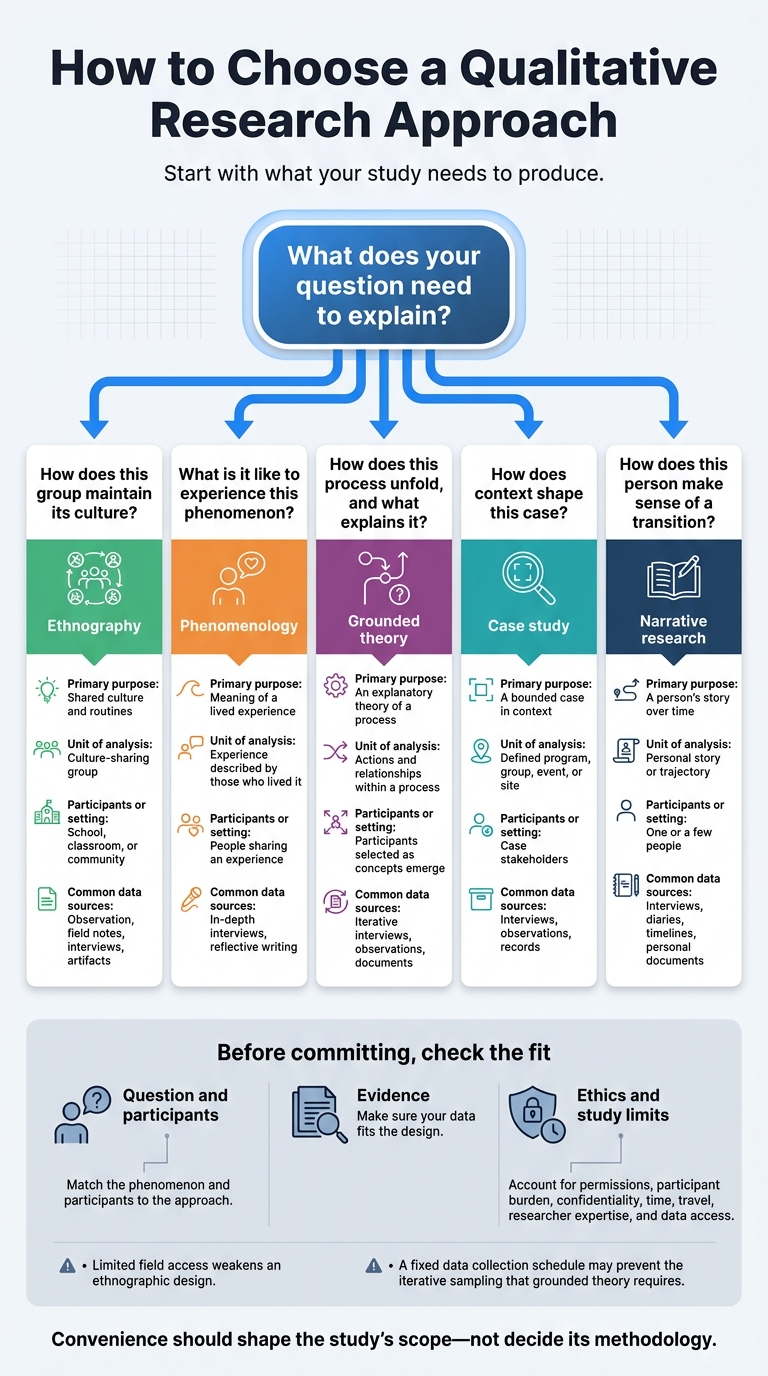
How to Choose a Qualitative Research Approach
Start with what your study needs to produce. Then weigh your access, timeline, expertise, and available evidence. Convenience should shape the study’s scope - not decide its methodology.
Compare the 5 Approaches
Use this table to match the findings you need with a research design.
| Approach | Primary purpose | Unit of analysis | Participants or setting | Common data sources | Best-fit question |
|---|---|---|---|---|---|
| Ethnography | Shared culture and routines | Culture-sharing group | School, classroom, or community | Observation, field notes, interviews, artifacts | How does this group maintain its culture? |
| Phenomenology | Meaning of a lived experience | Experience described by those who lived it | People sharing an experience | In-depth interviews, reflective writing | What is it like to experience this phenomenon? |
| Grounded theory | An explanatory theory of a process | Actions and relationships within a process | Participants selected as concepts emerge | Iterative interviews, observations, documents | How does this process unfold, and what explains it? |
| Case study | A bounded case in context | Defined program, group, event, or site | Case stakeholders | Interviews, observations, records | How does context shape this case? |
| Narrative research | A person’s story over time | Personal story or trajectory | One or a few people | Interviews, diaries, timelines, personal documents | How does this person make sense of a transition? |
These education examples are hypothetical study plans, not reported findings.
Ethnography: Observe a high school over a semester to study how teachers and students develop norms around participation and discipline.
Phenomenology: Interview first-generation college students about their lived experience of belonging during their first year.
Grounded theory: Interview students, tutors, and instructors to develop a theory of how students persist in online remedial mathematics.
Case study: Examine one elementary school’s implementation of restorative discipline using observations, interviews, and policy records.
Narrative research: Trace a teacher’s career-change story through interviews, journals, and professional documents.
The table can help narrow your options. Next, check whether your choice fits your question, evidence, and access.
Check the Question, Evidence, and Study Limits
A design may fit on paper but still be hard to carry out. Check these three areas before committing:
- Match the phenomenon and participants to the approach: shared practices for ethnography, lived experience for phenomenology, process actors for grounded theory, bounded-case stakeholders for case study, and one or a few people with direct experience for narrative research.
- Make sure your data fits the design: observation for ethnography, first-person accounts for phenomenology, iterative data for grounded theory, multiple sources for case study, and time-ordered personal accounts or documents for narrative research.
- Check ethics and study limits: account for permissions, participant burden, confidentiality, time, travel, researcher expertise, and data access.
Resolve access problems before naming the design. Limited field access weakens an ethnographic design. A fixed data collection schedule may prevent the iterative sampling that grounded theory requires. If access is limited, revise the question or choose a design that still fits the available evidence.
Once the approach fits the question, build the methodology around design, sampling, data collection, analysis, reflexivity, ethics, and trustworthiness.
How to Write the Qualitative Methodology Section
Research Design, Participant Selection, and Data Collection
Explain how your design and evidence fit the research question. Describe what you actually did - not just what the approach usually involves. Start with the question, design, setting, timeframe, and study boundaries. Include the guiding orientation only if it shaped design choices.
Next, explain eligibility, recruitment, purposive sampling, and participant characteristics relevant to the question. Report how many people were invited, enrolled, declined, withdrew, and completed the study. Justify sample adequacy through the depth and variation of the data and the point when new data stopped changing the analysis - not a fixed participant count. Identify whose perspectives are missing so readers can judge how well the design and sample fit the question.
For interview-based studies, document the interview guide, interviewer’s role, location or platform, session length, and language. Explain recording permissions, transcription and recording checks, de-identification, and encrypted storage. Include protocol revisions, accommodations, interpreters, and supporting field notes. COREQ’s 32-item checklist can help you spot missing details in interview and focus-group reports.
Data Analysis and Researcher Reflexivity
Show how you moved from raw data to findings. Name the analysis approach and explain how you used it. Describe data preparation, familiarization, coding, category or theme development, and interpretation. State whether coding was inductive, deductive, or a combination. Identify who analyzed the material and how you handled different interpretations.
Explain which software, if any, you used to manage and code the data. Include only analysis procedures that fit the design. Describe how you selected quotations and other excerpts to support claims, and how contradictory accounts changed - or limited - your interpretation. Keep analytic memos and decision records so readers can trace those choices.
Reflexivity means explaining how your position shaped the research. Describe your background, assumptions, institutional role, and relationships with participants. In school research, state whether you had authority over grades or discipline and how you addressed that power difference.
Show how reflexive journals, team discussions, or memos informed recruitment, interviewing, coding, and reporting. Clearly separate safeguards you used, such as a neutral interviewer or private interviews, from recommendations for future studies.
Ethics and Research Quality
Report the participant protections and research quality checks you used. State the institutional review board approval, exemption, or other required ethics review. Explain informed consent, voluntary participation, the option to skip questions, withdrawal conditions, and confidentiality limits, including mandatory-reporting obligations.
For minors, report parental permission and student assent where required. Explain how you addressed pressure linked to grades or services. Specify who could access recordings, where identifiers were stored, how long records would be kept, and how they would be securely destroyed. Do not promise anonymity if details could identify a participant.
Connect research quality to the procedures you actually used. Include only criteria those procedures support.
| Quality criterion | Suitable procedures | Evidence to report |
|---|---|---|
| Credibility | Triangulation, participant feedback when appropriate, prolonged engagement, and negative-case analysis | Which sources were compared, what feedback changed, and how conflicting accounts affected findings |
| Dependability | An audit trail of recruitment, protocol revisions, coding, and analytic decisions | Dated records explaining procedural changes and why data collection ended |
| Confirmability | Reflexive journals, peer debriefing, and comparison of different interpretations | Links between excerpts and claims, plus records of interpretations reconsidered |
| Transferability | Thick description of participants, setting, relationships, timeframe, and study boundaries | Enough protected contextual detail for readers to judge relevance elsewhere - not claims of statistical generalizability |
Conclusion: Methodology Template and Final Checklist
Use a Step-by-Step Methodology Template
Turn the framework above into a clear account of your study design. Draft in this order: question, design, participants, sampling, data collection, analysis, reflexivity, ethics, trustworthiness, limitations. Explain how the limitations affect interpretation and transferability.
Treat the following as drafting prompts, not completed research claims. Replace every bracket with verified study details, and remove anything that doesn't apply:
“This qualitative study used [ethnography, phenomenology, grounded theory, case study, or narrative research] to investigate [focused phenomenon or process] among [participants] in [setting].”
“The design was selected because [explain fit with the research question].”
“Analysis proceeded through [coding, comparison, narrative analysis, thematic analysis, or another named procedure].”
Check Alignment, Reporting, and Academic Integrity
Make sure every component addresses the same research question. Does the design answer that question? Do the data support the analysis, and does the analysis support the claims? Alignment matters more than the approach label. If the design, data, and claims don't line up, revise the methodology before submitting your draft.
Check for consistent terminology, traceable procedures, participant protections, and justified quality checks. Quotations should be accurate, de-identified, and support your interpretation. Use SRQR to spot omissions - not as a substitute for methodological judgment.
FAQs
Can I combine qualitative research approaches?
Yes, you can combine research approaches to better understand complex topics. Mixed methods bring qualitative and quantitative methods into one study, pairing statistical rigor with context and depth.
Choose a combination that fits your study’s goals, available resources, and ethical considerations. Clearly explain why you need both approaches to answer your research question.
How do I know when I have enough data?
In qualitative research, data saturation means you've gathered enough data that no new information, themes, or insights emerge. Researchers typically reach this point after 10–30 interviews, depending on the methodology.
Let your research questions and objectives guide your sample size - not a fixed number. Gather enough detail to address your study’s specific focus.
How is methodology different from methods?
Research methodology is the overall plan, framework, and reasoning that guide your study - the “why” behind your research design. It explains why your chosen approaches fit your research question.
Research methods are the tools you use to collect and analyze data - the “how,” such as interviews, surveys, or observations. Choosing these tools without a clear methodology can make your study harder to justify and its findings harder to trust.