

Research Method vs Methodology: The Difference with Examples
Confused about research methods and methodology? Here's the key difference:
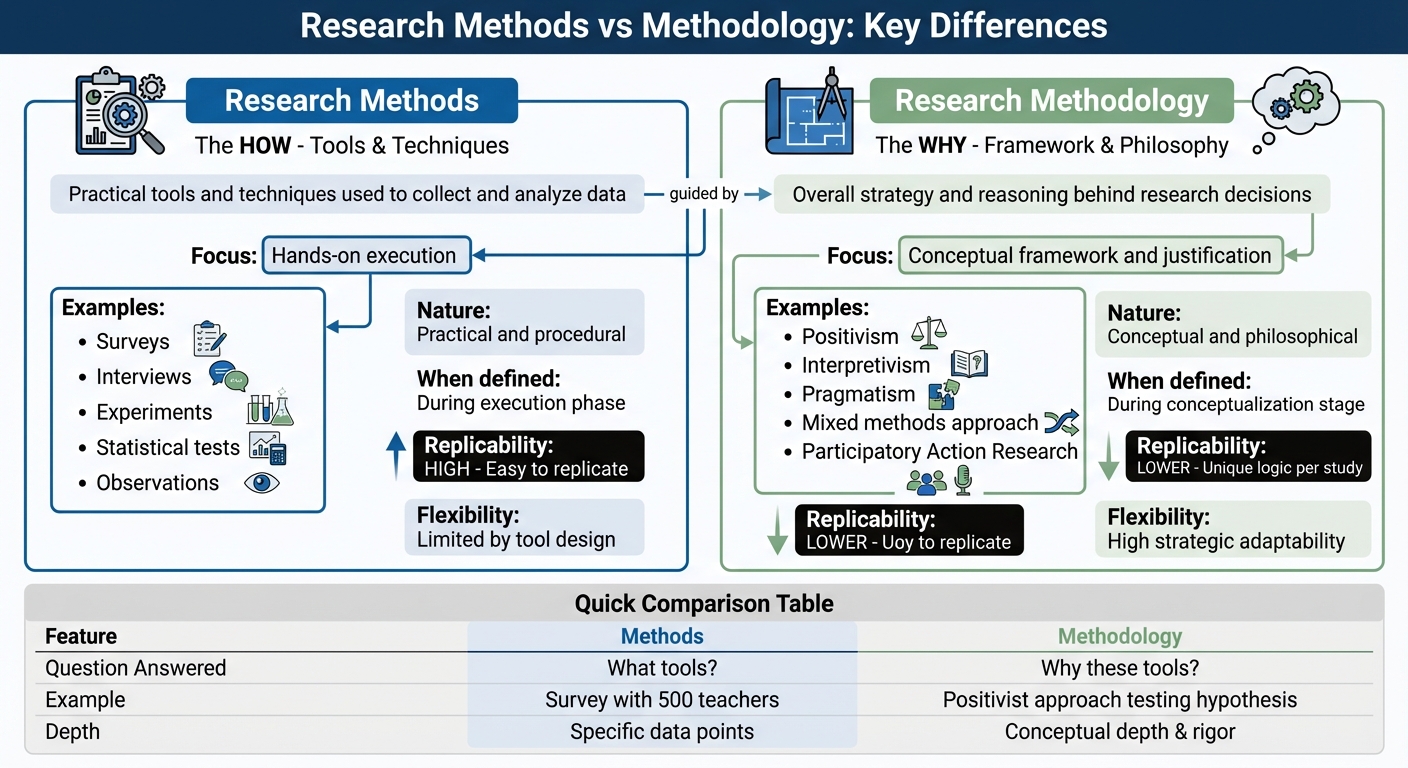
- Research methods are the tools and techniques you use to collect and analyze data, like surveys, interviews, or statistical tests.
- Research methodology is the reasoning behind your choices - your study's framework, philosophy, and strategy.
Mixing these up can weaken your research. For instance, labeling a survey as a "methodology" without explaining why it fits your research question could hurt your credibility.
Quick overview:
- Methods: Focus on "how" to collect and analyze data.
- Methodology: Explains "why" those methods are suitable for your study.
Understanding this distinction ensures your research is both logical and well-structured.
Research Methods vs Methodology: Key Differences and Examples
1. Research Method
Definition and Scope
Research methods are the actual tools and techniques researchers use to gather and analyze data. They are the hands-on execution of your research design. As Virginia Tech's research guide puts it:
"A research method is a strategy used to implement that plan [the research design]."
Broadly, research methods fall into two categories. Primary research involves directly collecting new data from participants, using tools like surveys, interviews, or experiments. On the other hand, secondary research relies on analyzing existing data sources, such as census records, medical databases, or previously published studies.
Purpose and Focus
The choice of research methods should align closely with your research question. For example, if you're looking to quantify something, surveys or questionnaires are a good fit. But if you're seeking to understand people's experiences or perspectives, interviews or focus groups might be more appropriate. Quantitative methods provide numerical insights, while qualitative approaches uncover the context and nuance behind those numbers.
Application in Research
Research methods are applied at every stage of a study. Data collection might involve experiments, surveys, or direct observation, while analysis could use statistical techniques like regression or qualitative tools like discourse analysis. Equally important is determining your sampling strategy to ensure you recruit participants effectively and efficiently.
Resource limitations often play a role in method selection. For instance, qualitative interviews can yield detailed insights but are time-intensive. Studies typically reach "data saturation" - the point where no new information emerges - after 10 to 30 interviews.
Practical Examples
| Research Goal | Appropriate Method |
|---|---|
| Measure prevalence of burnout among nurses | Questionnaire-based survey with validated scales |
| Understand patient experiences with telehealth | Semi-structured interviews or focus groups |
| Test effectiveness of a new teaching technique | Controlled laboratory experiment |
| Identify trends in graduation rates over time | Analysis of school registers (secondary data) |
For instance, if you're studying workplace trust, the first step is to turn the abstract idea of "trust" into measurable variables. This could involve designing a standardized questionnaire with interval scales, conducting cognitive interviews to refine the questions, or using a mixed-methods approach. Combining surveys with follow-up interviews allows you to capture both broad statistical trends and detailed personal stories.
With the methods clarified, the next step is to explore the conceptual framework that informs these choices: research methodology.
sbb-itb-1831901
2. Research Methodology
Definition and Scope
Research methodology shapes the overall strategy and reasoning behind your research decisions. Orlanda Harvey from Bournemouth University describes it as:
"Methodology is a broader concept as it refers to the overall approach to the research, includes a justification for this approach, and links to research philosophy, i.e., how we produce knowledge."
In essence, it encompasses your philosophical stance, research design, and the specific methods you employ. Think of it as the framework that connects the "why" of your research to the "how." While methods focus on hands-on execution, methodology provides the reasoning behind choosing those tools.
Purpose and Focus
Methodology goes beyond listing tools like interviews or surveys - it explains why those tools align with your research goals and assumptions. For example, a positivist approach might favor randomization and statistical analysis to uncover causation. On the other hand, an interpretivist perspective would prioritize rich, detailed descriptions to explore how individuals interpret their experiences.
This structured approach ensures academic rigor and transparency, helping others assess whether your conclusions are reliable and whether your chosen methods effectively address your research questions. A common pitfall in research is selecting methods that don't align well with the research question, leading to weak or irrelevant findings.
Application in Research
Your methodology is defined early in the research process, during the conceptualization stage, well before data collection begins. Start by identifying your philosophical stance - whether you believe in a single objective reality or multiple socially constructed realities. This stance will influence every methodological choice you make.
For instance, in June 2023, researchers Maya Stevens-Uninsky and Lawrence Mbuagbaw conducted a study in Freedom Park, South Africa, using a decolonized research methodology to investigate adolescent sexual health. They employed Participatory Action Research (PAR) and co-design methods, involving a Community Advisory Committee to shape their data collection process. This approach challenged traditional power dynamics, giving the community a voice and shaping the research in a meaningful way. Such examples highlight how methodology serves as the foundation for practical research applications.
Practical Examples
| Research Philosophy | Methodological Approach | Typical Methods Used |
|---|---|---|
| Positivism (objective reality) | Hypothesis testing with controlled variables | Randomized controlled trials, structured surveys |
| Interpretivism (socially constructed reality) | Understanding meaning and context | Semi-structured interviews, ethnography |
| Pragmatism (what works best) | Mixed methods based on research needs | Surveys combined with follow-up interviews |
Take teacher burnout as an example. A positivist approach might involve testing a hypothesis by using burnout scales across a large sample of 500 teachers. Alternatively, an interpretivist approach could involve conducting in-depth interviews with 15 teachers to understand their personal experiences. Methodology isn't just a technicality - it’s the backbone of reliable and meaningful research. By carefully aligning your approach with your research goals, you ensure your findings are both credible and impactful.
Method vs Methodology
Pros and Cons
Understanding the differences between methods and methodology is crucial when designing a study. Each has its own strengths and challenges, and knowing these can help you make informed decisions.
Methods offer clear, step-by-step procedures that are easy to replicate. They produce specific outcomes, like survey data or insights from interviews. However, they can be rigid. For instance, a structured survey with fixed questions won't adapt to unexpected responses. Additionally, certain methods, like large-scale experiments, can be expensive and time-intensive.
Methodology, in contrast, provides strategic flexibility. It allows you to tailor your overall approach based on the research question. A pragmatist methodology, for example, combines quantitative and qualitative techniques to capture both broad trends and detailed insights. But this flexibility comes with a challenge - it requires a solid understanding of research philosophy. As Magda Wojcik, PhD, explains:
"Methods are practical and procedural; methodology is conceptual and philosophical".
Here’s a summary of the key differences between research methods and methodology:
| Feature | Research Methods | Research Methodology |
|---|---|---|
| Flexibility | High tactical flexibility during execution (e.g., probing in interviews) | High strategic flexibility (e.g., choosing or combining paradigms) |
| Depth | Produces specific data points; qualitative methods provide detailed insights | Offers conceptual depth and academic rigor |
| Ease of Use | Easier to implement with clear, concrete steps | More abstract and requires a deeper philosophical understanding |
| Adaptability | Limited by the tool's design (e.g., fixed survey questions) | Highly adaptable, allowing for changes in tools if the context shifts |
| Replicability | High; procedures are easy to replicate | Lower; focuses on the unique logic and justification of a study |
One common challenge researchers face is the "design-question mismatch." This occurs when the chosen methodology doesn't align with the research question - like trying to make causal claims from a correlational design. To avoid this, always define your methodology first. Then, select methods that align with your philosophical framework and research objectives.
Conclusion
Understanding the difference between research methods and methodology is key to conducting credible research. While methods focus on what tools are used to gather data, methodology delves into why those tools are appropriate based on your research question and philosophical approach. As Alan Bryman explains, "Methods became as much to do with philosophical choices as technical ones".
A strong research design depends on aligning three critical layers: your research paradigm (like positivism, interpretivism, or pragmatism), your overall strategy, and the specific procedures you will use. Methodology serves as the foundation, guiding the selection of methods that align with your study’s goals. This alignment ensures your research design is both systematic and coherent.
For students and early-career researchers, discussing this distinction with your supervisors during the planning phase is essential. Avoid jumping straight to specific tools without first establishing a clear methodological framework. Use precise terminology: refer to "Methods" when describing tasks like conducting surveys or analyzing data, and "Methodology" when explaining the rationale behind your approach.
FAQs
Where do I explain methodology in my paper?
This section outlines the approach, design, data collection methods, and analysis procedures used in the study. It provides a clear explanation of the research process and the reasoning behind each step.
Research Approach and Design
The study employed a [qualitative/quantitative/mixed-methods] approach to address the research objectives. This approach was chosen to [briefly explain why this method was suitable, e.g., "capture detailed insights", "analyze statistical trends", etc.]. The research design was structured to ensure [mention key aspects of the design, such as reliability, validity, or flexibility].
Data Collection Methods
Data was collected using [specific methods, e.g., surveys, interviews, experiments, etc.]. The selection of these methods was based on [reason for choosing these methods, such as "their ability to gather in-depth information" or "their efficiency in reaching a large sample size"]. Participants were selected through [sampling method, e.g., random sampling, purposive sampling, etc.], ensuring [criteria for participant selection, such as diversity, relevance to the study, etc.].
- Primary Data Sources: [List or describe primary data sources, if applicable].
- Secondary Data Sources: [Include secondary sources if used, such as existing datasets, literature reviews, etc.].
Analysis Procedures
The collected data was analyzed using [specific analysis methods, e.g., thematic analysis, statistical software, etc.]. These methods were chosen to [explain why these methods were appropriate, such as "identify patterns", "test hypotheses", etc.]. The analysis process involved [briefly describe key steps, such as coding, statistical testing, or comparative analysis].
By detailing this methodology, the study ensures transparency and allows readers to understand how the findings were derived and validated.
How do I choose methods that fit my research question?
When deciding on research methods, start by determining whether your study aims to measure phenomena or delve into experiences. For questions like "how many?" or "what proportion?", quantitative methods such as surveys are your go-to. On the other hand, if you're looking to answer "why?" or "how?", qualitative methods like interviews are better suited.
Think about the complexity of your research, the scope of your study, and the type of data you need. Make sure your chosen methods align with your research objectives, your philosophical approach, and the resources you have available. This alignment is key to producing dependable results.
Can I change my methods without changing my methodology?
Yes, you can. Methods are the specific tools or techniques you use to gather and analyze data. On the other hand, methodology is the broader strategy or theoretical framework that guides your research. As long as your overall research approach stays consistent, changing methods won’t impact the methodology.