

Psychology Research Methodology: Methods, Designs, and Examples
I start with one question: What should this study tell me - what happens, what’s related, or what causes change? That answer guides how I measure variables, choose participants, and collect data. Even a study with 200 participants needs sound measurements and fair comparisons - not just a large sample.
Here’s how I connect the pieces:
- Methods: Experiments, surveys, interviews, focus groups, observation, and case studies provide different types of data.
- Designs: Experimental and correlational designs address cause or association. Cross-sectional and longitudinal designs set the timing. Mixed methods combine numbers with participants’ accounts.
- Planning: I define the sample, measures, budget, ethics review, consent process, and analysis before collecting data.
- Reporting: I check measurement quality, bias, and uncertainty, then explain what the results can - and cannot - support.
My rule: <u>match the claim to the design</u>. Following people over time can show change, but it does not prove cause and effect on its own.
Research Methods In Psychology [AP Psychology Review Unit 1 Topic 2]
sbb-itb-1831901
Data-Collection Methods in Psychology
Data-collection methods shape what researchers can measure - performance, self-reports, observed behavior, or case records - and how much control they have over gathering that evidence.
| Method | Purpose | Data type | Researcher control | Main strength | Main limitation |
|---|---|---|---|---|---|
| Experiment | Test whether an intervention or condition changes an outcome | Quantitative data, such as scores, times, or physiological measures | High when researchers manipulate conditions | Supports causal inference when well-designed | Artificial settings, ethical limits, and possible noncompliance |
| Survey | Measure attitudes, experiences, symptoms, or behaviors across many participants | Structured quantitative responses | Moderate; researchers control wording and administration | Efficient and relatively inexpensive for large samples | Self-report, sampling, and response biases |
| Interview | Understand individual experiences, meanings, and explanations | Qualitative transcripts; sometimes ratings | Low to moderate, depending on structure | Offers depth and chances to clarify answers | Time-consuming and subject to interviewer and recall bias |
| Focus group | Examine shared views, disagreements, and group norms | Group discussion transcripts | Moderate; a moderator guides discussion | Shows social interaction and group perspectives | Dominant participants, conformity, and confidentiality concerns |
| Observation | Record behavior as it happens | Behavioral counts, codes, field notes, or video data | Low in naturalistic settings; higher in controlled settings | Records behavior rather than relying only on self-report | Observer bias and behavior changes caused by observation |
| Case study | Examine one person, group, organization, or unusual case in depth | Mixed qualitative and quantitative records | Variable; often low experimental control | Offers detailed understanding of complex or rare phenomena | Rarely establishes causation or generalizes well |
Comparison based on methodological guidance in.
Choose a method for the evidence it can produce, not its popularity. Then choose a study design that supports the claims you want to test.
Experiments and Behavioral Tasks
A behavioral task measures performance. It becomes an experiment only when researchers manipulate conditions. To test an intervention, researchers manipulate the condition, randomly assign participants, and include a control group. Instructions, scoring, and follow-up timing should stay consistent. Where possible, use blinded assessors or automated scoring.
Lab experiments maximize control, while field experiments test interventions in everyday settings. Natural experiments use exposure caused by outside events. Before making causal claims, researchers must justify their comparison groups and rule out competing events or trends.
Surveys, Interviews, and Focus Groups
Across formats, use consistent, clear, neutral wording and a defined recall period. Pilot the questions, check whether recruitment reaches the target population, and report response rates and missing answers. A larger sample doesn't fix biased recruitment. Self-reports are still subject to memory errors and socially desirable answers. Stress ratings, for example, measure reported stress - not what causes it.
Structured interviews follow fixed questions in a fixed order. Semi-structured interviews cover common topics but leave room for follow-up questions. Open-ended interviews let participants shape the discussion, producing detailed accounts rather than just ratings.
Focus groups examine how participants discuss and challenge views together. Moderators should invite quieter participants to speak and manage dominant speakers. For sensitive topics, use individual interviews; confidentiality is harder to protect in a focus group.
Observation and Case Studies
Naturalistic observation records behavior in ordinary settings. Controlled observation uses a standardized situation. For either approach, define target behaviors in a coding manual, train observers, and check inter-rater agreement.
Blinded coding reduces observer bias. Giving participants time to get used to being watched may reduce changes in their behavior. Neither step replaces privacy and consent safeguards.
Case studies bring together observations, interviews, tests, and records to examine an individual, group, or unusual case in depth. They can generate hypotheses, but they rarely establish causation or represent a broader population.
Whether a study is experimental, correlational, cross-sectional, or longitudinal also shapes the claims its data can support.
Study Designs and What They Can Show
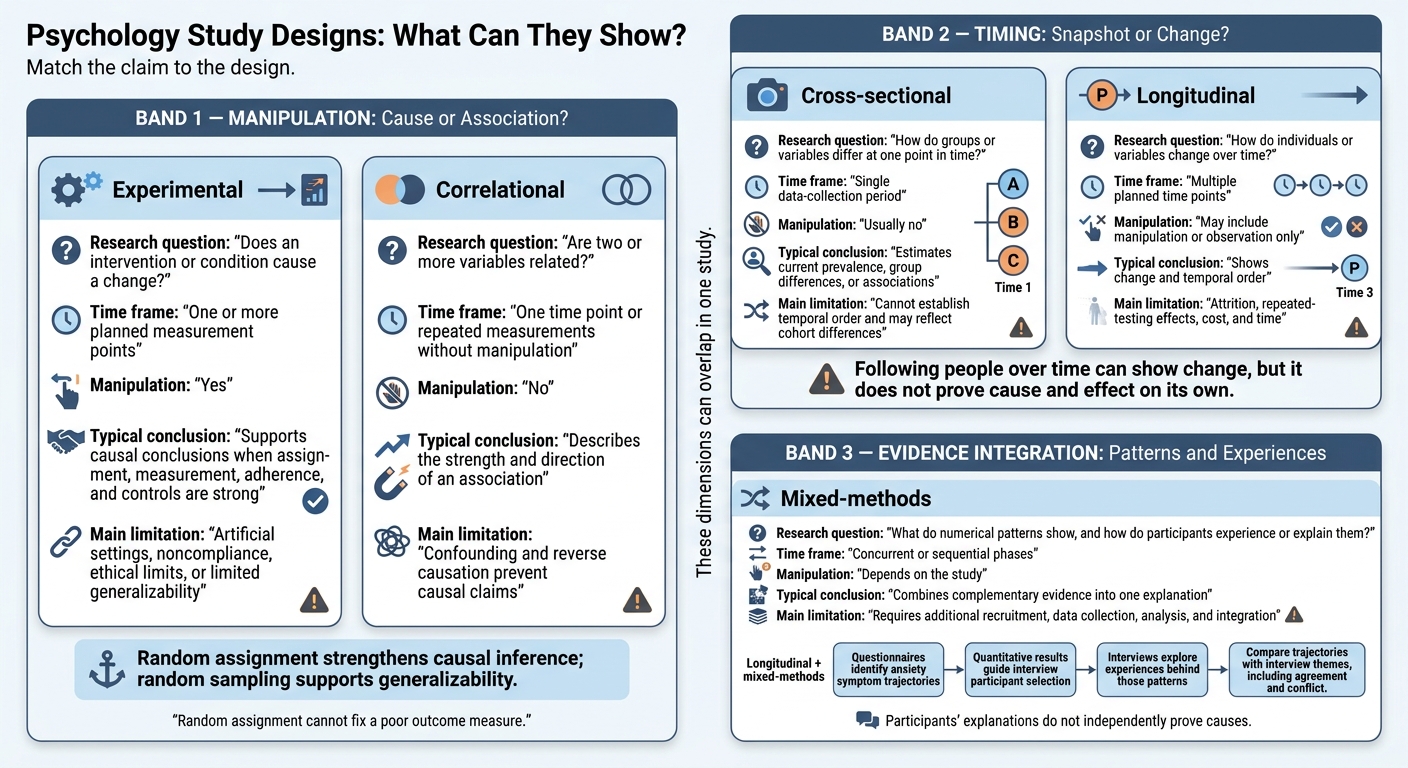
Psychology Study Designs: What Can They Show?
Design labels describe different parts of a study, not competing choices. What matters is the kind of claim each design can support. Experimental and correlational describe manipulation versus observation. Cross-sectional and longitudinal describe timing. Mixed methods describes how evidence is combined. These dimensions can overlap, as the table shows.
| Design | Research question | Time frame | Manipulation | Typical conclusion | Main limitation |
|---|---|---|---|---|---|
| Experimental | Does an intervention or condition cause a change? | One or more planned measurement points | Yes | Supports causal conclusions when assignment, measurement, adherence, and controls are strong | Artificial settings, noncompliance, ethical limits, or limited generalizability |
| Correlational | Are two or more variables related? | One time point or repeated measurements without manipulation | No | Describes the strength and direction of an association | Confounding and reverse causation prevent causal claims |
| Cross-sectional | How do groups or variables differ at one point in time? | Single data-collection period | Usually no | Estimates current prevalence, group differences, or associations | Cannot establish temporal order and may reflect cohort differences |
| Longitudinal | How do individuals or variables change over time? | Multiple planned time points | May include manipulation or observation only | Shows change and temporal order | Attrition, repeated-testing effects, cost, and time |
| Mixed-methods | What do numerical patterns show, and how do participants experience or explain them? | Concurrent or sequential phases | Depends on the study | Combines complementary evidence into one explanation | Requires additional recruitment, data collection, analysis, and integration |
Experimental vs. Correlational Designs
Random assignment strengthens causal inference; random sampling supports generalizability. Random assignment reduces baseline group differences on average. But causal claims also depend on manipulation, a sound comparison condition, valid measurement, and adherence to the assigned condition. Random assignment cannot fix a poor outcome measure.
A sleep–anxiety association supports a narrower conclusion. Financial strain or chronic pain could affect both variables - a confounding problem. Anxiety could also disrupt sleep, creating reverse causation.
Repeated measurements can help show which variable comes first. Statistical adjustment, however, addresses only the confounding adequately captured in the analysis. Report that shorter sleep was associated with higher anxiety - not that it caused anxiety - unless the design supports that claim.
Timing adds another layer: cross-sectional and longitudinal designs answer different questions about change.
Cross-Sectional vs. Longitudinal Designs
Researchers can study the same topic using different timing structures.
Comparing first-year students with seniors at one time does not measure individual change: the groups may have entered college under different economic or public health conditions. These are cohort effects. Following the same students across academic years better captures change, but attrition can distort results if students with greater anxiety are more likely to leave.
Plan how to retain participants, report participation at every wave, and check whether dropout relates to measured symptoms. When a study needs both patterns and explanations, mixed methods can connect the two.
Mixed-Methods Designs
Plan integration before collecting data. Mixed methods combine quantitative and qualitative evidence to answer one psychology question in greater depth.
In a longitudinal anxiety study, questionnaires can identify symptom trajectories, while interviews explore experiences behind those patterns. An explanatory sequential design analyzes quantitative results first, then uses those results to select interview participants. Integration means comparing trajectories with interview themes - through a joint display, for instance - and explaining where the findings agree or conflict.
Interviews can add depth to interpretation, but participants’ explanations do not independently prove causes. Budget for interview recruitment, transcription, qualitative analysis, and integration. Present the findings together rather than splitting them into separate sections.
Plan, Evaluate, and Report a Study
Match Methods and Design to Your Question
Once you’ve chosen a method and design, plan the study around what you want to infer: description, association, or causation. Use experiments for intervention questions, correlational studies for association questions, longitudinal studies for change over time, and interviews or focus groups for questions about experience. Specify the population, intervention or exposure, comparison, outcome, and time frame. For each variable, define the measure, scoring rules, and assessment schedule.
Document who qualifies, where you’ll recruit, what participants will receive, how much you’ll ask of them, and how you’ll keep them involved. Justify the quantitative sample size with a power or precision analysis - not a universal minimum - and account for expected dropout. Budget for staff, equipment, transcription, secure storage, and participant payments.
Before collecting data, set primary and secondary outcomes, analysis models or coding procedures, exclusions, and rules for missing data. Preregister these decisions when appropriate, and keep confirmatory and exploratory analyses separate.
Check Ethics, Measurement, and Validity
Check ethics and measurement before collecting data. Submit the project to your institution’s institutional review board (IRB) for the appropriate review before recruitment or data collection. Don’t assume the study is exempt. Consent should explain the procedures, duration, risks, benefits, confidentiality, and voluntary participation, including the right to withdraw.
Protect privacy during data collection and maintain confidentiality afterward with restricted access and secure storage. Plan safeguards for vulnerable participants and a response to severe distress. Any deception requires a clear scientific rationale, appropriate IRB approval, safeguards against risk, and timely debriefing. Don’t mislead participants about material risks.
Check reliability - how consistently a measure produces scores - and construct validity - whether it measures the intended concept. Assess internal validity by checking whether competing explanations weaken the findings. Assess external validity by considering how far the findings apply beyond the sample.
Choose measures that fit participants’ age, language, culture, and accessibility needs. Check licensing requirements and pilot the procedures. Address sampling bias, demand characteristics, researcher expectations, attrition, and self-report recall errors through suitable recruitment, neutral instructions, blinding where feasible, retention plans, and additional data sources. Report relevant reliability estimates from the current sample.
Interpret Findings and Report Limitations
After analysis, report what the data show - and what they cannot show. Statistical significance alone does not make a result meaningful or causal. Report effects in their original units, effect sizes, and confidence intervals alongside statistical tests.
Review alternative explanations, sample restrictions, measurement weaknesses, missing data, and protocol deviations before labeling conclusions descriptive, associational, or causal. Nonexperimental findings remain descriptive or associational.
For qualitative findings, show how the evidence supports each theme and include contradictory accounts. Use APA Journal Article Reporting Standards to document recruitment, procedures, analysis decisions, uncertainty, and limitations so readers can evaluate the study.
Conclusion: A Research Methods and Design Checklist
Use this checklist before collecting data:
- Question and variables: State your research question, target population, and intended claim. Define how you’ll measure each variable, including scoring rules and the assessment schedule.
- Method and design: Choose a method and design that fit your question. Check that recruitment, eligibility criteria, sample size, and measurement quality support the claim you plan to make.
- Ethics and feasibility: Confirm IRB approval, consent, privacy protections, and risk management. Make sure recruitment, follow-up, compensation, staffing, and secure storage fit your timeline and budget.
- Analysis and claims: Set primary outcomes, analysis steps, exclusions, and missing-data rules in advance. State what your findings can and can’t support, and report limitations clearly. Longitudinal data show change and temporal order, but do not establish causation on their own, especially when confounding and selection bias remain unaddressed.
FAQs
How do I choose a design when random assignment isn't possible?
Use the Acknowledge-Justify-Mitigate framework. Start by explaining why random assignment isn’t possible, whether due to access limits or ethical concerns. Then explain how your chosen design fits your research goals and questions.
Next, describe how you’ll reduce the limits of a nonrandomized approach. For example, compare your selected group with broader population measures to assess how well it represents that population and strengthen confidence in your findings.
How do I estimate sample size for a pilot study?
Sample size depends on your research method and goals. For quantitative research, use power analysis to estimate how many participants you need to detect meaningful effects, typically targeting a 95% confidence level.
For qualitative pilots, aim for data saturation: the point when participants stop providing new insights. This typically occurs after 10 to 30 interviews or with 6 to 20 participants. Choose a sample size that fits your research questions and available resources.
What should I do when survey and interview findings conflict?
Treat conflicting findings as a chance to examine contradictions and find new perspectives - not as failures. Use mixed methods so results from one method can help explain results from the other.
Compare both sources through triangulation to refine your findings and strengthen your study’s credibility and validity. Report differences openly to show care and rigor in your approach.