

Essay Outline Templates: Examples for 7 Essay Types You Can Copy
I start an essay outline with the assignment - not a five-paragraph rule. Match your outline to the prompt, write your main idea, and give each body section a source or concrete detail.
These 7 templates, each with a planning example, cover different writing goals:
- Argumentative: Defend a claim and answer an objection.
- Persuasive: Move a specific audience toward agreement or action.
- Expository: Explain a topic with facts.
- Analytical: Show how parts of a subject support your reading.
- Narrative: Tell a story built around change.
- Descriptive: Arrange sensory details around one main impression.
- Compare-and-contrast: Examine two subjects using the same criteria.
My final check: <u>read the main idea and section headings together</u>. They should follow one clear path. Adjust the length to your assignment, check your sources, and use optional AI writing tools only within your instructor’s rules.
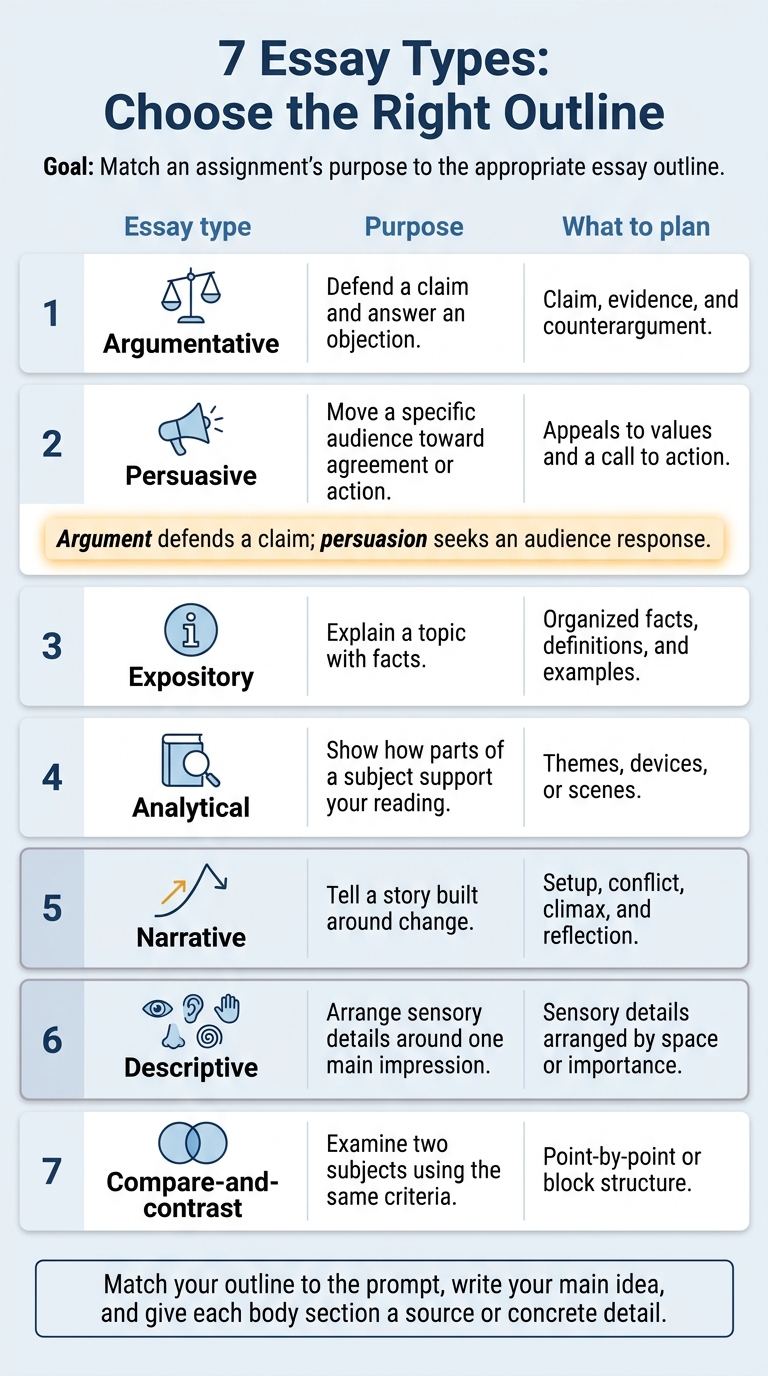
7 Essay Types: Choose the Right Outline
5 Essay Outlines That Actually Work | Argumentative, Compare/Contrast & More
sbb-itb-1831901
Which Essay Type Fits Your Assignment?
Before you choose a copy-ready template, match your assignment prompt to the essay type and outline below.
Assignment Purpose
| Essay type | What the prompt asks for | What to plan |
|---|---|---|
| Argumentative | Defend a position with logic and evidence. | Claim, evidence, and counterargument. |
| Persuasive | Convince readers to agree or take action. | Appeals to values and a call to action. |
| Expository | Explain or inform without taking sides. | Organized facts, definitions, and examples. |
| Analytical | Interpret a subject’s meaning or examine its parts. | Themes, devices, or scenes. |
| Narrative | Tell a story or recount an experience. | Setup, conflict, climax, and reflection. |
| Descriptive | Describe a person, place, or object through sensory details. | Sensory details arranged by space or importance. |
| Compare-and-contrast | Examine similarities and differences between subjects. | Point-by-point or block structure. |
Argument defends a claim; persuasion seeks an audience response.
Thesis or Central Idea
Next, shape your thesis or central idea to fit the essay type.
| Essay type | What the prompt asks for | What to plan |
|---|---|---|
| Argumentative | A debatable claim that previews your main arguments. | Claim, evidence, and counterargument. |
| Persuasive | A position tied to audience values and the action you want readers to take. | Appeals to values and a call to action. |
| Expository | A neutral focus that defines the topic and scope. | Organized facts, definitions, and examples. |
| Analytical | An interpretive claim about how the parts work together. | Themes, devices, or scenes. |
| Narrative | A theme or insight developed through an experience. | Setup, conflict, climax, and reflection. |
| Descriptive | One main impression that ties the description together. | Sensory details arranged by space or importance. |
| Compare-and-contrast | A claim explaining why the similarities or differences matter. | Point-by-point or block structure. |
Body Organization
| Essay type | What the prompt asks for | What to plan |
|---|---|---|
| Argumentative | Logical claims backed by evidence, plus a counterargument and rebuttal. | Claim, evidence, and counterargument. |
| Persuasive | Arguments that build toward agreement or action. | Appeals to values and a call to action. |
| Expository | Categories, steps in time order, or cause-and-effect relationships. | Organized facts, definitions, and examples. |
| Analytical | Sections built around meaning rather than plot summary. | Themes, devices, or scenes. |
| Narrative | A story arc with clear shifts in time. | Setup, conflict, climax, and reflection. |
| Descriptive | Details arranged by space or importance. | Sensory details arranged by space or importance. |
| Compare-and-contrast | A structured comparison using the same criteria for both subjects. | Point-by-point or block structure. |
For a block comparison, cover the criteria in the same order for both subjects.
Supporting Evidence and Details
| Essay type | What the prompt asks for | What to plan |
|---|---|---|
| Argumentative | Statistics, expert views, and case studies. | Claim, evidence, and counterargument. |
| Persuasive | Facts, logic, and anecdotes tied to audience values. | Appeals to values and a call to action. |
| Expository | Facts, definitions, data, and examples. | Organized facts, definitions, and examples. |
| Analytical | Quotations, key scenes, or data followed by your interpretation. | Themes, devices, or scenes. |
| Narrative | Actions, dialogue, sensory details, and thoughts. | Setup, conflict, climax, and reflection. |
| Descriptive | Sensory observations and figurative language chosen for a purpose. | Sensory details arranged by space or importance. |
| Compare-and-contrast | Evidence for both subjects using the same criteria. | Point-by-point or block structure. |
Before drafting, pair each body section with one source or detail. Check that your thesis and topic sentences follow a single line of thought. Use those pairings to draft your outline in the next section.
1. Argumentative Essay
Use this template when an assignment asks you to defend a claim with evidence, not just explain a topic. Before drafting, connect each source to one claim.
Copy-Ready Template
Introduction and claim: [Introduce the issue → state your position and two reasons.]
Reason 1: [Make a supporting claim → cite evidence → explain how it supports your position.]
Reason 2: [Make a different supporting claim → cite evidence → explain the connection.]
Counterargument and rebuttal: [Present the strongest objection fairly → answer it with evidence or qualify your claim.]
Conclusion: [Restate your position in light of the evidence → summarize your main reasons.]
Filled-In Planning Example: Later High School Start Times
Introduction and claim: U.S. high schools should start at 8:30 a.m. or later to better align with adolescent biology and support learning.
Reason 1: Later start times could better match teen sleep patterns. Evidence: [sleep-cycle research]
Reason 2: Well-rested students may focus and retain more. Evidence: [studies on attention and academic performance]
Counterargument and rebuttal: Later starts could raise bus costs and disrupt sports schedules. Use bus-route and activity schedules to test whether the changes are workable. Evidence: [bus-route and activity-schedule data]
Conclusion: Support later starts if the sleep and learning evidence outweighs the logistical costs.
Check the plan: Does each reason support changing the start time - not just getting more sleep? Does the rebuttal address the actual cost or scheduling objection? Keep gaps marked until you have the evidence.
2. Persuasive Essay
Use this outline when your assignment asks you to change minds or prompt action. A persuasive essay speaks to a specific audience and asks them to take a specific action. Support your case with facts, logic, and emotional appeals that connect to the audience’s values.
Copy-Ready Template
Audience and action: [Name the audience → ask for a specific action.]
Barrier: [Explain who faces a barrier and what current conditions prevent them from acting.]
Reason 1: [Connect evidence of need to an audience priority.]
Reason 2: [Explain how the proposal would help and identify supporting evidence.]
Objection and reply: [Address the strongest concern → respond with evidence.]
Action: [State who should do what and how to move the decision forward.]
Follow this order in the example below.
Bus-Service Proposal: What to Put in Each Slot
Audience and action: Ask city council members to expand targeted evening bus service.
Barrier: Use local schedules to identify evening service gaps that limit access to jobs.
Reason 1: Use route-level evening ridership data to show need. Link the findings to council priorities such as job access.
Reason 2: Use job-access evidence to show how expanded evening service could reduce transportation barriers to employment.
Objection and reply: Address budget resistance with operating-cost estimates and evidence of long-term savings or grants.
Action: Make the next step a request for a costed service plan listing routes, hours, funding, and evaluation measures.
Check the plan: Do your reasons match council members’ priorities? Does the council have the power to approve the action you’re requesting? Read your position and topic sentences together to check whether they lead logically to that action.
3. Expository Essay
Use this outline to explain a topic objectively. Start with a thesis that tells readers what they’ll learn. Then choose a structure that fits: process, cause and effect, definition and classification, examples, or comparison and contrast. Map your choice onto the outline below.
Copy-Ready Template
Introduction: [Give the background readers need → state an objective, explanatory thesis.]
Body Section 1: [Explain the first stage, cause, category, or feature → support it with evidence.]
Body Section 2: [Explain the next point → show how it relates to the first.]
Body Section 3: [Explain the final point or outcome → address relevant exceptions.]
Conclusion: [Connect the main points → explain why they matter without adding an argument.]
Use multiple paragraphs where needed. Give each paragraph one main idea, a topic sentence, factual support, and a transition.
The example below follows this structure.
Federal Bill: What to Put in Each Slot
Introduction: Explain how a federal bill becomes law. Thesis: A federal bill moves through sponsorship and committee review, approval by both chambers of Congress in identical form, and presidential action or a veto override.
Body Section 1: Introduce the bill, then show committee referral, hearings, amendments, and possible failure.
Body Section 2: Explain House and Senate approval of identical text, and show how differences get resolved.
Body Section 3: Explain presidential signature, veto, or enactment without a signature under constitutional rules; note a veto override requires two-thirds in both chambers. Note pocket vetoes as an exception.
Conclusion: Summarize the process and final outcome without evaluation.
Check the plan: Legislative routes vary, so don’t present every step as inevitable. Verify procedural details, then read the thesis and topic sentences together to check that the process is clear.
4. Analytical Essay
Use this structure when an assignment asks what a text means or how it works. An analytical essay studies a subject’s parts and what they do. Choose a lens and build a thesis someone could debate. Each body section should support one claim - not retell the plot.
Copy-Ready Template
Introduction: [Name the subject → establish your lens → state your interpretation as a thesis.]
Analysis Section 1: [Make a claim → identify evidence → describe a relevant detail → explain its function → connect it to the thesis.]
Analysis Section 2: [Make a second claim → follow the same evidence-to-explanation sequence.]
Analysis Section 3: [Make a third claim → follow the same sequence, addressing a complication if relevant.]
Link the claims: [Explain how the three claims work together to support your interpretation.]
Conclusion: [Restate your interpretation in new words → explain why it matters without adding evidence.]
The example below shows how your lens guides each body section.
The Scarlet Letter: Identity Through Symbolism
Use this model when your prompt asks you to interpret meaning, not summarize events.
Introduction: Examine Nathaniel Hawthorne’s novel through the lens of societal labeling and self-definition. Thesis: Hester Prynne’s transformation of the scarlet letter from a badge of adultery to a symbol of “ability” illustrates that identity is fluid, shaped by personal resilience rather than communal judgment.
Analysis Section 1: In the opening scaffold scene, the letter is a public mark of shame meant to isolate Hester. Its elaborate embroidery undercuts that purpose by adding personal expression to an imposed punishment, showing tension between public labeling and individual agency.
Analysis Section 2: In Chapter 13, townspeople reinterpret the letter as “Able.” Hester’s service changes how they read it, showing how actions can reshape a publicly assigned identity.
Analysis Section 3: In the forest meeting, Pearl refuses to recognize Hester after she removes the letter. Her response suggests it has become part of Hester’s identity, not just an external punishment.
Link the claims: Together, these scenes show how public judgment, personal action, and private relationships keep redefining Hester: changing the public label does not erase its private significance.Then close by stating the significance of the interpretation.
Conclusion: The scarlet letter changes meaning as Hester resists the community’s label, proving identity cannot be fixed by public judgment alone.
Check the plan: Check quotations against your assigned edition and note the page references before drafting. Include only enough plot summary to place the evidence in context. If a section explains what happens but not how the detail supports your interpretation, revise it.
5. Narrative Essay
Analytical essays explain meaning. Narrative essays show change through events. Build your story around a meaningful turning point rather than a list of things that happened. Set the scene, establish tension, and show how the experience changes your understanding.
Copy-Ready Template
Setting and tension: [Start with a hook → set the scene → show what feels uncertain or at stake.]
Beginning: [Describe your starting situation and first action → add a sensory detail that serves the story.]
Middle: [Show the complication and your response → add a time transition, such as “After…” → use sensory details to make the difficulty clear.]
Turning point: [Identify the moment that changes the situation → include dialogue only if it is accurate or clearly paraphrased.]
Climax: [Show the decisive action you take → explain the immediate result.]
Resolution and reflection: [Describe what happens afterward → explain how your understanding changed and why it matters.]
Example: Starting at a New School
Setting and beginning: Entering a new school, the narrator feels uncertain about where they fit.
Middle: Confusing signs and crowded hallways make the narrator feel more lost.
Turning point: A classmate’s help breaks the isolation and makes connection possible.
Climax: The narrator approaches a classmate and takes the first step toward connection.
Resolution and reflection: Small interactions shift belonging from possibility to reality: help opens the door, and reaching out makes it real.
Check the plan: State the turning point in one sentence. Does it lead to the narrator’s decisive action? Does the reflection explain how that action changes their sense of belonging? Add time transitions between major events, and keep only sensory details that serve the story. In a personal narrative, use accurate dialogue or label it as paraphrased.
6. Descriptive Essay
A narrative shows change. A description holds one moment still. Start with a central feeling or idea, then choose details that help readers experience it.
Before drafting, pick an order: spatial, movement-based, general-to-specific, or specific-to-general. Arrange the outline’s body sections to match.
Use this outline to keep every detail focused on one impression.
Copy-Ready Template
Introduction: [Open with a hook → state the dominant impression.]
Overall view: [Set the scene and mood.]
Visual details: [Choose colors, shapes, or lighting that support the impression.]
Sound, smell, touch, or taste: [Tie relevant sensory details to the same impression.]
Meaning: [Show what the scene conveys.]
Conclusion: [Return to a key detail → reinforce the dominant impression without repeating every detail.]
Example: A Summer Farmers Market
Introduction: Present the summer market as a place where everyday encounters create neighborhood connection.
Overall view: Establish the bustling square before following a walk among the stalls.
Visual details: Focus on bright produce as a sign of the shared abundance that draws neighbors together.
Sound, smell, touch, or taste: Use vendors’ greetings to show familiar relationships, warm pavement to suggest comfort, and fragrant herbs to suggest a shared kitchen.
Meaning: Show how the scene creates belonging.
Conclusion: Return to the greetings to end on the market’s sense of community.
Check the plan: Read your dominant impression alongside your topic sentences. Do they all support the same impression? Next, trace your planned route through the scene. Cut details that don't fit, and add transitions where the description jumps.
7. Compare-and-Contrast Essay
A compare-and-contrast essay needs shared criteria so both subjects get equal treatment. Use point-by-point to compare them directly under each criterion. Choose block structure to cover one subject at a time.
Check your facts using NCES IPEDS, institutional Consumer Information pages, net price calculators, program catalogs, and transfer agreements.
| Criterion | Subject one: Community college | Subject two: Four-year college | Evidence | Significance |
|---|---|---|---|---|
| Costs | Usually lower tuition; often no room and board fees | Higher tuition; includes room, board, and student activity fees | College Board data; institutional aid pages and net price calculators | Affects student debt and access for low-income students |
| Program pathways | Certificates, associate degrees, and transfer preparation | Bachelor’s degrees and specialized study | Program catalogs; official articulation agreements | Shapes time to degree and career entry points |
| Campus experience | Often commuter-focused | May offer more residential activities | Housing pages; club listings; student engagement surveys | Affects social networking and involvement in college life |
Keep these same three criteria throughout your outline so readers can follow each comparison.
Copy-Ready Templates
Point-by-point
Introduction: [Introduce both subjects → state a thesis naming the shared criteria.]
Costs: [Present evidence for subject one → present evidence for subject two → explain why the difference matters.]
Program pathways: [Present evidence for both subjects → explain where the routes differ or overlap.]
Campus experience: [Present evidence for both subjects → explain what the comparison means for students.]
Conclusion: [Connect the findings to the thesis → explain which student needs shape the choice.]
Block
Introduction: [Introduce both subjects → state a thesis naming the shared criteria.]
Subject one: [Cover costs → program pathways → campus experience; support each with evidence.]
Subject two: [Cover costs → program pathways → campus experience; use matching evidence in the same order.]
Conclusion: [Show how the comparison supports the thesis → explain why the differences matter.]
The example below applies the same criteria to two college options, keeping the focus on evidence rather than opinion.
Example: Community College vs. Four-Year College
Introduction: Compare the two routes through costs, program pathways, and campus experience; explain how their differences serve different student needs.
Costs: College Board reported average published tuition and fees of $3,990 at public two-year colleges for in-district students versus $11,260 at public four-year institutions for in-state students in 2023–24 - a $7,270 gap. Compare aid and living expenses before drawing conclusions about affordability.
Program pathways: Contrast certificates, associate degrees, and transfer preparation with bachelor’s-degree pathways; check whether transfer credits meet the intended major’s requirements.
Campus experience: Compare commuter and residential options using each college’s housing and activity listings, rather than assuming either model applies everywhere.
Conclusion: Neither route is a universal winner; the fit depends on the student’s budget, degree goal, and preferred experience.
Check the plan: Give both subjects roughly equal space and evidence. Compare like with like: tuition with tuition, not tuition with total living costs. After each comparison, explain why the difference matters.
Optional Drafting Support With Yomu AI
Finish your outline before using drafting tools to expand, revise, or check your draft. Start by choosing your essay type, developing your thesis or central idea, and assigning evidence to each section. Then use Yomu AI’s Document Assistant to expand notes or review a section. Sentence and paragraph autocomplete can also suggest wording - but accept only suggestions that fit your argument and tone.
Use paraphrasing only after you understand the source. Use summarization to take notes or shorten your own draft. Check the output against the original for changes in meaning. Another author’s ideas still need attribution when you rewrite them, and exact wording needs quotation marks.
Yomu’s citation tools support in-text citations, bibliographies, DOI imports, and more than 700 citation styles. Check every source, quotation, and citation style. Generated citations can contain errors or point to sources that don’t exist. During final checks, treat the plagiarism checker as a way to flag passages for manual review. Low similarity doesn’t prove originality, and high similarity may include quoted or referenced material.
Before submitting, check your instructor’s AI policy, disclose assistance when required, and verify every factual claim. Save your outline, notes, and draft history. You remain responsible for the essay’s ideas, evidence, wording, and final submission.
Choose a Template and Check Your Plan
Once you choose a template, check that it fits the assignment. Replace every placeholder with a specific topic sentence, scene note, or evidence note. Adjust the outline to match the prompt, rubric, and word limit.
Then read your thesis and headings in order. This helps you spot gaps and repeated ideas before you draft.
Use this checklist to check your plan:
- [ ] Purpose: The structure addresses the action words in the prompt.
- [ ] Focus: The thesis or central idea is specific. If you’re writing an argument, the thesis is debatable.
- [ ] Relevance: Every body section develops the main focus.
- [ ] Order: Sections follow a clear argument, sequence, or spatial arrangement.
- [ ] Support: Claims have evidence. Narrative and descriptive sections include concrete details.
- [ ] Conclusion: The ending reinforces the main point with a final insight, reflection, or action step.
- [ ] Sources: Source details are recorded in the required MLA, APA, or Chicago style.
FAQs
How detailed should my essay outline be?
A good essay outline is a roadmap, not a first draft. Include a working thesis, main points, topic sentences, evidence or source notes, and transition cues. Save the complete prose for the draft.
Your outline has enough detail if you can follow the argument from top to bottom without getting lost. If it’s longer than the essay itself, cut back on sub-bullets so each section has one clear purpose.
Can I combine essay types in one outline?
Yes. Use one central thesis, then organize the body sections by purpose. Use analytical paragraphs to interpret ideas and argumentative or persuasive sections to present claims, evidence, and counterpoints.
Keep each body paragraph focused on one main idea, supported by a topic sentence and relevant details. Use transitions to connect sections, and end with a conclusion that ties everything back to your thesis.
How should I divide my word count among sections?
Divide your word count based on the assignment’s total length, not a fixed formula. Plan three to five focused body sections, using three for a standard five-paragraph essay. For longer papers, add sections only when they offer separate evidence or analysis.
Keep your analysis depth and thesis scope in line with the word limit. If your outline goes beyond the planned essay length, cut sub-bullets so each section has one clear purpose.