

5 Compare and Contrast Essay Examples With Outlines
A compare-and-contrast essay needs more than a list of differences: it needs a clear argument. Choose 3–5 shared criteria, support both sides with evidence, and explain what the comparison shows.
These five examples pair short essays with matching outlines:
- Online vs. in-person learning: flexibility, interaction, technology needs, and student support.
- City vs. rural living: total costs, jobs, services, space, and daily life.
- Public vs. private schools: funding, admissions, curriculum, and student services.
- E-books vs. printed books: portability, reading tools, accessibility, ownership, and cost.
- Renewable vs. fossil-fuel energy: emissions, generation costs, and reliability.
Each model compares the subjects point by point. A paragraph-building guide and review checklist show how to turn comparison notes into an argument - and check that sources support the claims.
What a Perfect Compare & Contrast Essay Looks Like (Real Example)
sbb-itb-1831901
How to Organize a Compare-and-Contrast Essay
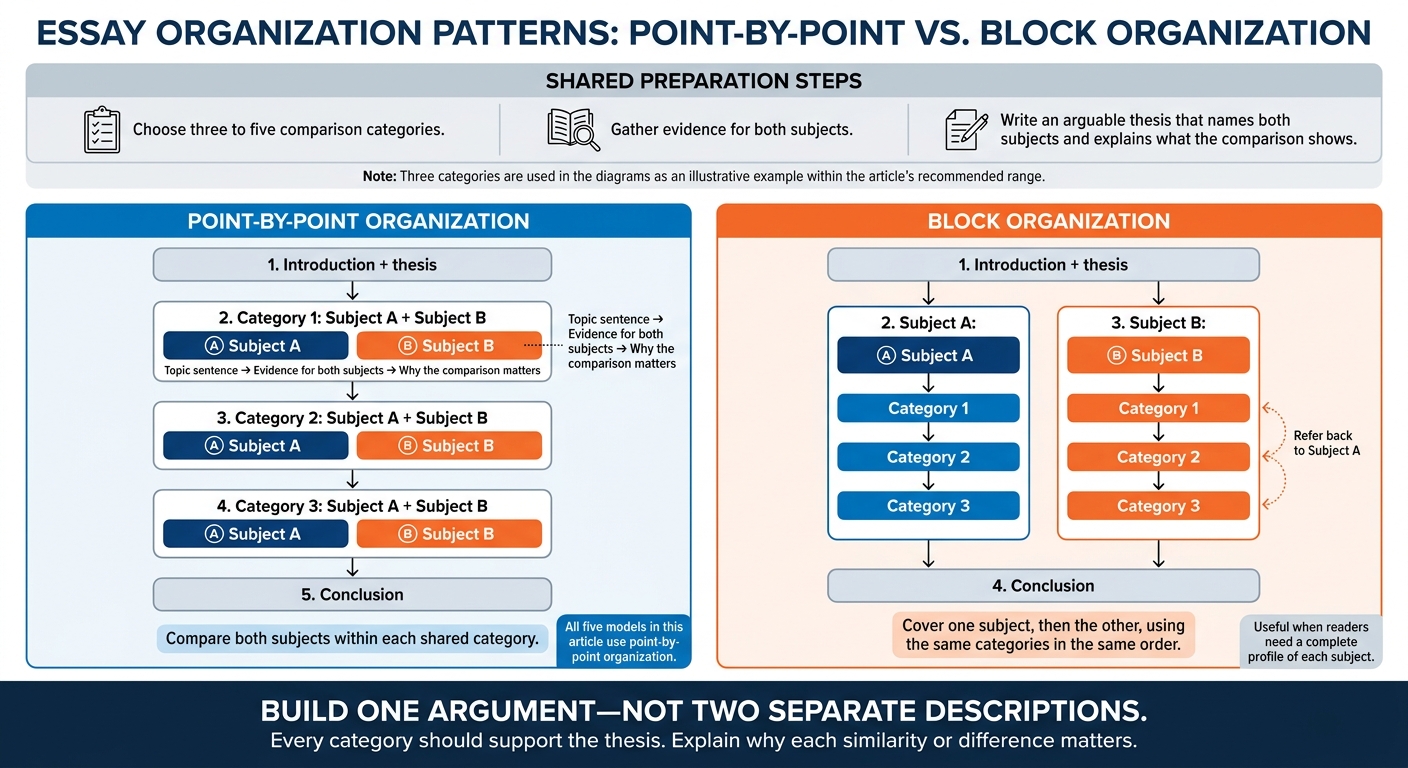
Compare-and-Contrast Essay Structure: Point-by-Point vs. Block
Choose three to five comparison categories before you draft. Each should support your thesis rather than point out a surface-level difference. Gather evidence for both subjects, then cut categories that fit only one subject or lead to obvious observations.
Write an arguable thesis that names both subjects and explains what the comparison shows. Make a claim you can prove, and finalize it after reviewing your evidence. That way, your argument stays grounded in what you can support.
Point-by-point organization compares both subjects within each category. Each body paragraph or section covers a shared category, keeping the evidence side by side so readers can follow the comparison.
Block organization covers one subject, then the other, using the same categories in the same order. Use this approach when readers need a complete profile of each subject. The second block must still refer back to the first, though. Otherwise, you risk writing two separate descriptions instead of a comparison.
All five models below use point-by-point organization. Each body paragraph opens with a topic sentence that supports the thesis, gives evidence for both subjects, and explains why the comparison matters. Transitions like similarly, whereas, and however make those relationships clear. Read your thesis and topic sentences together: they should build one argument, not list facts. The first example below shows how the thesis, evidence, and conclusion work together.
1. Online vs. In-Person Learning
Example essay
Online and in-person courses can use the same curriculum, instructors, assignments, and assessments. Both require preparation and active participation. Neither format is best for everyone: online learning offers greater scheduling flexibility, while in-person learning provides clear structure and immediate interaction.
Asynchronous online courses let students watch recorded lessons around work or family commitments, while campus courses require attendance at set times and locations. In addition, online learning requires a reliable device, internet access, and a suitable study space.
Interaction and support depend on course design. Classroom students can ask questions face to face and use campus equipment; online students may use discussion boards, video meetings, email, and scheduled appointments.
In a Maastricht University public-health master’s course, students in asynchronous online problem-based learning averaged 7.8 on unit tests, compared with 7.3 for face-to-face students. The difference was not statistically significant, so the higher online average does not prove an advantage.
The best choice depends on the student and the course. Online study may suit students who need flexible access and can manage deadlines independently. In-person study may serve those who need regular classroom routines or hands-on equipment. Students should compare flexibility, structure, and available support - not assume that either format guarantees success.
Matching outline: Introduction - define both formats and explain why the choice matters. Thesis - online offers flexibility and access; in-person offers structure and immediate interaction. Body 1 - compare shared curriculum, instructors, assignments, and assessments. Body 2 - cover scheduling, commuting, technology, and study space. Body 3 - compare face-to-face questions, nonverbal feedback, and campus resources with online tools. Body 4 - contrast an external routine with independent time management. Body 5 - examine academic outcomes and course fit. Conclusion - restate the thesis, including its limits.
The next comparison uses the same point-by-point structure to look at where people live.
2. City vs. Rural Living
Example essay
City and rural residents share housing, work, services, and community needs; in 2020, 80.0% of Americans lived in urban areas and 20.0% in rural areas. City living offers greater access to jobs and services, while rural living may provide more space and privacy; the better choice depends on priorities and transportation access.
Cost is the first major trade-off. City residents may pay more for smaller homes but have options for walking or public transportation. Rural residents may get more space, yet spend more on fuel, vehicle maintenance, and heating. Rent or mortgage payments alone can misstate affordability.
Access is the second major trade-off. Cities concentrate jobs, colleges, hospitals, and entertainment. Rural communities have jobs in fields such as manufacturing, agriculture, tourism, and health care, but specialized services may require longer trips. Remote work and telehealth can reduce some distance barriers, provided reliable internet is available.
Lifestyle adds one more difference. Cities may offer more cultural events and social opportunities alongside noise and congestion. Rural areas may offer quieter surroundings and more outdoor space, but fewer nearby venues. People who value convenience may prefer cities; those who value space may prefer rural areas if transportation and service access are adequate.
Matching outline: Introduction - introduce shared needs and frame the comparison using Census categories. Thesis - weigh access against space and privacy, accounting for total costs. Body 1 - Costs - compare housing, transportation, and household expenses. Body 2 - Access - compare employment, education, health care, and services. Body 3 - Lifestyle and conclusion - link noise, outdoor space, and social options to a judgment about which setting may suit different needs and under what conditions.
3. Public vs. Private Schools
Example essay
Public and private schools both teach core subjects, assess student progress, and may offer sports, arts, and clubs. Their main differences are funding, admissions, governance, and student services; the better choice depends on student needs, family resources, and available schools.
Once access is clear, the next comparison is cost. Funding shapes access: public schools are government funded and usually tuition-free for resident families, while private schools charge tuition, often with some financial aid. Public access depends on residence and district rules; private schools may require applications, interviews, or entrance tests.
Curriculum and support also differ. Public schools follow district, state, and federal requirements and must serve eligible students with disabilities; private schools control more of their programs and vary in the services they provide. Test scores alone do not prove one sector is better, because results also reflect student background and admissions practices.
Families should therefore compare actual schools rather than sector labels, because quality varies within both sectors. Reviewing course catalogs, total costs, admissions rules, and available specialists can reveal which school fits a student’s goals and support needs.
Matching outline: Introduction and thesis - explain shared educational goals and name the main differences. Body 1 - Funding and access - compare tuition, financial aid, attendance boundaries, and application requirements. Body 2 - Curriculum, governance, and support - show how governance and legal duties shape programs and services. Conclusion - use these comparisons to recommend checking individual schools rather than assuming either sector is better.
The next example moves from school choice to reading formats.
4. E-Books vs. Printed Books
Example essay
Pew Research Center reported that in its October 2025 survey, 64% of U.S. adults had read a print book during the previous 12 months, compared with 31% who had read an e-book. Both formats support reading, but they differ in portability, accessibility, and ownership; the best choice depends on the reader’s needs and device access.
Portability favors e-books because one device can hold many titles. Printed books need more space, but require no battery or compatible software. Both formats support bookmarks and annotations, though digital notes can be searchable; paper notes stay on the page.
Accessibility and ownership create further trade-offs. E-books may offer adjustable text and text-to-speech, depending on the file and device. Print offers screen-free reading, although readers who need larger text may need a separate edition. Digital access can carry licensing restrictions, while physical copies can usually be lent or resold. Neither format is always cheaper: device costs, used-book prices, and borrowing options affect the total.
E-books suit readers who need portable libraries or adjustable text; print suits those who value screen-free reading, easy sharing, and no charging.
Matching outline: Introduction and thesis - use Pew’s figures to show that print remains more common, define both formats, and name the comparison criteria. Body 1 - Portability and reading tools - compare storage, battery needs, bookmarks, and notes. Body 2 - Accessibility, ownership, and cost - compare adjustable text, screen-free reading, licensing, sharing, resale, and total cost. Conclusion - link each format’s strengths to specific reading needs.
The final example compares energy sources and shows how their long-term effects on the planet change the argument.
5. Renewable Energy vs. Fossil-Fuel Energy
Example essay
Renewable sources, such as wind and solar, replenish naturally. Fossil fuels, such as coal and natural gas, come from finite deposits. Both supply energy, but renewables are the stronger long-term choice: they produce lower life-cycle emissions and are increasingly cost-competitive for new generation. Fossil fuels still help meet demand when wind and solar output varies.
Their effects on the environment set them apart. Burning fossil fuels releases carbon dioxide and air pollutants. Wind and solar produce electricity without burning fuel, though manufacturing, mining, and construction still have impacts. Comparing emissions across the full life cycle - not just during operation - provides a more balanced picture.
Cost also favors some renewables. Lazard’s 2025 analysis identified utility-scale solar and onshore wind as the lowest-cost unsubsidized options for new U.S. power projects. But levelized costs leave out some transmission, storage, and reliability costs. Cheap generation doesn’t always mean a low-cost power system.
Reliability calls for a balanced view. Wind and solar output changes with weather and daylight. Fossil-fuel plants can generally supply power on demand, but fuel disruptions and equipment failures can interrupt that supply. Storage, transmission, and a diverse mix of resources can help close these gaps. The case for renewables is strongest when grid reliability is part of the plan.
Matching outline:
- Introduction and thesis - define both categories, explain their shared purpose, and argue for renewables while acknowledging reliability needs.
- Body 1 - Environmental impact - compare combustion emissions and full life-cycle emissions.
- Body 2 - Cost - use Lazard’s 2025 findings and explain what generation-cost estimates leave out.
- Body 3 - Reliability - compare weather dependence with fuel-supply risks.
- Conclusion - Renewable expansion requires grid planning.
Next, turn these outline points into full paragraphs.
Turn Comparison Notes Into Paragraphs
Use the outline above to turn each comparison into a paragraph, working through the table one category at a time. For the online vs. in-person example, the thesis is that online learning offers flexibility, while in-person learning offers more immediate interaction and external structure. The better fit depends on the student’s needs.
| Comparison category | Online learning | In-person learning | Relevance to the thesis |
|---|---|---|---|
| Flexibility | Asynchronous courses let students access materials around other commitments. | Classes usually meet at set times and locations. | Contrasts scheduling freedom with routine. |
| Interaction | Discussion boards, video meetings, and messaging connect students. | Face-to-face discussion allows immediate responses and nonverbal cues. | Shows how students ask questions and get feedback. |
| Technology requirements | Requires reliable internet, a suitable device, and digital skills. | May still use devices, but classroom facilities support participation. | Shows the technology cost of flexibility. |
| Student responsibility | Students often manage study time and seek help more independently. | Scheduled meetings and instructor presence add structure. | Contrasts self-management with built-in structure. |
To turn the flexibility row into a paragraph, make a claim, add evidence for both sides, and explain the trade-off. A 2024 survey summarized by the University of Maryland found that 77% of students supported participating in course activities in the ways they preferred. At the same time, 61% preferred in-person course experiences, and 15% preferred online courses.
Treat these results as evidence about preferences, not learning outcomes. They show that students value flexibility even when they prefer classroom learning. Your job is to compare students’ needs, not declare a winner.
Here’s a model paragraph for the flexibility row:
Online learning gives students more control over when and where they study, while in-person learning provides a fixed routine. An online student who works a daytime shift can watch a recorded lecture in the evening and submit assignments through the course platform. By contrast, an in-person student must attend class at the scheduled time but can receive immediate clarification from the instructor and classmates. The contrast shows that online learning reduces scheduling barriers, whereas classroom learning supplies external structure. Online learning fits students who need adaptable schedules; in-person learning fits students who benefit from regular attendance and direct guidance.
In your draft, remove the labels and connect the sentences naturally. The table decides what to compare; the paragraph explains why it matters. Before describing a course as fully flexible, check whether it’s asynchronous.
Use the checklist below to confirm that each paragraph stays tied to one comparison category.
Compare-and-Contrast Essay Checklist
Use this checklist to review each outline and paragraph before drafting the full essay.
- Check the purpose and thesis. For each of the five models above, ask: Do these subjects belong in the same comparison? Does the thesis make a specific, arguable claim about their relationship?
- Check parallel categories and evidence. Each paragraph should compare the same category across both subjects and support major claims on both sides. Balanced coverage means equal attention, not equal length. Cut details that don’t serve the comparison.
- Check the argument’s flow. Read the thesis and topic sentences in order. They should build one logical argument, with transitions that correctly signal similarity or contrast. Every point in the conclusion should come from the body. Move new arguments into the body or delete them.
- Check facts and citations. Open every source and confirm that it supports your exact wording. Before comparing figures, verify dates, numbers, units, and limits. Cite paraphrases and quotations consistently in the assigned MLA, APA, or Chicago styles. Match every in-text citation to a full source entry.
- Check responsibility for the final draft. If you draft with Yomu AI, verify every source yourself and provide your own analysis. Follow your course’s AI policy, and disclose assistance when required. Save notes and drafts that show how your argument developed to keep the final draft aligned with the examples above.
Conclusion: Use the Examples to Plan Your Essay
All five models show how a compare-and-contrast essay uses a focused thesis, shared categories, and evidence to support a judgment.
Use these models to shape your outline. Borrow the structure, not the wording or claims. Pick three to five meaningful comparison categories and organize them in a two-column chart. Gather evidence for both subjects, then use the pattern you find to draft a working thesis.
FAQs
Does my compare-and-contrast essay need a winner?
No. You don’t have to choose a winner. It depends on your essay’s purpose. In an explanatory essay, describe similarities and differences without bias. In an evaluation essay, you can take a clear stance and explain why one subject is better.
Often, the stronger approach is to show that neither subject wins in every situation. The better choice depends on a person’s needs, goals, or circumstances.
How can I narrow a broad comparison topic?
Focus your topic with the who, what, and where method. For example, examine how specific digital learning tools affect concentration in high school classrooms.
Then use a source matrix or comparison chart to select two or three comparison points, such as cost, effectiveness, or impact. Apply the “So what?” test to make sure each point supports your thesis and meets your assignment’s goals.
How many sources does my essay need?
There’s no fixed number of sources an essay needs. The right number depends on your assignment requirements and the scope of your research question. Check your prompt for a required source count.
Then, focus on how well your evidence supports your main points. Use a source matrix or outline to check that each body section has relevant, reliable evidence. Bring different perspectives together rather than simply collecting citations.