

Color vs Colour: Style Guide Rules for Students
Should you use "color" or "colour"? It depends on your audience and style guide. In American English, "color" is standard, while British English uses "colour." Mixing the two can make your writing inconsistent. Here’s how to choose:
- American English ("color"): Used in the U.S. and guided by style manuals like APA, MLA, and Chicago. Set your word processor to "English (United States)" to avoid errors.
- British English ("colour"): Common in the U.K., Canada, Australia, and other Commonwealth countries. Follow guides like the Oxford Style Manual, and set your language to "English (United Kingdom)."
- Key Tip: Stick to one spelling style throughout your work for clarity and professionalism. Always maintain the original spelling in quotes or proper nouns.
The difference originates from historical changes: Noah Webster simplified American spellings (e.g., "color"), while Samuel Johnson's dictionary preserved the "-our" forms in British English. Use tools, like your word processor or AI, to ensure consistent spelling.
Color or Colour? What is the difference?
sbb-itb-1831901
American English: Using 'Color'
In the U.S., the spelling "color" is the standard choice in academic and professional writing. This preference dates back to Noah Webster's 1828 dictionary, which established the "-or" ending as the norm, favoring it over the French-influenced "-our" spelling.
"It is often assumed that characteristically American spellings were invented by Noah Webster. He was influential in popularizing certain spellings in the United States, but he did not originate them. Rather [...] he chose already existing options such as center, color, and check for the simplicity, analogy or etymology." - John Algeo, A Companion to the American Revolution
All related words - like "colorful", "coloring", and "colored" - follow this same pattern, using the "-or" form. This approach is consistently upheld by major American style guides, including APA, MLA, and the Chicago Manual of Style, all of which rely on Merriam-Webster's dictionary as their authority. Below, we’ll explore how these style guides enforce this rule.
Style Guide Rules for 'Color'
APA style, widely used in fields such as social sciences, education, and business, requires adherence to American English spelling. Similarly, MLA, which is common in humanities and literature, and the Chicago Manual of Style, used in history, publishing, and the arts, also mandate the use of American spellings like "color."
To avoid errors, set your word processor to "English (United States)." This setting will automatically flag "colour" as incorrect, helping you maintain consistency and avoid mixing British and American spellings. Keep in mind, however, that proper nouns are exceptions to this rule - names like "Sydney Harbour" retain the British "u", while "Pearl Harbor" follows the American standard.
British English: Using "Colour"
In the UK, Ireland, Australia, New Zealand, and most Commonwealth nations, "colour" is the standard spelling in both academic and everyday writing. This preference dates back to Samuel Johnson's A Dictionary of the English Language (1755), which leaned toward French-influenced spellings rather than Latin ones. This historical decision continues to influence modern spelling conventions.
This tradition is evident in educational writing, where all word forms retain the "u" - such as "colourful", "colouring", and "coloured." Examples include phrases like "Hank's favourite colour is green" and idioms like "with flying colours", "true colours", and "rose-coloured glasses."
National practices also reflect this pattern. In Canada, "colour" is generally preferred, though American spellings occasionally appear due to external influences. Interestingly, most Canadian newspapers officially returned to using the British "-our" spelling in the 1990s after the release of the Canadian Oxford Dictionary.
Style Guide Rules for "Colour"
British style guides, including the Oxford Style Manual, BBC guidelines, and UK Government standards, mandate the use of "colour". If you're writing for academic institutions in Britain, Australia, or Canada, it's essential to stick to this standard. To ensure consistency, set your word processor to "English (United Kingdom)" or "English (Canada)" to catch American spellings.
Keep in mind that proper nouns can be exceptions. For example, the Australian Labor Party adopted the American spelling "Labor" in 1912 due to U.S. influence, while NASA's Space Shuttle Endeavour uses the British spelling as a tribute to Captain James Cook's HMS Endeavour.
Why the Spelling Difference Exists
The difference between "color" and "colour" can be traced back to two influential dictionaries. In 1755, Samuel Johnson's A Dictionary of the English Language established British spelling norms, favoring forms influenced by French. Johnson acknowledged this preference, stating:
"The French generally supplied us".
His work solidified the "-our" endings for words like "colour", "honour", and "labour" in Britain and its territories.
On the other side of the Atlantic, American English took a separate route after the Revolutionary War. Noah Webster believed that the newly independent United States needed its own linguistic identity to gain respect on the global stage. He argued:
"As an independent people, our reputation abroad demands that, in all things, we should be federal; be national".
Webster's 1828 American Dictionary of the English Language showcased his vision for simplifying English. He altered spellings like "colour" to "color" and "centre" to "center" to better reflect pronunciation and practicality. His Blue-Backed Speller became a cultural staple, second only to the Bible in sales for nearly a century.
Interestingly, while Commonwealth countries adhered to British norms, Canada adopted a mix of both British and American spellings. Not all of Webster's ideas caught on, though. Americans rejected his more radical suggestions, such as spelling "tongue" as "tung" or "women" as "wimmen". Still, his successful reforms created a lasting divide, with each system embodying unique historical decisions about language, identity, and efficiency.
This divergence goes beyond individual words, influencing broader spelling patterns - a topic we'll delve into next.
Related Words and Spelling Patterns
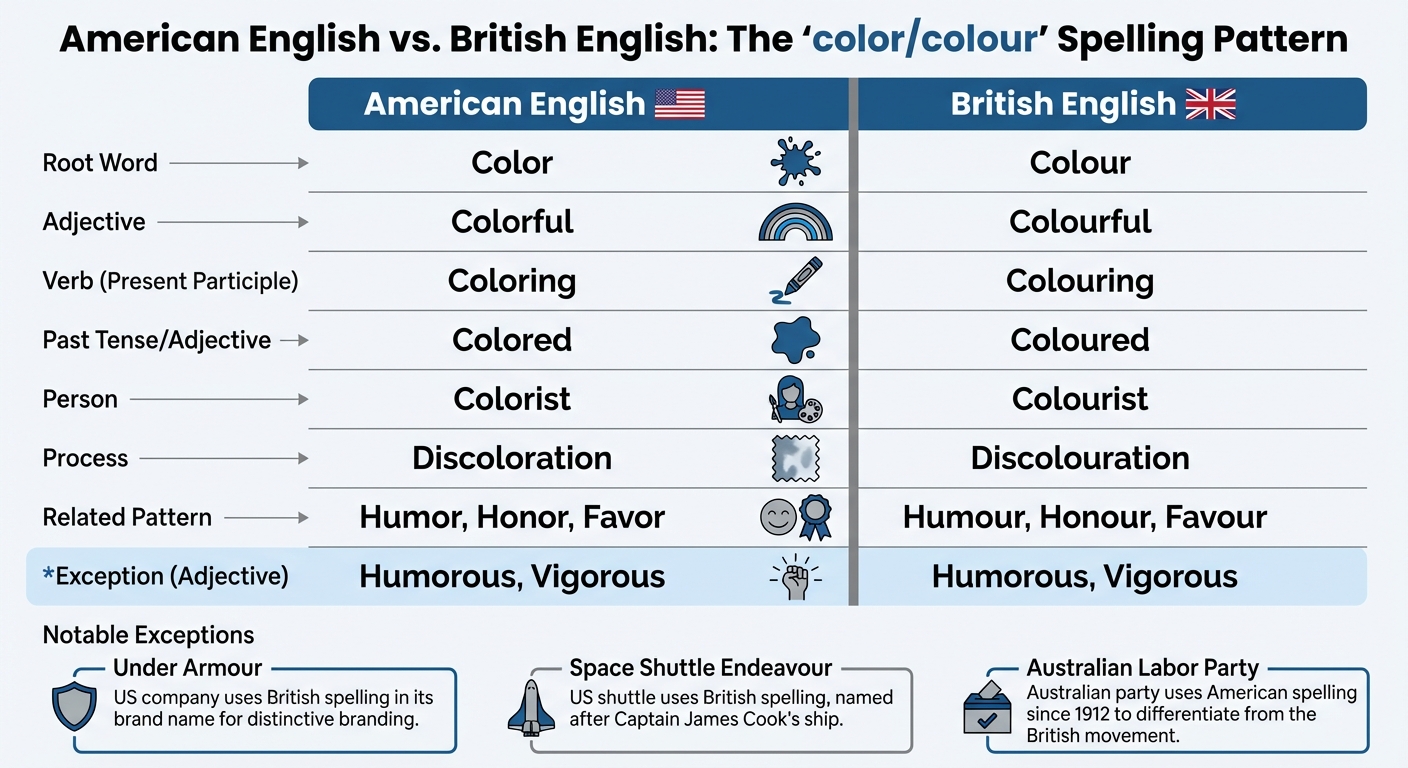
American vs British English Color Spelling Comparison Chart
Expanding on the earlier points, the same spelling rules apply to related words and their derivatives, emphasizing the need for consistency in academic and professional writing.
Take "color" and "colour" as examples. The -or/-our pattern also applies to words like "honor/honour", "favor/favour", and "humor/humour." If you choose "color", you'll naturally write "colorful", "coloring", "colored", and "colorist." Similarly, if you go with "colour", you'll use "colourful", "colouring", and "coloured" for consistency.
In American English, the "u" is dropped in all derivatives. British English, on the other hand, retains the "u" in most cases, although there are exceptions when Latin suffixes are involved. For instance, British writers use "humorous" and "vigorous" instead of "humourous" or "vigourous", even though the root words are "humour" and "vigour."
There are some interesting exceptions to these patterns. Under Armour, the American sports equipment company, uses the British "-our" spelling in its name, despite being based in the United States. Similarly, the Space Shuttle Endeavour, named after Captain James Cook's HMS Endeavour, kept the British spelling when it was commissioned in the 1980s. On the other hand, the Australian Labor Party broke away from the British "-our" tradition in 1912, adopting the American "-or" spelling under the influence of the American labor movement and King O'Malley, even though "labour" remains the standard spelling in Australia.
Spelling Comparison Table
| Word Type | American English | British English |
|---|---|---|
| Root Word | Color | Colour |
| Adjective | Colorful | Colourful |
| Verb (Present Participle) | Coloring | Colouring |
| Past Tense/Adjective | Colored | Coloured |
| Person | Colorist | Colourist |
| Process | Discoloration | Discolouration |
| Related Pattern | Humor, Honor, Favor | Humour, Honour, Favour |
| Exception (Adjective) | Humorous, Vigorous | Humorous, Vigorous |
This breakdown highlights the importance of sticking to one spelling style throughout your work. Mixing forms, like using "color" alongside "colourful" or "honor" with "honourable", can create a jarring inconsistency, which might make your writing seem less polished or credible.
How to Choose the Right Spelling
Deciding between "color" and "colour" depends on your audience, institutional guidelines, and the style guide you're following. Many academic journals and universities specify their preferred version of English in their author guidelines. For example, if you're submitting to a U.S.-based journal or writing for an American university, you'll need to use "color." On the other hand, if your institution adheres to British English conventions, "colour" is the correct choice.
When no specific guidelines are provided, match your spelling to your target audience's location. Use "color" for U.S. readers and regions influenced by American English, and "colour" for audiences in the U.K. and Commonwealth countries.
Style guides can also offer guidance. American-based guides like APA and the Chicago Manual of Style default to American English spelling and recommend Merriam-Webster as the standard dictionary. British academic standards, such as Oxford spelling, retain the "-our" ending, even when other conventions are adopted. The most important thing is consistency. Grammarly emphasizes this point:
"Maintaining consistency within your writing is more important than the spelling you use in this context".
Here are some practical tips to ensure consistency. Always preserve the original spelling in direct quotes and citations, even if it differs from the rest of your text. For instance, if you're writing in American English but quoting a British source, leave "colour" as it appears in the original. The same rule applies to book titles, article names, and proper nouns.
Finally, set your word processor's language to match your chosen English variant. This simple step helps you avoid accidental spelling errors that could detract from your credibility.
Tips for Maintaining Consistent Spelling
Keeping your spelling consistent is essential for maintaining academic credibility and ensuring your work aligns with style guide requirements. Both manual reviews and automated tools can play a role in achieving this.
Start by configuring your word processor to catch regional spelling variations. Set the proofing language to either "English (United States)" or "English (United Kingdom)" through Review > Language > Language Preferences. For example, selecting U.S. English will flag words like "colour" as incorrect in American contexts.
It’s also helpful to create a personal reference list of common spelling differences between American and British English. Examples include pairs like analyze/analyse, defense/defence, and center/centre. Keeping this list nearby while drafting can help you spot inconsistencies early.
Pay extra attention to titles, headings, and abstracts, as errors in these sections are especially noticeable. Even if you rely on spellcheck tools, manually reviewing these key areas can catch mistakes that automated systems might miss. If your spellchecker has accidentally "learned" an incorrect spelling, use the "Reset Ignored Words and Grammar" tool to restore its accuracy. Additionally, review your custom dictionary periodically to remove any incorrect entries that could cause issues in future documents.
How Yomu AI Helps with Spelling Consistency
Yomu AI takes consistency checks to the next level by automating the process. It identifies and corrects regional spelling variations, such as "color" versus "colour", ensuring your document stays aligned with your chosen English variant. For instance, it recognizes patterns like the American "-or" versus the British "-our" endings and flags any unexpected shifts as you write.
Yomu AI also supports compliance with major academic style guides, including APA, MLA, and the Chicago Manual of Style. In addition to spelling consistency, its features - like paraphrasing, summarization, and a plagiarism checker - help maintain academic integrity throughout your work.
Conclusion
Using color or colour correctly is a matter of following regional spelling conventions, which is critical in academic writing. American English prefers color, while British and Commonwealth English use colour. Both are correct within their respective contexts, but mixing them can hurt your credibility.
Sticking to your style guide ensures precision and demonstrates your understanding of academic communication. As Proof-Reading-Service.com explains:
"Consistency signals respect for the norms of the journal or institution and shows that the author understands how academic communication works".
Inconsistent spelling can distract readers and make your work appear less professional. To avoid this, review your style guidelines and adjust your word processor to the appropriate regional setting. However, manually maintaining consistency in long documents like theses or dissertations can be time-consuming.
That’s where Yomu AI comes in. This tool automatically detects and aligns regional spelling patterns, ensuring consistency throughout your document. Beyond spelling, Yomu AI also offers features like paraphrasing, summarization, and a reliable plagiarism checker to help you create polished and credible academic work.
FAQs
Which spelling should I use if my professor doesn’t specify?
If your professor hasn’t given specific instructions, stick with the American spelling, like “color”, when writing in the United States. This aligns with standard American English and is commonly used in academic contexts. Consistency is key, so make sure to apply the same spelling style throughout your work.
Do I keep the original spelling in quotes and titles?
Yes, when quoting or referencing titles, it’s important to keep the original spelling intact, respecting the regional conventions used. For instance, use 'color' when writing for an American English audience and 'colour' if the context is British English. Consistency in these choices helps maintain clarity and professionalism throughout your writing.
How can I quickly check my whole paper for mixed spellings?
To spot mixed spellings like "color" and "colour", use a spellchecker or grammar tool that lets you select a preferred language. Many programs, such as Microsoft Word, allow you to adjust language settings to flag these inconsistencies. These tools help ensure your writing sticks to either American or British English conventions, keeping your work consistent and clear.