

Organize vs Organise: Which One to Use in University Papers
When deciding between "organize" and "organise" in academic writing, the choice depends on your audience's location and the style guide you're following. Here's what you need to know:
- "Organize" is standard in American and Canadian English.
- "Organise" is common in British, Australian, and New Zealand English.
- Consistency is key - mixing the two spellings in one document can make your work look unpolished.
- Check your institution's or journal's style guide for specific requirements.
Quick Comparison Table
| Spelling Variant | Preferred Regions | Example Style Guides |
|---|---|---|
| Organize | USA, Canada | APA, MLA |
| Organise | UK, Australia, NZ | British style guides |
| Oxford Spelling (Organize) | Used in some UK publications | UN, WHO, Oxford University Press |
To ensure consistency, set your word processor to the appropriate English variant. Tools like Yomu AI can also help maintain uniformity across your writing. Always double-check your institution's guidelines to align with their standards.
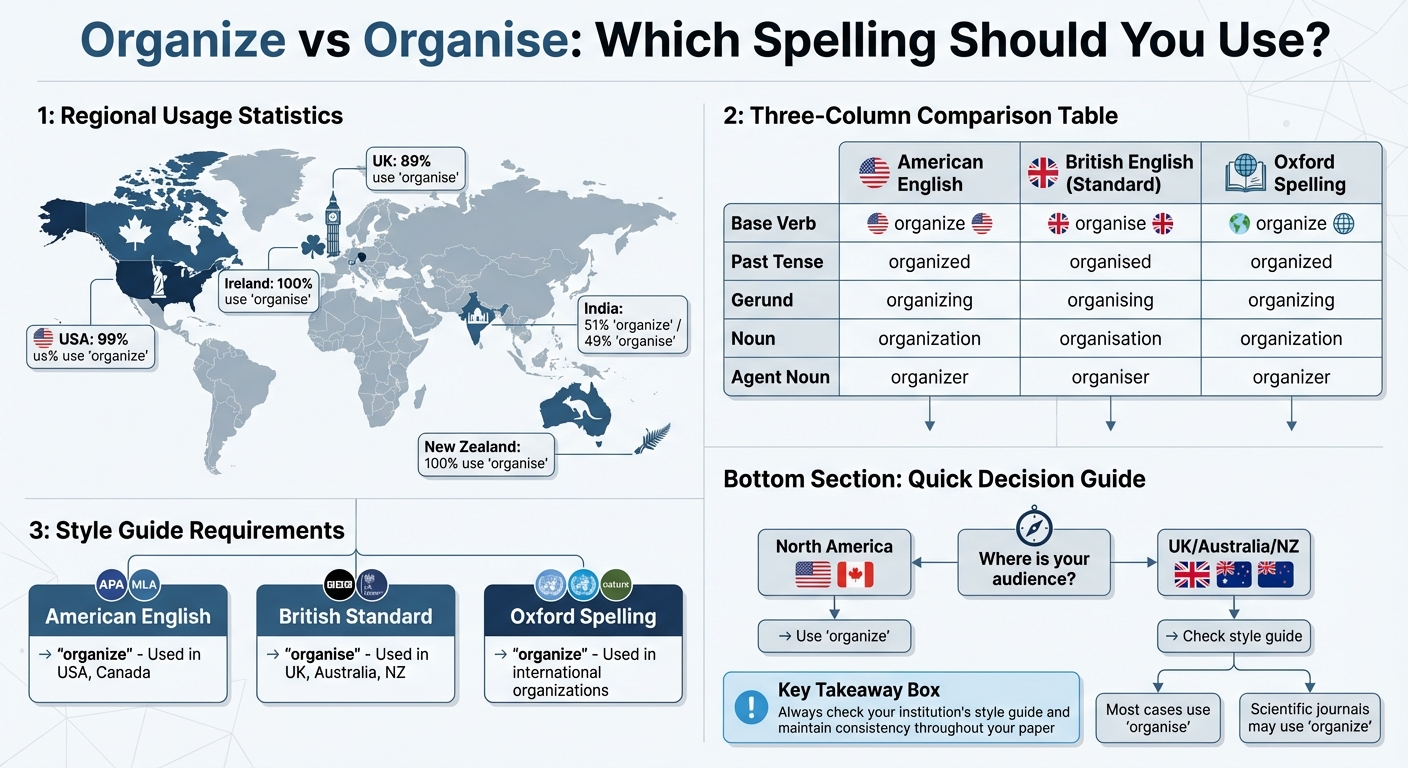
Organize vs Organise: Regional Usage and Spelling Guide
Organise vs Organize – Which One Is Correct? 🤔
sbb-itb-1831901
American English: Using "Organize"
In the US and Canada, "organize" is the standard spelling in academic writing, a convention established by Noah Webster's 1828 An American Dictionary of the English Language. Webster's work significantly influenced American spelling, reshaping hundreds of words and cementing this form in academic contexts. The "-ize" ending, rooted in Greek and Latin, has long been recognized as the correct form. Even the Oxford English Dictionary supports this spelling on etymological grounds.
When using "organize" in your writing, it's important to apply the same spelling to related forms like organized, organizing, organization, and organizer. This consistency is grounded in both historical and linguistic traditions, making it a key element of formal academic research writing.
Examples of "Organize" in Academic Papers
The use of "organize" is widespread in publications. For instance, the Los Angeles Times highlighted its practicality in 2024: "Having an efficient system to file and otherwise organize these documents can save frustration and time". Similarly, the National Post in Canada used the "z" spelling in a labor discussion: "If organized labour is as great for workers as its supporters claim...".
In academic papers, examples might include sentences like:
- "The manager is responsible for organizing staff duties."
- "We need to organize the office before the new employees arrive."
Maintaining uniform spelling is crucial across all academic disciplines.
APA and MLA Spelling Rules
Major style guides reflect this preference for American English. Both APA and MLA styles mandate the use of "organize." APA Style explicitly states:
"Spelling in APA Style papers should match the Merriam-Webster.com Dictionary."
Since Merriam-Webster lists "organize" as the only acceptable spelling, this rule also applies to all derivatives, including terms found in the APA Dictionary of Psychology. Using an APA citation manager can help ensure these spelling and formatting rules are applied consistently throughout your document. MLA adheres to the same American spelling conventions, ensuring uniformity across various fields of study.
To avoid accidentally mixing British and American spellings, you can set your word processor's spell-check tool to "English (United States)." This small adjustment ensures your paper aligns with the required academic standards.
British English: Using "Organise"
After looking at American conventions, let's dive into the British perspective.
In countries like the United Kingdom, Ireland, Australia, and New Zealand, "organise" is the preferred spelling for academic writing. In fact, 89% of writers in the UK favor "organise" over "organize", with Ireland and New Zealand showing a full 100% preference for "organise." Australia isn't far behind, with 88% choosing this spelling.
However, there’s an exception: the Oxford University Press (OUP) uses "organize" with a "z" in its publications. While most UK publications stick with "organise", some institutions, like Oxford, lean toward "organize" due to its Greek etymological roots. Interestingly, the University of Oxford itself recommends "organise" in its style guide for university communications, stating that it aligns better with common British usage and avoids unnecessary exceptions.
This creates two acceptable standards within British English. Standard British English opts for "-ise" (organise, realise), which you’ll find in government documents, the BBC, the Irish Times, and the Sydney Morning Herald. Oxford spelling, on the other hand, uses "-ize" (organize, realize) and is favored by organizations like the United Nations, WHO, and NATO. Even with Oxford spelling, though, some words like "analyse" and "paralyse" always take an "s" because they stem from the Greek noun lysis, not the -izo suffix.
If you’re writing for a UK university, check your department’s style guide. If "organise" is the standard, use it consistently across all forms: organised, organising, organisation, and organiser. Setting your word processor to "English (United Kingdom)" helps ensure consistency throughout your work.
Examples of "Organise" in Academic Papers
British publications commonly stick to "-ise" spellings in formal writing. For instance, the BBC uses "organise" across its news and educational content. Here’s how this spelling might appear in academic contexts:
- "The research team will organise focus groups across three regions."
- "Universities must organise their resources to support international students."
The same principle applies to derivatives like "organisation" and "organiser."
UK Style Guide Requirements
Most UK universities adhere to standard British spelling, favoring "organise" with an "s". However, some academic journals and publishers, such as Nature, require Oxford spelling and mandate the "-ize" form.
No matter which standard you follow, consistency is key. If your institution or publisher specifies "organise", make sure all related forms match. Always check your course syllabus, department handbook, or a journal’s "Instructions for Authors" section to confirm the required spelling. International journals often clarify which British standard they expect.
Organize vs Organise: Side-by-Side Comparison
"Organize" or "organise"? The choice depends on which side of the Atlantic you're on - or which style guide you're following. In American English, "organize" is the standard, while British English typically favors "organise". However, Oxford spelling, a British variant used by the Oxford University Press, the United Nations, the World Health Organization, and many scientific journals, opts for "organize" while following specific academic paper citations.
Regional preferences highlight these differences even further. In the US, "organize" dominates with 99% of usage, while in the UK, "organise" leads with 89%. Canada leans toward "organize" at 77%, while Australia and New Zealand overwhelmingly prefer "organise" at 88% and 100%, respectively. India is almost evenly split, with 51% using "organize" and 49% "organise".
To make these distinctions clearer, here's a quick-reference table:
Spelling Comparison Table
| Form | American English | British English (Standard) | Oxford Spelling |
|---|---|---|---|
| Base Verb | Organize | Organise | Organize |
| Past Tense | Organized | Organised | Organized |
| Gerund | Organizing | Organising | Organizing |
| Noun | Organization | Organisation | Organization |
| Agent Noun | Organizer | Organiser | Organizer |
| Regional Usage | USA, Canada, Philippines | UK, Australia, NZ | UN, Scientific Journals, OUP |
When choosing between these spellings, consistency is key. If you go with "organise", make sure related forms like "organised", "organising", "organisation", and "organiser" match throughout your writing. Mixing "-ise" and "-ize" forms in the same document can come across as careless to academic readers.
Keeping Spelling Consistent in Your Paper
Mixed spellings can make your paper seem less professional. APA guidelines emphasize maintaining uniform spelling throughout your document. When spellings vary, it can dilute your paper's clarity and authority.
"If the dictionary offers a choice of spellings, select one and use it consistently throughout your paper." - APA Style
Inconsistencies in spelling can also lead to typos that distract readers. Thankfully, tools like Yomu AI offer a straightforward way to maintain consistency across your work.
How Yomu AI Checks Spelling Consistency
Yomu AI ensures your spelling matches the dialect you choose. For instance, if you select American English, it will flag words like "organise" and suggest "organize", while also ensuring related forms - like "organized", "organizing", and "organization" - align with the same convention. Additionally, it can standardize to Oxford spelling, which is often required by academic journals such as Nature and international organizations like the UN. The tool works actively to spot and correct inconsistencies based on your selected dialect. This attention to detail even extends to citations, as explained below.
Using Yomu AI with Citation Formats
APA Style specifies that spelling should align with the Merriam-Webster.com Dictionary. When configured for APA papers, Yomu AI adheres to this standard, ensuring consistency across your entire document - from the main text to the reference list. This alignment not only standardizes your spelling but also upholds the scholarly precision expected in academic writing.
To avoid mixed spellings from the start, set your regional preference before drafting. While Yomu AI is excellent at catching inconsistencies, a final manual review is always a good idea to ensure that every word fits the context correctly.
Conclusion
The way you spell certain words can subtly influence the perception of your academic work. Choosing between "organize" and "organise" depends on your audience and the style guide you're following. In American English, "organize" is standard, while British English often opts for "organise." However, Oxford spelling adds a twist by favoring "organize" for etymological reasons.
Inconsistent spelling can detract from the professionalism of your manuscript. To avoid this, check your institution's guidelines and set your language preference early on. This ensures consistency throughout your work. Tools like Yomu AI can help you maintain alignment with your chosen style.
FAQs
Which spelling should I use if my professor doesn’t specify?
If your professor doesn’t provide specific guidance, stick with 'organize' for American English, as it’s the standard spelling in the U.S. On the other hand, 'organise' is typically used in British English and other regions outside North America. Match the spelling to your university's location or the style guide you’re following, and make sure to use the same version consistently throughout your paper.
Do I need to match the spelling in quoted text or titles?
Yes, you should always keep the original spelling found in quoted text or titles, even if it doesn’t align with your regional spelling rules. This approach ensures precision and honors the integrity of the source.
Is Oxford “-ize” acceptable in UK university papers?
Yes, using Oxford “-ize” spelling is perfectly acceptable in UK university papers. This form, known as Oxford spelling, opts for the “-ize” suffix in many words derived from Greek. It’s a standard British English style, widely used in academic contexts, including by Oxford University Press. However, it’s always a good idea to review your university’s specific guidelines to ensure you’re following their preferred style.