

Center vs Centre vs Central: Usage Rules
Want clarity on "center", "centre", and "central"? Here's the key takeaway:
- "Center" is the American spelling, used 92.2% of the time in the U.S.
- "Centre" is the British spelling, preferred in the U.K., Canada, and Australia.
- "Central" is an adjective meaning "main" or "important" and is spelled the same globally.
Quick Tips:
- Use "center" for U.S. audiences and "centre" for British/Commonwealth contexts.
- Stick to one spelling throughout your writing to maintain professionalism.
- "Central" works universally, avoiding regional spelling conflicts.
In short: Match your spelling to your audience. Consistency ensures clarity and credibility.
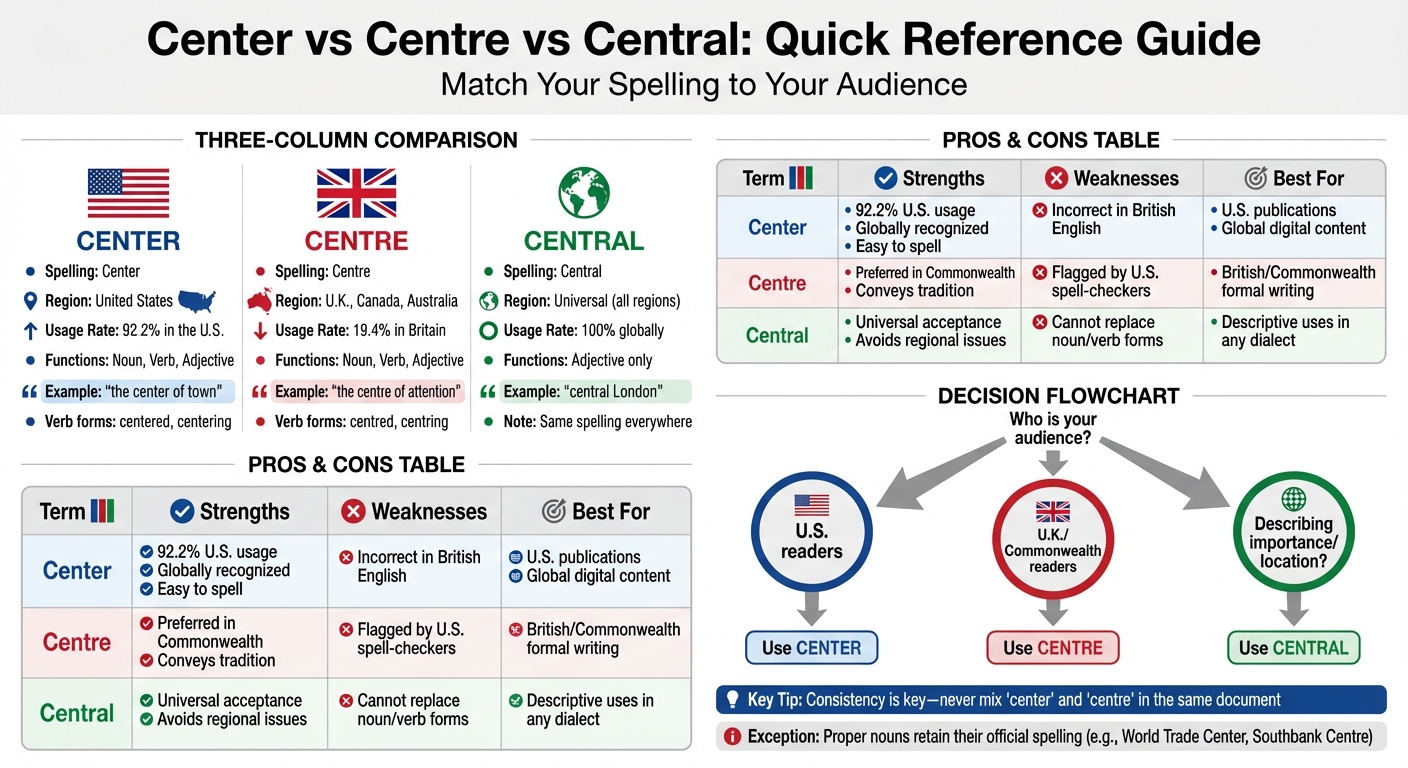
Center vs Centre vs Central: Quick Reference Guide for American and British English
🔵 Centre or Center re-er British and American Spelling Differences - English Spelling - Spell Centre
sbb-itb-1831901
Spelling Differences: American vs. British English
The divergence between "center" and "centre" traces back to the Greek kentron and Latin centrum, with the split emerging after British and American language reforms. In Britain, Samuel Johnson's dictionary cemented the -re ending, while Noah Webster in the U.S. advocated for the -er form. Webster's approach aimed to simplify spelling and create a distinct American linguistic identity. As John Algeo explains:
"it is often assumed that characteristically American spellings were invented by Noah Webster... he chose already existing options such as center, color and check for the simplicity, analogy or etymology".
This historical shift highlights how spelling choices became standardized in authoritative style guides.
Interestingly, while "center" and "centre" differ by region, the related adjective "central" remains consistent across dialects. This is because adding the suffix -al eliminates the silent "e" in both forms. Similar patterns can be seen with other word pairs: Americans use theater, fiber, and liter, while British preferences lean toward theatre, fibre, and litre. These historical distinctions continue to influence academic and professional writing, where adhering to regional norms ensures clarity and professionalism.
Today, the divide in usage is clear. In the U.S., "center" dominates with a 92.2% usage rate, whereas in Britain, "centre" appears only 19.4% of the time, often limited to proper nouns or technical terms. The next step is to examine how these variations affect sentence structure and meaning.
What Each Term Means
Let’s dive deeper into the meanings behind center, centre, and central. Knowing how these terms differ can sharpen your writing, especially in academic or professional settings where precision is key.
Center vs. Centre
The words center and centre are simply regional spellings of the same term. They both describe a midpoint, the core of something, or a designated facility. As Marius Alza from Grammar Tips puts it:
"Both 'center' and 'centre' refer to the same thing. As nouns, they signify the 'middle' part or point of an area."
These words can function in different ways:
- As nouns: "the center of a circle", "a shopping center"
- As verbs: "to center a picture"
- As adjectives (though less common): "a center point"
The spelling you use depends on where you’re writing. In the U.S., it’s center, while British English uses centre.
Central
Unlike center and centre, central is an adjective. It’s used to describe something located at or near the middle or something critically important. Merriam-Webster defines it as:
"of primary importance: essential, principal"
Here’s how these distinctions play out:
- Center and centre identify a specific place or point. For example, "the center of town" refers to a precise location.
- Central, however, emphasizes importance or prominence. Consider "central London", which implies a key or significant part of the city, or "the central issue", highlighting the primary concern in a discussion.
One thing to note: while center and centre vary by region, central is spelled the same everywhere.
Up next, we’ll look at examples to see how these terms fit into everyday writing.
How to Use These Terms in Sentences
When deciding between center and centre, consider the audience's region and stick to one form throughout your writing.
For American readers, always use center. For example, in September 2022, Long Island News 12 reported on a corruption case at the center of an investigation involving a former Suffolk police chief. U.S. publications consistently use center in all contexts. Similarly, for verbs, stick to "centered" and "centering" in American English.
For British, Australian, or Canadian audiences, opt for centre. The BBC, for instance, reported in September 2022 about the Science, Technology, Engineering, and Maths centre (STEM) at Airbus in Stevenage, supporting the company's Mars rover exploration program. In these regions, verbs like "centred" and "centring" are the norm. However, when it comes to proper nouns, always use the official spelling.
Proper nouns retain their designated spelling regardless of the audience. Examples include "World Trade Center" and "Southbank Centre". As Jasper from Stack Exchange explains:
"Native speakers of American English use 'center'. The only common usage of 'centre' in American English is primarily in names intended to evoke a certain prestige".
Finally, for expressions of importance rather than location, use central universally. Whether you're discussing "a central theme" in an academic context or "the central issue" in a business setting, central is appropriate across all English variants.
Pros and Cons
Each term comes with its own set of strengths and limitations, depending on the context of your writing. Knowing these trade-offs ensures your word choice matches your audience's expectations and the tone of your content.
Center is the dominant spelling in the U.S., accounting for 92.2% of usage. It’s a safe bet for American publications, digital content, and international scenarios where American English is the standard. However, in British contexts, it may stand out as incorrect, potentially undermining your adherence to local norms.
Centre, on the other hand, is embraced in formal British English and carries a sense of tradition and refinement. As Marius Alza from Grammar.com explains:
"For more elegance in a formal message towards a British person, 'centre' is much preferred in UK".
That said, American spell-checkers often flag it as an error, and its related verb forms (like centring and centred) can feel unfamiliar to those used to American English conventions.
Central offers a way to bypass the regional spelling debate altogether. It’s universally accepted as an adjective, suitable for describing both location and significance. However, it doesn’t work as a noun or verb - so you can’t substitute it for phrases like "shopping center".
Here’s a quick summary to help you decide which term fits your context:
| Term | Strengths | Weaknesses | Best For |
|---|---|---|---|
| Center | Widely used in the U.S.; globally recognized; easy to spell | May be flagged as incorrect in British/Commonwealth English | U.S. publications; global digital content |
| Centre | Preferred in British/Commonwealth English; conveys tradition | Marked as nonstandard in U.S. contexts | British/Commonwealth formal writing |
| Central | Universally accepted as an adjective; avoids regional issues | Cannot replace noun or verb forms | Descriptive uses in any English dialect |
The takeaway? Consistency is key. Mixing spellings like "center" and "centre" in the same document can come across as sloppy rather than versatile. By sticking to one form based on your audience and purpose, you’ll maintain professionalism and clarity.
This breakdown sets the stage for final recommendations in the Conclusion.
Conclusion
The difference between "center", "centre", and "central" boils down to geography and grammar rules. For an American audience, stick with "center" and its related verb forms like "centered" and "centering." Outside the U.S., follow the local convention, where "centre" is the standard. Despite the spelling differences, both versions mean the same thing, reflecting regional preferences.
When it comes to the adjective "central", it works universally to indicate something of primary importance. However, for nouns and verbs, remain consistent - use "center" or "centre" depending on your audience. Avoid mixing forms unless you're dealing with proper nouns like "World Trade Center" or "Southbank Centre", which always retain their official spellings. This approach ensures clarity and professionalism in your writing.
"Whether you're writing about the 'center of gravity' for an American journal or the 'centre of attention' in a story for a British publisher, using the correct spelling is important for clear communication."
To avoid errors, identify your audience and set your spell-checker to match their preferred English - either U.S. or U.K. dialect. If you're working with a style guide like APA or Oxford, follow its specific rules to maintain consistency. This eliminates accidental mixing of forms and keeps your writing polished.
Understanding and applying these distinctions shows respect for your readers and their linguistic expectations. Consistent and clear language not only enhances readability but also strengthens your credibility. Matching your audience's spelling preferences ensures your message is delivered effectively.
FAQs
Which spelling should I use for an international audience?
The spelling you choose depends on the version of English you're using. For American English, go with "center", while British English uses "centre". If you're targeting a global audience, "center" is often the preferred choice because of its widespread recognition. Whatever you decide, make sure to stay consistent with your spelling throughout the content. Consistency helps maintain clarity and professionalism.
Should I change the spelling within official names and titles?
Always keep the original spelling of official names and titles exactly as used by the organization. For instance, if an entity uses "Center" or "Centre" in its name, stick with their chosen spelling. Altering it could lead to inconsistency or make the information appear inaccurate. In the rest of your text, you can adjust spelling to match your audience or style guide - like using "Center" for U.S. readers and "Centre" for U.K. readers - but never modify the official name. Accuracy and credibility depend on this attention to detail.
How do I choose between 'center' and 'central' in a sentence?
When deciding between 'center' and 'central', it's all about context and function:
- 'Center' works as a noun or verb. As a noun, it refers to a middle point or location (e.g., "The park is at the center of the city"). As a verb, it describes the act of placing something in the middle (e.g., "Please center the text on the page").
- 'Central' is an adjective. It's used to describe something of primary importance or something situated at the core of a larger context (e.g., "The central office handles customer inquiries").
In short, choose 'center' for the middle point or action, and 'central' to describe importance or a core position.