

Program vs Programme: Academic Writing Rules by Region
When deciding between "program" and "programme" in academic writing, the choice depends on regional English conventions:
- American English: Always uses "program" for all contexts (e.g., graduate program, computer program, television program).
- British English: Uses "programme" for non-computing contexts (e.g., television programme, graduate programme) but "program" for anything related to computers or software.
- Canadian and Australian English: Generally prefer "program" in all contexts, aligning more with American English.
Why it matters: Consistent spelling enhances clarity and professionalism in academic writing. Editors and reviewers may view inconsistencies as careless, which could undermine the credibility of your work. Always check the journal's regional language preference and use tools like word processors or AI to maintain consistency.
Key tip: Use "program" universally for computing contexts, regardless of regional norms, and match your spelling to your target audience or publication's requirements.
| Quick Comparison | American English | British English | Canadian/Australian English |
|---|---|---|---|
| Graduate course | Program | Programme | Program |
| Computer software | Program | Program | Program |
| Television show | Program | Programme | Program |
Focus on consistency, and always preserve original spellings in citations. Tools like Yomu AI can help ensure your work adheres to the correct regional standards while maintaining professionalism.
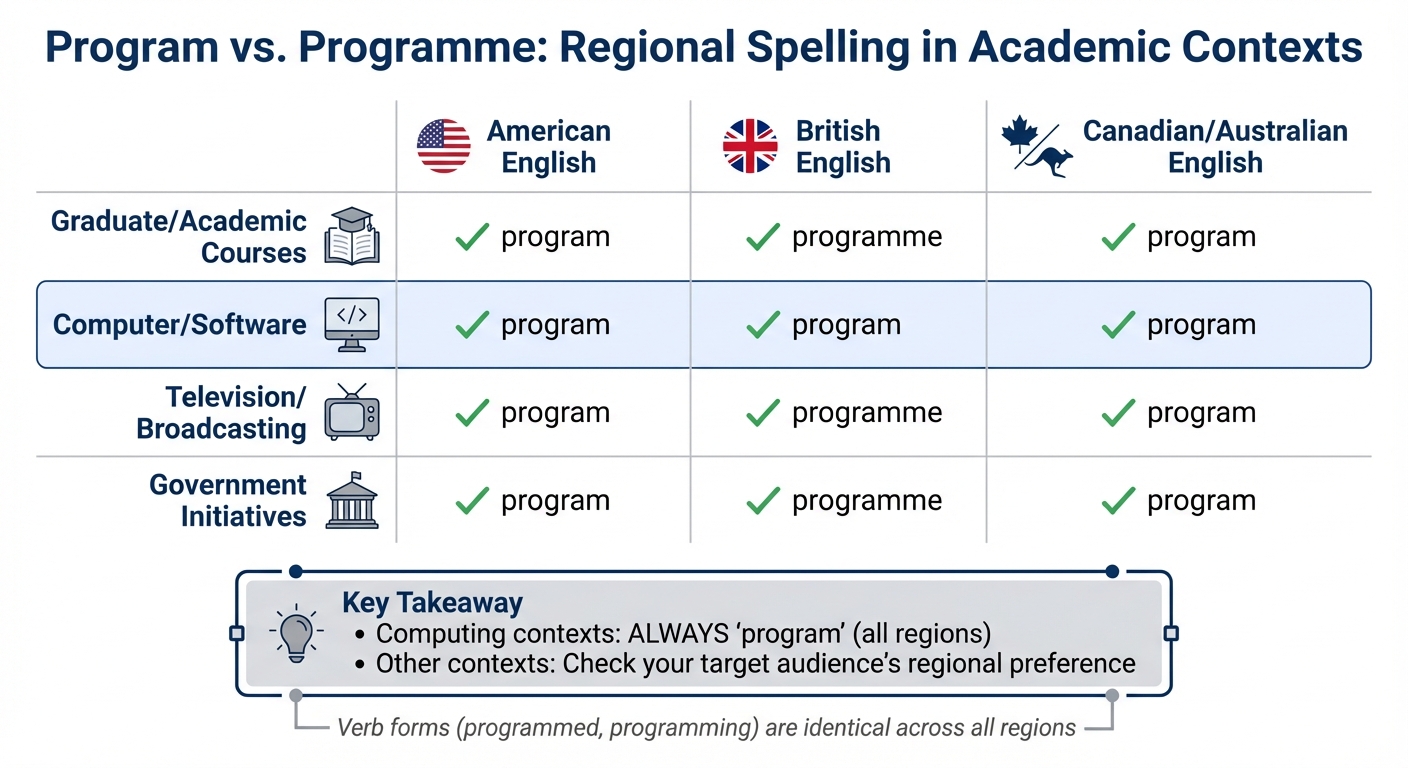
Program vs Programme: Regional Spelling Guide for Academic Writing
Program or Programme?
sbb-itb-1831901
American English vs British English: Spelling Differences
Let’s dive into the practical spelling differences between American and British English. One clear example is how the word "program" is used. In American English, "program" is the standard spelling across all contexts. Whether it's a "graduate program", a "television program", or a "computer program", the spelling remains consistent. In British English, though, the story changes. While "programme" is used for most contexts, like "graduate programme" or "television programme", the computing world sticks to "program." So, a British writer would say "computer program" when discussing software but switch to "programme" for other uses.
Trevor Marshall, MSc, from QuillBot, explains this distinction well:
In American English, the correct spelling is always program. In British English, it is less simple. For most meanings of the noun and the verb, it is spelled programme, with the exception being in the computing world, where the preferred spelling is program.
This dual usage can create some quirky inconsistencies. For instance, The Guardian highlighted this in October 2016, reporting:
Google scientists have created a computer program that uses basic reasoning to learn to navigate the London Underground system by itself.
Yet, the same publication often refers to "television programme" in other articles. This switching between spellings depending on the context reflects the challenges British writers face when adhering to these rules.
Interestingly, both regions spell "programmed" and "programming" the same way. For example, an American researcher might say, "I programmed the simulation", and a British researcher would write the exact same thing.
When it comes to Canadian and Australian English, the preference leans toward "program" in all cases. For example, The Ottawa Citizen reported: "Seven programs run by Algonquin College at its Perth, Pembroke and Ottawa locations have been suspended because of low enrollment".
For those focused on academic research writing, these regional differences are crucial. British journals often require "programme" for educational contexts but stick with "program" for computing. Meanwhile, American journals consistently use "program" across the board. Understanding these conventions is key when tailoring manuscripts for different audiences.
1. Program (American English)
When it comes to regional language differences, American English sticks to one straightforward term: "program." This singular spelling is used consistently across academic, technical, and everyday contexts in the United States.
Spelling Conventions
In American English, "program" is the standard spelling for all uses. Whether you're talking about a graduate program, a television program, or a computer program, the word remains unchanged. This simplified approach dates back to Noah Webster's 1828 dictionary, which prioritized phonetic and streamlined spellings. For inflected forms, the rules are simple: "programmed" (past tense) and "programming" (present participle) both double the "m." This consistency makes it easier to follow spelling rules in academic and professional writing.
Academic Context Usage
U.S. universities, academic journals, and research institutions exclusively use "program" in formal writing. You'll see it in terms like "doctoral program", "research program", or "honors program", all referring to structured courses or curricula. If you set your word processor to "English (United States)", it will automatically flag "programme" as incorrect, helping maintain uniformity in your documents.
Computing and Technical Usage
In the world of computing, "program" is also the standard in American English. Whether you're discussing software development, coding, or computer applications, "program" is universally accepted - even outside the U.S. This consistency in technical contexts ensures clarity, especially for researchers working on projects that bridge educational programs and technology. It helps distinguish between curriculum-based and software-related discussions without confusion.
2. Programme (British English)
In British English, there’s a clear distinction between "programme" and "program", with each serving specific contexts. While American English uses "program" universally, British English reserves "programme" for most uses but adopts "program" exclusively for computing. This distinction stems from historical French influences, creating a dual-spelling system that American English never adopted.
Spelling Conventions
In British English, "programme" is the go-to spelling for schedules, broadcasts, plans, and structured courses. You’ll see it in phrases like "television programme", "theatre programme", or "government programme." Interestingly, the verb forms - "programmed" and "programming" - are consistent with American English, doubling the "m" regardless of the starting term. This uniformity helps maintain clarity and professionalism across different contexts, especially in academic writing.
Academic Context Usage
In academia, British universities and research institutions favor "programme" for courses and research initiatives. Terms such as "doctoral programme", "research programme", and "programme of studies" are standard in UK academic journals and formal documents. For instance, The Guardian featured an article by Tom Kibasi in November 2019, where "programmes" described government privatization plans, reflecting this standard usage in policy and planning discussions. Maintaining consistency in spelling is crucial in academic writing; switching between "programme" and "program" within the same document can appear careless and unprofessional.
Computing and Technical Usage
When it comes to computing, British English aligns with American conventions, using "program" exclusively. This applies to software development, coding, and computer science research. As Professor Paul Brians of Washington State University explains:
In all computer-related contexts, the UK standard spelling is like the US one: 'program.'
This distinction ensures clarity, with "programme" reserved for non-computing contexts and "program" for anything related to technology.
Regional Preferences
Other English-speaking regions often follow British conventions, but there are exceptions. Canada, for example, uses "program" across all contexts, aligning with American English while retaining British spellings like "colour" and "honour." Australia generally sticks to British norms, with "programme" still taught in schools, though government documents increasingly favor "program." These regional differences highlight the importance of understanding and applying the correct term, particularly in UK academic writing.
Regional Writing Guidelines for Academic Authors
When it comes to regional spelling differences, academic writers need to stick to clear guidelines to ensure consistency. Take the example of "program" versus "programme." The choice depends on your target audience and the location of the publication. The best starting point is the journal's "Instructions for Authors", which usually specify whether to use UK English or US English. If no preference is stated, align your spelling with the journal's geographic base - for instance, Oxford University Press often uses British English, while the American Psychological Association favors American English.
A practical tip? Set your word processor to the correct English variant. For example, configuring Microsoft Word to "English (United States)" or "English (United Kingdom)" will flag spelling inconsistencies automatically. This helps avoid mixing terms like "program" and "programme" in the same document. Proof-Reading-Service.com highlights the importance of this:
Inconsistent spelling suggests that the manuscript has not been carefully proofread, which may influence reviewers' and editors' impressions of the work.
Using these tools ensures your manuscript stays polished and consistent.
Another helpful strategy is to create a personal style sheet. This is essentially a list of key terms - like "research program" or "research programme" - that you can refer to throughout your writing. For British English, dictionaries such as Oxford or Collins are reliable resources. For American English, Merriam-Webster is a solid choice.
One important rule: always preserve the original spelling in citations, even if it differs from your chosen convention. For example, a US-based author citing a British article should write "The Impact of Educational Programmes" exactly as it appears in the source. This attention to detail reflects professionalism and respect for the original work.
Writing Tools for Regional Spelling Consistency
Modern AI writing tools make it easier than ever to ensure regional spelling consistency. For example, Yomu AI includes features tailored for academic writers to meet specific regional standards. The Fix Fluency Tool allows you to highlight text and make grammatical adjustments that align with your chosen regional norms. Meanwhile, the Academise Feature transforms informal language into a formal academic tone, ensuring your spelling and style meet the professional expectations of your audience.
These tools are particularly adept at handling tricky, context-sensitive differences. For instance, in British English, "programme" refers to events, while "program" is used for software. AI tools can flag these subtle distinctions, which might otherwise go unnoticed. This level of precision is invaluable for academic writers aiming for consistency across their work.
To streamline the process, you can set your preferred language in Yomu AI to match the requirements of your target journal, such as "English (United States)" or "English (United Kingdom)." Once set, the platform performs automated checks throughout your document. The AI Feedback Engine goes beyond basic spell-checking, analyzing your text for clarity and coherence while ensuring it adheres to the regional style you've selected.
For high-stakes academic submissions, it's wise to pair AI assistance with a final human review. While AI is great at catching inconsistencies - like alternating between "program" and "programme" - professional academic editing services often provide an additional layer of scrutiny. Many academic editors report strong satisfaction rates for journal article editing. This combination not only ensures precision but also helps maintain originality, which is increasingly important as universities and publishers monitor similarity rates.
One standout feature of Yomu AI is its real-time feedback. Instead of waiting until the end of your writing process to catch inconsistencies, the tool provides immediate suggestions as you type. This not only saves time but also helps you develop stronger habits, making the editing process far smoother in the long run.
Conclusion
Regional conventions play a key role in shaping academic writing standards. For instance, in American English, the word "program" is used universally - whether referring to academic courses, TV shows, government initiatives, or software. On the other hand, British English sticks to "programme" in most cases, except when it comes to computing, where "program" is the norm.
Maintaining consistent spelling is crucial for both accuracy and professionalism. Any inconsistency can distract readers and potentially weaken the credibility of your research.
As mentioned earlier, Yomu AI can help ensure your manuscript aligns with regional standards. By setting your preferred variant - American or British English - the platform automatically checks for consistency. Its advanced AI even accounts for context, ensuring you use "programme" for events and "program" for computing, as appropriate. This precise attention to detail helps your academic writing meet the expectations of your audience, whether you're submitting to a U.S.-based journal or a U.K. institution. Regional consistency isn't just a detail; it's a vital part of polished academic submissions.
FAQs
Which spelling should I use if my journal doesn’t specify US or UK English?
If your journal doesn’t specify whether to use US or UK English, stick with “program” for American English and “programme” for British English. If no regional preference is given, choose one style and stick with it throughout your writing. Staying consistent helps keep your work clear and professional.
Can I mix “program” and “programme” in one paper if the contexts differ?
In a single paper, it’s possible to use both “program” and “programme” if the contexts require it. In American English, “program” is the standard term for all uses. However, in British English, the distinction is more specific: “programme” refers to shows, events, or structured plans, while “program” is used exclusively for computers and coding.
To keep your writing clear and professional, make sure to stay consistent within each context. For example, avoid switching between “program” and “programme” when referring to the same type of event or activity.
How do I keep spelling consistent while preserving original spellings in citations?
To keep your writing consistent, stick to one form of English throughout your document - like American English ("program") or British English ("programme"). However, when citing sources or using direct quotes, always retain the original spellings. This ensures accuracy, respects the source material, and avoids any confusion or misrepresentation.