

Can a Thesis Statement Be Two Sentences?
If you’re asking whether a thesis statement can be two sentences, the answer is simple: yes, it can. While most academic guidelines recommend a single sentence, a two-sentence thesis is often better for complex topics. It allows you to clearly state your argument and provide additional context or clarification without overloading a single sentence.
Here’s when a two-sentence thesis works best:
- When your argument involves multiple layers or nuances.
- When you need to explain the significance or scope of your claim.
- For advanced academic writing, like college research papers or dissertations.
Key takeaway: Use one sentence for straightforward arguments and two sentences for more detailed or layered ideas. The goal is clarity, not following rigid rules.
How to Write a CLEAR THESIS Statement: Examples of a Thesis Statement
sbb-itb-1831901
The Problem: Can a Thesis Statement Be Two Sentences?
Most academic guidelines suggest that a thesis statement should be a single sentence to clearly present the core argument. Keeping it brief helps avoid overwhelming the reader and ensures that the central claim remains focused and easy to identify. High school and introductory college courses often enforce this one-sentence rule to teach students how to concentrate on a single main idea.
However, when dealing with more complex topics, squeezing everything into one sentence can create problems. This approach may lead to a thesis that merely states facts without offering deeper insight or analysis. Writers might resort to lofty but hollow wording in an effort to stay concise. The result? A thesis that lacks a strong, debatable stance.
Trying to pack multiple layers of meaning into a single sentence can also lead to clutter. Such sentences often become too long and challenging for readers to follow. According to the Hamilton College Writing Center, more intricate "three-story" theses often require more than one sentence. This highlights some misunderstandings about what makes a thesis statement effective.
Common Misconceptions About Thesis Statements
One widespread misconception is that a thesis must always be a single sentence. This belief, often instilled in high school, continues into college. Yet, for college-level research papers, thesis statements can span 1–2 sentences (20–50 words), and dissertations may extend to 1–3 sentences (30–75 words).
Another mistake is equating brevity with clarity. Writers sometimes oversimplify their arguments to fit the one-sentence format, leading to thesis statements that fail to reflect the complexity of their analysis. The Vanderbilt University Writing Studio emphasizes this point:
"Don't be afraid to draft a thesis statement that is more than one sentence".
The primary goal isn't to rigidly follow a rule but to craft a thesis that provides a clear and effective roadmap for the reader.
When Can a Two-Sentence Thesis Statement Be Appropriate?
A two-sentence thesis statement works well when tackling complex arguments that require both a main claim and additional clarification to ensure clarity. For example, college-level research papers often use thesis statements that span 20–50 words across one or two sentences, which allows for both the primary argument and the nuanced support it needs. This structure is especially useful when you need room to establish a detailed claim without sacrificing readability.
Dissertations, on the other hand, typically require more depth. These can range from 30–75 words, spread across one to three sentences, to clearly define the scope, objectives, and intricacies of the argument. In cases where a "three-story thesis" is necessary - one that challenges assumptions and delves into broader implications - this extended format provides the space needed for a thorough explanation.
Scenarios for Using Two Sentences
Certain types of writing naturally lend themselves to a two-sentence thesis. Analytical arguments with multiple layers often benefit from this approach. Trying to condense intricate relationships or ideas into a single sentence can lead to confusion. By splitting the thesis into two sentences, you can use the first to present a straightforward observation or even acknowledge a counterpoint, while reserving the second for a deeper, more nuanced interpretation.
Complex arguments also thrive with this structure. California State University San Marcos highlights that multifaceted theses often require verbs that express relationships between ideas and are "often more than one sentence". This flexibility ensures that even detailed arguments remain clear and well-organized.
Criteria for an Effective Two-Sentence Thesis Statement
To make a two-sentence thesis work, the sentences must function as a cohesive unit rather than as two unrelated statements. Use conjunctive adverbs (like however, nevertheless, or yet) and transition words (such as because, since, or while) to create a seamless connection between the sentences.
Even with this structure, specificity and conciseness are critical. Avoid vague or overly broad language. If your thesis feels cluttered, it might be because you're cramming in too many ideas or overcomplicating the explanation. The aim is to provide readers with a clear and focused roadmap while maintaining the level of detail necessary for a complex topic. This balance ensures your thesis remains both accessible and insightful.
Single-Sentence vs. Two-Sentence Thesis Statements
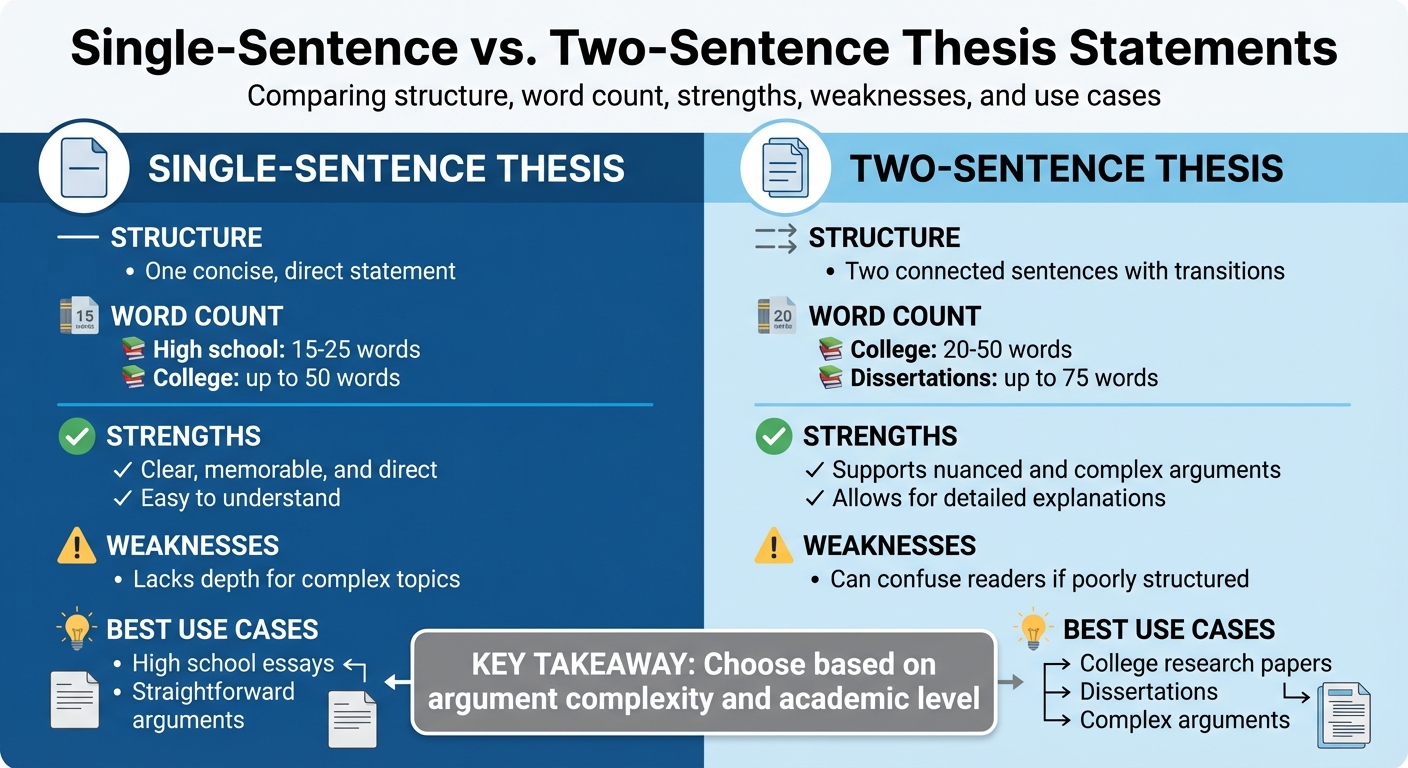
Single-Sentence vs Two-Sentence Thesis Statements Comparison
The choice between a single-sentence and a two-sentence thesis depends on both the complexity of your argument and the academic level of your work. A single-sentence thesis is ideal for straightforward claims where your position can be stated directly. This format is commonly used in high school essays and shorter assignments because it emphasizes clarity and brevity over deeper analysis. As Daniel Felix from Yomu AI explains:
"A one-sentence thesis might suffice for a high school essay, while a more nuanced, two-sentence thesis could be necessary for a college research paper or a dissertation".
This distinction helps clarify when simplicity is more effective than detail.
On the other hand, two-sentence thesis statements are better suited for complex arguments that require more explanation. These are often used in college research papers and dissertations, where it’s essential not only to state your argument but also to explain its significance. Hamilton College notes:
"Due to the complexity of three-story theses, three-story theses often are not restricted to a single sentence".
This approach provides the space needed to challenge assumptions, explore deeper meanings, and add the level of analysis expected in advanced academic writing.
While single-sentence theses excel in clarity, they can oversimplify nuanced topics. Trying to condense a layered argument into one sentence might strip away essential details. On the flip side, two-sentence theses can become overly wordy or confusing if the sentences aren't tightly connected. Without clear transitions, the main point might get lost.
Comparison Table: Single-Sentence vs. Two-Sentence Thesis Statements
| Feature | Single-Sentence Thesis | Two-Sentence Thesis |
|---|---|---|
| Structure | One concise, direct statement | Two connected sentences with transitions |
| Word Count | 15–25 words (high school), up to 50 (college) | 20–50 words (college), up to 75 (dissertations) |
| Strengths | Clear, memorable, and direct | Supports nuanced and complex arguments |
| Weaknesses | Lacks depth for complex topics | Can confuse readers if poorly structured |
| Best Use Cases | High school essays | College research papers, dissertations |
This table highlights the key differences between the two formats. Choose your thesis structure based on the demands of your assignment. If your argument involves a layered approach, such as "Yes, but..." or "Although... however...", a two-sentence thesis will likely provide the necessary space to address that complexity. In simpler cases, a single-sentence thesis delivers clarity without sacrificing meaning.
How to Write Effective Two-Sentence Thesis Statements
Crafting a two-sentence thesis statement means striking the right balance between being clear and presenting a layered argument. The first sentence should lay out your main claim in a straightforward way, while the second sentence adds depth by explaining why your argument matters or how it will unfold. This approach is especially useful for "three-story" theses, which aim to go beyond surface-level observations and challenge assumptions. Below are steps to help you create a thesis that is both concise and thought-provoking.
Step 1: State Your Main Claim
Start by presenting a clear and debatable argument that directly answers the assignment question. Vanderbilt University highlights that:
"a thesis statement is a very specific argument that guides your paper".
Avoid vague or overly broad statements that lack focus. For instance, instead of saying, "Social media affects teenagers", opt for something like, "Social media platforms exploit teenage users' psychological vulnerabilities to maximize engagement time." The revised version takes a firm stance that invites debate, making it more effective.
Focus on the "what" of your argument in this first sentence. Clearly define your topic and position without overcomplicating things.
Step 2: Add Supporting Points or Nuances
The second sentence should answer the "why" or "so what?" of your argument. This is where you provide a glimpse into the reasoning or significance behind your claim. For example, if your first sentence argues that social media exploits teenage vulnerabilities, your second sentence might elaborate: "Examining Instagram's algorithms and TikTok's infinite scroll illustrates how profit motives can compromise user well-being."
This second part is your chance to move beyond a surface-level claim and introduce the complexity of your argument. It should give readers a sense of the evidence and direction your paper will take, without overwhelming them with too much detail.
Step 3: Ensure Unity and Clarity
Make sure the two sentences work together as a seamless roadmap for your paper. Use transitional words like however, therefore, or although to highlight the connection between your main claim and its deeper implications.
To test your thesis, ask yourself if it answers "how" and "why" questions about your argument. If it leaves readers wondering, refine it further. Keep the word count manageable - college-level two-sentence theses typically range between 20 and 50 words. Daniel Felix from Yomu AI advises:
"A good rule of thumb is this: your thesis statement should be as long as it needs to be to convey your main idea while staying concise and direct".
Trim any unnecessary repetition or jargon, and make sure your language is specific and concrete. This approach ensures your thesis remains clear while offering enough complexity to guide your readers effectively.
Improving Thesis Statements with Yomu AI
Crafting a strong thesis statement takes practice, but Yomu AI makes the process easier. With its Thesis Statement Generator, you can transform broad topics into concise, arguable claims. Paired with AI-powered editing tools, the platform helps you refine, expand, or condense your thesis to create a clear direction for your essay or research paper.
Using Yomu AI for Thesis Refinement
Start by entering your topic into the Thesis Statement Generator to produce a preliminary thesis. If the result feels too vague or overly wordy, the AI Editing Tools can help you polish it. For instance, the Sentence Rewriter suggests ways to enhance vocabulary and sentence structure, while the Paraphrasing Tool simplifies complex ideas without losing their essence.
For papers requiring more depth, the Sentence Expander can turn a simple claim into a more detailed two-sentence thesis, adding necessary context. The Intelligent Document Assistant offers real-time feedback on clarity and tone, ensuring your work aligns with academic standards. As Daniel Felix from Yomu AI explains:
"A strong thesis statement serves as the backbone of your essay, guiding both you and your readers through your argument".
In addition to improving language and structure, Yomu AI helps ensure your work remains original and credible.
Maintaining Academic Integrity with Yomu AI
Yomu AI also supports academic integrity, a critical aspect of academic writing. Its advanced plagiarism checker provides detailed insights to confirm the originality of your thesis. Running your work through this tool before submission adds an extra layer of assurance.
Additionally, Yomu AI simplifies citation management. Its integrated tool ensures proper formatting and sourcing from the beginning of your writing process. You can also use the personal library feature to save and reuse sources across multiple projects - an invaluable resource for long-term research efforts. Together, these tools help you maintain consistency and credibility in your academic work.
Conclusion
The choice between a one- or two-sentence thesis largely depends on the complexity of your argument.
For straightforward topics, like those often found in high school essays, a single sentence works well. On the other hand, more intricate college-level arguments may call for two sentences. Persuasive essays typically thrive on a concise thesis (15–25 words), while detailed research papers may require a slightly longer, two-sentence structure (20–50 words).
Regardless of length, every thesis must clearly define its topic and make a specific claim. Above all, clarity, precision, and arguability matter most. As Hamilton College puts it:
"The thesis, usually expressed in one or two sentences, is the central, organizing claim of your paper".
As your research progresses, your thesis might need adjustments. If your essay veers from the original claim, refine either the thesis or the essay to ensure alignment.
Tools like Yomu AI can help streamline this process. Its Thesis Statement Generator offers a starting point for crafting claims, while the Sentence Expander adds depth. Additionally, features like the plagiarism checker and citation management tools help maintain academic integrity.
Ultimately, the goal is to create a thesis that effectively guides your readers. Whether it's one sentence or two, practice and the right resources will help you master the art of thesis writing.
FAQs
Where should a two-sentence thesis go in my essay?
A two-sentence thesis belongs near the end of your introduction. It acts as the core argument, steering the focus and structure of your essay.
How do I know if my topic needs two sentences?
To determine whether your thesis statement should consist of one or two sentences, think about how intricate your topic is and how much detail your analysis demands. For simpler topics, a single sentence often does the job. However, if your idea is more layered or nuanced, a two-sentence thesis can offer the clarity and depth needed to effectively outline your argument and guide your paper’s direction.
Can my thesis be three sentences instead?
Yes, a thesis can absolutely stretch to three sentences, especially when dealing with more complex topics or arguments. Using multiple sentences allows you to add detail, address various facets of your argument, or provide necessary context. The key is ensuring the ideas flow logically and clearly support the main point you're making.