

Thesis Statement vs Topic Sentence: Quick Rules and Examples
When writing an essay, understanding the difference between a thesis statement and a topic sentence is crucial. Both are key to structuring your argument, but they serve different purposes:
- Thesis Statement: Found at the end of your introduction, it presents the essay's main argument or claim. It covers the entire essay's scope and acts as the foundation for your writing.
- Topic Sentence: Found at the beginning of each body paragraph, it introduces the paragraph's main idea. It supports the thesis by breaking down the argument into smaller, focused points.
Key Differences:
- A thesis covers the whole essay; a topic sentence focuses on one paragraph.
- A thesis is broad; a topic sentence is specific.
- A thesis appears once in the introduction; topic sentences appear in every body paragraph.
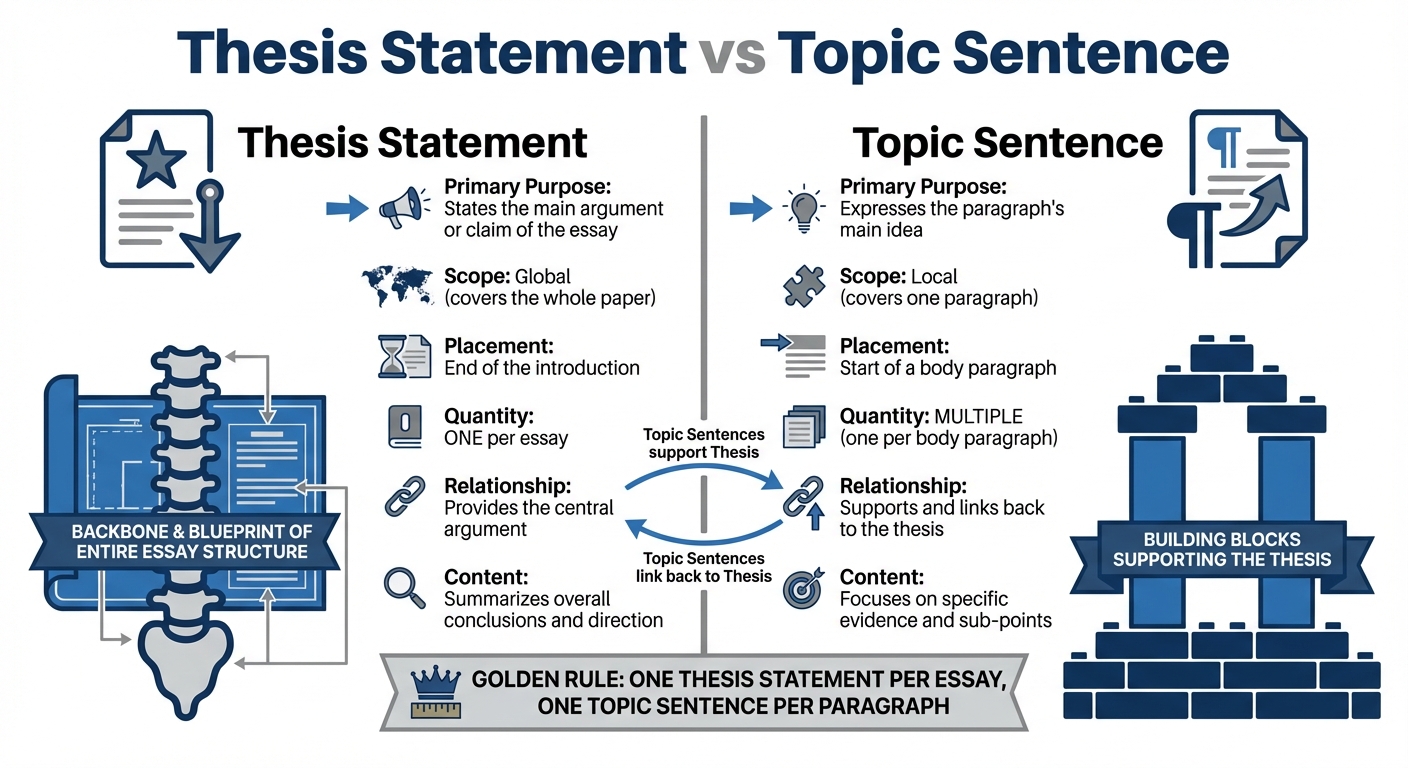
Thesis Statement vs Topic Sentence: Key Differences Comparison Chart
Thesis Statement vs Topic Sentences | English Writing Skills
sbb-itb-1831901
What is a Thesis Statement?
Let’s take a closer look at the thesis statement, a key element of essay writing that ties everything together.
A thesis statement is more than just the topic of your essay - it’s your specific argument or perspective on that topic. For instance, if your topic is "social media", your thesis could be, "Social media helps users become more informed voters by encouraging critical consumption of information."
Definition and Features
You’ll typically find the thesis statement at the end of your introduction, serving as a bridge between your opening paragraph and the main body of your essay. A good thesis isn’t just a fact; it’s a claim that can be debated. For example, "World War II ended in 1945" is a simple fact, but "The Allied victory in World War II was primarily due to superior industrial capacity" presents an argument that invites discussion and requires evidence.
"A thesis statement is not a fact; it takes a position about a fact – a position that not everyone will support." - Kennesaw State University Writing Center
The best thesis statements are clear, precise, and manageable. They avoid vague or overly broad language. For example, instead of saying "College is hard", a more effective thesis would be, "First-year college students struggle most with time management because they underestimate the workload and lack organizational skills."
This clarity and focus make your thesis the foundation of your essay.
What It Does in an Essay
Think of your thesis as the backbone of your essay - it holds everything together. Every paragraph, piece of evidence, and argument you present should connect directly to your thesis. It not only defines what you aim to prove but also guides your reader through your reasoning.
"Think of your paper as a human body, and your thesis statement as the spinal cord. Without it, there is no structure." - UNT Dallas
A strong thesis keeps your writing focused and ensures your argument stays on track. For readers, it provides a clear roadmap of what to expect. To test the strength of your thesis, ask yourself the "So What?" question. If someone could read it and wonder why it matters, take a moment to refine it or tie it to a broader issue.
What is a Topic Sentence?
Once you've nailed down your thesis statement, the next step is to focus on topic sentences. These are the backbone of your paragraphs, each one supporting your thesis in a specific way.
A topic sentence conveys the main idea of a single paragraph. While it operates on a smaller scale than your thesis, its role is just as important. Your thesis drives your entire essay, but a topic sentence directs the focus of one paragraph, ensuring it ties back to your central argument.
Definition and Features
Typically, the topic sentence appears at the start of a paragraph, setting the stage for what's to come. This placement helps maintain logical flow and keeps readers on track.
"A topic sentence has several important functions: it substantiates or supports an essay's thesis statement; it unifies the content of a paragraph and directs the order of the sentences; and it advises the reader of the subject to be discussed." - Indiana University Writing Tutorial Services
A well-crafted topic sentence does three key things: it signals the paragraph's purpose, connects to your thesis, and defines the scope of the discussion within that paragraph. For instance, if your thesis argues that social media enhances voter engagement, a topic sentence might be: "Social media platforms enable real-time fact-checking, which helps users evaluate political claims more critically." Every sentence in that paragraph must support this idea.
Write topic sentences in your own words, emphasizing analysis rather than relying solely on quotes or facts.
This clarity ensures that each paragraph contributes meaningfully to your overall argument, as explored further below.
What It Does in Paragraphs
Just as a thesis statement guides your essay, a topic sentence steers each paragraph, keeping your argument cohesive. Think of topic sentences as mini-leaders, ensuring every paragraph serves your thesis. They break your argument into manageable pieces, allowing each paragraph to tackle a specific aspect of your claim.
"Ideally, if a reader carefully reads your introduction, the topic sentence of each paragraph, and your conclusion, they should understand not only your main argument or claim but how you construct the evidence and support for that claim, piece by piece." - Naval Postgraduate School Graduate Writing Center
Rules to Tell Thesis Statements and Topic Sentences Apart
To better understand how thesis statements and topic sentences function, let’s break down their differences in purpose, scope, and placement.
Main Differences in Purpose, Scope, and Placement
The easiest way to tell a thesis statement and a topic sentence apart is by their scope. A thesis statement governs the entire essay. It’s the central argument or claim you’ll support throughout your writing. On the other hand, a topic sentence focuses on a single paragraph, introducing one point that supports the thesis.
"A useful metaphor would be to think of the thesis statement of a text as a general: it controls all the major decisions of the writing. There is only one thesis statement in a text. Topic sentences, in this relationship, serve as captains: they organize and sub-divide the overall goals of a writing into individual components." - Lumen Learning
Placement also helps distinguish the two. A thesis statement typically comes at the end of the introduction, after setting up the necessary context. Topic sentences, however, appear at the start of each body paragraph, signaling its focus. This consistent placement makes it easier for readers to follow your argument.
The scope of each is another key difference. A thesis statement operates at a global level, summarizing your conclusions and mapping out the entire essay. Topic sentences work on a local level, organizing specific details and sub-points within individual paragraphs. Think of the thesis as the blueprint for the essay, while topic sentences are the building blocks that bring it to life.
Comparison Table: Thesis Statement vs Topic Sentence
| Feature | Thesis Statement | Topic Sentence |
|---|---|---|
| Primary Purpose | States the main argument or claim of the essay | Expresses the paragraph's main idea |
| Scope | Global (covers the whole paper) | Local (covers one paragraph) |
| Placement | End of the introduction | Start of a body paragraph |
| Quantity | One per essay | Multiple (one per body paragraph) |
| Relationship | Provides the central argument | Supports and links back to the thesis |
| Content | Summarizes overall conclusions and direction | Focuses on specific evidence and sub-points |
A quick way to test this in practice is to read only the first sentence of each body paragraph in a well-organized essay. If these sentences alone give you a clear outline of the argument, they’re effective topic sentences. Meanwhile, the thesis should stand as the one sentence that encapsulates the essay’s central claim.
Together, the thesis and topic sentences ensure your essay stays cohesive and easy to follow. Each plays a unique role in building a strong, logical structure.
Examples of Thesis Statements and Topic Sentences
Understanding how thesis statements and topic sentences work together can make these concepts easier to grasp. Let’s explore two essay types to see how they play distinct roles.
Example from a Persuasive Essay
Thesis statement: "Despite its controversial nature, genetic engineering in agriculture is a good solution to global food security challenges."
This thesis presents a clear and debatable claim about genetic engineering. The topic sentences in the body paragraphs support this argument:
- Genetic engineering techniques can significantly enhance crop yields and nutritional content.
- Pest-resistant crops reduce the need for harmful pesticides.
- Adoption of these crops can increase farmer income in developing countries.
- Genetically modified crops are more resilient against climate change.
Each topic sentence introduces a specific argument that ties back to the thesis. Together, these points build a case for genetic engineering as a solution to food security challenges. Each topic sentence acts as a mini-argument, contributing to the overall claim.
Example from a Research Paper
In academic writing, the same structure applies but with a focus on evidence-based arguments.
Thesis statement: "While both genetic and environmental factors significantly influence human behavior, most characteristics result from a complex interplay between genes and environment."
The topic sentences guide the argument step by step:
- Twin and adoption studies provide evidence for the heritability of conditions like schizophrenia.
- These studies also show that both factors play a role in personality and depression.
- Interaction models show traits like obesity are influenced by both genetics and environment.
Here, each topic sentence introduces research evidence that supports the thesis. The first two highlight the importance of both genetic and environmental factors, while the third illustrates their interaction. Together, these sentences outline the argument, giving readers a clear framework for the paper. Strong topic sentences like these provide a roadmap for understanding the thesis in depth.
Conclusion: Improve Your Writing with Yomu AI

Understanding the Key Differences
Grasping the roles of thesis statements and topic sentences is essential for crafting a cohesive essay. The thesis statement, usually placed at the end of the introduction, acts as the backbone of your argument. On the other hand, topic sentences serve as guides for each paragraph, tying them back to the thesis. As Study.com explains, a lack of a clear thesis or coherent points can disrupt the reader's experience.
Here’s the golden rule: one thesis statement per essay, one topic sentence per paragraph. Each topic sentence must directly support the thesis, ensuring your essay flows logically and persuasively. By mastering this structure, you’ll not only strengthen your argument but also create a smoother reading experience.
Yomu AI: Your Writing Companion
Yomu AI offers a powerful toolkit to refine both thesis statements and topic sentences, making your essays more polished and effective. With the Autocomplete feature, you can generate compelling reasons to back up your thesis and draft topic sentences that seamlessly connect to your argument. The Document Assistant provides instant feedback on your essay’s structure, helping you spot and fix weak links between your thesis and paragraphs.
For those aiming for a more polished academic tone, the Academise tool transforms informal language into a professional style, ensuring both your thesis and topic sentences meet academic standards. Struggling with organization? Yomu's Structured Outlining tool creates detailed outlines based on your research question, showing how each topic sentence supports your main argument before you even start writing.
Yomu AI isn’t just a tool - it’s your partner in crafting essays that are clear, focused, and persuasive. Whether you need help with generating ideas, refining language, or ensuring logical structure, Yomu AI has you covered.
FAQs
Can a thesis statement be more than one sentence?
Yes, a thesis statement can stretch beyond a single sentence, particularly in longer or more intricate essays. This often happens when the argument is multifaceted and develops throughout the piece. However, it’s crucial that the thesis stays clear and focused, outlining the essay's main idea or purpose to effectively guide the reader.
Do I always need a topic sentence in every body paragraph?
No, not every body paragraph absolutely needs a topic sentence. That said, having one is highly recommended. A topic sentence helps steer the reader by clearly stating the main idea of the paragraph. This is especially important in academic writing, where maintaining focus and clarity is key.
How can I tell if my topic sentences support my thesis?
To make sure your topic sentences effectively back up your thesis, ensure each one directly ties to and expands on a specific part of your main argument. A solid topic sentence should:
- Summarize the paragraph's key idea while staying aligned with your thesis.
- Serve as a mini-thesis, presenting a claim that the paragraph will go on to support.
Every topic sentence should work to reinforce and build upon the central argument of your essay.