

ChatGPT Prompts for Academic Writing That Improve Structure Without Replacing Your Voice
Academic writing often feels overwhelming, especially when organizing ideas or ensuring smooth transitions. This article highlights how precise ChatGPT prompts can improve your paper's structure while preserving your personal writing style. Here’s a quick summary of the key takeaways:
- Thesis Development: Use prompts to refine your thesis, test assumptions, and align it with your research and paper length.
- Outline Organization: Create clear outlines, deconstruct arguments, and audit logical flow for better structure.
- Transitions & Flow: Strengthen connections between paragraphs using targeted prompts for logical and seamless progression.
- Argument Clarity: Test your arguments, identify gaps, and address counterpoints to make your claims stronger.
The key is treating ChatGPT as a thinking partner - providing clear, specific inputs like drafts or research notes to get tailored, actionable suggestions. Always double-check AI-generated content for accuracy and compliance with ethical guidelines. Start small, experiment with prompts, and refine your workflow to save time while maintaining your unique voice.
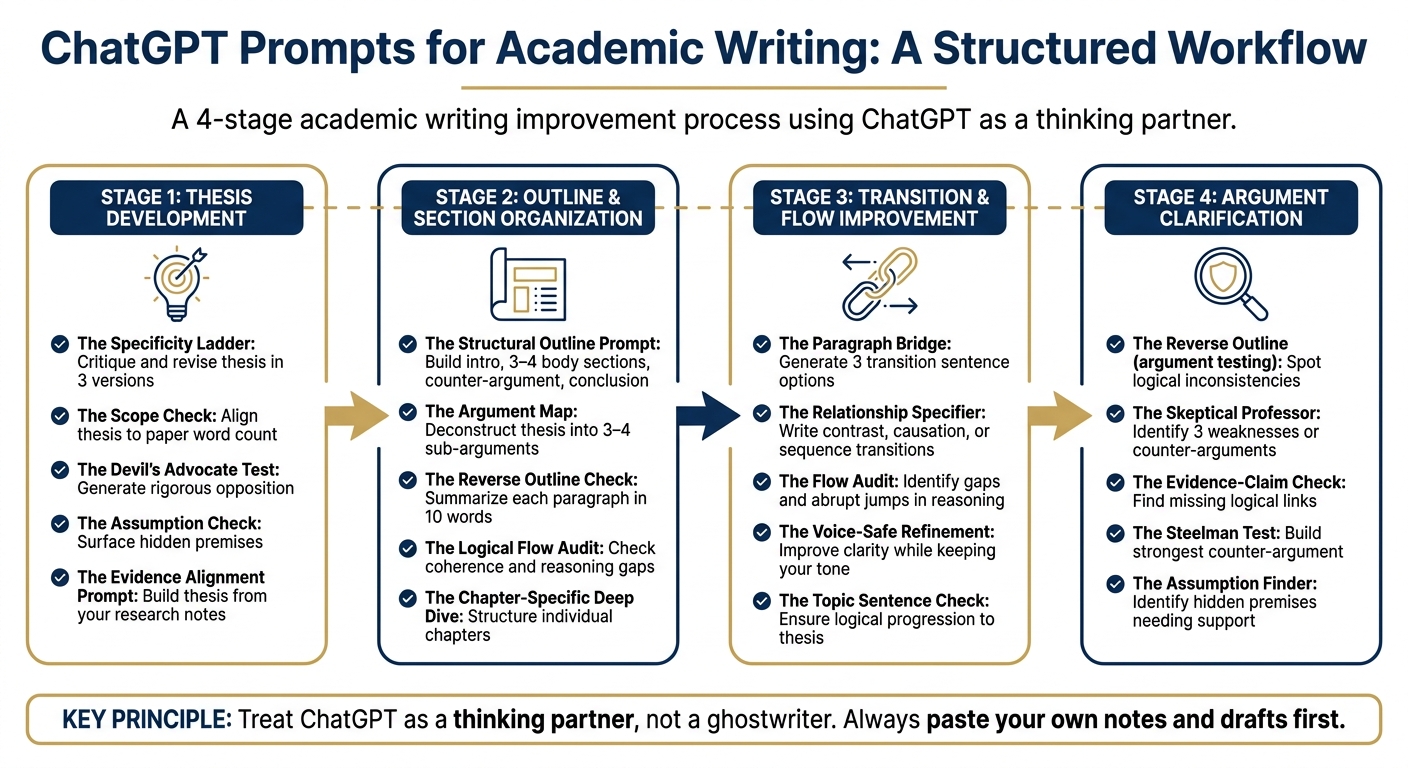
ChatGPT Prompts for Academic Writing: A Structured Workflow
10 ChatGPT Academic Writing Prompts That Will Take Your Writing From 0 to 100 | A Beginners Guide
sbb-itb-1831901
1. Thesis Development
A vague thesis doesn’t do much for your argument. Instead of relying on ChatGPT to craft your thesis from scratch, use it as a tool to refine and strengthen your draft through precise prompts.
"Vague requests = vague responses. Precise prompts = actually helpful output." - Alex P.
Here are five prompts to help sharpen your thesis while keeping your personal voice intact:
- The Specificity Ladder: Ask ChatGPT to "Critique and strengthen this draft thesis: '[YOUR THESIS]'. Provide 3 revised versions with increasing specificity." This way, you’ll get multiple options to consider, rather than just one generic suggestion.
- The Scope Check: Include your target word count in the prompt. For example, "My thesis is: '[YOUR THESIS]'. For a 2,000-word paper, is this appropriately scoped? Suggest how to narrow or expand it." This ensures your thesis aligns with the depth of your paper - neither too broad nor too narrow.
- The Devil's Advocate Test: Use a prompt like "Generate the most intellectually rigorous opposition position to this thesis: '[YOUR THESIS]'." Seeing a strong counter-argument early on helps you refine your claim and anticipate criticism.
- The Assumption Check: Try "What implicit assumptions underlie this argument: '[YOUR THESIS]'?" This technique surfaces hidden premises in your thesis, so you can address them head-on in your paper.
- The Evidence Alignment Prompt: Paste your research notes into ChatGPT and ask, "Using only the provided notes, construct three potential thesis statements that are argumentative and specific." This ensures the AI’s suggestions are grounded in your actual research, keeping them relevant and well-supported.
The key to all these prompts is constraint. The more specific the context you provide - like your notes, word count, or academic level - the more tailored and useful the output will be. As Alex P. wisely notes, "The students who get good results treat AI responses as rough drafts to argue with, not final answers."
Next, we’ll look at how structured outlines can further refine your paper’s framework.
2. Outline and Section Organization
Once your thesis is defined, the next crucial step is organizing your content. A clear structure doesn't just support your argument - it also keeps your writing focused and your academic voice consistent. Think of your outline as the skeleton of your work, holding everything together.
- The Structural Outline Prompt: Start by providing ChatGPT with your thesis and research notes. Then, ask it to "Create an academic outline with an Introduction, 3–4 body sections with topic sentences, a counter-argument section, and a Conclusion." By specifying these components, you can ensure the output meets academic expectations. Including your research notes is essential for accuracy and relevance.
- The Argument Map: Break your thesis into smaller, manageable parts. For example, you might prompt ChatGPT to "Deconstruct your thesis into 3–4 sub-arguments, noting each claim, required evidence, and its link to the main thesis." This method transforms a complex argument into a clear, actionable plan.
- The Reverse Outline Check: If you already have a draft, this technique is invaluable. Paste your draft and ask: "Perform a reverse outline. List the main point of each paragraph in 10 words or less." This will help you identify any logical inconsistencies or areas needing improvement.
- The Logical Flow Audit: After drafting an outline, ensure everything connects smoothly. Use the prompt: "Review this outline for logical coherence. Does each point follow from the previous one? Are there any gaps in reasoning?" This step is particularly helpful when you're too close to the material to spot flaws.
- The Chapter-Specific Deep Dive: For more extensive projects, like dissertations or theses, focus on one chapter at a time. Try asking: "I'm writing Chapter 3 on [specific topic]. Its goal is to [state purpose]. Suggest a detailed internal structure for this chapter." The more specific your request, the more practical the output will be.
Remember, providing concrete notes or drafts alongside your prompts is key to getting useful and relevant results.
With a solid outline in place, polishing transitions and ensuring your arguments flow smoothly becomes much easier.
"The key to using Canvas effectively for academic writing is to provide enough context for the AI to generate useful text and edit your paper chunk by chunk." - Ilya Shabanov, The Effortless Academic
3. Transition and Flow Improvement
Strong transitions are the glue that holds your ideas together, turning individual points into a seamless argument. Without them, even the most well-researched work can feel disconnected and difficult to follow. The good news? ChatGPT can help you refine these connections without altering your unique voice. With the clear outline you established earlier, you can now focus on making your ideas flow effortlessly.
Here are five practical prompts to enhance the flow of your paper while staying true to your style:
- The Paragraph Bridge: Copy the last sentence of one paragraph and the first sentence of the next, then ask, "Can you suggest three sentences to transition between these points?" This approach helps ChatGPT understand how the ideas relate and provides smoother connections.
- The Relationship Specifier: Be specific about the kind of transition you need. For example: "Write a transition that highlights the contrast between these two arguments: [text]." Whether it’s contrast, causation, addition, or sequence, this method ensures the transition fits your intent.
- The Flow Audit: Paste an entire section and ask, "Does this section flow logically? Can you identify any gaps or abrupt jumps in reasoning?" This prompt helps pinpoint structural issues and areas where your argument might need reinforcement.
- The Voice-Safe Refinement: Preserve your tone and style while improving readability. For example: "Refine this paragraph for clarity and coherence, but keep my tone and sentence length: [text]." This ensures the output doesn’t feel overly formal or generic.
- The Topic Sentence Check: Compile all your topic sentences and ask, "Do these topic sentences create a logical progression and tie back to the thesis? Suggest changes if needed." This quick review can help you identify where your argument might stray off course before diving into detailed edits.
"You can also use ChatGPT to structure your writing and add transitions in a way that ensures a logical flow." - Ifeoma Joy Okorie, Techpoint Africa
4. Argument Clarification
A well-structured paper can fall flat if its core arguments lack clarity. ChatGPT can act as a valuable tool to help critique and refine your arguments while ensuring your personal voice remains intact. By focusing on clear structure and logical flow, you can strengthen the overall impact of your writing.
Here are five prompts to help you sharpen your arguments without losing your unique perspective:
- The Reverse Outline (for argument testing): Ask ChatGPT to summarize the main point of each paragraph in 10 words or less. This method helps you spot inconsistencies in your logical progression or identify sections that stray off-topic.
- The Skeptical Professor: Use a prompt like, "Act as a skeptical professor grading this essay. Identify three weaknesses in my argument or potential counter-arguments I haven't addressed." This approach highlights blind spots or overlooked counterpoints that you might have missed.
- The Evidence-Claim Check: Share a specific claim and its supporting evidence, then ask, "Explain how this evidence supports the claim and identify any missing logical links." This helps pinpoint gaps between your argument and the evidence you present.
- The Steelman Test: Prompt ChatGPT to "build the strongest possible counter-argument against my thesis." Engaging with the best version of an opposing view allows you to refine your position with greater precision.
- The Assumption Finder: Ask ChatGPT to "identify hidden assumptions requiring explicit support." Often, arguments rely on premises that seem obvious to the writer but may not be clear to readers. This prompt brings those assumptions to light. If you're using statistical results, you can also instruct ChatGPT to describe the data in prose without interpreting it.
"Always paste your primary research or lecture notes into the chat first to ensure ChatGPT uses factual data rather than hallucinating external information." - Duetoday
Conclusion
Let’s wrap up by focusing on how to strengthen your paper’s structure while staying true to your own voice.
The prompts shared throughout this article emphasize one key principle: treat ChatGPT as a thinking partner, not a ghostwriter. Whether you’re refining your thesis, organizing sections, overcoming writer's block, or improving transitions, the goal remains the same - bolster your paper’s structure without losing the personal touch that makes it yours.
One habit worth adopting is grounding your prompts. Always include your notes or drafts when working with ChatGPT. This ensures the AI stays aligned with your ideas, avoiding generic or irrelevant content. As a practical rule of thumb:
"Use it as a tutor and editor, not as a substitute for your own critical thinking." - Duetoday
Work on your draft step by step. Break it into sections, outline your ideas, and refine each part individually. This approach keeps you in control of your argument’s flow and depth, ensuring the final product is unmistakably your own.
Also, double-check any citations or AI writing aid suggestions. Cross-reference them with trusted databases and follow your university’s guidelines on ethical AI use.
Ultimately, the core takeaway here is simple: AI can be a powerful ally in enhancing your academic work, but it’s your voice and critical thinking that drive the results.
Use these prompts intentionally. Start small - try one or two, see how they work, and tweak them to fit your workflow.
"ChatGPT won't write a great essay for you. But knowing how to use ChatGPT to write an essay the right way will cut your writing time in half." - Louis Corneloup, Founder of Dupple
FAQs
What should I paste into ChatGPT to get useful structural feedback?
To get practical feedback on your writing's structure, use prompts that specifically ask for analysis and suggestions. Here are some examples:
- "Can you review the structure of my essay and recommend ways to improve it?"
- "Does this paragraph flow logically? If not, how can I fix it?"
- "What can I do to enhance the organization and transitions in my paper?"
These kinds of prompts guide ChatGPT to focus on areas like structure, transitions, and coherence, ensuring it respects your writing style and voice.
How do I keep ChatGPT from changing my writing voice?
To keep ChatGPT aligned with your writing style, give it specific instructions like, "keep my tone" or "rewrite this in my voice while making it clearer." Then, take the time to review and tweak the AI's output to better match your personal touch. By crafting precise prompts and fine-tuning the results, you can maintain your unique style while leveraging ChatGPT's ability to enhance structure and flow.
How can I use ChatGPT without risking plagiarism or policy issues?
Using ChatGPT effectively means treating it as a supportive tool rather than a shortcut. It can help you organize ideas, review drafts, or refine your arguments, but it’s important to avoid relying on it for generating entire essays or direct answers. Doing so can lead to issues with plagiarism or policy violations.
Always make sure to review and edit any AI-generated content, double-check your sources for accuracy, and clearly acknowledge any assistance provided by AI. By focusing on enhancing your own writing and maintaining your personal voice, you can uphold academic integrity while benefiting from the tool’s capabilities.