

How to Write the Methodology Chapter for a Thesis
The methodology chapter is where you explain how you conducted your research and why you chose specific methods. It’s all about showing your process is well-planned, logical, and transparent. This section is critical for ensuring your work can be evaluated, replicated, or built upon by others. Here’s a quick breakdown of what to include:
- Research Design: Specify if your study is qualitative, quantitative, or mixed-methods, and explain how this aligns with your research goals.
- Study Setting & Participants: Describe where the research took place, who participated, how they were selected, and why they are relevant to your study.
- Ethical Considerations: Detail how you protected participants, obtained consent, and followed ethical guidelines.
- Data Collection: Explain the tools (e.g., surveys, interviews) and techniques you used, along with your sampling strategy.
- Data Analysis: Outline how you processed and interpreted the data, including software and statistical or qualitative methods.
- Justification & Limitations: Discuss why your methods were the best choice for your research and acknowledge any limitations or trade-offs.
Each step should be clear enough for another researcher to replicate your study. Tools like Yomu AI can help streamline your writing, manage academic paper citations, and ensure accuracy in your methodology chapter.
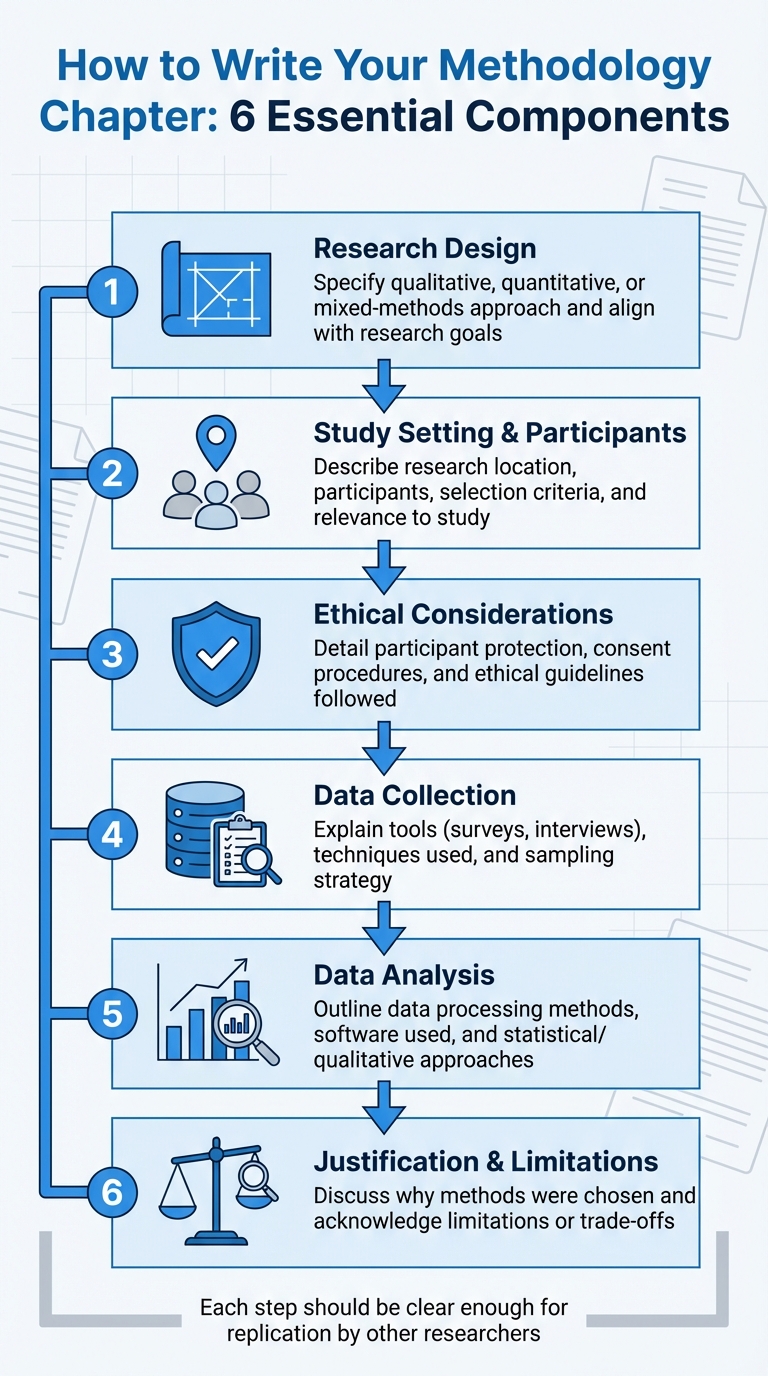
6 Essential Components of a Thesis Methodology Chapter
How to write a methodology section – structure it around these six key headings
sbb-itb-1831901
Key Parts of Your Methodology Chapter
Your methodology chapter is the roadmap of your research process, showing readers exactly how you carried out your study. Think of it as a guide for replication. As the University of Southampton Library explains:
"The methodology of a dissertation is like constructing a house of cards. Having strong and stable foundations for your research relies on your ability to make informed and rational choices".
This chapter usually accounts for 10% to 20% of your total thesis length, so you need to be selective about what to include. Its purpose is not just to outline what you did but to justify why those methods were the best fit for your research questions. These choices set the stage for explaining how you collected and analyzed your data.
Research Design and Approach
Your research design provides the structure for your study. Start by explaining whether you used a qualitative, quantitative, or mixed-methods approach, and connect this choice to your research goals.
For instance, if you're conducting a quantitative study, you might need a sample size of at least 300 participants to detect medium effects with α = .05 and a power of .80. For qualitative studies, data saturation typically occurs after 10 to 30 interviews, depending on your methodology. Be sure to specify your research strategy, such as experimental, case study, or ethnography.
Next, clarify your research philosophy. Did you adopt a positivist stance, which assumes there is one objective reality? Or did you follow an interpretivist perspective, which recognizes multiple subjective realities? This decision shapes how you gather and interpret data. Additionally, explain whether your study is cross-sectional (focused on a single point in time) or longitudinal (tracking changes over time). These choices are critical for ensuring your study is both credible and reproducible.
Study Setting and Participants
Describe the setting where your research took place and provide details about your participants. This information allows others to replicate your study, evaluate its relevance to other contexts, and assess its rigor.
Include your sample size, which should be determined through power analysis or data saturation, and explain how participants were recruited (e.g., through email, social media, or university networks). Clearly outline your inclusion and exclusion criteria.
The research setting is equally important. Whether you conducted your study in a lab, a clinical environment, a specific community, or online, this context helps readers understand potential biases and the appropriateness of the setting. Transparency here ensures readers can fully grasp the conditions under which your data was collected.
Once you've established the context and participants, the next step is to address ethical considerations.
Ethical Considerations
Ethical considerations are a cornerstone of any research project. This section should detail the steps you took to ensure the integrity of your study and the protection of your participants.
Start by describing how you obtained approval from an Institutional Review Board (IRB) or ethics board and followed informed consent procedures. Explain how you ensured participant anonymity and secured sensitive data. These measures are not just formalities - they demonstrate your commitment to ethical research practices.
If your study involved vulnerable populations or sensitive topics, highlight any extra precautions you took. For example, describe how you tailored your consent process or implemented additional safeguards to protect participants. These efforts show adherence to institutional ethical standards and help build trust in your findings.
Data Collection Methods
After establishing your research design and ethical considerations, it's crucial to detail how you gathered your data. This section explains the tools and techniques you used and why they were suitable for your research questions. Providing these specifics not only strengthens the credibility of your methodology but also reinforces the structure of your thesis.
As Hamed Taherdoost from University Canada West states:
"One of the main stages in a research study is data collection that enables the researcher to find answers to research questions".
Offer enough detail to make your process replicable. Clearly outline each step and specify the instruments used. Start by discussing your sampling strategies, then dive into the tools and techniques employed.
Sampling Strategies
Your sampling strategy determines the scope and relevance of your study. It directly affects the validity of your findings. Begin by clarifying whether you relied on probability sampling (random selection for generalizable results) or non-probability sampling (targeted selection for deep insights or niche populations).
For quantitative research, justify your sample size. For instance, one study aimed for 350 participants to ensure generalizability, ultimately collecting 371 usable responses after filtering incomplete surveys. In qualitative studies, data saturation often occurs after conducting 10 to 30 interviews.
Make sure your sample aligns with your research goals. This alignment helps readers understand how well your findings might apply to other settings.
Once your sample is defined, move on to the instruments you used for data collection.
Instruments and Techniques
Detail the specific tools you used to collect your data, whether they were surveys, interviews, observations, or experiments. Each method has its strengths and weaknesses.
- Surveys are effective for reaching large, dispersed groups and are easy to analyze statistically. However, they can suffer from response bias and low participation rates. For example, a study on paramedic confidence levels anticipated an 83% response rate for questionnaires but achieved only 26%, highlighting the challenge of non-response bias.
- Interviews allow for in-depth exploration and high response rates but can be time-consuming, costly, and subject to interviewer bias.
- Focus groups, typically involving 6 to 12 participants with shared characteristics, generate rich insights through group dynamics but can be challenging to manage.
If you created your own instruments, pilot testing is essential to identify and address any ambiguities. For surveys, consider placing sensitive or demographic questions at the end to build trust and reduce early drop-out rates. If applicable, include the results of your pilot testing to demonstrate the reliability of your tools.
Also, specify the software and tools used for data analysis. Mention programs like SPSS, Stata, R, NVivo, or Atlas.ti to show your methodological rigor and support replicability. Providing these details ensures transparency and helps others evaluate the reliability of your research process.
Data Analysis Methods
Once you've gathered your data, the next step is to explain how you processed and interpreted it. This section walks through your analysis process, showing how raw data transforms into clear results. The goal is to provide enough detail so other researchers can replicate your work.
Start with your data preparation steps. Describe how you cleaned the dataset, dealt with missing values, and handled outliers or extreme responses. For quantitative studies, mention the software you used - whether it was Excel, SPSS, Stata, R, or Python. For qualitative research, specify tools like NVivo or Atlas.ti, and include version numbers for clarity.
Next, outline your analytical strategy. For quantitative research, detail the statistical tests you performed, such as regression analysis, ANOVA, or t-tests. For qualitative work, explain your approach, whether it involved thematic analysis, grounded theory, or discourse analysis. Make sure to connect each technique directly to your research questions.
As Johnson points out, "The methods section is also an argument, meaning that it aims to convince your reader of the value of your method through a narrative that briefly applies your method to the context of your research". This approach helps justify your choice of techniques and tools.
Analysis Techniques and Tools
The methods you choose depend on the type of research and the questions you're addressing. For quantitative studies, specify the statistical tests you conducted, explain why you chose them, and describe how you checked assumptions like normality or multicollinearity. For qualitative research, detail your coding methods - whether open, axial, or selective - and note whether you transcribed interviews verbatim or summarized general ideas.
Be specific about the software you used and why you chose it. For example, if you used R, mention the specific packages, such as sandwich or lmtest. If SPSS was your tool for running a two-way ANOVA, state that clearly. This level of detail ensures your analysis can be replicated.
Also, include the steps you took to ensure validity, reliability, or trustworthiness. Techniques like triangulation or member checking can help reinforce the credibility of your analysis.
Once your techniques are laid out, connect them to your study's theoretical framework.
Theoretical Framework
Your analytical methods should align closely with your theoretical framework. This ensures that your interpretation of the data reflects your research philosophy. For instance, positivist approaches often guide quantitative hypothesis testing, while interpretivist frameworks are more suited to qualitative coding and theme development.
Explain how your theoretical framework influenced your analytical choices. For example, if you employed grounded theory, justify why this exploratory method fits your study - perhaps because there’s limited prior research in your area. Similarly, if you used content analysis, explain how its structured approach to identifying word frequencies and themes supports your research questions.
Explaining Your Methodological Choices
After outlining your research design, data collection, and analysis, it's time to explain why you made those specific choices. This section ties your methods directly to your research questions, creating a clear argument for their relevance. As Derek Jansen puts it, "The methodology chapter should explain how you designed your study and why you made those choices".
The goal here is to demonstrate that your methods are not arbitrary but are carefully selected to address your research aims. For example, combining qualitative insights with quantitative data can validate both individual experiences and broader patterns.
Reasons for Your Method Selection
Each method you chose should be directly linked to your research question, with support from established literature. For instance, if you opted for grounded theory, you might explain that it’s ideal for exploratory studies with limited prior research. If surveys were your choice, you could highlight their efficiency in collecting large datasets with strong representativeness.
It’s also helpful to compare your chosen methods with alternatives you considered. Take, for example, the thesis "Exploring the indirect effects of climate change on fire activity in Australian wet Eucalypt forests." The author, Brown, justified their selection of specific instrumented sites by comparing forest structural properties derived from lidar data at these sites to stratified, randomly sampled points across the landscape. This comparison showed that CH95 and LPI0.5 values fell within one standard deviation of the 1:1 line, underscoring the representativeness of the chosen sites.
Don’t shy away from discussing practical trade-offs. Constraints like time or budget often require compromises. For example, while a larger sample size might have been ideal, limited resources could have made it unfeasible. Acknowledging such decisions shows that you’ve carefully weighed the ideal against the practical.
Acknowledging Limitations
No methodology is perfect, and addressing limitations shows that you’ve critically evaluated your approach. The key is to differentiate between manageable constraints and critical flaws. For instance, a smaller-than-desired sample size is a manageable constraint, while using a tool that doesn’t effectively measure your key variable would be a critical flaw.
Frame limitations as intentional trade-offs. A narrow geographic focus may reduce generalizability but allow for greater depth and consistency. Similarly, a cross-sectional design might limit causal conclusions but prove efficient for capturing a snapshot of the phenomena under study.
Finally, detail how you mitigated these limitations. If your sample size was small, perhaps you conducted in-depth interviews to gain richer insights. If subjectivity was a concern in qualitative research, you might have used techniques like member checking or triangulation to enhance reliability. By addressing these challenges head-on, you highlight the thoughtful and deliberate nature of your methodological choices.
Using Yomu AI for Your Methodology Chapter

Crafting a methodology chapter requires precision in both content and formatting. To simplify this demanding process, tools like Yomu AI can be incredibly helpful. Yomu AI combines writing assistance with features like citation management and verification tools. It connects to the Semantic Scholar database, which houses over 200 million academic papers, giving you access to methodological frameworks and prior studies that can support your research design.
Citations and Plagiarism Checking
Citations in a methodology chapter are critical - they link your work to established frameworks, tools, and previous studies. Yomu AI's citation tool, powered by Sourcely, helps you find and format references directly in your document. It also syncs with platforms like Zotero, Mendeley, and EndNote, ensuring your references stay updated.
One standout feature is the Hallucination Shield, designed to tackle a common problem in AI-assisted writing: fabricated references. This tool flags questionable claims or sources that may not exist, ensuring all your citations are backed by real academic material. Running this check on your methodology section ensures that technical references and software citations are accurate.
Yomu AI also includes an advanced plagiarism checker. Before submission, this tool reviews your document to ensure originality, even when describing established methods. As Shuji Yamamoto, CEO of Yomu.ai, puts it:
"Yomu.ai is a one-stop shopping tool that not only supports writing academic papers with text creation tools but also allows for the insertion of figures and tables... It also features a citation search function, making it particularly efficient for students who are not accustomed to writing papers in journal formats".
By combining citation management with tools to maintain accuracy and originality, Yomu AI simplifies one of the most challenging parts of academic writing.
Writing and Editing Support
Yomu AI also offers tools to refine your writing and editing process. Features like the Document Assistant, AI Autocomplete, and paraphrasing tools ensure your methodology chapter maintains a consistent academic tone and polished style. The Document Assistant provides targeted feedback on specific sections, helping you improve explanations of research design or data collection methods.
For researchers working from outlines or drafts, Yomu AI’s bullet-to-text tool transforms rough notes into well-structured academic prose. It also allows you to insert figures and tables directly into your text, complete with proper captions and formatting - ideal for presenting study settings, sampling methods, or data analysis workflows. Dr. Lauren Martinez, a neuroscience researcher, shares her experience:
"The integration between our writing platform and research databases has reduced my literature review time by approximately 40%. I can now discover, evaluate, and cite relevant papers without constant context switching".
With tools to streamline both writing and editing, Yomu AI helps researchers focus on what matters: presenting their methodology clearly and effectively.
Conclusion
A well-crafted methodology chapter is the backbone of your thesis. It’s not just about listing the steps you took - it’s about presenting a structured approach that reflects academic rigor and builds trust in your findings. Research shows that a detailed methodology can increase citation rates and bolster the credibility of your study.
Think of your methodology as a recipe another researcher could follow to replicate your work. Every decision - from research design to sampling methods and analysis techniques - needs to be clearly explained and justified. By outlining how you collected and analyzed your data, you transform subjective opinions into evidence that others can verify.
Don’t shy away from addressing limitations. Acknowledging trade-offs and constraints doesn’t weaken your work; it highlights your intellectual honesty. Each choice you make, whether in design or data analysis, plays a vital role in validating your research.
Tools like Yomu AI can simplify the process by managing citations, using a plagiarism checker, and polishing your academic writing. This frees you to focus on what matters most: explaining your research process and defending your decisions with clarity.
Your methodology chapter isn’t just a formality - it’s the framework that supports every argument you’ll make in your results and discussion. A clear and precise methodology strengthens your thesis from the ground up.
FAQs
How do I choose between qualitative, quantitative, or mixed methods?
When deciding on a research approach, it's all about aligning your methods with your questions and goals.
- Qualitative methods are ideal if you're digging into the "why" and "how" behind a phenomenon. These focus on words, ideas, and deeper understanding.
- Quantitative methods work best when you're measuring, testing hypotheses, or analyzing patterns through numbers and statistics.
- Mixed methods combine the strengths of both, giving you a broader perspective to tackle complex questions from different viewpoints.
What details make my study replicable in the methodology chapter?
To make your study easier to replicate, provide a detailed account of your research design, participant or sample selection, data collection methods, and analysis techniques. Be specific about the steps you followed, the tools or materials you used, and the criteria you applied when choosing participants or data points. It's also important to explain why you made these methodological decisions and how others can follow the same process to replicate your results.
How do I justify my methods and limitations without weakening my thesis?
To explain your methods and limitations effectively, focus on demonstrating that your choices align with your research objectives. Clearly articulate why you selected particular methods, comparing them to other possible approaches and pointing out their advantages. When discussing limitations, be upfront about any weaknesses, but also highlight the steps you took to address or minimize their impact. Citing relevant studies and literature not only supports your reasoning but also enhances the trustworthiness of your work.