
Opinion Essay Examples: 8 Model Essays Explained Paragraph by Paragraph
If you want to write a strong opinion essay, this article gives you the pattern right away: a 5-paragraph setup, a clear thesis, 2 main reasons, 1 paragraph that deals with the other side, and a closing paragraph that restates the claim in new words.
I’d sum up the article like this: don’t copy the sample essays - copy the structure. The 8 examples cover school topics like homework, college funding, digital devices, testing, social media, uniforms, PE, and remote learning. In each one, every paragraph has one job: introduction, reason 1, reason 2, counterpoint + response, and conclusion.
Here’s the main takeaway you can use at once:
- Start with a clear opinion
- Preview your reasons in the intro
- Give one main point per body paragraph
- Use facts, examples, and explanation together
- Deal with the other side without losing your claim
- End by restating the thesis, not by adding new proof
Quick comparison of the 8 model essays:
| Essay topic | Main claim type | Main body pattern | What it teaches |
|---|---|---|---|
| Homework | Against heavy required homework | Inequality, stress, limits of gains | How to argue against a common school rule |
| College funding | For more public funding | Access, workforce, long-term return | How to build a policy argument |
| Digital devices | Mixed position | Access, engagement, limits/rules | How to argue for a middle ground |
| Standardized testing | Against heavy use | Student harm, narrow teaching, other assessment methods | How to critique a school system |
| Social media and teens | Mostly harmful | Mental health, some upsides, role of support | How to use a qualified claim |
| School uniforms | For uniforms | Equity, self-expression, cost | How to answer a common objection |
| Mandatory PE | For PE | Health, learning, scheduling concerns | How to defend a school subject |
| Remote learning | For hybrid remote options | Flexibility, course access, support needs | How to argue for a balanced solution |
The article’s big lesson is simple: when the thesis and topic sentences line up, the essay makes sense fast. That’s what these models are there to show.
How To Write An Opinion Essay in 8 Steps (with examples) 📝
sbb-itb-1831901
How to Read These Opinion Essay Models
Each of the eight numbered examples that follow includes two parts: a full model essay and a paragraph-by-paragraph breakdown. Read the essay once from start to finish so you can catch the writer’s main claim. Then go back and read it a second time, matching each paragraph to the job it does.
As you move through each model, watch for nine specific moves: the hook (the opening line that pulls the reader in), background (the context that sets up the issue), and thesis (the writer’s clear position, often at the end of the introduction). In each body paragraph, spot the topic sentence (the reason stated up front), the evidence (a fact, statistic, or example), and the explanation (the writer’s comments that tie the evidence back to the thesis). Then find the counterargument (a fair summary of the other side), the rebuttal (the writer’s answer to it), and the conclusion move (a restatement of the thesis plus a final thought or call to action).
Use these labels as you read. Try marking each move as H for hook, B for background, T for thesis, TS for topic sentence, Ev for evidence, Ex for explanation, CA for counterargument, R for rebuttal, and C for conclusion. If you’re working on paper, use colored marks. In Google Docs, use comments.
All eight essays use U.S. spelling such as “behavior” and “favor.” The topics also reflect common U.S. school debates, so they should feel familiar.
"Topic sentences do three jobs: Tell you what to research next, keep paragraphs from becoming grab-bags of quotes, [and] make transitions obvious." - Daniel Felix, Author
Don’t copy the wording. Copy the structure. Once you can see how each paragraph earns its place, you can use that same pattern for any school topic you want to write about. With that key in hand, start with Example 1 and trace how each paragraph works.
1. Should Students Be Required to Do Homework?
Model Essay
In the United States, high school students usually spend about an hour on homework each school night, but some students deal with workloads that go past two hours a night. That difference between the average and the upper end points to a bigger issue: is it fair or useful to require homework for every student in the same way? Students should not be required to complete large amounts of daily homework because too much homework widens inequality, adds harmful stress, and gives less academic payoff after a reasonable daily limit.
Required homework can widen the achievement gap for reasons that have little to do with effort or skill. Research on the "homework gap" shows that students without steady internet access, a quiet place to study, or an adult who can help are much more likely to skip assignments or turn them in only partly done. When homework is required and graded, those home-resource differences turn into lower grades and lost credit. Students from well-resourced homes can turn extra assignments into extra practice and better scores, while students from under-resourced homes face penalties that can deepen frustration and self-doubt. In public schools, requiring large amounts of homework without taking those differences into account builds inequality right into the grading system.
Heavy homework loads also affect student health. A 2019 survey found that more than 54% of U.S. teenagers feel stress tied to homework, and among students in grades 9–12, 63% report homework-related stress, with 46% saying they feel that pressure every day. Stanford research links heavy workloads to headaches, stomach problems, and sleep deprivation. When students spend hours each night finishing assignments, homework pushes aside sleep, sports, jobs, and time with family. By morning, many are simply worn out. Schools that require heavy homework may get more assignments turned in, but they do it at the cost of student well-being.
Supporters of required homework do have evidence on their side. Meta-analyses show that 64%–72% of studies find homework effective at improving academic achievement in grades 6–12, and one high school study found that students who spent 31–90 minutes per day on homework scored about 40 points higher on the SAT Math subtest than students who did no daily homework. But Harris Cooper's research also shows that homework gains level off at about 90 minutes to 2½ hours per night for high school students. After that point, more time is not linked to higher grades and may connect to worse outcomes. The National Education Association and National PTA support a "10-minute rule" - about 10 minutes of homework per grade level per night - yet typical schedules across several classes often go past that limit. So yes, homework can help. The problem is that current practice often goes too far.
Given that heavy homework requirements deepen the homework gap, add to student stress, and provide only limited academic gains past a reasonable amount of time, schools should rethink when and how they require assignments. Moderate, well-planned homework can support learning, but blanket rules ignore differences in home life and student health. Districts could set evidence-based time limits, shift more practice into class, and offer optional targeted assignments.
Paragraph-by-Paragraph Breakdown
This example shows how one clear position can grow into a full five-paragraph argument.
Paragraph 1 - Introduction
The opening sentence works as the hook: a concrete U.S. statistic about average nightly homework time, followed right away by the fact that some students face much heavier loads. The next sentence gives background by setting up the fairness issue the essay will answer. The final sentence is the thesis. It takes a clear stand and previews three reasons - inequality, stress, and diminishing returns - that the body paragraphs develop one by one.
Paragraph 2 - Body Paragraph 1 (Inequality)
The topic sentence states the claim in plain terms: required homework widens the achievement gap. The evidence comes from research on the homework gap, which shows that students without home resources are more likely to skip assignments or finish only part of them. The explanation then ties that evidence back to the thesis. It shows how graded, required homework turns differences in home resources into differences in grades, which means students are punished for circumstances outside their control rather than for a lack of effort.
Paragraph 3 - Body Paragraph 2 (Stress)
The topic sentence moves the argument to student health. The evidence is specific and sourced: 54% of U.S. teenagers report homework-related stress, 63% of high school students feel it, and Stanford research connects heavy workloads to physical symptoms. The explanation lays out the chain clearly - time spent on homework is time taken away from sleep, exercise, and family life. That point links back to the thesis by arguing that required high-volume homework swaps one measurable result, assignment completion, for another, student exhaustion.
Paragraph 4 - Counterargument and Rebuttal
This paragraph starts by fairly presenting the other side: meta-analyses and SAT data show that homework can improve achievement, especially in high school. That move makes the essay stronger because it shows the writer is not ignoring contrary evidence. The rebuttal then narrows the claim instead of rejecting it outright. Cooper's research shows that the gains flatten around 90 minutes, and the NEA/PTA 10-minute rule is often exceeded in practice. In other words, homework may help, but not in its current high-volume, required form.
Paragraph 5 - Conclusion
The thesis restatement brings the three reasons together without copying the original sentence word for word. The synthesis shows that both time and assignment design matter. The forward-looking statement ends with a concrete policy direction - evidence-based time limits, in-class practice, and optional targeted assignments - so the essay closes with a practical next step instead of a vague call for change.
Example 2 uses the same structure for a different school debate.
2. Should College Education Be Publicly Funded?
Model Essay
In 2025–26, in-state students at public four-year colleges faced average published tuition and fees of $11,950, while the median outstanding student loan balance was between $20,000 and $24,999. For many families, college doesn’t feel like a clear path up. It feels like a bet with a hefty price tag. Public colleges in the United States should receive more public funding because it opens doors to economic mobility, helps build a stronger workforce, and can pay back more over time than it costs up front.
High tuition hits low- and middle-income students the hardest. In 2024–25, even after grant aid, first-time full-time in-state students at public four-year colleges still had to cover an estimated average of $15,790 for tuition, fees, housing, and food, plus about $4,990 for books, transportation, and other costs. The average Pell Grant in 2023–24 was $4,930 per recipient, which covered only part of that total. When students from lower-income households have to choose between heavy borrowing and giving up on college, the loss doesn’t stop with them. The country misses out on people who could have gone on to work, pay taxes, and add to their communities. More public funding lowers that wall.
There’s also a national payoff. College graduates tend to earn higher median incomes and face lower unemployment, and public colleges train workers for fields the country needs, including healthcare, engineering, and technology. When more people can earn degrees without carrying crushing debt, they have more room to build careers, spend money, and contribute to the tax base. That strengthens the economy in a direct way.
Critics make a fair point: more public funding means more government spending, and taxpayers foot the bill. That concern is real. State and local education appropriations were already 17.9% above 2019 pre-pandemic levels in 2025, or an extra $1,774 per full-time equivalent student. But that trend also shows that public investment in higher education is already moving up. If that spending leads to more graduates, higher earnings, and less need for social support later, a good share of the cost can come back over time.
Public funding for college is not just money handed out with no return. It is a long-term investment in access, workforce strength, and shared economic growth. The pattern in the evidence points the same way: when tuition stays high, qualified students get pushed out, and that price is paid far beyond the campus gates.
Paragraph-by-Paragraph Breakdown
Here’s how each paragraph builds the argument.
Paragraph 1 - Introduction
The first two sentences set up the issue with tuition and debt figures. The last sentence gives the main claim and previews the three reasons: economic mobility, workforce needs, and long-term fiscal payoff.
Paragraph 2 - Body Paragraph 1 (Access and Equity)
The topic sentence makes the point directly: high tuition weighs most on lower-income students. The evidence is concrete: the $15,790 estimated annual cost after grant aid, the extra $4,990 in other expenses, and the $4,930 average Pell Grant that does not cover enough. The explanation links those numbers back to the thesis by showing what happens when students face a harsh choice between debt and no college at all.
Paragraph 3 - Body Paragraph 2 (Workforce and National Returns)
The topic sentence shifts from personal access to the country’s gain. The evidence shows that graduates tend to earn more, face lower unemployment, and fill jobs in healthcare, engineering, and technology. The explanation ties that back to the main claim: when graduates aren’t weighed down by debt, they are in a better spot to work, pay taxes, and help the economy.
Paragraph 4 - Counterargument and Rebuttal
This paragraph presents the cost objection, then pushes back by arguing that long-term fiscal gains can offset much of the expense. That keeps the counterargument grounded instead of brushing it aside. The evidence notes that state and local appropriations were already 17.9% above pre-pandemic levels, or $1,774 more per full-time equivalent student.
Paragraph 5 - Conclusion
The conclusion returns to the thesis by framing public funding as an investment, not a handout. It pulls together the three main points - access, workforce strength, and economic return - so the essay ends on a practical, policy-focused note.
3. Should Schools Integrate More Digital Devices and Apps in Everyday Instruction?
Model Essay
Digital devices are already part of daily life for many students. But classrooms still differ a lot in how they use them, and how often. Schools should bring digital devices and apps into everyday instruction, but not in a free-for-all way. Teachers need clear rules, limits on off-task use, and sensible screen-time boundaries. When used with care, digital tools can improve learning. When used poorly, they can pull students off track.
Digital devices give students faster access to information and can make learning fit the student better. A student who has trouble with math can use an adaptive app and work at a pace that suits them, while a student who is ready for more can move ahead. Apps can also help English language learners with built-in translation and text-to-speech, and they can help students with learning disabilities through assistive tools that are hard to match in a paper-and-pencil classroom. By the start of the 2021–22 school year, 96% of public schools were providing digital devices to students who needed them. At this point, access is close to universal. So the main issue is no longer whether students can get devices. It is whether schools are using them with purpose.
Devices can also make lessons more engaging when there is a clear learning goal behind them. In science, a virtual simulation lets students test variables that might be too expensive or unsafe in a physical lab. In history, students can study digitized primary sources instead of relying on one textbook. In a shared document, classmates can give and get feedback right away. That is the key idea here: not more screen time for its own sake, but better use of screens for research, practice, collaboration, and accessibility.
The biggest risk is not the devices alone. It is what happens when no one manages their use. OECD data found that 65% of students across OECD countries reported being distracted by digital devices during at least some math lessons. Students distracted by peers using devices scored about three-quarters of a school year lower in math. OECD also reports that, on average across OECD countries, students who spent up to one hour a day on digital devices for leisure at school scored 49 points higher in math than those who spent five to seven hours a day on screens for leisure. Those numbers do not make the case against technology. They make the case against unmanaged use. Schools that turn off notifications, set clear device rules, and limit personal phone use during instruction can keep many of the gains while cutting down on the harm.
Digital tools are a resource, not a shortcut. They help most when teachers connect them to clear goals and manage how students use them. Schools that bring devices into instruction with care, instead of using them everywhere or avoiding them altogether, give students both the skills and the judgment they will need beyond the classroom.
Paragraph-by-Paragraph Breakdown
Here is how each paragraph builds the argument.
Paragraph 1 - Introduction
The opening starts with a plain fact students know from daily life: devices are already around them all the time. The thesis comes at the end of the paragraph and takes a middle position - yes to using devices in class, but only with teacher guidance, clear limits, and balance. That sets up the rest of the essay: two reasons in favor, followed by the concern about distraction.
Paragraph 2 - Body Paragraph 1 (Access and Personalized Learning)
The topic sentence centers on access and personalized learning. The evidence includes the statistic that by the start of the 2021–22 school year, 96% of public schools were providing digital devices to students who needed them. The explanation then shifts the debate. If access is mostly in place, the harder question is how schools use devices in class. The examples - adaptive math apps, translation tools, and assistive features - show what that can look like in practice.
Paragraph 3 - Body Paragraph 2 (Engagement and Digital Literacy)
The topic sentence says that devices can boost engagement when they serve a clear purpose. The evidence comes from classroom examples such as science simulations, digital primary sources, and live peer editing. The explanation ties those examples back to the thesis by showing that tech works best when it supports a specific task, not when it is added just because it is there. The last sentence pulls the paragraph together by naming four areas where this use pays off: research, practice, collaboration, and accessibility.
Paragraph 4 - Counterargument and Rebuttal
This paragraph treats the distraction issue seriously instead of brushing it aside. The evidence is concrete: 65% of OECD students reported being distracted by digital devices during at least some math lessons. Students distracted by peers using devices scored about three-quarters of a school year lower in math. OECD also reports that students who spent up to one hour a day on digital devices for leisure at school scored 49 points higher in math than those who spent five to seven hours a day on screens for leisure. The rebuttal is straightforward. The argument is not that distraction does not exist. It is that the bigger problem is unmanaged use, not the tools themselves. Schools that limit notifications and set firm device rules can lower distraction without getting rid of the tools.
Paragraph 5 - Conclusion
The conclusion restates the thesis in direct language: digital tools are a resource, not a shortcut. It brings together the three main ideas - personalized access, engagement, and careful management - and closes with a practical point: schools that use devices with care help students build both skill and judgment for life beyond school.
4. Does Standardized Testing Help or Harm Student Learning?
Model Essay
Read the essay first, then match each paragraph to its job in the breakdown.
Each year, millions of U.S. students sit for standardized tests that can shape school accountability, grade promotion, and graduation. Supporters say these exams offer a fair way to compare students and schools. Critics argue that they pull learning off course. Although standardized tests can offer useful data, schools often use them in ways that deepen inequity, narrow instruction, and push aside richer forms of assessment.
First, high-stakes tests hit low-income students, students of color, and English learners the hardest. Research shows again and again that students in these groups are more likely to fail exit exams, repeat a grade, or lose a diploma because of test scores, often with little long-term academic gain. Failing a graduation exam is linked to higher dropout rates and weaker job prospects. The problem goes deeper than outcomes alone. Test questions and formats can carry cultural and language bias, and scores often reflect uneven access to strong teaching more than actual ability. A system that claims to be neutral should not punish the students already facing the steepest barriers.
Second, high-stakes standardized testing often shrinks classroom learning, pushing teachers to chase scores instead of deep understanding. When schools are under pressure to boost results, they spend more time on tested subjects and basic skills, while science, social studies, the arts, and higher-order thinking get squeezed out. Classrooms can slide into drill-and-practice worksheets and endless test runs. That may lift multiple-choice scores, but it leaves students less ready to apply what they know, work with others, or solve hard problems. Research also shows that cortisol levels in students climb sharply - on average about 18% - during high-stakes exams, showing a measurable physical stress response. When a system rewards test prep over real learning, it sends a plain message: scores matter more than knowledge.
Finally, schools should rely less on high-stakes standardized tests and use richer ways to assess learning. A mix of test scores, classroom grades, teacher observations, student work samples, and local assessments gives a fuller picture and makes it less likely that one test day will shape a student's future. Performance tasks, portfolios, and capstone projects ask students to show writing, problem solving, and teamwork - skills that matter beyond school. When schools do use standardized tests, those tests should be shorter, more diagnostic, and used mainly to spot student needs rather than punish schools or students. Supporters are right to say that tests can reveal achievement gaps and help direct resources where they are needed most, but those goals can be served better through redesigned assessments and more equitable policies.
Taken together, the evidence shows that heavy reliance on standardized tests is hurting, not helping, student learning in U.S. schools. These exams land hardest on communities already facing the biggest obstacles, steer teachers toward narrow test prep instead of deep learning, and crowd out fairer assessments that could show a fuller picture of what students know and can do. If we want tests to serve students, we need an assessment system that measures what matters most: real, lasting learning.
Paragraph-by-Paragraph Breakdown
Here is how each paragraph builds the argument.
Paragraph 1 - Introduction
The opening starts with a clear, student-focused fact: millions of students take tests that can shape their futures. The next two sentences give brief context, defining the debate in plain terms and showing both sides. The last sentence states the thesis. It points ahead to the three main ideas: equity, instruction, and alternatives.
Paragraph 2 - Body Paragraph 1 (Fairness and Equity)
The topic sentence makes the main claim right away: these tests harm some groups of students more than others. The paragraph then uses research on exit exams, diploma denial, and dropout risk to show direct harm. After that, it explains why this matters for learning, since students who get penalized by the system may pull back from school. A second part of the evidence looks at bias in test design and the way scores can reflect unequal access to resources more than ability. The last sentence ties the paragraph back to the thesis by challenging the idea that a system like this helps learning.
Paragraph 3 - Body Paragraph 2 (Instructional Impact)
The topic sentence shifts the focus to what testing pressure does inside classrooms. The evidence shows curriculum narrowing - less time for non-tested subjects and higher-order thinking - and a move toward drill-based instruction. The stress data adds one more form of harm that can be measured. Each part of the evidence is followed by an explanation of how learning suffers: lower engagement, less ability to apply knowledge, and a warped sense of what school is for. The last sentence brings the paragraph's main idea back in a way that sticks.
Paragraph 4 - Body Paragraph 3 (Reforms and Alternatives)
This paragraph moves from critique to solutions. It offers three clear reforms: using multiple measures, adding performance-based assessments and portfolios, and redesigning tests so they diagnose rather than punish. Just as important, the paragraph includes a concession - supporters are right that tests can reveal gaps and help direct resources - then answers that point by arguing those goals are served better through redesigned systems. That move makes the essay stronger because it shows the writer has taken the other side seriously.
Paragraph 5 - Conclusion
The conclusion restates the thesis in new language. It pulls the three main reasons together in two sentences, then ends with a forward-looking call for an assessment system centered on real learning. The tone stays firm without sounding dismissive, showing how a strong conclusion should synthesize ideas rather than just repeat them.
5. Is Social Media Overall Beneficial or Harmful for Teenagers?
Model Essay
Nearly 95% of U.S. teens use at least one social media platform, and about one-third say they are online "almost constantly." Social media is woven into daily teen life. But when use is heavy and unchecked, it does more harm than good because it increases mental health risks and can warp self-image.
The biggest problem is mental health. Teens who spend more than 3 hours per day on social media face roughly double the risk of depression and anxiety compared with those who use it less. Among the heaviest users, 10% reported suicidal intent or self-harm in the past year, compared with 5% of the lowest-use group, and 17% reported poor body image, compared with 6% of the lowest-use group. Those figures hit hard for a reason. Constant comparison and a steady stream of polished, idealized images can add stress and chip away at self-esteem. Passive scrolling, especially late at night, has the strongest ties to poor mood and lost sleep. A tool that often leaves teens feeling worse about themselves isn't just harmless background noise.
Still, social media can help some teenagers in real ways. Many use it to stay in touch with friends, find groups built around shared interests, and get peer support after school hours. For teens who feel alone offline, those spaces can ease loneliness and offer fast access to useful information, including mental health resources. The key difference is how they use it: active use - posting, learning, talking with others - seems less risky than passive scrolling. So yes, there are upsides, but they depend a lot on active use and adult support.
Even then, context matters. Among high-frequency users with weak parental relationships and little monitoring, 22% reported thoughts of suicide or self-harm. That number fell to just 2% among equally heavy users who had strong parental relationships and active monitoring, which shows that harm is not automatic and can drop when teens have support and structure. But many teens don't have that kind of steady guidance, and that's why the overall balance still leans negative.
The evidence points in one direction: heavy, unmanaged social media use can damage teen mental health. Connection and self-expression can happen on these platforms, but they rely on boundaries, media literacy, and guidance from parents or schools. Until those supports are more common, social media leans harmful for teenagers.
Paragraph-by-Paragraph Breakdown
Here is how each paragraph builds the argument.
Paragraph 1 - Introduction
The opening uses a hard number right away to show how common social media is in teen life. The thesis ends the paragraph with a clear position, but it also adds an important limit: social media is overall more harmful than helpful mainly when use is heavy and unmanaged. That small qualifier makes the claim more fair and easier to defend.
Paragraph 2 - Body Paragraph 1 (Mental Health Risk)
The topic sentence states the main harm without dancing around it. Then the paragraph adds two kinds of proof: a time-use finding about 3 hours per day and a comparison between the highest and lowest user groups on self-harm and body image. After the numbers, the essay explains why they matter by linking them to comparison, idealized images, stress, and self-esteem. It ends by pointing to the use pattern most tied to harm: passive scrolling at night. That level of detail gives the argument more force.
Paragraph 3 - Body Paragraph 2 (Genuine Benefits)
This paragraph gives the other side a fair hearing. It points to real upsides - friendship, community, and access to support - and connects them to the research. More importantly, it brings in the difference between active and passive use, which is the key nuance in the essay. The closing concession matters: the upsides are there, but they depend on active use and adult guidance. That keeps the essay balanced without blurring its main claim.
Paragraph 4 - Body Paragraph 3 (The Role of Context)
Here, the focus shifts from what social media does to why results can look so different from one teen to another. The parental monitoring data is the strongest proof in the essay because it shows a 20-point gap in self-harm reports among heavy users based on support at home. The paragraph uses that finding to show that harm is not guaranteed, then turns back to a tougher truth: many teens lack the support that helps lower risk. That back-and-forth makes the argument feel more human and more convincing.
Paragraph 5 - Conclusion
The conclusion restates the thesis in new words and keeps the focus on the main judgment. It points back to the role of boundaries, media literacy, and guidance from parents or schools without piling on new evidence. Instead of repeating the whole essay, it pulls the main ideas together and leaves a clear final view: social media can help teenagers, but for many of them, the downsides still outweigh the upsides.
6. Should Public Schools Require Uniforms?
Model Essay
About 1 in 5 U.S. public schools now require uniforms, up from fewer than 3% in the mid-1990s. Even so, people still argue hard about whether all public schools should do the same. Public schools should require uniforms because they promote equity among students, shift self-expression into better outlets, and can cut clothing costs for families.
The clearest argument for uniforms is equity. When students wear the same clothes, it's much harder to spot who has money for expensive brands and who doesn't. Research shows that in schools with uniform policies, fashion bullying and clothing-related social pressure are much lower, and both students and teachers connect uniforms with less socioeconomic division and more inclusion. One middle school study found that after uniforms were introduced, police log reports fell by 63% in the first year, and students reported fewer discipline issues and less gang involvement. Take brand competition out of the school day, and students can pay less attention to labels and more attention to what they do.
Uniforms do limit clothing choices, but they don't erase self-expression. Students still show who they are through hairstyles, accessories, clubs, sports, and classwork. In fact, 54% of students in one Nevada middle school study said they still had their identity when they wore a uniform. That shift matters. It moves attention away from brands and toward interests, effort, and talent, which can ease the pressure to keep up with fashion trends.
Uniforms can also make school clothing costs simpler and, over time, lower for many families. Without a uniform policy, families can spend $300–$500 a year on school clothes, while a basic uniform set usually costs $200–$300 and can be reused or handed down. In the same Nevada study, about 50% of students said uniforms save money on clothes. Some districts also offer assistance programs for low-income families, which can make the up-front cost easier to handle.
Public schools should require uniforms because the policy deals with three school-day problems at once: visible income gaps, clothing pressure, and uneven family costs. Pair the rule with inclusive design, religious accommodations, and family support. Then uniforms stop being just about sameness and start being about making school a place where students can focus on learning.
Paragraph-by-Paragraph Breakdown
Here is what each paragraph is doing and why.
Paragraph 1 - Introduction
The opening starts with a clear statistic to show how common uniform policies already are, which grounds the debate in facts instead of theory. The thesis closes the paragraph and previews the three reasons - equity, self-expression, and cost - so the reader can see exactly where the essay is headed. That three-part preview turns the thesis into a roadmap, not just a personal view.
Paragraph 2 - Body Paragraph 1 (Equity)
The topic sentence makes a plain claim: uniforms promote equity. The paragraph then builds with two kinds of evidence - a finding about lower social pressure and a school-level figure showing a 63% drop in police log reports - and explains how those points connect. The last sentence ties the idea together: less brand competition can mean more focus on learning. That's the evidence-plus-explanation pattern at work.
Paragraph 3 - Body Paragraph 2 (Self-Expression)
This paragraph starts by naming the counterargument directly, which shows the essay is dealing with the issue in an open way. Then it turns the point: clothes are one form of self-expression, not the only one. The figure showing that 54% of students said they still had their identity while wearing a uniform works well because it comes from students themselves, not only from adults or researchers. The explanation links back to the thesis by showing that uniforms may lessen social pressure instead of just swapping one kind for another.
Paragraph 4 - Body Paragraph 3 (Costs)
The topic sentence presents cost as a practical reason, not just an extra perk. The comparison - $300–$500 versus $200–$300 - makes the point concrete and easy for U.S. families to picture. The student survey result, with 50% saying uniforms save money on clothes, adds a human voice to the numbers. Mentioning district assistance programs also answers the concern that uniforms might put pressure on low-income families, which helps the argument stay fair.
Paragraph 5 - Conclusion
The conclusion restates the thesis in new wording instead of repeating the introduction word for word. It quickly brings back all three reasons, then adds a practical condition: the policy works best when schools pair it with inclusive design and family support. That final move fits a common U.S. focus on fairness and practical problem-solving. It leaves the reader with a clear takeaway instead of a plain summary.
The next model uses the same five-paragraph structure on a different school policy topic.
7. Should Physical Education Be Mandatory Throughout High School?
Planning Table
| Advantages of Mandatory PE | Concerns About Mandatory PE |
|---|---|
| Helps students meet federal guidelines of at least 60 minutes of daily activity | Takes time away from AP courses or electives |
| School PE can account for roughly 40% of a teen's daily physical activity | Some students feel anxious or embarrassed in group settings |
| Can support learning outcomes | Poorly designed programs may demotivate students |
| Students who take PE are almost twice as likely to remain active into adulthood at healthy levels | Students already in sports may feel over-scheduled |
| Builds daily activity habits | Scheduling trade-offs can be difficult in crowded timetables |
Model Essay
Only about 17% of U.S. high school students meet current physical activity recommendations, or about 1 in 6. Many schools trim PE to make more room for tested subjects, but that trade-off can backfire. Physical education should be mandatory throughout high school because steady physical activity supports health, improves focus and learning, and helps students build habits that last. The first reason is simple: physical health.
The clearest case for mandatory PE is what it does for students' bodies. Federal guidelines say teens should get at least 60 minutes of physical activity daily, yet most do not reach that mark. School PE can make up roughly 40% of a student's daily activity, which means it is one of the steadiest ways many teens get enough movement. Regular activity lowers the risk of obesity, heart disease, and type 2 diabetes. It also cuts stress and can improve self-esteem. If PE is not required, a lot of students just will not move enough during the school day.
PE can also help students in class instead of pulling them away from schoolwork. A three-year study of physically active lessons found that students in the active group improved academic achievement by about 6%, while the control group had a 1% decrease. Another meta-analysis found gains in math achievement from school-based physical activity programs. That makes sense. Exercise supports executive function, including working memory, attention, and cognitive flexibility, which students rely on when they learn and take tests. The CDC even lists "improves grades and test scores" and "helps students focus while in class" as direct benefits of school PE.
Of course, the pushback is not hard to understand. Some people say PE takes time from AP classes or electives. Others worry about injuries, or point out that students who are not athletic may feel awkward or singled out. Those are fair concerns, but they say more about weak program design than about PE as an idea. Research shows that adding more PE time does not hurt test scores. In fact, moving from two days a week to daily PE was linked to better scores. Schools can also make PE work for more students by offering choices, such as personal fitness goals, non-competitive units, and a stronger focus on lifelong wellness instead of pure competition.
Physical education should stay required in high school because the evidence points in the same direction: it helps build healthier bodies and sharper minds. Cutting PE to protect academics can end up hurting both health and learning. A better move is to improve and update PE programs so that every student can take part and benefit, no matter their athletic skill.
Paragraph-by-Paragraph Breakdown
Here is what each paragraph is doing and why.
Paragraph 1 - Introduction
The opening uses a clear U.S. statistic: only about 17% of high school students meet daily activity guidelines. The next line gives context by noting that schools often cut PE to make room for tested subjects. That brings in the counterpoint early, which helps frame the debate. The thesis then lays out the essay's main reasons - health, focus, and long-term well-being. The last sentence acts as a bridge into the first body paragraph.
Paragraph 2 - Body Paragraph 1 (Health)
The topic sentence makes the main point right away: the strongest case for mandatory PE is physical health. The paragraph then adds two key pieces of evidence: federal activity guidelines and the finding that PE supplies roughly 40% of many students' daily activity. From there, it connects movement to lower disease risk and better mental well-being. The final sentence explains why that matters. Without required PE, many students are not likely to get enough activity during the day.
Paragraph 3 - Body Paragraph 2 (Focus and Learning)
This paragraph takes on the common claim that PE hurts academics by taking time away from class. Instead, it argues the opposite. The evidence includes a 6% academic gain in one study and math gains in a meta-analysis. The explanation then shows why this happens by pointing to executive function. That gives the paragraph more than just stats; it gives a cause. The CDC citation adds support from a national public health source.
Paragraph 4 - Body Paragraph 3 (Handling Objections)
This paragraph starts by stating the main objections plainly: scheduling pressure, injuries, and student discomfort. That makes the essay sound fair rather than one-sided. It then shifts to the main response: the problem is poor design, not PE itself. The evidence that daily PE is linked to better test scores answers the scheduling concern. The suggestions about student choice, non-competitive units, and fitness-based goals answer the concerns about discomfort and injury. The paragraph stays tight by tying each objection back to the same point.
Paragraph 5 - Conclusion
The conclusion restates the thesis in new words by saying PE supports healthier bodies and sharper minds. It then adds one more idea: schools may hurt academic goals when they cut PE to protect them. That gives the ending a bit more force. The final sentence shifts from argument to policy by calling for stronger, updated PE programs instead of removal.
The next model applies the same structure to remote learning.
8. Should Schools Offer More Remote Learning Options?
Planning Table
| Learning Mode | Main Strengths | Main Weaknesses | Best Use Case |
|---|---|---|---|
| In-person | Strongest social interaction, immediate teacher support, clear structure | Fixed schedule, less flexible for health or travel needs | Students who benefit from routine and direct supervision |
| Fully online | Maximum flexibility, useful for health or scheduling needs | Lower engagement, digital divide risks, weaker average achievement | Students needing a fully remote setup with strong support systems |
| Hybrid | Balances flexibility with face-to-face support, often stronger outcomes than fully online | More complex scheduling and coordination | Students who need flexibility but still benefit from in-person instruction |
Model Essay
Since 2020, millions of American students have learned what it’s like to go to class from a kitchen table or a bedroom desk. What started as an emergency response turned into a bigger debate about how schools should teach. Public schools in the United States should offer more remote learning through hybrid models because flexible scheduling can help students stay involved, online access can open more course choices, and strong support can reduce motivation and internet-access problems. The key is structure. Flexibility works best when schools set clear routines and support systems.
The strongest argument for more remote options is flexibility. Students with jobs, health issues, or caregiving duties can still keep up with school when part of their learning happens online. One parent survey found that greater flexibility in schedule was the biggest benefit of remote schooling. Remote learning also gives students a chance to replay recorded lessons and go back over hard material at their own pace. In plain terms, they don’t have to miss the lesson just because they didn’t grasp it the first time. That kind of setup works best with scheduled live classes, on-demand materials, and steady teacher check-ins.
Remote learning can also expand access to classes that small or rural schools may not be able to offer in person, such as AP Physics or advanced computer science. For example, a small high school could work with a statewide online program to make those classes available, while an on-site staff member helps students stay on track. Blended programs have been linked to moving students from about the 50th to the 64th percentile in achievement, in part because students get more individualized pacing and access to a broader range of courses. Put simply, remote tools can help schools get around distance and staffing limits that block students from advanced classes. Still, that only matters if schools deal with the hard parts too.
And those hard parts are real. Research shows that students who learn fully online often report lower engagement, more isolation, and weaker motivation. The achievement numbers point in the same direction: one synthesis found average negative effects on reading of –0.14σ and math of –0.17σ for remote schooling. Then there’s the digital divide. At the height of remote learning, about 15 million U.S. students did not have reliable internet at home. On top of that, only 72% of rural residents had moderate- or high-speed broadband available in their census blocks. Those numbers don’t mean schools should drop remote options. They mean schools need to back those options with school-issued devices, subsidized hotspots, and on-campus learning labs for students who can’t get work done at home.
Schools should grow remote learning inside hybrid systems, not use it to replace in-person school. Hybrid models keep face-to-face relationships and direct teacher help while adding the flexibility and course access that remote tools can provide. Districts can begin with pilot hybrid schedules, larger virtual course catalogs for advanced and specialized subjects, and steady tracking of student outcomes and well-being. The aim is to make remote learning a solid option for students who need it, with the devices, internet access, and support that help it succeed.
Paragraph-by-Paragraph Breakdown
Here’s what each paragraph is doing and why.
Paragraph 1 - Introduction
The opening starts with a shared American experience: students learning from home since 2020. From there, it moves straight to the main issue - whether remote learning should remain a backup plan or become a regular school option. The thesis takes a clear side: schools should expand remote learning through hybrid models. It also previews the three main reasons: flexibility, access, and concerns about motivation and internet access. The last sentence sets the tone for the rest of the essay by making one point clear: flexibility needs structure.
Paragraph 2 - Body Paragraph 1 (Flexibility)
This paragraph focuses on the first reason, and it does so right away. It explains how remote learning can help students whose lives don’t fit neatly into a fixed school day, including those with jobs, health concerns, or family duties. The survey evidence gives the point support, and the explanation shows why that support matters in day-to-day school life. The last sentence brings the idea down to earth by naming the parts that make flexible learning work: live sessions, on-demand materials, and teacher check-ins.
Paragraph 3 - Body Paragraph 2 (Access)
This paragraph turns to access. The main point is simple: remote learning can give students in small or rural schools a shot at classes their school may not have the staff to teach on campus. The example of a school working with a statewide online program keeps the point concrete instead of abstract. Then the achievement data adds weight to the claim. The paragraph stays centered on access and closes by setting up the next section, which deals with the downsides.
Paragraph 4 - Body Paragraph 3 (Challenges and Solutions)
This paragraph shifts the essay by saying, in effect, yes, the problems are real. That matters because it shows the argument isn’t brushing aside the weak spots of remote learning. The statistics on engagement, isolation, motivation, achievement, and broadband access make that case with hard numbers. After laying out the problems, the paragraph moves to fixes: devices, hotspots, and learning labs. That turn keeps the argument grounded and practical.
Paragraph 5 - Conclusion
The conclusion returns to the main claim, but in new language. It stresses that hybrid learning should add to in-person school, not replace it. It also pulls together the essay’s three main ideas without sounding like a copy of the earlier paragraphs. The last part shifts from opinion to action by pointing to pilot programs, broader virtual course catalogs, and tracking student results and well-being.
What All 8 Opinion Essays Have in Common
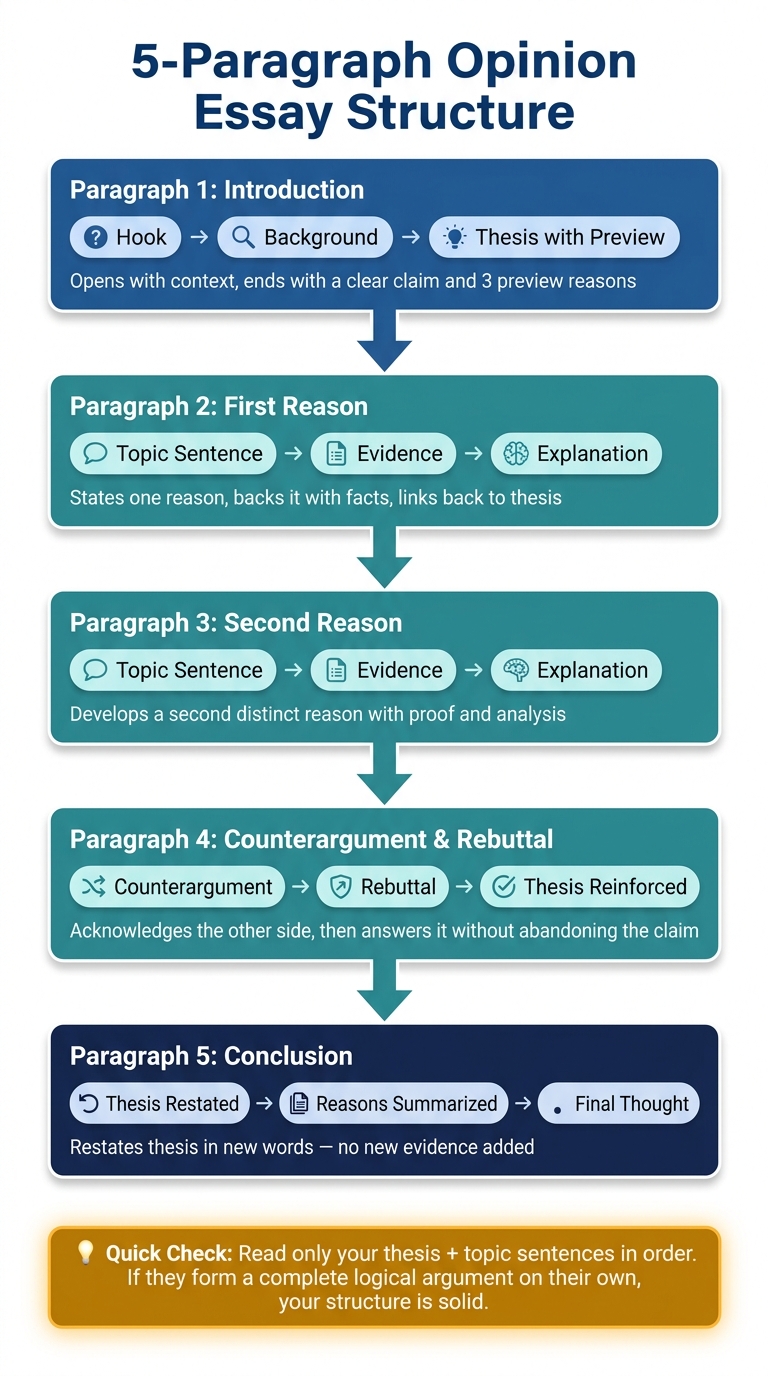
5-Paragraph Opinion Essay Structure: A Visual Guide
All eight essays follow the same basic setup. Each one starts with context, ends the introduction with a clear thesis, builds that thesis through body paragraphs, and finishes by restating the main claim in new words. You don't need to memorize every model. The point is to reuse the pattern when you face a new prompt. That's what makes these essays useful as templates.
The body paragraphs follow a clear rhythm too. Each paragraph makes one main point. It doesn't try to prove two ideas at once. It starts with a topic sentence, gives evidence, and then explains how that evidence supports the thesis. That evidence-plus-explanation combo is what makes the writing persuasive. In most cases, the counterargument shows up in body paragraph 3. It helps the essay sound fair and well argued without pulling attention away from the main claim.
Use this quick map:
| Essay Section | Function |
|---|---|
| Introduction | Hook, context, thesis with preview |
| Body Paragraph 1 | First reason, evidence, explanation |
| Body Paragraph 2 | Second reason, evidence, explanation |
| Body Paragraph 3 | Counterargument, rebuttal, thesis reinforced |
| Conclusion | Thesis restated, reasons summarized, final thought |
Now here's a simple way to check your structure. Read only the thesis and the topic sentences, in order. If those lines create a full, logical argument by themselves, you're on the right track. Also, notice what the conclusions don't do: they do not bring in new evidence. They restate the thesis and the main reasons instead.
Use this structure as you draft your own opinion essay in the next section.
Turn These Models Into Your Own Essay
Use the same setup for your own essay. Pick a topic you can argue in one clear sentence. Think: "Should high schools start after 8:30 a.m.?" or "Should public schools restrict smartphone use during class?" Common topics help because your reasons show up faster, and you spend less time hunting for ideas.
Then use the paragraph roles from the model essays as a simple drafting guide. Each paragraph should do a clear job, not wander all over the place.
A basic planning step helps a lot. Make a pros-and-cons chart or a cause-and-effect table, then pull out the best two or three reasons for your body paragraphs. That becomes your outline.
Draft fast. After that, reverse-outline the essay by summarizing each paragraph in one sentence. If a paragraph feels out of place or weak, cut it or move it. This is where the structure starts to click.
Next, read the draft aloud. It’s one of the easiest ways to catch clunky wording, repeated phrasing, and fuzzy claims. Swap vague language for specific details.
You can also use Yomu AI to smooth the tone, paraphrase lines that sound too repetitive, tighten evidence, check originality, and generate MLA or APA citations. That gets your draft in shape for the final conclusion section.
Conclusion
Strong opinion essays work because each paragraph does one clear job. After reading all eight examples, that pattern becomes much easier to notice. And once you can spot what each paragraph is doing, you can read and understand almost any strong opinion essay with a lot more confidence.
These models match common U.S. classroom prompts, so they work well as templates for your own writing.
Use the models as guides, not as scripts. Look at the structure, then write your own version in your own words. That's the fastest way to turn a model into an original essay.
Start by identifying each paragraph's role. Then pick one topic, state one clear opinion, and build the essay from there.
FAQs
How do I choose the best reasons for my opinion essay?
Choose reasons that people could reasonably disagree with, not points that feel obvious or hard to argue against. Each reason should support your thesis in a clear way and be backed by solid proof, like statistics, expert opinions, or real-life examples.
Each reason also needs its own job. That means it should be different from your other points, matter to your audience, and fit within your word count. If two reasons sound almost the same, one of them probably needs to go.
You also want reasons that can hold up under pressure. A strong point doesn’t just support your argument on the surface - it gives you room to answer pushback without circling back to the same idea again and again.
What if my topic does not fit a five-paragraph structure?
You don’t need to force every essay into a five-paragraph format. That setup is common in school, but it’s only one option. Add body paragraphs when each one brings its own point, evidence, or analysis. If a paragraph doesn’t do new work, it probably doesn’t need to be there.
When your topic is more complex, shape the essay around the topic itself. A chronological structure may work best for a topic that unfolds over time. A cause-and-effect setup may make more sense when you’re showing how one thing led to another. Either way, each paragraph should stay centered on one main idea and lead cleanly into the next.
How can I use these model essays without copying them?
Use these model essays as structural templates, not as content to borrow.
They show you the shape of a strong essay: where the hook goes, how the thesis is set up, and how each body paragraph opens with a clear topic sentence. Think of them like blueprints. You’re studying the frame, not copying the furniture.
Focus on the way each essay is built:
- It starts with a claim
- It backs that claim with evidence
- It deals with counterarguments instead of dodging them
Then do the same with your own subject, ideas, and research. That’s the key. The model gives you the pattern; your job is to fill it with original thinking and support. If you mix up the two, the writing can feel borrowed. If you separate them, the essay stays clear and grounded.