

Methodology Justification Examples for Graduate Papers
Struggling to justify your research methodology? This guide breaks down how to defend your choices effectively in graduate papers. A well-justified methodology directly ties your methods to your research objectives, enhances credibility, and ensures your study is replicable. Here’s what you’ll learn:
- Align methods with objectives: Every method should clearly support your research goals.
- Cite supporting literature: Reference established sources to validate your approach.
- Address constraints: Explain trade-offs and how you managed limitations.
- Justify qualitative, quantitative, or mixed methods: Show why your chosen approach fits your research questions.
- Rule out alternatives: Demonstrate why other methods weren’t suitable.
- Explain sampling strategies: Ensure your sample aligns with your goals.
- Ensure rigor: Maintain transparency and provide enough detail for reproducibility.
This article provides practical examples, sentence starters, and strategies for crafting a solid methodology section, whether you’re using qualitative, quantitative, or mixed methods. Follow these steps to build a strong, logical foundation for your research.
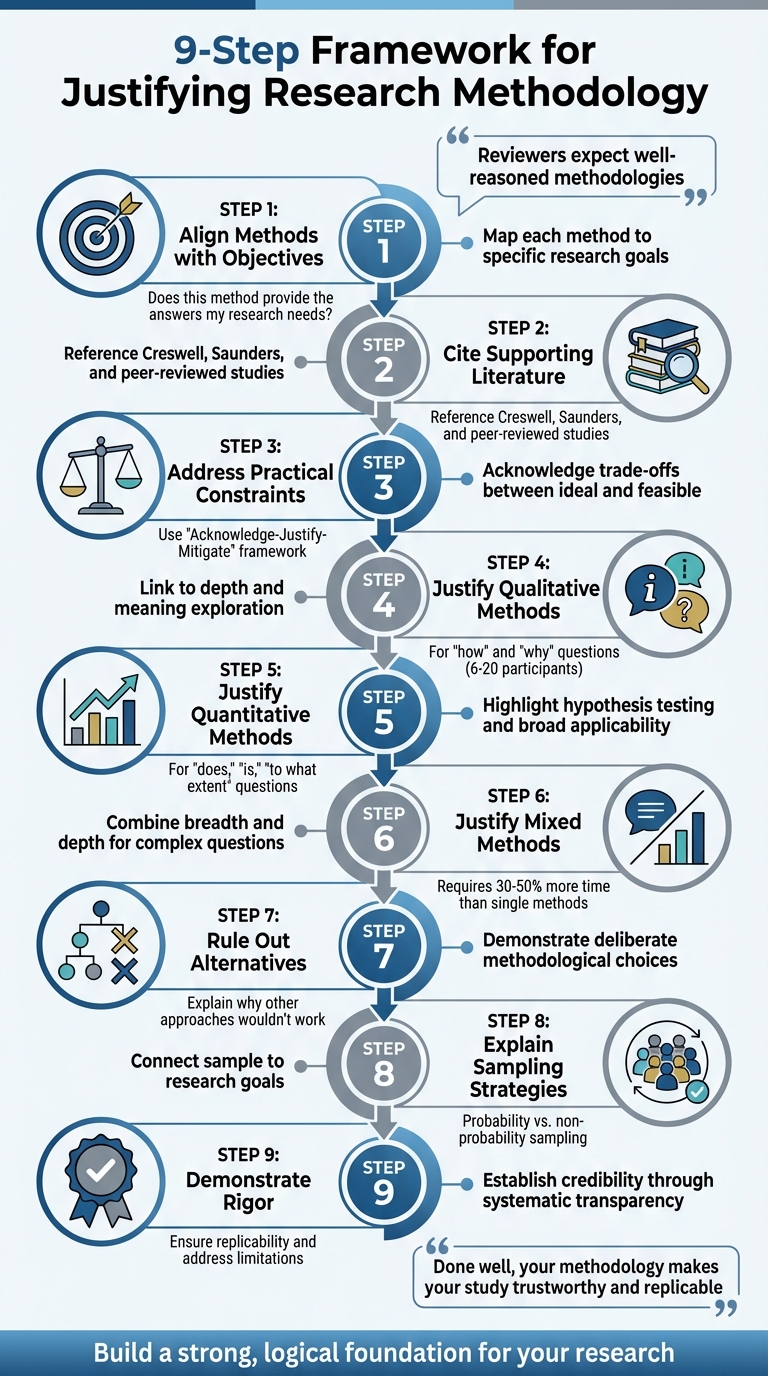
9-Step Framework for Justifying Research Methodology in Graduate Papers
1. Aligning Methods with Research Objectives
Map Each Method to a Specific Objective
Think of your methodology as the foundation of your study - every decision should directly tie back to your research objectives. Reviewers expect a clear connection between your research questions, the methods you choose, and the techniques for collecting and analyzing data. If this alignment is missing, the credibility of your study could be questioned. This connection is essential for demonstrating how your methods serve your research goals.
Be explicit about how each methodological choice supports a specific objective. For instance, in 2016, Jennifer Bibb used a mixed-methods approach in her thesis, Musical Recovery: The Role of Group Singing in Regaining Healthy Relationships with Music to Promote Mental Health Recovery. Her dual aim required distinct methods: qualitative approaches to explore participant experiences and quantitative measures to assess feelings of belonging. This combination of methods relied on diverse self-reporting techniques.
The type of objective you have should guide your research strategy. For example, experimental designs are well-suited for studying causation, while ethnographic research is ideal for understanding group dynamics and culture. Before committing to a method, ask yourself, "Does this method provide the kind of answers my research needs?" If your goal is to test a hypothesis, quantitative data is essential. On the other hand, exploring personal experiences often calls for qualitative methods.
A great example of this alignment comes from Brown's 2022 thesis, Exploring the Indirect Effects of Climate Change on Fire Activity in Australian Wet Eucalypt Forests. Brown carefully selected instrumented sites based on historical fire disturbances and used a specific threshold - lidar-estimated structural properties (CH95 and LPI0.5) had to fall within one standard deviation of a 1:1 line. This criterion ensured the sites were representative of the broader landscape and directly supported the study's objective of representativeness.
Derek Jansen, MBA, from Grad Coach, underscores the importance of keeping your research objectives front and center:
"The methodology needs to align with your research aims, objectives and research questions. Therefore, it's useful to frontload this component to remind the reader (and yourself!) what you're trying to achieve".
sbb-itb-1831901
2. Citing Supporting Literature
Ground Your Methods in Established Academic Sources
Connecting your methods to established academic literature is a powerful way to strengthen your research design. It shows that your approach isn't just a personal preference but is rooted in widely accepted practices within your field. By doing so, you demonstrate that your methodology aligns with disciplinary norms, which reassures reviewers about the reliability of your work. Citing recognized sources transforms your choices into scholarly decisions backed by evidence.
To achieve this, start by referencing foundational methodology texts, such as those by Creswell or Saunders, which provide frameworks to support your decisions. As Jenny Hill, PhD, explains:
"Citing sources like Creswell or Saunders can help validate your choices and make your approach feel grounded in solid methodology".
In addition to textbooks, seek out methodological precedents - peer-reviewed studies within your field that have employed similar methods. These citations create a bridge between theory and practice, showcasing both academic rigor and practical relevance.
When citing literature, focus on explaining why you chose a particular method rather than just describing its implementation. A useful strategy is the Evidence-Action formula: pair an evidence-based statement with a citation, followed by your specific plan. For example: "In line with best practice for qualitative research [O'Brien et al.], this study will employ semi-structured interviews to capture participant experiences."
ResearchPal emphasizes the importance of this approach:
"Situating your methodology within existing literature signals competence and reduces the likelihood of reviewer pushback".
3. Addressing Practical Constraints
Acknowledge Trade-offs Between Ideal and Feasible Designs
Graduate research often operates within the boundaries of real-world constraints like time, budget, access, and expertise. Instead of glossing over these limitations, strong research methodologies openly address them, explaining why specific choices were made within these boundaries. This approach not only demonstrates thoughtful decision-making but also reinforces the credibility of the research.
Derek Jansen, MBA, highlights this reality:
"No research methodology is perfect – there will always be trade-offs between the 'ideal' methodology and what's practical and viable, given your constraints".
For instance, time constraints often influence design decisions. A six-month thesis deadline might rule out longitudinal studies, making a cross-sectional design more practical. Similarly, budget limitations can restrict access to tools like survey software, participant incentives, or funding for travel. Data access can also be a hurdle, sometimes necessitating convenience sampling when a truly random sample is out of reach within the given timeframe.
To handle these challenges systematically, the "Acknowledge-Justify-Mitigate" framework offers a structured approach. This involves stating the limitation, explaining why it was necessary, and outlining steps to minimize its impact. A great example of this can be seen in Brown's 2022 study at the University of Melbourne. Due to historical fire disturbances, Brown couldn’t randomly select forest sites. Instead, they compared structural properties of the chosen sites with stratified random points across the landscape. By ensuring key metrics (CH95 and LPI0.5) fell within one standard deviation of the 1:1 line, they demonstrated that the non-random sites still reliably represented the broader area.
As ResearchPal succinctly puts it:
"Reviewers do not expect perfect methodologies. They expect well-reasoned ones".
4. Justifying Qualitative Methods
Link Research Questions to the Need for Depth and Meaning
Qualitative methods are ideal for exploring the "how" and "why" behind phenomena, focusing on depth and meaning rather than numbers. Research questions like "How do participants experience...", "Why do individuals perceive...", or "What does this mean to..." clearly signal the need for a deeper understanding that surveys and statistical tools can't fully address.
Take, for example, a 2016 University of Melbourne thesis by researcher Bibb. In this study on therapeutic singing groups, Bibb used qualitative methods because the goal was to understand how participants described their personal experiences. Similarly, when examining war veterans' views on political issues, qualitative interviews are preferred. This is because such research aims to capture subjective insights and verbal data - something numerical surveys simply can't do effectively.
John W. Creswell, a Professor of Family Medicine, emphasizes this point:
"Qualitative research is especially useful when the researcher does not know the important variables to examine".
This highlights the importance of acknowledging the trade-offs in qualitative research. A strong justification for using these methods often involves prioritizing depth and contextual understanding over broad statistical generalizations. For graduate students, qualitative approaches can also be appealing from a practical standpoint. They tend to require fewer resources compared to large-scale quantitative studies, as they rely on smaller sample sizes - usually between 6 and 20 participants - to achieve data saturation. This makes them a cost-effective choice for researchers working with limited budgets.
5. Justifying Quantitative Methods
Highlighting Hypothesis Testing and Broad Applicability
Quantitative methods focus on testing hypotheses and measuring relationships, making them ideal for research that seeks to answer questions like "does", "is", or "to what extent". Unlike qualitative approaches, which delve into detailed individual experiences, quantitative research emphasizes numerical data and statistical analysis, enabling researchers to draw conclusions that apply to larger populations.
As Academic Writing Expert Steven Robinson explains:
"A quantitative approach enables getting practical results if your research problem involves collecting extensive numerical data".
The strength of this methodology lies in its ability to produce objective, replicable, and statistically significant findings. While qualitative research prioritizes depth and smaller sample sizes, quantitative studies often require dozens - or even hundreds - of participants to identify patterns and achieve meaningful results. This larger scale ensures that conclusions can extend beyond the initial sample, allowing for more generalized applications.
For example, Brown's 2022 thesis illustrates how quantitative benchmarks can confirm the representativeness of study sites. This focus on precision and scalability is especially critical in disciplines like psychology, economics, and medicine, where accurate measurements and generalizable findings are essential.
6. Justifying Mixed Methods
Combining Breadth and Depth for Complex Research Questions
Mixed methods research is a powerful way to tackle complex research questions by blending quantitative and qualitative approaches. With this combination, researchers can uncover patterns through quantitative data while also diving into context and meaning via qualitative insights. This dual approach provides a more rounded perspective, helping to address multifaceted questions effectively.
To justify using mixed methods, you can rely on one of these key rationales: Triangulation (comparing results from both methods for consistency), Complementarity (using one method to enhance or explain findings from the other), Development (informing one phase of research based on results from the other), Initiation (exploring contradictions to uncover new perspectives), or Expansion (examining different aspects of the research question). Be specific about how you’ll integrate these methods - whether they’ll run at the same time or in sequence, and whether one method will take precedence over the other.
Dr. Grace Alexander explains it well:
"Mixed methods research provides the credibility of quantitative findings strengthened through qualitative context, whilst giving qualitative insights the generalisability that quantitative methods afford."
Keep in mind that mixed methods research often requires significantly more time - about 30% to 50% more than single-method studies. When proposing this approach, highlight the added value it brings and demonstrate how you’ll manage the extra workload within your dissertation timeline.
7. Rulings Out Alternative Methods
Demonstrating Deliberate Methodological Choices
When designing your research, it’s not enough to explain why you chose a particular method - you also need to show why other approaches wouldn’t work. This adds depth to your reasoning and highlights the deliberate thought process behind your choices.
Start by identifying one or two alternative methods that could have been viable but ultimately didn’t align with your goals. For example, imagine you opted for in-depth interviews to explore personal experiences with chronic illness. You could explain why you ruled out a quantitative survey. While surveys are useful for gathering broad data, they lack the ability to capture the nuanced, personal insights that qualitative interviews can provide. This comparison underscores how your chosen method aligns more closely with your research objectives.
Constraints also play a role in these decisions. Perhaps a longitudinal study would have been ideal for observing changes over time. However, if you were working with a tight timeline, a cross-sectional approach might have been the only practical option. Acknowledging such trade-offs shows that your choices were not only thoughtful but also realistic.
Sometimes, a single method might not suffice. As John W. Creswell notes:
"A mixed methods design is useful when an exclusively quantitative or qualitative approach is inadequate to fully understand a research problem".
This highlights the importance of tailoring your methods to the complexity of the research question.
The methodology guide from Sheffield Hallam University offers a straightforward way to approach this:
"At every point where you faced a decision, ask: Why did you choose this approach? Why not something else?"
8. Explaining Sampling Strategies
Connecting Your Sample to Your Research Goals
Sampling strategies play a key role in ensuring that your research participants align with the goals of your study. The process should be deliberate and well-thought-out. As ResearchPal emphasizes:
"A sampling strategy must be intentional - not accidental".
The method you choose should directly reflect your research question. For example, if your goal is to generalize findings to a larger population, probability sampling is a strong choice. This approach gives every individual in the population a known chance of being selected, which also allows you to calculate sampling error. On the other hand, if your study focuses on exploring nuanced experiences or developing theories, non-probability methods like purposive sampling are more suitable. These methods enable you to select participants with specific characteristics that fit your study's objectives. However, it’s important to consider practical limitations when making these decisions.
Be transparent about constraints like time, budget, or accessibility, as these factors inevitably shape your sampling choices. For instance, if you opted for convenience sampling due to a tight deadline, explain how the sample still provides meaningful insights within the context of your research.
Additionally, when using methods like convenience sampling, it’s crucial to address potential selection bias and justify your sample size. The concept of theoretical saturation - when no new information emerges from additional participants - can be a helpful framework for this .
A practical example comes from researchers Zia et al. and Bashir et al. in 2024. They used criterion-based purposive sampling, selecting participants based on specific work experience and demographic traits. This approach ensured their samples were perfectly aligned with their research goals.
9. Demonstrating Methodological Rigor
Establishing Credibility Through Systematic Transparency
When your methods align with your research goals and practical constraints, you lay the groundwork for a credible study. Methodological rigor ensures your approach is logical and dependable. As ResearchPal explains:
"Reviewers do not expect perfect methodologies. They expect well-reasoned ones."
The core idea here is to maintain a clear and logical connection between your research philosophy, questions, methods, and analysis. If this alignment falters, reviewers may see it as a critical flaw that weakens the entire study.
Transparency is another cornerstone of rigor. Instead of glossing over limitations, openly address them. Explain why certain compromises were necessary and how you minimized their impact. For instance, if a limited budget reduced your sample size, clarify how you maintained data quality through other strategies.
Detail is equally important. Your methodology should be replicable - detailed enough for another researcher to reproduce your study. This means spelling out every step, from data cleaning (like managing missing data or outliers) to the specifics of qualitative analysis, such as thematic coding. These details showcase the care and precision behind your work.
The approach to rigor varies depending on your research type. Quantitative studies often emphasize validity and reliability, while qualitative research leans on trustworthiness through techniques like triangulation or member checking. Both approaches highlight the strength of your study. Additionally, explicitly stating your research paradigm - whether positivist or interpretivist - helps clarify how your worldview influenced your interpretation of the data.
Grounding your methods in established frameworks from scholars like Creswell or Saunders further strengthens your credibility. This shows that your methodology is rooted in widely accepted academic principles, not improvised. As W. Edwards Deming aptly put it:
"Without data, you're just another person with an opinion."
10. Using Flexible Sentence Starters
Practical Frameworks for Clear Methodological Justifications
Sentence starters are a simple yet powerful way to connect your research objectives to your chosen methods. They don’t just describe what you did - they explain why you did it. This approach ensures your reasoning is clear and helps reviewers understand the logic behind your decisions.
For instance, you can use structured phrasing to directly link your methods to your research goals. A sentence like, "This study uses a [design] to investigate [topic] because [justification]" immediately ties your methodology to its purpose. Similarly, phrases such as "A [phenomenological/quantitative] approach was adopted to explore..." provide a straightforward rationale for your approach.
The goal is to connect every decision back to your research question. For example, when explaining tool selection, you might say, "These tools were selected due to their established reliability in previous studies examining [topic]...". If addressing constraints, try, "While [Alternative Method] was considered, [Chosen Method] was selected due to [practical constraint]." This level of transparency reassures reviewers and strengthens your argument.
Pay attention to verb tense - use past tense for completed studies and future tense for proposals. Keep your language straightforward and focused. For example, a starter like "The interest in both [understanding/X] and [measuring/Y] the experience suggested a [mixed method] approach..." shows how your dual objectives naturally guided your methodological choices. This type of clarity ensures your rationale is solid and supports the overall flow of your methodology section.
How to Justify Your Research Methodology Clearly
Conclusion
Justifying your methodology goes beyond simply explaining what you did - it highlights why your decisions were the best fit for your research. As Derek Jansen, MBA, puts it:
"Done well, your methodology makes your study trustworthy and replicable".
Every justification you provide should reinforce your approach within the framework of scholarly standards.
Alignment is key. Your research questions, methodology, data collection, and analysis methods need to form a cohesive system . When these elements are clearly connected, reviewers are more likely to trust your work. On the other hand, a lack of alignment can lead to skepticism and even rejection. Strong justification not only builds credibility but also ensures your methods are robust and defensible.
Rigor matters. This involves demonstrating sound scholarly judgment by addressing trade-offs and explaining how you managed limitations . Reviewers look for designs that strike a balance between credibility and practicality. Be transparent about constraints, refer to disciplinary standards to validate your choices, and provide reasons for excluding alternative methods.
The examples in this article offer adaptable frameworks you can tailor to your research. Whether you're using qualitative interviews, quantitative surveys, or mixed methods, always tie your methods back to your research aims. Support your decisions with references to established literature. Use the sentence starters and structures as guides, but make sure they fit your unique context. These frameworks are designed to integrate smoothly into your overall research design, helping you present a well-justified and cohesive study.
FAQs
How do I justify my method in one paragraph?
To achieve our research objectives, the chosen approach provides a precise alignment with the variables and phenomena under study, ensuring both depth and relevance. This method stands out by offering a balanced combination of comprehensive data collection and nuanced analysis, which alternative approaches fail to provide. Its structured framework enhances credibility and reliability, as it allows for consistent replication and minimizes potential errors. While acknowledging inherent limitations, such as potential biases in data interpretation, these are mitigated through rigorous controls and transparency in reporting. This ensures the methodology remains robust and well-suited to address the research goals effectively.
What’s the fastest way to cite sources that support my method?
The fastest way to cite sources in your methodology section is to use concise references that directly support your chosen methods. Right after describing a method, include a brief mention of relevant studies, frameworks, or guidelines. For instance: "This method was selected as it aligns with established qualitative research practices (Smith, 2023)." This keeps your methodology grounded in evidence without requiring lengthy explanations.
How do I defend convenience sampling without weakening my study?
Convenience sampling often gets a bad rap, but it offers some clear, practical benefits that make it a smart choice in certain research contexts. For starters, it allows for quick and efficient data collection, especially when you're working with limited time or resources. Instead of spending months finding a perfectly random sample, you can get the data you need to move forward with your study.
This method also aligns well with research aimed at exploratory insights or preliminary findings. When you're testing ideas or gathering early data to shape a larger project, convenience sampling can be a highly effective approach. Sure, it has its limitations - like the potential for bias - but these trade-offs are often acceptable when the goal is to get a general sense of trends or behaviors.
To maintain credibility, it's important to acknowledge these limitations upfront. For example, you can discuss how potential biases are managed or minimized. Whether it's by comparing findings to other studies or being transparent about the scope of your conclusions, these steps help ensure your research remains valuable and reliable.