

How to Write a Persuasive Essay: Structure, Steps, and a Full Example
To write a persuasive essay, choose a debatable position, support it with research, and answer the strongest objection. I start with a focused thesis and an outline - not a fixed five-paragraph rule.
In this guide, I’ll show you how to:
- Plan: Check the assignment, research both sides, and track your sources.
- Draft: Build an introduction, connect each body paragraph to your thesis, and respond to an opposing view.
- Revise: Check your logic and academic paper citations before editing wording. Use AI only when course rules allow it, and review its suggestions yourself.
I’ll also walk through a complete essay arguing for school start times of 8:30 a.m. or later, using research on sleep, classroom participation, and driving safety. My final checklist keeps the focus on one goal: <u>an argument readers can follow and check</u> - not just an opinion.
How to Write a Persuasive Essay Step-by-Step
sbb-itb-1831901
Persuasive Essay Structure
Persuasive essays don’t need a fixed five-paragraph format. Let the assignment guide your paragraph count and depth. A logical order matters more than a set number of paragraphs.
Introduction and Thesis
Introduce the issue, provide enough background for readers to follow, and explain why it matters. Leave detailed evidence for the body.
End the introduction with a specific, debatable thesis that states your position and previews your main reasons. Readers should be able to reasonably disagree with your claim. Each body paragraph should then support one part of that thesis.
Body Paragraphs: Evidence and Reasoning
Give each paragraph one main job. Start with a topic sentence that states a reason, add reliable evidence, and explain how it supports your thesis. Evidence provides the facts; reasoning explains why those facts matter. End with a transition that connects to the next point, rather than adding a phrase just to fill space.
When outlining, identify each paragraph’s claim, source, evidence, reasoning, and any limitation or opposing view. Once you’ve built your case, address the strongest objection.
Counterargument, Rebuttal, and Conclusion
Present the strongest reasonable objection without distorting it. Then respond with evidence, a limitation of the objection, or a practical fix.
In the conclusion, restate your position in different words and briefly show how your reasons fit together. End with a realistic action readers can take or explain what your argument means beyond the immediate issue. Don’t introduce new evidence.
How to Plan, Draft, and Revise
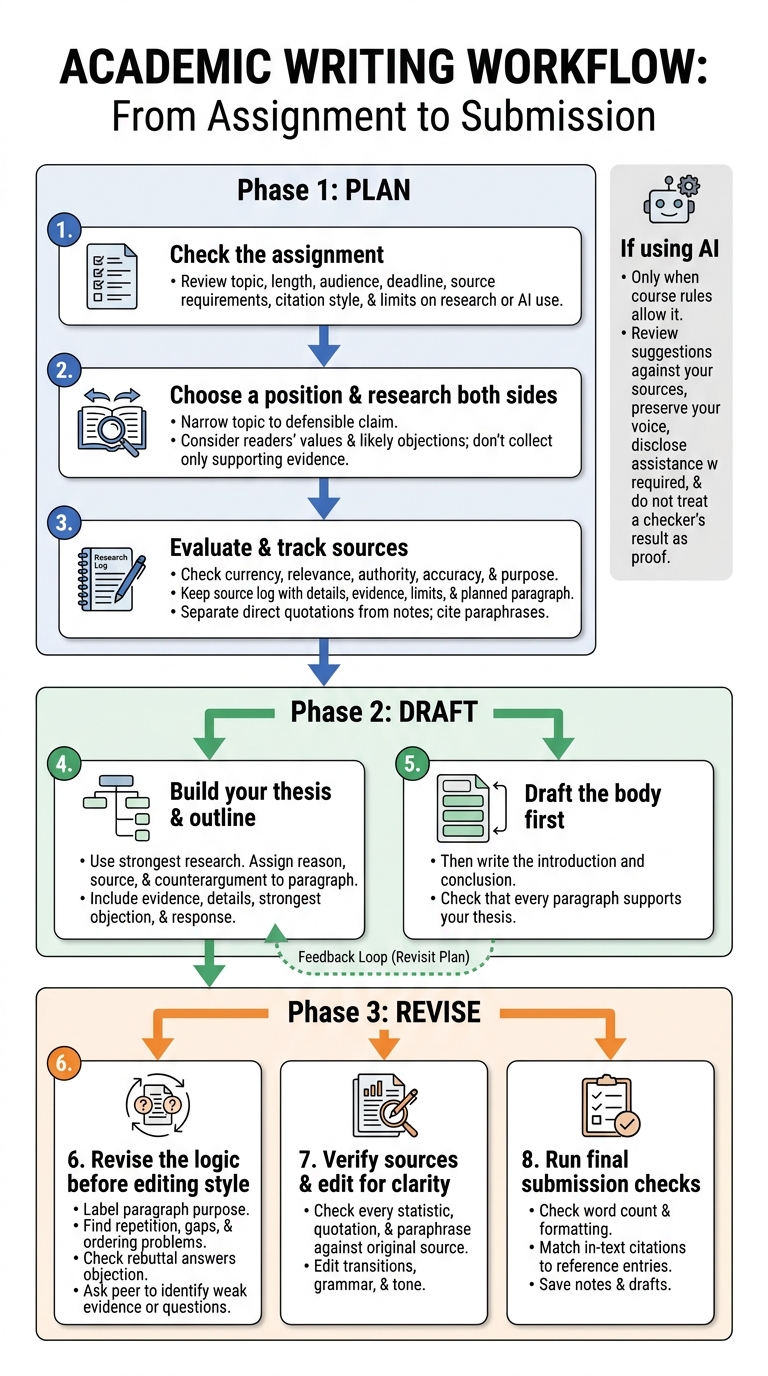
How to Write a Persuasive Essay: Research to Revision
1. Choose a Position and Research Your Topic
Turn the structure into a plan. Read the prompt for the topic, length, audience, deadline, source requirements, citation style, and limits on research or AI use. Narrow your topic to a claim you can defend within the word limit. Before settling on it, think about what readers value and why they might disagree. Let those concerns shape your research rather than looking only for evidence that supports your view. Your research should serve your thesis, evidence, and rebuttal, not just fill your notes with facts.
Check each source for currency, relevance, authority, accuracy, and purpose. Keep a source log alongside your outline. Record the author, title, date, link, useful evidence, limits, and the paragraph where you plan to use it. Keep direct quotations separate from your own notes, and cite paraphrases too.
2. Write Your Thesis, Outline, and Draft
Build a draft thesis from your strongest research. Keep its scope realistic: a short assignment can't give every angle equal attention. Assign each reason, source, and counterargument to a paragraph. Add evidence and source details to the outline before drafting, and leave room for the strongest objection and your response.
Draft the body first. Once the argument is settled, write the introduction and conclusion. Then check that every paragraph still supports your thesis.
3. Revise Your Argument and Edit Your Writing
Revise the logic before editing style. Add a short label beside each paragraph to spot repeated points, gaps in support, or ideas that belong in a different order. Does your rebuttal answer the objection? Check every statistic, quotation, and paraphrase against its original source. Ask a peer to point out the weakest evidence or an unanswered question. Then edit for clarity, transitions, grammar, and tone.
If course rules allow it, use Yomu AI for drafting, paraphrasing, citation formatting, and plagiarism checks. Check every suggestion against your sources, keep your own voice, and disclose AI assistance when required. Save your notes and drafts, and don't treat a checker's result as proof. Finally, check the word count and formatting, and match in-text citations to reference entries.
Apply these checks as you read the model essay that follows to see how its techniques work and how you might use them.
Complete Persuasive Essay Example: Later School Start Times
Model Thesis and Sources
Thesis: U.S. middle and high schools should start at 8:30 a.m. or later because later starts improve sleep, school-day functioning, and travel safety.
The American Academy of Pediatrics recommends this schedule. CDC reporting adds context on sleep, while research on school outcomes and crashes supports the other claims.
The draft below puts that structure to work.
Full Essay: Why Schools Should Begin at 8:30 a.m. or Later
Adolescents’ sleep cycles shift later, so early start times make enough sleep harder to get. The AAP recommends that middle and high schools start no earlier than 8:30 a.m. U.S. middle and high schools should start at 8:30 a.m. or later because later starts improve sleep, school-day functioning, and travel safety.
First, later starts give teenagers more opportunity to sleep. CDC reporting explains that the schedule can help adolescents get about 8.5–9.5 hours of sleep. Delaying the first bell addresses a constraint students cannot fully change on their own, although bedtime habits and home responsibilities still matter.
Second, reviews have linked later start times with better attendance, less tardiness, and fewer students falling asleep in class. These findings suggest that more rest can improve participation, but observational studies cannot prove the schedule alone caused the gains.
Third, additional sleep may reduce morning crash risk. A study reported that teen-driver crash rates fell 16.5% in one district after high-school start times were delayed by one hour, while rates elsewhere in the state rose 7.8% during the same period. Reducing morning sleepiness is a reasonable safety goal, although traffic conditions and other differences could have affected the results.
The strongest objection is practical, not logical. Critics rightly point to transportation costs, athletics, after-school jobs, childcare, and family work schedules. Districts should review transportation and family impacts, consult students and caregivers, coordinate athletics, and phase in the change with supervised morning options. These changes cost time and money. But logistical difficulty does not erase the evidence supporting adolescent sleep and readiness to learn.
School boards should adopt an 8:30 a.m. or later start while developing a workable local plan and monitoring attendance, student sleep, and safety afterward.
How the Model Essay Builds Its Argument
The essay turns one specific thesis into three supported claims. Cautious wording keeps those claims within what the research can show. It also addresses a serious objection with practical steps rather than brushing it aside.
Conclusion: Check Your Essay Before Submission
Use the model essay as a benchmark for your draft. Before submitting, check your work against the assignment prompt, required length, formatting rules, and citation requirements. Revise first, then proofread.
Structure check: Make sure your thesis is specific and debatable, and each paragraph makes one focused point. Label each paragraph’s purpose in the margin. Check that every claim has evidence and explanation, and that your rebuttal directly answers a fair opposing view.
Clarity check: Cut repeated points, unsupported claims, and absolute words such as “always,” “everyone,” and “proves.” Your conclusion should close the argument without copying the introduction or adding unsupported claims. Read your draft aloud to catch awkward wording and missing transitions.
Source check: Verify facts, quotations, and paraphrases against the original sources. Match every in-text citation to a full reference entry in the assigned citation style. Then check your wording one last time before submitting.
Use Yomu AI for a final wording and originality check, but review its suggestions and any flagged overlap yourself. A plagiarism check can help spot overlap; you’re still responsible for verifying sources and giving proper credit.
FAQs
How is a persuasive essay different from an argumentative essay?
Both essay types use logic and evidence to support a claim, but their main goals differ. An argumentative essay defends a position through reasoning and evidence. A persuasive essay seeks to get readers to agree with a viewpoint or take action, appealing to their values through logic, the writer’s authority, and emotion.
How much evidence does each paragraph need?
Each body paragraph should develop one main point that supports your thesis. Open with a clear topic sentence, then back it up with reliable evidence, such as statistics, facts, expert opinions, or examples. Explain how that evidence supports your argument.
There’s no set amount of evidence you need. Instead, support every major claim with reliable, relevant information and show why it matters to your thesis. Quality, relevance, and accuracy matter more than the number of sources.
What if my research contradicts my thesis?
Use research that conflicts with your position to deepen your analysis, not something to brush aside. Check whether differences in context, methods, or sample sizes explain why the findings don’t agree. Those differences may point to unanswered questions or details that need a closer look.
If the evidence exposes a weakness in your position, adjust your argument. Narrow your claim, add a needed safeguard, or revise your reasoning rather than dismissing the opposing view.