

Best Persuasive Essay Topics by Major (STEM, Business, Humanities)
Struggling to find a great topic for your persuasive essay? Here’s a quick guide to 30 specific ideas across STEM, Business, and Humanities that tackle current debates and ethical questions. These topics are designed to help you craft strong arguments and engage readers with timely issues.
Key Takeaways:
- STEM Topics: Focus on AI ethics, environmental challenges, and technology accountability (e.g., regulating facial recognition or CRISPR use).
- Business Topics: Examine workplace shifts, corporate ethics, and sustainability (e.g., gig worker rights or fast fashion taxes).
- Humanities Topics: Explore identity, historical responsibility, and digital rights (e.g., internet access as a human right or repatriating cultural artifacts).
Each topic is framed to encourage research, critical thinking, and meaningful discussions. Start with a subject that resonates with you, back it up with solid evidence, and address counterarguments to build a persuasive essay.
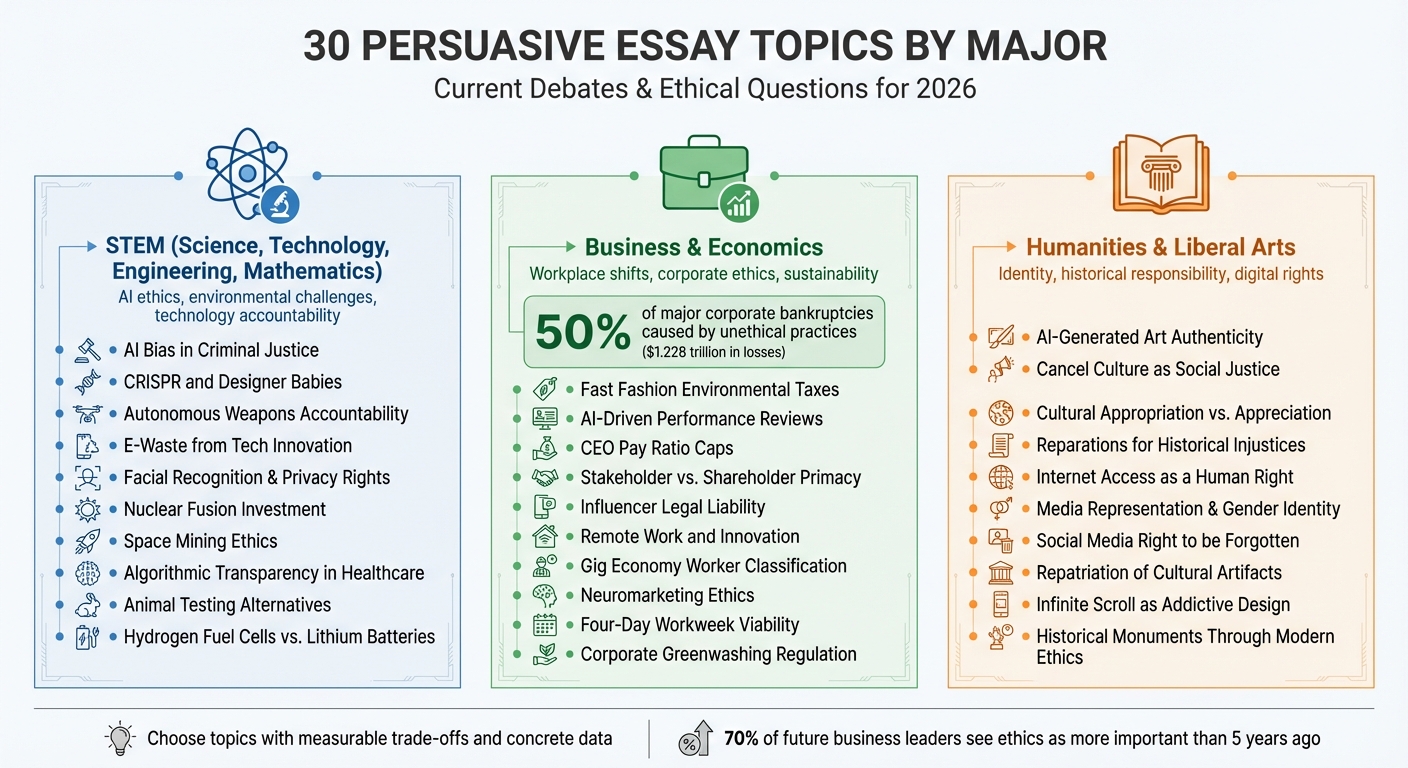
30 Persuasive Essay Topics Across STEM, Business, and Humanities Majors
101 Persuasive Essay Topic Ideas | Essay Writing
sbb-itb-1831901
1. STEM Topics
STEM's fast-paced advancements are raising ethical questions we've never had to face before. Joe Burgett from Science Sensei captures this perfectly:
"Science and technology are evolving at an unprecedented rate... forcing us to reconsider what is right, fair, and responsible."
The most compelling STEM essays tackle issues of feasibility, ethics, and accountability. Below are 10 thought-provoking topics that delve into debates taking place in labs, boardrooms, and even courts. Each one challenges you to weigh the potential of technology against its ethical implications.
1. AI Bias in Criminal Justice
Should predictive policing algorithms, often trained on biased historical data, be banned? This topic asks you to consider whether the efficiency gains are worth the risk of perpetuating racial profiling.
2. CRISPR and Designer Babies
Should CRISPR technology be used to create disease-free offspring? Explore the genetic risks and the broader implications for social equity.
3. Autonomous Weapons Accountability
Who is responsible when autonomous weapons make life-and-death decisions? As Burgett notes, "When machines are empowered to make life-and-death decisions independently, questions of accountability and moral responsibility become blurred."
4. E-Waste from Tech Innovation
Should tech companies be required to fund recycling programs for the e-waste generated by their products? This debate considers the environmental damage from discarded electronics and the toll of rare earth mineral extraction.
5. Facial Recognition and Privacy Rights
Does real-time surveillance through facial recognition technology infringe on individual freedoms more than it protects public safety? Weigh the balance between security and privacy.
6. Nuclear Fusion Investment
Should the U.S. government allocate more funding to nuclear fusion research? While the idea of nearly limitless clean energy is appealing, the high costs and uncertain development timelines present significant challenges.
7. Space Mining Ethics
Should private companies be allowed to mine asteroids and other celestial bodies? This topic examines the potential economic benefits versus the risks of environmental contamination and disputes over resource ownership.
8. Algorithmic Transparency in Healthcare
Should AI diagnostic tools be required to explain their "black box" decision-making processes? This debate focuses on transparency and trust in life-or-death healthcare scenarios.
9. Animal Testing Alternatives
With advanced computer modeling and in vitro techniques on the rise, is it time to phase out animal testing? This question asks whether the moral justification for using animals in research still holds up.
10. Hydrogen Fuel Cells vs. Lithium Batteries
Which technology should the U.S. prioritize for electric vehicles: hydrogen fuel cells or lithium-ion batteries? Compare the environmental impact of large-scale lithium battery production with the efficiency challenges of hydrogen fuel cells.
When choosing a topic, focus on issues that involve measurable trade-offs rather than simple yes-or-no answers. The strongest arguments highlight key stakeholders and rely on concrete data - like emission statistics or survival rates - to support the case. These STEM topics, rooted in real-world dilemmas, also provide a springboard for engaging discussions in fields like business and the humanities.
2. Business Topics
In 2026, business essays have shifted focus to scrutinize corporate practices that directly affect people, communities, and the environment. The most compelling topics dive into controversial issues, supported by hard data like market trends and financial reports.
Over the past three decades, unethical business practices have led to over 50% of major corporate bankruptcies, resulting in losses of approximately $1.228 trillion. At the same time, 70% of future business leaders now see ethics as more important than it was five years ago. This growing tension between profit motives and ethical considerations offers a rich landscape for persuasive and thought-provoking discussions. Below are ten timely topics that explore this dynamic.
Topics That Merge Data and Ethical Debate
1. Fast Fashion Environmental Taxes
Should clothing brands be taxed based on their production volume to address the environmental damage caused by textile waste? This debate weighs the ecological costs against potential impacts on consumer prices and small businesses.
2. AI-Driven Performance Reviews
Is it ethical for companies to rely on artificial intelligence for hiring and employee evaluations? This topic examines the balance between efficiency gains and the risks of algorithmic bias and reduced human judgment in critical decisions.
3. CEO Pay Ratio Caps
Should governments enforce limits on the ratio between CEO pay and average employee salaries? Explore whether such caps could reduce income inequality or unintentionally push top executives to work abroad.
4. Stakeholder vs. Shareholder Primacy
Should businesses prioritize all stakeholders - employees, communities, and the environment - over maximizing shareholder returns? Analyze whether addressing broader societal needs can outperform a profit-focused approach.
5. Influencer Legal Liability
Should influencers face legal consequences for promoting misleading products that result in financial or health harm? With influencer marketing on the rise, questions about accountability remain unresolved.
6. Remote Work and Innovation
Does extended remote work hinder innovation compared to in-office collaboration? Compare productivity metrics with the creative benefits that often come from spontaneous, face-to-face interactions.
7. Gig Economy Worker Classification
Should gig workers for platforms like Uber be classified as full-time employees with benefits? This debate pits the flexibility of gig work against the need for labor rights and protections.
8. Neuromarketing Ethics
Is it ethical for companies to use brain scans and neurological data to influence consumer behavior? Consider whether this practice crosses the line from persuasion to outright manipulation.
9. Four-Day Workweek Viability
Should U.S. companies implement a four-day workweek as standard practice? Weigh the potential for increased productivity and employee satisfaction against operational challenges and client demands in traditional industries.
10. Corporate Greenwashing Regulation
Should companies face legal consequences for overstating their environmental commitments in marketing? As transparency becomes more critical, this topic examines the consequences of misleading sustainability claims.
Final Tips for Selecting a Topic
To craft a strong business essay, focus on issues where you can find reliable evidence, such as annual reports, market research from sources like Pew Research, or peer-reviewed studies. The most persuasive arguments clearly identify affected stakeholders, quantify trade-offs, and address counterarguments directly.
3. Humanities Topics
Humanities essays invite us to examine technology, identity, and historical responsibility through the lens of human values. Building on the analytical and ethical discussions found in STEM and Business fields, these topics delve into the cultural and personal dimensions of our world.
As Jacob Smith, Ph.D. from Columbia University, emphasizes:
"Humanities research is essential to understand different cultures, explore human behavior, and improve society".
Emerging fields like Digital and Medical Humanities now blend longstanding questions with modern challenges. Below are ten topics that reflect the ethical and cultural tensions shaping today's society.
Topics That Challenge Cultural and Ethical Boundaries
1. AI-Generated Art Authenticity
Can AI-generated artwork be seen as genuine creative expression, or is it merely algorithmic output? This debate questions whether creativity inherently requires human consciousness or if machines are capable of producing meaningful art.
2. Cancel Culture as Social Justice
Is "cancel culture" a tool for accountability, or does it resemble digital mob justice that bypasses due process? This topic explores whether public shaming on social media leads to genuine reform or perpetuates new forms of injustice.
3. Cultural Appropriation vs. Appreciation
How can we distinguish between cultural appropriation and appreciation in media and fashion? This discussion analyzes whether borrowing cultural elements can ever be a respectful exchange or if it always risks exploitation.
4. Reparations for Historical Injustices
Should governments issue formal apologies and financial reparations for slavery and colonialism? This topic examines whether current generations bear responsibility for historical wrongs and whether reparations can address intergenerational trauma.
5. Internet Access as a Human Right
Should access to the internet and data privacy be recognized as basic human rights in the digital age? This debate weighs the importance of connectivity for education and employment against the logistical challenges of universal access.
6. Media Representation and Gender Identity
Does media representation of LGBTQ+ individuals and gender diversity influence societal acceptance, or does it merely mirror existing attitudes? This question examines whether increased visibility in entertainment drives cultural change or reflects it.
7. Social Media Posts and the Right to be Forgotten
Should teenagers have the right to permanently erase their social media history? This debate considers whether youthful mistakes should define individuals indefinitely or if digital redemption should be an option.
8. Repatriation of Cultural Artifacts
Should museums return cultural artifacts to their countries of origin, even if they have been held for centuries? This discussion explores the balance between global access to artifacts and respecting the cultural ownership of historically colonized nations.
9. Infinite Scroll as Addictive Design
Should social media platforms be required by law to eliminate "infinite scroll" features that exploit behavioral psychology? This debate questions whether such design choices amount to manipulation that warrants regulation akin to gambling or tobacco products.
10. Historical Monuments Through Modern Ethics
Should statues and monuments honoring controversial historical figures be removed from public spaces? This topic considers whether past leaders should be judged by today's moral standards or preserved as complex reminders of history.
Final Tips for Selecting a Topic
Choose topics supported by peer-reviewed research, historical records, and expert opinions. The most compelling humanities essays address opposing perspectives while presenting a well-reasoned interpretation of human values and social responsibility.
Conclusion
Selecting the right persuasive essay topic can make all the difference in your writing. When you choose a subject that connects with current issues in fields like STEM, Business, or the Humanities, your work has the potential to engage readers who are invested in ongoing discussions. As Daniel Felix, Writer and Educator, explains:
"The right topic not only helps you articulate your point of view effectively but also keeps your audience engaged and invested in what you have to say".
By focusing on relevant, timely debates, you position yourself to contribute meaningfully to academic and professional conversations.
The topics explored within these disciplines highlight key discussions shaping today's world. In an era marked by rapid changes in technology, business strategies, and societal norms, choosing a strong topic is more important than ever.
Your topic serves as the backbone of your essay, but thorough research is what transforms it into a compelling argument. Before finalizing your choice, dive into credible sources to build a solid foundation. The most persuasive essays don’t just argue a single point - they also engage with opposing views, skillfully addressing and countering them to show a nuanced understanding of the issue.
If you’re aiming to refine your essay further - whether it’s improving transitions, structuring arguments, or maintaining an academic tone - tools like Yomu AI can be a valuable resource. With features such as sentence and paragraph suggestions, paraphrasing assistance, citation formatting, and a plagiarism checker, it’s designed to help you write with clarity and confidence. A free trial lets you explore how these tools can enhance your writing process.
Ultimately, a well-chosen topic doesn’t just make your essay persuasive - it sparks thought and conversation. Pick a subject that excites you, back it up with robust research, and let your enthusiasm guide your argument.
FAQs
How do I pick the best topic for my major?
When selecting a topic, aim for something that not only connects to your field but also stirs conversation and ties into current trends. For example:
- STEM fields: You could dive into technological ethics, like the implications of artificial intelligence in daily life, or discuss pressing environmental challenges, such as renewable energy innovations.
- Business: Topics like corporate responsibility in a globalized world or the impact of shifting economic policies on small businesses can provide a rich ground for analysis.
- Humanities: Consider exploring ethical dilemmas or cultural debates, such as the role of social media in shaping modern identity.
The key is to choose a subject that excites you. Passion for your topic will naturally lead to stronger arguments and a more engaging essay.
What sources should I use to support my argument?
To back up your persuasive essay, rely on trustworthy and relevant sources such as academic journals, government documents, and materials from well-known organizations. Examples of reliable sources include peer-reviewed articles, respected news platforms, and expert analyses. Make sure the sources you use are up-to-date and offer verified facts or data to support your argument. Referencing credible publications not only reinforces the strength of your claims but also boosts the overall reliability of your essay.
How do I address counterarguments effectively?
To tackle counterarguments in a persuasive essay, start by openly acknowledging opposing viewpoints. Clearly present these perspectives to show you’ve considered them. Then, counter these arguments with solid evidence and well-thought-out reasoning. Use facts, examples, or logic to challenge their validity. Finally, circle back to your original position, explaining why it holds up better under scrutiny. This method not only strengthens your argument but also boosts your credibility with readers by showing you’ve thoughtfully addressed differing opinions.