
How to Write Footnotes in an Essay: Rules for APA, MLA, and Chicago
If you get footnotes wrong, your paper can lose points fast. The short answer is simple: Chicago uses footnotes for citing sources, MLA uses them for extra comments or source notes, and APA uses them only for brief side notes or copyright details.
Here’s the whole article in one glance:
- APA: use footnotes rarely; keep them short; put source citations in the References list
- MLA: use footnotes for extra explanation or brief source notes; keep normal citations in the text; still list sources on the Works Cited page
- Chicago Notes-Bibliography: use footnotes as the main citation system; give a full note first, then a short note later
- All three styles: use superscript numbers, number notes in order, and place the number after punctuation in most cases
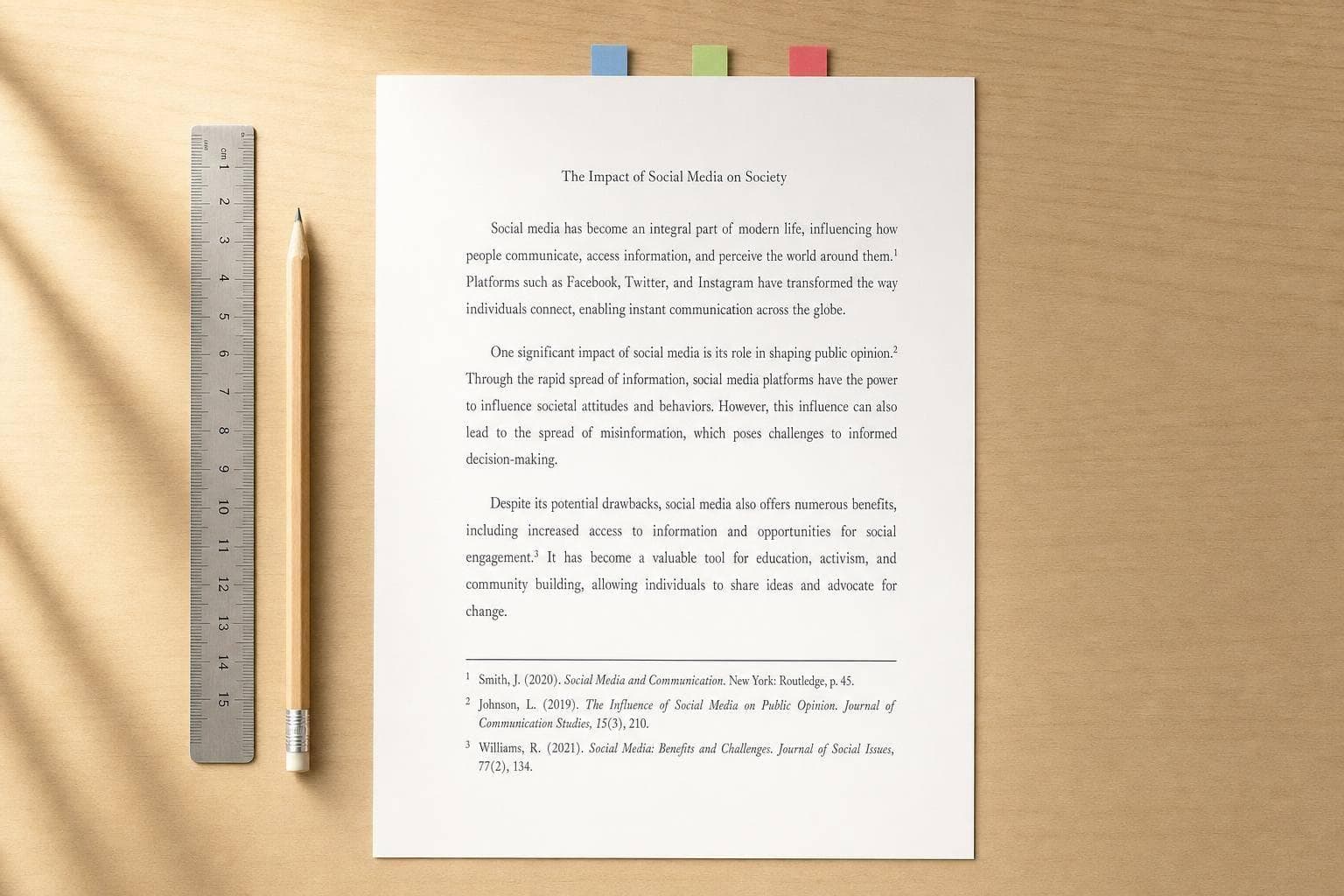
A footnote sits at the bottom of the page and matches a superscript number in your sentence. That sounds simple, but many students mix up when to use footnotes, where the number goes, and what belongs inside the note. This guide clears up those three points fast.
Footnotes Tutorial - Chicago Manual of Style
sbb-itb-1831901
Quick Comparison
| Style | Main citation method | What footnotes are for | What to watch for |
|---|---|---|---|
| APA | Parenthetical citations | Brief extra notes or copyright notes | Don’t use footnotes for normal source citations |
| MLA | Parenthetical citations | Explanatory or bibliographic notes | Add cited sources to Works Cited too |
| Chicago (Notes-Bibliography) | Footnotes or endnotes | Main source documentation | Use full first notes, then shortened notes |
One key rule stays the same across styles: the note number usually goes after the period or comma. If you use your word processor’s footnote tool, it will handle numbering for you and cut down errors.
For many student papers, 1 out of 3 style questions comes down to this: Do I need a footnote at all? In most cases, the answer depends on your instructor and whether you’re writing in APA, MLA, or Chicago.
This guide gives you the rules, the main differences, and the mistakes I’d check before turning in the paper.
When to Use Footnotes in APA, MLA, and Chicago
APA, MLA, and Chicago don’t treat footnotes the same way.
APA: Use Footnotes Only for Brief Extra Notes
In APA, footnotes are used sparingly. They’re mainly for short clarifications, brief definitions, or copyright credit for reproduced material - details that don’t fit neatly into the sentence itself. If a footnote starts to run long, that’s usually a sign the information should move into the main text or be cut.
MLA keeps footnotes limited too, while Chicago relies on them much more.
MLA and Chicago: When Notes Support or Replace In-Text Citation
MLA uses footnotes sparingly for explanatory notes or source notes. Chicago Notes-Bibliography uses footnotes as its main citation method, and it also allows longer notes that add context.
Chicago Author-Date works differently. It uses parenthetical citations instead of footnotes and is common in the social sciences.
Once you know whether footnotes are allowed, the next step is putting the number in the right place.
Check Assignment Rules Before You Start
A paper can follow the right style guide and still miss the mark for your class if your instructor has other rules. Your instructor’s directions come first. Some history departments and journals also add their own requirements on top of the style guide.
Before you start, scan the prompt for terms like:
- superscript
- notes
- bibliography
- parenthetical
If the prompt only says “Chicago style” and doesn’t get more specific, ask whether your instructor wants Notes-Bibliography or Author-Date before you draft your notes.
How to Place and Format Footnote Numbers Correctly
Once footnotes are allowed in your paper, get the placement right before you deal with APA, MLA, or Chicago style details.
Use Superscript Arabic Numerals in Consecutive Order
Footnotes are marked in your text with superscript numbers (1, 2, 3), and those numbers should run in consecutive order throughout the paper. The easiest way to handle this is to use your word processor’s footnote tool, which keeps the numbering automatic.
Place the Footnote Number After Punctuation
Put the superscript number after the punctuation mark. There are two exceptions. If the note applies only to a word before a dash, place the number before the dash. With parentheses, place the number inside only when the note applies to the parenthetical material alone.
Format Notes at the Bottom of the Page or on a Notes Page
Footnotes go at the bottom of the page, while endnotes go on a separate notes page. Then format each note entry based on the style guide you’re using.
After the marker is in place, format the note text according to APA, MLA, or Chicago.
How to Format Footnotes in APA, MLA, and Chicago
Now that placement is clear, let's look at what goes inside the note. This is where the styles split: APA uses footnotes for brief extra details, MLA uses them for explanation, and Chicago uses them for source citation.
APA Footnotes: Content Notes, Copyright Notes, and References
APA uses footnotes for brief content notes and copyright notes. A content note adds short supplemental information that doesn't fit cleanly in the main text. A copyright note gives credit for reprinted material, such as a long quotation or a table taken from another source.
APA footnotes should stay brief. If a note starts getting long, it likely belongs in the main text or an appendix. Also, standard source citations do not go in APA footnotes. They go in the References list.
Here’s what each type can look like:
- Content note: ¹ This point is discussed further in the next section.
- Copyright note: ² Reprinted from Title of Source, p. 88. Copyright 2023 by the publisher. Reprinted with permission.
If you put notes on a separate page, label it "Footnotes" and center the heading without bolding it.
MLA handles notes in a different way. Instead of using them for normal citation, it uses them to add explanation.
MLA Footnotes: Explanatory Notes and Bibliographic Notes
MLA footnotes are used for explanatory notes and bibliographic notes. Explanatory notes add context or commentary. Bibliographic notes can point readers to related sources without shifting the citation into the text, or they can briefly comment on sources.
If you use endnotes instead of footnotes in MLA, place them on a separate page labeled "Notes". The heading should be centered and not bolded, and the notes should be double-spaced and listed in consecutive order.
Examples:
- Explanatory note: ³ This point deserves a fuller discussion than the main text allows.
- Bibliographic note: ⁴ For related discussion, see also other sources on this topic.
Chicago works differently from both APA and MLA because the footnote itself carries the citation.
Chicago Footnotes: First Full Note, Then Shortened Notes
Chicago's Notes-Bibliography system is the main citation method where footnotes do the citation work. The first time you cite a source, include the full citation. After that, use a shortened version.
Here’s how first full notes can look for three common source types:
| Source Type | First Full Footnote |
|---|---|
| Book | ¹ John Smith, The History of Modern Europe (New York: Oxford University Press, 2023), 45. |
| Journal Article | ² David Chen, "Digital Archives and Historical Research", Journal of Digital Humanities 12, no. 2 (2023): 45–67, https://doi.org/10.1234/jdh.2023.12.2.45. |
| Website (no author) | ³ "The Civil Rights Movement", National Archives, accessed April 10, 2023, https://www.archives.gov/civil-rights. |
For later citations of the same source, use the shortened form: author's last name, shortened title, page number. So after the full Smith note above, the next citation becomes: ⁴ Smith, History of Modern Europe, 67.
Avoid using Ibid. Chicago prefers shortened author-title notes because they stay clear when notes are moved or read out of order.
These differences matter most in the side-by-side comparison that follows.
APA vs. MLA vs. Chicago: Key Differences and Common Errors
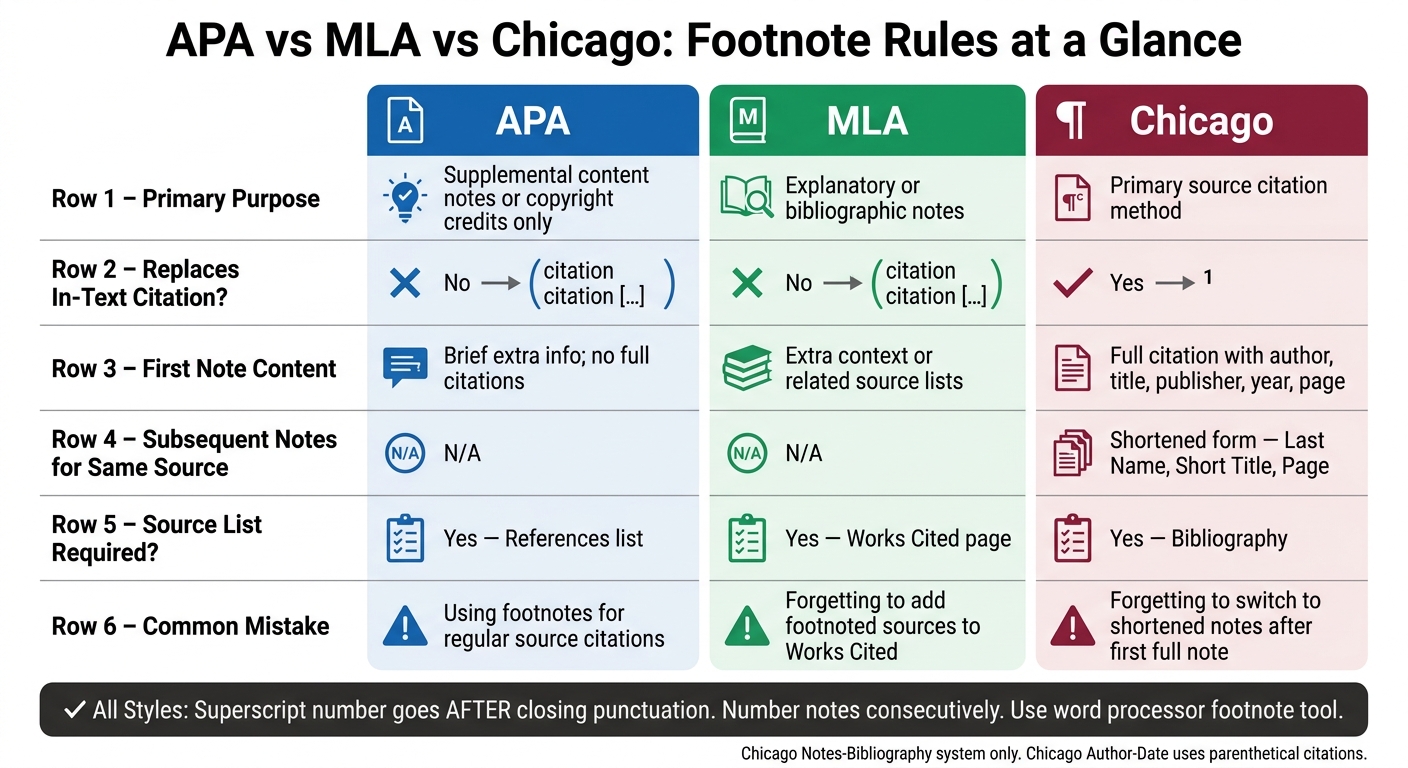
APA vs MLA vs Chicago Footnotes: Quick Style Guide
Side-by-Side Rules for Purpose, Format, and Source Handling
After you learn the rules, this comparison makes the differences much easier to see.
| Feature | APA (7th Ed.) | MLA (9th Ed.) | Chicago (Notes-Bib) |
|---|---|---|---|
| Primary purpose | Supplemental content or copyright only | Explanatory or bibliographic notes | Primary source citation method |
| Replaces in-text citation? | No | No | Yes |
| First note content | Brief extra info; no full citations | Extra context or source lists | Full citation with page number |
| Subsequent notes | N/A | N/A | Shortened: Author, Short Title, Page |
Mistakes Students Make Most Often
Once you know what each style expects, the usual mistakes start to stand out.
The most common ones are using the wrong footnote purpose, putting the superscript in the wrong spot, and forgetting Chicago short notes. That last one trips people up all the time: in Chicago, the first note gives the full citation, but every note after that for the same source switches to the shortened form: last name, short title, and page number.
MLA has its own snag. Students sometimes mention a source in a footnote but forget to add that same source to the Works Cited page. It sounds small, but it can cost points.
One rule stays the same across all three styles: the superscript number goes after the closing punctuation, not before it. And if you want to avoid a messy numbering problem, use your word processor’s built-in Insert Footnote tool instead of typing numbers by hand. It keeps everything in order for you.
Conclusion: Rules to Check Before You Submit
Before you submit, do four quick checks:
- Make sure footnotes are being used for the right purpose in your assigned style
- Check that every superscript comes after the closing punctuation
- Confirm that each note matches the right format for APA, MLA, or Chicago
- Cross-check each footnoted source against your References list, Works Cited page, or Bibliography
FAQs
Do I need footnotes or endnotes?
It depends on your citation style and the rules for your assignment. Chicago notes and bibliography uses footnotes or endnotes, which is common in fields like history and literature.
APA uses parenthetical author-date citations in the text instead of footnotes. Check your instructor’s guidelines so you know whether to use footnotes at the bottom of each page or endnotes at the end of your paper.
What if my instructor says only “Chicago style”?
Chicago style has two systems: Notes-Bibliography and Author-Date. Use the one your instructor asks for.
Here’s the simple difference:
- Notes-Bibliography uses footnotes or endnotes. You’ll see it most often in humanities subjects like history and literature.
- Author-Date uses parenthetical in-text citations. It’s more common in the social sciences.
The big rule is simple: don’t mix the two systems. Pick one and stick with it throughout your paper.
Do footnotes replace the bibliography?
No. Footnotes don’t replace the bibliography.
In the notes and bibliography system, footnotes cite sources in the text, while the bibliography lists every source in one place at the end of the document. They work together.
The footnotes point readers to the source as they move through the paper. The bibliography then gives the full list of sources, arranged alphabetically, so readers can scan and find each one easily.