
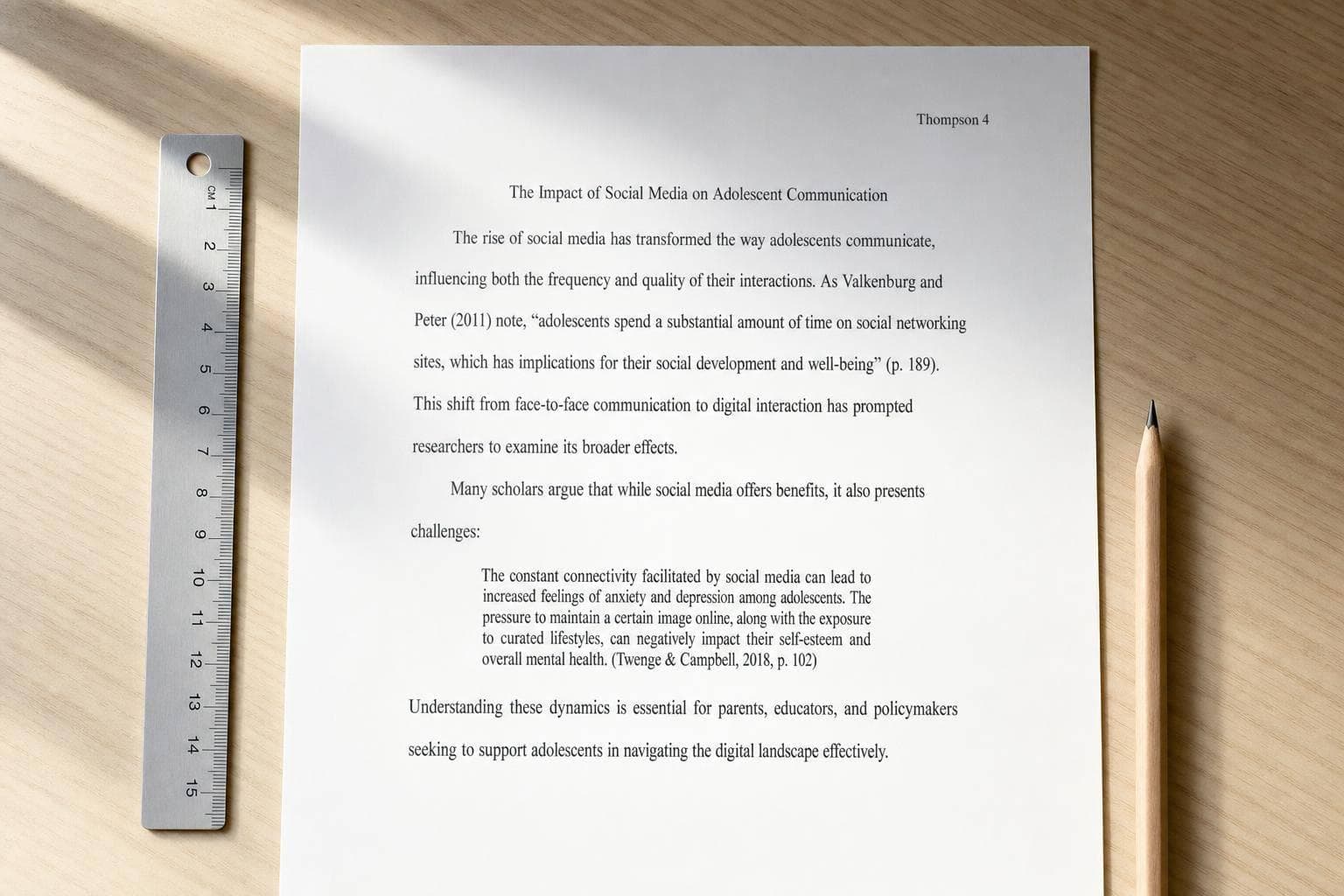
How to Format Long Quotes in an Essay (APA, MLA, Chicago Block Quotes)
If a quote is long enough, I don’t keep it in quotation marks - I format it as a block quote. The main cutoff points are simple: APA = 40+ words, MLA = more than 4 lines of prose or more than 3 lines of poetry, and Chicago = often 5+ lines, about 100+ words, or 2+ paragraphs.
Here’s the short version:
- I start the quote on a new line
- I indent the whole quote 0.5 inches from the left margin
- I remove quotation marks
- I keep the source text exactly the same
- I place the citation and punctuation based on the style guide
That’s where many students lose points. A small punctuation error or the wrong spacing can make the format incorrect.
Quick Comparison
| Style | When I use a block quote | Spacing | Citation placement |
|---|---|---|---|
| APA | 40+ words | Double-spaced | After final punctuation |
| MLA | More than 4 lines of prose or more than 3 lines of poetry | Double-spaced | After final punctuation |
| Chicago | 5+ lines, about 100+ words, or 2+ paragraphs | Usually single-spaced | After final punctuation |
A few rules matter most: 0.5-inch indent, no quotation marks, and style-specific citation placement. In most cases, if I check the quote length first and then match the style rules, the format is easy to get right.
Block Quotations – How to Format in APA & MLA
sbb-itb-1831901
How to Format a Block Quote in APA, MLA, and Chicago
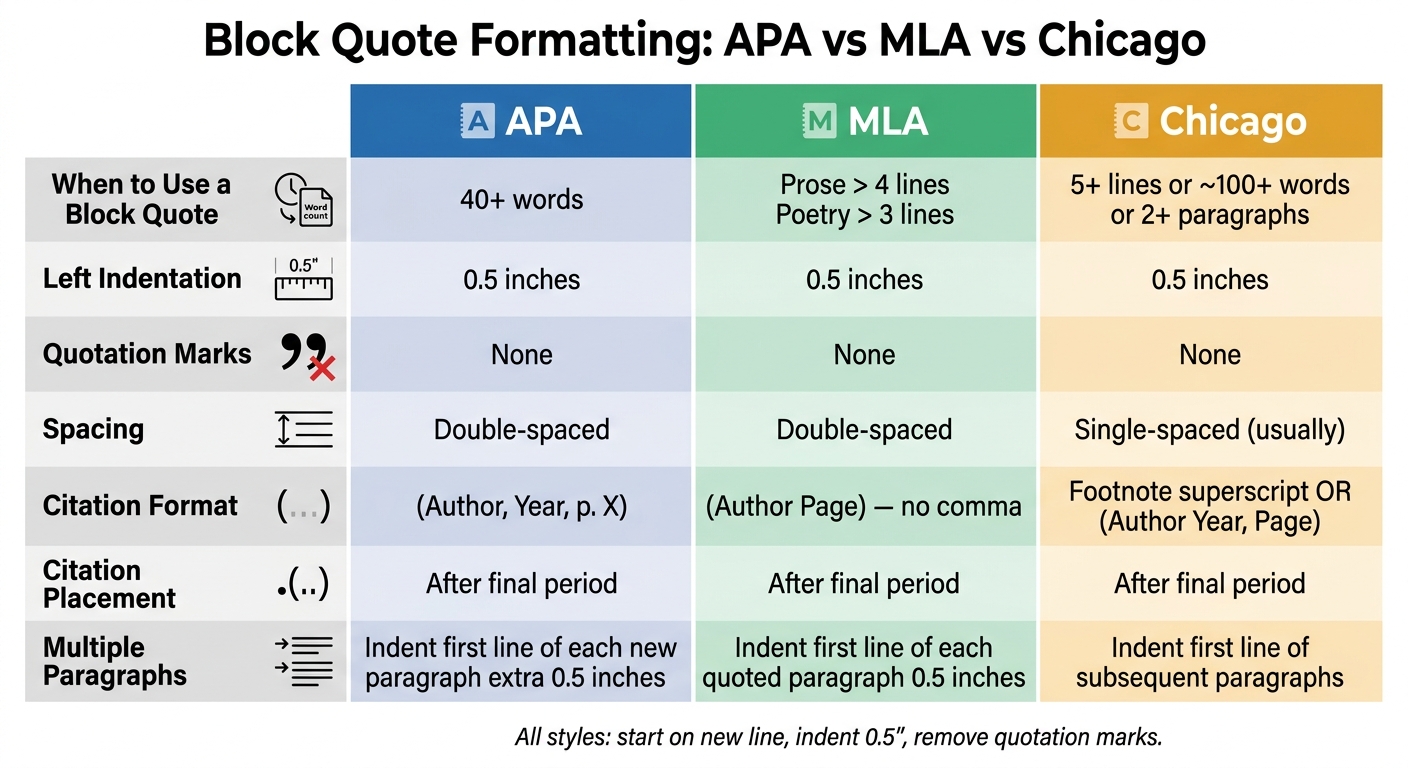
APA vs MLA vs Chicago Block Quote Formatting Rules
The core setup is the same across all three styles: start the quote on a new line, indent the entire block 0.5 inches from the left margin, and remove quotation marks. After that, each style has its own rules.
APA Block Quote Format
APA uses a block quote for 40 words or more. Keep the quote double-spaced. Put the citation after the final punctuation, and do not add a period after the closing parenthesis.
If the block quote runs across more than one paragraph, indent the first line of each new paragraph by an extra 0.5 inches.
MLA Block Quote Format
MLA uses a block quote for prose that runs longer than four lines or poetry that runs longer than three lines. Keep the quote double-spaced. In MLA, the period comes before the parenthetical citation.
Use the author's last name and page number with no comma, like this: (Smith 42).
Chicago Block Quote Format
Chicago uses a block quote for five or more lines, about 100 words, or two or more paragraphs. Chicago block quotes are usually single-spaced and set off with blank lines before and after.
Citation placement depends on which Chicago system you're using:
- In Notes-Bibliography, place a superscript footnote number after the final punctuation.
- In Author-Date, place the parenthetical citation after the final punctuation in this format: (Author Year, page).
The chart below compares APA, MLA, and Chicago side by side.
Block Quote Comparison Chart
APA vs. MLA vs. Chicago at a Glance
Use the chart below to check the academic paper citation rules for your style.
| Feature | APA | MLA | Chicago |
|---|---|---|---|
| When to use | 40+ words | Prose: > 4 lines; Poetry: > 3 lines | 5+ lines or 100+ words |
| Left indentation | 0.5 inches | 0.5 inches | 0.5 inches |
| Quotation marks | None | None | None |
| Spacing | Double-spaced | Double-spaced | Single-spaced (usually) |
| Citation format | (Author, Year, p. X) | (Author Page) | Footnote or (Author Year, Page) |
| Citation placement | After final period | After final period | After final period |
| Multiple paragraphs | Indent first line of each new paragraph an extra 0.5 inches | Indent the first line of each quoted paragraph 0.5 inches | Indent first line of subsequent paragraphs |
Once you’ve matched your style to the chart, review the common errors below before you submit.
Common Block Quote Mistakes and How to Avoid Them
Even if you've looked over the comparison chart, it's easy for small formatting slips to sneak in and cost you points. In most cases, the mistakes come down to two things: how the block quote appears on the page and where the citation and punctuation go.
Quotation Marks, Indentation, and Spacing Errors
Block quotes should not use quotation marks.
The full quote should be indented 0.5 inches from the left margin.
You also need to follow the spacing rules for the style guide you're using.
Citation and Punctuation Placement Errors
Citation placement trips up a lot of students because the rules change by style. In APA and MLA, put the period at the end of the quoted text, then place the parenthetical citation after it. In Chicago Notes-Bibliography, the superscript number comes after the final period at the end of the block.
For MLA, the parenthetical citation should include only the page number. The main thing is to keep the block quote format and citation style consistent with the rest of the paper.
Use the final checklist below to catch any remaining formatting errors.
Final Checklist for Formatting Long Quotes in an Essay
Use this final check after you’ve applied the APA, MLA, or Chicago rules above.
Step-by-Step Formatting Sequence
Go through these checks in order.
- Choose your citation style. Make sure your assignment calls for APA, MLA, or Chicago. If you’re not sure, check your syllabus or your professor’s directions.
- Confirm the quote length. Check that the passage meets the block quote limit for your style.
- Write a lead-in sentence. Set up the quote with a signal phrase or a full sentence that ends with a colon.
- Start the quote on a new line. Put the block quote on its own line so it stands apart from the rest of your paragraph.
- Apply the correct indent. Indent the block 0.5 inches from the left margin and remove quotation marks.
- Preserve the original text. Keep the source wording exactly as it appears and leave out quotation marks.
- Set the spacing. Use the spacing required by your style guide.
- Place the citation correctly. Put the citation after the final punctuation, based on your style’s rules.
Then do one last proofread for spacing, punctuation, and citation placement.
FAQs
Do I need a lead-in before a block quote?
Yes. In academic writing, you should introduce a block quote with a signal phrase or lead-in sentence.
That short setup gives the quote context, keeps your argument moving, and helps readers see why the longer passage belongs there in APA, MLA, or Chicago style.
Can I shorten or edit a block quote?
Yes - but do it with care.
If you cut part of a block quote to make it shorter, mark the missing text with an ellipsis. That way, readers can see that you edited the passage. Just as important, your edit must not change the author's meaning.
The shortened quote should also still read cleanly. If it sounds broken or awkward after the cut, it needs more work.
And one more thing: make sure the edited block quote still follows the rules of your citation style, including:
- proper indentation
- ellipsis use
- citation placement
Small edits are fine. Misleading edits are not.
What if my professor wants different formatting?
If your professor asks for formatting that differs from standard APA, MLA, or Chicago rules, follow those directions first.
Check the syllabus or ask for confirmation if anything feels unclear. Then stick with that format consistently across the entire paper.