

How to Write an Explanatory Essay (Structure, Examples, and Common Mistakes)
An explanatory essay is simple: you explain a topic with facts, clear logic, and a neutral tone. You do not argue, and you do not tell a personal story. In most school papers, the basic format is introduction + 3 body paragraphs + conclusion, with each body paragraph covering one main point.
Here’s the full idea in plain English:
- What it is: a paper that helps the reader understand a topic
- When to use it: when the prompt says explain, describe, define, summarize, or show how
- What makes it different: it informs instead of persuading
- How to structure it:
- intro with background and a neutral thesis
- body paragraphs with one point each
- conclusion that restates the main idea
- What strong paragraphs need: a topic sentence, evidence, explanation, and a transition
- Common mistakes: biased wording, unsupported opinions, weak organization, and adding new facts at the end
A few practical details matter too. In many U.S. high school classes, body paragraphs often run about 5–8 sentences. And one of the most common problems in student writing is dropped evidence - that’s when you give a quote, fact, or statistic but fail to explain what it means.
Let Me Explain: Expository Writing - Learn How To Write an Expository Essay
sbb-itb-1831901
Quick Comparison
| Essay Type | Main Goal | Thesis | Tone | Main Structure |
|---|---|---|---|---|
| Explanatory | Explain a topic | States what the essay will explain | Neutral | Ideas, causes, steps, or effects |
| Argumentative | Convince the reader | Takes a position | Firm | Claims, evidence, counterpoints |
| Narrative | Tell a story | Shares a lesson or insight | Personal | Beginning, middle, end |
If I had to boil the article down to one rule, it would be this: if your reader should understand the topic better after reading, you’re writing an explanatory essay.
What an Explanatory Essay Is and When to Use One
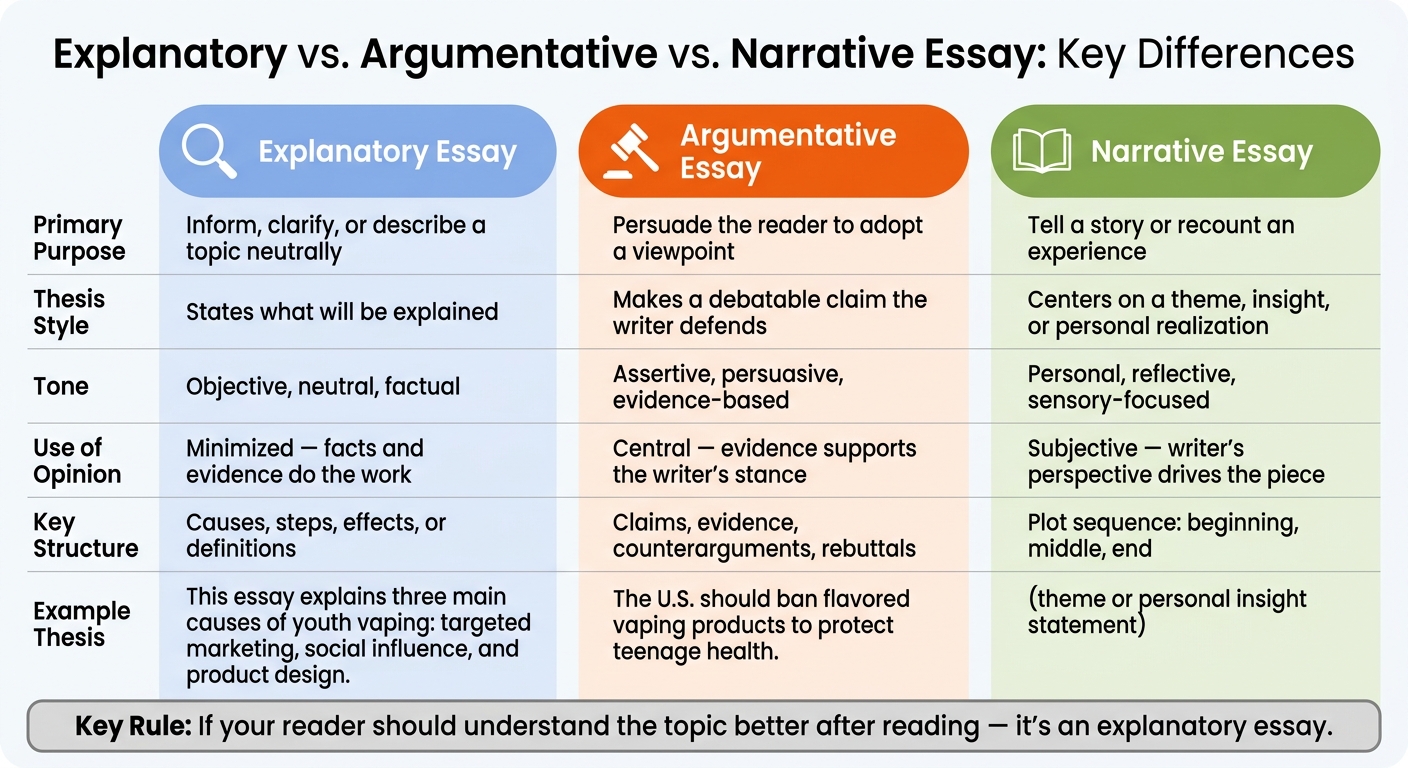
Explanatory vs. Argumentative vs. Narrative Essay: Key Differences
An explanatory essay helps the reader understand a topic more clearly. Its job is to inform, clarify, or describe. That means you should rely on facts, logic, and relevant examples, while keeping the tone objective.
One of the easiest ways to spot this kind of assignment is to look at the task verb in the prompt.
Common topics include the Electoral College, teen sleep deprivation, and federal student aid.
When a prompt uses words like explain, describe, define, summarize, or show how, it usually points to an explanatory essay. For example, if the prompt says, "explain how social media influences political participation among young adults," that's explanatory.
Here's the simple rule: if the goal is understanding, write an explanatory essay. If the goal is persuasion, write an argumentative essay.
How Explanatory Essays Differ From Argumentative and Narrative Essays
The main differences come down to purpose, thesis, and tone. This side-by-side view makes it easier to see:
| Feature | Explanatory Essay | Argumentative Essay | Narrative Essay |
|---|---|---|---|
| Primary Purpose | Inform, clarify, or describe a topic neutrally | Persuade the reader to adopt a viewpoint | Tell a story or recount an experience |
| Thesis Style | States what will be explained | Makes a debatable claim the writer defends | Often centers on a theme, insight, or personal realization |
| Tone | Objective, neutral, factual | Assertive, persuasive, evidence-based | Personal, reflective, sensory-focused |
| Use of Opinion | Personal opinions are minimized; facts and evidence do the work | Writer's stance is central; evidence supports a position | Subjective; the writer's perspective drives the piece |
| Key Structure | Logical categories such as causes, steps, effects, or definitions | Claims, evidence, counterarguments, and rebuttals | Plot sequence: beginning, middle, end |
The most common point of confusion is explanatory vs. argumentative writing. Both use evidence. Both include a thesis. But the thesis does different work in each one.
- Explanatory: "This essay explains three main causes of youth vaping: targeted marketing, social influence, and product design."
- Argumentative: "The U.S. should ban flavored vaping products to protect teenage health."
The first one tells the reader what the essay will explain. The second one argues for a position. That one shift changes the whole paper - your thesis, your evidence, and your tone.
Where Students Encounter Explanatory Essays in U.S. Schools and Colleges
Students run into explanatory essays in middle school, high school, and first-year composition when the assignment asks them to inform rather than argue. In middle school, a teacher might ask students to explain a theme in a novel or describe how a scientific process works. District-level writing assessments often use prompts like "Explain how one invention changed daily life in the United States," and the rubrics tend to focus on clarity, organization, and use of evidence.
In high school and first-year composition, often called English 101 or ENGL 1101, explanatory assignments often show up early in the course. State standardized writing exams and college-readiness assessments also include informative/explanatory tasks. Students may need to read one or more sources and then explain a concept or process. If the rubric stresses clarity, organization, and sources, you're almost certainly dealing with an explanatory assignment.
Once you can identify the assignment type, the next move is to follow a simple essay structure.
Standard Explanatory Essay Structure From Introduction to Conclusion
Once you know the assignment is explanatory, this structure helps keep your writing clear and neutral.
Most explanatory essays follow a simple three-part format: introduction, body paragraphs, and conclusion. In shorter assignments, that often turns into a five-paragraph essay. In longer papers, you just add more body paragraphs.
Introduction: Hook, Background, and an Objective Thesis
The introduction has three jobs: hook the reader, give brief context, and state an objective thesis. A good hook might be a surprising fact, a short scenario, or a broad statement that naturally narrows to your topic. After that, give only the background the reader needs to understand what you're explaining. Then end the introduction with a clear, neutral thesis.
This is where many students get tripped up. The thesis in an explanatory essay should explain, not argue.
- Weak: "School uniforms are bad." - This takes a side.
- Strong: "School uniforms are used in many districts to create consistency, reduce visible distractions, and simplify morning decision-making for students." - This tells the reader what the essay will explain.
The stronger version uses neutral wording and makes the essay's focus clear.
After the thesis, move into the body with one main idea per paragraph.
Body Paragraphs: One Main Idea, Evidence, and Clear Explanation
Each body paragraph should focus on one main idea. The goal is to explain one part of the topic, not debate it. A simple pattern works well here: topic sentence, evidence, explanation, and transition.
Your paragraph structure should fit the topic you're covering. For example:
- General-to-specific works well when you start with a broad idea and break it into parts.
- Cause-and-effect fits topics that explain why something happens and what follows.
- Step-by-step works best for process essays where order matters.
In U.S. high school assignments, a common guideline is for each body paragraph to be about 5–8 sentences and centered on one main idea.
Once you've explained your main points, wrap up the section by restating them in a clear, brief way.
Conclusion: Restate the Main Idea Without Adding New Evidence
In the conclusion, restate the thesis in new words. Don't copy and paste it from the introduction. Then briefly revisit the main points, again using fresh wording. End with a closing sentence that gives the reader a sense that the essay is complete.
This part matters more than students sometimes think. If you add new facts, sources, or arguments at the end, the essay can feel messy and unfinished. The conclusion should make the topic clearer, not send the reader in a new direction. Think of it as a summary, not a last-minute add-on.
How to Write Strong Explanatory Paragraphs With Examples
A strong explanatory essay depends on strong paragraphs. Each paragraph should stick to one clear idea.
Most strong explanatory paragraphs have four parts:
- a clear topic sentence
- relevant evidence
- explanation
- a closing transition
Good Topic Ideas and Thesis Statement Examples
Pick topics that explain how or why something works. That makes it much easier to write a neutral thesis.
Here are three examples with matching thesis statements:
- How sleep affects academic performance: "Consistent sleep of 7–9 hours per night supports academic performance by improving concentration, memory, and mood."
- How community colleges support transfer students: "Community colleges support transfer students by offering articulation agreements, dedicated advising, and flexible scheduling that match lower-division courses to four-year degree requirements."
- How extracurricular activities build transferable skills: "Participation in extracurricular activities helps students develop transferable skills such as time management, teamwork, and communication through practice, collaboration, and leadership."
Each thesis uses neutral verbs like support, improve, or helps develop. None of them argue a side or push a personal opinion.
Once the thesis is set, each body paragraph should build out one supporting point.
A Sample Body Paragraph With Line-by-Line Breakdown
The next step is turning a thesis into one focused body paragraph. Here’s an example, broken into its parts:
"Another way community colleges support transfer students is by offering dedicated academic advising focused on the transfer process. Many community colleges in the United States employ advisors who specialize in helping students choose courses that match four-year university requirements, monitor their credit progression, and complete application materials on time. These advisors often use tools such as degree planning worksheets and transfer guides to show students how each course will count toward their intended major, which reduces confusion and prevents wasted credits. As a result, focused advising helps students transfer with fewer wasted credits and a clearer plan."
Here’s what each part is doing:
- "Another way…" - signals a new supporting point
- Topic sentence - names the paragraph’s focus
- Evidence - shows what advisors do
- Explanation and closing sentence - show why it matters and connect back to the thesis
Notice how the paragraph stays objective from start to finish.
Use the table below to check whether your own paragraph is doing each job clearly.
Strong vs. Weak Paragraph Development
| Feature | Strong Explanatory Paragraph | Weak Explanatory Paragraph |
|---|---|---|
| Topic sentence clarity | States one specific aspect of the thesis in neutral language | Unfocused, or includes personal opinions like "I think" or "the best" |
| Evidence relevance | Uses concrete facts, examples, or data that directly explain the topic sentence | Includes random details or unrelated facts that don't match the paragraph's focus |
| Explanation depth | Clearly explains how or why the evidence supports the main idea | Lists evidence without explaining its meaning, or restates the topic sentence without adding explanation |
| Transitions and cohesion | Uses phrases like "Another way", "For example", or "As a result" to guide flow | Jumps between ideas without transitions |
One simple rule: if a fact or statistic shows up in your paragraph, explain it. If you don’t, the paragraph can feel thin and unfinished. University writing centers note that unexplained quotations or data are a common flaw in student writing.
Common Mistakes to Avoid and a Final Writing Checklist
Mistakes That Make Explanatory Essays Confusing or Biased
Once your structure is set, this is the place to catch the problems that weaken an explanatory essay. In most cases, the trouble comes from bias, thin support, or messy organization.
One of the biggest mistakes is turning the thesis into an argument. A line like "School uniforms are unfair and should be banned in all schools" takes a side. That's debate writing, not explanation. A better version shifts the focus to how or why: "This essay explains how school uniform policies in U.S. public schools are designed, enforced, and experienced by students." That tells the reader what the essay will explain without pushing them toward a verdict.
The next problem is unsupported opinion. Phrases like "I think" and loaded words like "ridiculous" or "amazing" tilt the tone. They make the essay sound personal when it should sound grounded. Swap them out for clear, factual wording, and back up each claim with evidence.
A third pattern shows up all the time: dropped evidence. This happens when a writer adds a statistic, quote, or example and then jumps straight to the next point. The result? A paragraph that feels like a pile of facts instead of an explanation. After each piece of evidence, add a short line explaining what it shows and why it matters.
| Mistake | Effect on Essay | Practical Fix |
|---|---|---|
| Argumentative thesis | Essay reads like a debate, not an explanation | Reframe the thesis to focus on how or why something works |
| Biased or informal tone ("I think…", casual language) | Makes the essay feel subjective and reduces credibility | Replace opinions and informal phrasing with neutral, factual language |
| Dropped evidence (no follow-up) | Paragraphs feel like disconnected fact lists | Add a brief explanation of what the evidence shows and why it matters |
| Vague or overly broad topic | Leads to surface-level, general explanations | Narrow by group, time, place, or specific aspect |
| Disorganized paragraphs | Readers lose track of the main explanation | Give each paragraph one main idea; use clear topic sentences |
| Conclusion adds new evidence | Conclusion feels unfinished; move new points into body paragraphs | Restate the main explanation only |
Using Yomu AI to Plan, Draft, and Revise an Explanatory Essay
Yomu AI can help at each stage of an explanatory essay, from planning to revision. Start with your own ideas first. Then use Yomu AI to sharpen them. It's especially useful for spotting bias, weak transitions, and dropped evidence.
| Yomu AI Feature | Explanatory Essay Task | How It Helps |
|---|---|---|
| Outline and document structuring | Organizing introduction, body, and conclusion | Proposes logical sequences and helps ensure each section has one clear focus |
| Thesis refinement | Writing a neutral, objective thesis | Flags argumentative phrasing and suggests explanatory alternatives |
| Paragraph drafting | Drafting body paragraphs | Extends topic sentences into coherent explanations with transitions and supporting details |
| Paraphrasing | Clarifying complex or wordy sentences | Rewrites unclear passages in precise language without changing the meaning |
| Paragraph summary | Checking paragraph focus | Summarizes each paragraph so you can see whether it explains the intended point clearly |
| Citation formatting | Integrating evidence smoothly | Suggests citation formats and introductory phrases to avoid dropped evidence |
Use Yomu AI like a coach. Write your thesis first, then ask it for a more objective version. If it gives you sentence suggestions, rewrite them in your own words. That way, the thinking stays yours.
Final Recap: Key Elements of a Clear Explanatory Essay
Use this checklist for your last revision pass.
Topic and thesis
- [ ] Is my topic narrow enough to cover thoroughly within the assigned length?
- [ ] Does my thesis state what I will explain in neutral language?
Organization and evidence
- [ ] Does each body paragraph focus on exactly one main idea?
- [ ] Does every paragraph start with a clear topic sentence?
- [ ] After each quote or statistic, did I explain what it shows?
- [ ] Do transitions connect paragraphs logically (cause and effect, addition, contrast)?
Tone and style
- [ ] Did I avoid phrases like "I think" or emotionally charged words?
- [ ] Is the tone consistent and formal throughout?
Final edit
- [ ] Did I check spelling, grammar, and punctuation?
- [ ] Are all sources cited correctly in the required format (MLA, APA, or Chicago)?
- [ ] Does my conclusion restate the main explanation without introducing new evidence?
If even one box is still unchecked, the draft needs more work before submission.
FAQs
How long should an explanatory essay be?
There’s no set word count for an explanatory essay. The right length depends on your assignment prompt, so check the instructions first and stick to any limits.
A common structure includes three to five body sections. But the depth of your analysis, and even the number of sections, should match the length you’ve been assigned. Keep your thesis narrow enough that you can explain it well within the word limit.
Can I use sources in an explanatory essay?
Yes. Sources give your claims factual, objective support. When you use reliable evidence - like peer-reviewed journals, government reports, expert insights, and statistics - your essay stays clear, focused, and easier to follow.
You should cite any outside information, data, or ideas. That helps you maintain academic integrity and avoid plagiarism. It also shows readers where your points come from, which makes your writing more convincing.
Use the citation style your assignment requires, such as MLA, APA, or Chicago.
How do I know if my thesis sounds neutral?
Check whether your thesis fits the goal of an explanatory essay: to inform with factual, unbiased information, not to persuade or argue.
A neutral thesis tells readers what they’ll learn without personal opinion, emotional wording, or a stance people could debate. If it explains instead of argues, it will usually sound neutral.