

How to Reply to a Discussion Post: 10 Response Examples for Online Classes
Discussion replies can affect 10% to 30% of your final grade, so a short “I agree” can cost you points. When I reply to a classmate, I keep it simple: show I read the post, add one new point, and end with a question that keeps the thread going.
Here’s the whole idea in plain English:
- Read the prompt, rubric, and post first
- Pick one goal for the reply: agree, question, connect, answer, disagree, critique, synthesize, reflect, or follow up
- Use a simple pattern: acknowledge, add, ask
- Write in a clear, respectful, college-level tone
- Back up points with course material or a source when the class asks for it
- Aim for about 175–250 words if your instructor does not give a different length
- Remember timing rules, since many courses want 1–2 peer replies each week by 11:59 p.m.
The article also walks through 10 common reply types I can use in online classes:
- Agree and add
- Ask for clarification
- Build on an example
- Connect to the reading
- Answer a classmate’s question
- Disagree with respect
- Give a focused critique
- Link ideas from several posts
- Reflect on what I learned
- Come back later with a follow-up
Tips For Students Writing & Responding To Discussion Posts
sbb-itb-1831901
Quick Comparison
| Reply type | Best use | Main risk |
|---|---|---|
| Agree and add | I agree but have more to say | Repeating the same idea |
| Clarifying question | A point is unclear | Asking a yes/no question |
| Build on an example | I have a related case or contrast | Retelling without analysis |
| Connect to reading | The post links to course ideas | Using vague source language |
| Answer a question | A peer asks something direct | Giving an opinion with no support |
| Respectful disagreement | I see the issue another way | Sounding personal or harsh |
| Focused critique | One part needs more depth | Giving vague feedback |
| Link several posts | Many classmates touch the same issue | Listing points with no link |
| Reflection | The topic changed my view | Telling a story with no class link |
| Follow-up | I return later in the week | Repeating my earlier comment |
If I want a strong reply, I do not try to say everything. I make one clear point, support it, and ask a question that invites more than a yes or no answer.
How to Prepare Before You Reply
Before you draft anything, take a minute to figure out what the prompt, rubric, and original post are actually asking for.
Re-read the Prompt, Rubric, and Original Post
Start with the discussion prompt and look for action words like "analyze", "compare", or "evaluate." Those words tell you what kind of response your instructor wants. If the prompt says "evaluate", you're being asked to make a judgment, not just repeat what someone said. Then use the rubric to narrow things down even more.
Check for the basics first: word count, citation rules, and whether your reply needs to push the discussion forward. After that, go back to your classmate's post and read it slowly. As you read, answer three simple questions:
- What is their main claim?
- What evidence did they use?
- What did they leave unanswered or unclear?
Write one short note for each. That gives you a clear target before you start writing.
Once you know what the post needs, pick the reply goal that makes the most sense.
Choose a Response Goal Before You Write
Before you write, choose one clear goal for your reply. That keeps your response focused and stops it from drifting into a vague paragraph that says a little bit of everything.
| Response Goal | When to Use It |
|---|---|
| Agree + extend | You share the classmate's view but can add new evidence or an example |
| Respectfully disagree | You see a flaw in reasoning or have conflicting evidence to share |
| Clarify | The post is interesting but vague, incomplete, or confusing |
| Connect to course readings | The rubric requires citations or you can anchor the idea in the textbook |
| Synthesize multiple posts | Several classmates have shared related ideas you can tie together |
If your notes are all over the place or your wording sounds stiff, Yomu AI can help you shape the reply.
Use Yomu AI to Organize, Paraphrase, and Check Citations
After you choose a goal, Yomu AI can help turn rough notes into a clean reply. Paste in your notes and ask Yomu to sort them into a simple outline: an opening that acknowledges your classmate's point, a middle section that adds evidence, and a closing question that keeps the conversation going.
Yomu can also help with dense course readings. If a passage feels hard to work with, ask Yomu to restate it in plain language. Then put that idea into your own words and add the right citation. For citation help, give Yomu the basic source details - author, year, and title - and it can suggest APA or MLA-style in-text citations and reference entries that you can adjust for your reply.
If your draft sounds too harsh, Yomu can smooth out the tone. For example:
"You clearly didn't understand this theory"
can become:
"I interpreted this theory differently."
A Simple Structure for Writing Strong Replies
Once you know your goal, use the Acknowledge, Add, Ask pattern to shape your reply. It’s a simple way to draft a strong response fast, and it works in almost any online class.
Use the Acknowledge, Add, Ask Pattern
Acknowledge starts the reply with a short, accurate restatement of your classmate’s main point. One or two sentences is plenty. The point is to show that you read the post closely. Use the person’s name and mention something specific they wrote, not just the broad topic.
Add is where the reply starts to matter for your grade. Bring in one new idea, such as analysis, course material, or a relevant example. Stay focused. If you try to squeeze in too many points, the reply usually ends up thin.
Then close with an open-ended question that invites a paragraph, not a yes/no answer. Good options include extension questions, like “How would this apply in a different setting?”, or implication questions, like “If this is true, what does it mean for policy?” That keeps the discussion moving and shows you’re engaged.
Aim for 175–250 words. That gives you enough space to cover all three parts without stuffing in extra filler.
Write with Evidence, Clarity, and Respect
In the Add step, ground your point in something concrete. Name the source, such as the author, textbook title, or lecture, instead of falling back on vague lines like “studies show.” For example: "Our textbook by Northouse (2021) notes that self-regulation helps leaders respond thoughtfully rather than react impulsively" is much stronger than "leadership experts agree." Use the citation style your course asks for; in many cases, a simple in-text citation will do. You can also use a citation generator to ensure accuracy.
Once you’ve added evidence, keep your wording direct and respectful. If you disagree, go after the idea, not the person. Neutral phrasing helps: “I see this differently” or “An alternative interpretation is...” works far better than second-person blame like “You ignored…”. Stick to what the argument does or does not account for. The goal is critical thinking, not scoring points.
Keep sentences short, cut filler, and read the post once before you hit submit.
The examples below show how this pattern works in common discussion situations.
10 Response Examples for Common Online Discussion Situations
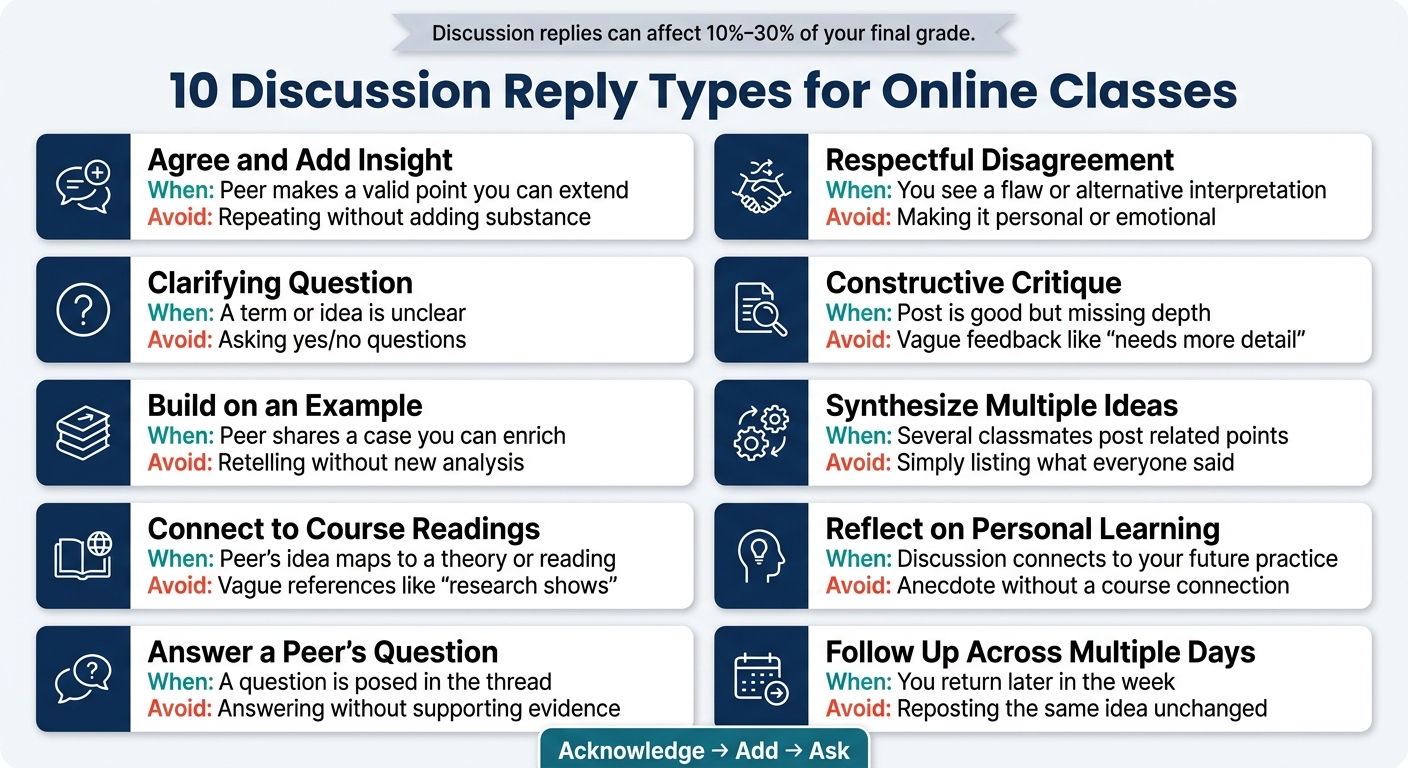
10 Discussion Reply Types: When to Use Each & Mistakes to Avoid
These examples use the Acknowledge, Add, Ask pattern. The goal is simple: move the discussion forward instead of posting a reply that just says “I agree.” Examples 1–5 help you keep the conversation going. Examples 6–10 push it further.
Examples 1–5: Agree, Question, Build, Connect, Answer
Example 1 - Agree and Add Insight
I agree with your point about clear expectations in online discussion boards, especially your observation that generic praise or agreement does not move the conversation forward. Building on that, a stronger reply usually adds one new idea, example, or source so it demonstrates critical thinking rather than repetition. Do you think that approach would be even more important in a class with short word limits?
Use this when you agree with the post and can add a new angle.
Example 2 - Clarifying Question
Your discussion of cultural competence in healthcare raised an important point about representation in patient education materials. Could you clarify what you mean by authentic inclusion - are you referring to language access, examples in the materials, or both? How do you see that working in a time-limited clinical setting?
Use this when a classmate has a good idea, but one term or point still needs to be clarified.
Example 3 - Build on an Example
Your example of a public health campaign illustrates how message framing can shape audience response. A similar example is another campus wellness campaign that used the same basic approach but targeted a narrower student group. Taken together, these examples suggest that audience segmentation can change how persuasive a message is. What do you think helps determine when a broad message is better than a targeted one?
Use this when a peer shares a case you can extend with a similar or contrasting example.
Example 4 - Connect to Course Readings (with Citation)
Your point about stakeholder resistance during organizational change aligns with this week's change-management reading (Smith, 2020). The reading suggests that people are more likely to engage when they understand both the purpose and the practical impact of the change. This connection suggests that the resistance you described may reflect a communication gap rather than simple opposition. Do you think that would play out differently in another organizational setting?
Use a short in-text citation in whatever format your course requires.
Example 5 - Answer a Peer's Question
You asked whether evidence-based practice can be realistically used in under-resourced clinical settings. Based on our readings, I think it can be done if the process is adapted to the setting instead of copied exactly. For example, a team could start with a brief evidence scan and a small pilot intervention before deciding whether to expand it further. I'm curious whether others have seen similar adaptations in clinical practice.
Use this when someone asks a direct question in the thread. Answer it first, then back it up with a source or example.
If you want another option, the next set helps with disagreement, synthesis, and follow-up.
Examples 6–10: Disagree, Critique, Synthesize, Reflect, Follow Up
These five examples are useful when you need to challenge an idea, connect several posts, or come back later in the week with more to say.
Example 6 - Respectful Disagreement with Evidence
I appreciate your analysis of social media and civic participation, but I interpret the evidence differently. While these platforms can lower barriers to participation, one concern I have is whether quick actions translate into deeper involvement in community issues. I'd be interested in your thoughts on how we might distinguish visible engagement from sustained participation.
Use this when you see a weak spot in the argument or read the evidence another way. Focus on the idea, not the person.
Example 7 - Constructive Critique or Suggestion
Your discussion of workplace wellness programs is strong, especially your point about employee autonomy. One area that might benefit from further development is the difference between voluntary programs and top-down policies. You could strengthen this by explaining how self-determination theory helps connect autonomy to motivation.
Start with what works, then point to one part that needs more depth and explain how to improve it.
Example 8 - Synthesize Multiple Classmates' Ideas
Several classmates have raised related points about supply chain transparency and consumer trust. Taken together, these posts suggest that ethical sourcing is not just an operations issue but also a communication issue. A question that emerges from this synthesis is whether third-party certification actually solves the problem or simply shifts the accountability burden.
Use this when several people are circling the same topic. Name classmates or refer to their ideas clearly so readers can see the pattern.
Example 9 - Reflect on Personal Learning or Future Practice
This discussion has shifted my understanding of trauma-informed care by making me rethink how I interpret non-compliance in clinical settings. Previously, I assumed resistant behavior reflected a lack of motivation, but now I recognize it may signal an unmet safety need. In my future role as a social worker, I plan to begin intake conversations with open-ended questions about comfort and past experiences before discussing treatment goals.
Use this when the discussion changes how you think about your field or your future work. Keep the reflection tied to course ideas.
Example 10 - Follow Up Across Multiple Days
Returning to our earlier discussion on restorative justice practices, I appreciated your point that implementation varies by district. Since my last post, I've reconsidered my view on mandatory training and now think voluntary adoption works better when paired with peer coaching. To keep this conversation going, I wonder how district size and available resources affect which approach is most sustainable.
Use this when you return later in the week. Show that your thinking has changed or grown since your earlier post.
When to Use Each Response Type: Comparison Table
Use the table below to match each reply type to the discussion situation.
| Reply Type | When to Use It | Common Mistake to Avoid |
|---|---|---|
| Agree and Add Insight | Peer makes a valid point you can extend with new evidence or context | Repeating the original post without adding substance |
| Clarifying Question | Post is interesting but one term or idea is unclear | Asking a yes/no question or sounding accusatory |
| Build on an Example | Peer shares a case you can enrich with a parallel or contrasting example | Retelling the same example without new analysis |
| Connect to Course Readings | Peer's idea maps to a theory or assigned reading | Using vague references like research shows |
| Answer a Peer's Question | A question is posed in the thread | Answering without supporting evidence |
| Respectful Disagreement | You see a flaw or alternative interpretation | Making it personal or emotional |
| Constructive Critique | Post is good but missing depth or a key distinction | Vague feedback like needs more detail |
| Synthesize Multiple Ideas | Several classmates have posted related points | Simply listing what everyone said |
| Reflect on Personal Learning | Discussion connects to your professional identity or future practice | Sharing personal anecdote without a course connection |
| Follow Up Across Multiple Days | You return later in the week to continue the thread | Reposting the same idea without adding anything new |
Conclusion: Write Replies That Add Value
These examples work best when your replies stay relevant, specific, respectful, and tied to course ideas.
The 10 examples are starting points, not scripts. Use them as a base, then adjust them to fit your course level and your instructor’s expectations. Graduate and professional courses often call for more technical wording and fuller citations, but the acknowledge, add, ask structure can still work at any level.
That’s part of why this matters. Active discussion participation is linked to stronger learning outcomes and higher grades.
If you use a writing tool while drafting, keep the final call in your own hands. Use Yomu AI to organize ideas, paraphrase sources, and check citations, but make sure the argument and voice stay yours.
Each reply is a chance to add something useful while also meeting course requirements. Treat these examples as templates, then shape each response in your own way.
FAQs
How long should a discussion reply be?
Got it. I’ll keep the writing balanced, clear, and concise, with enough detail to explain ideas well without padding. I’ll also aim for shorter, easy-to-read sentences and focus on substance over length.
What if I disagree with a classmate?
Keep the tone respectful and center your reply on the argument, not the person. See the disagreement as a way to learn more, not as an attack.
Start with a short summary of your classmate’s point so they know you understood it. However, make your own view clear by adding evidence, examples, or logic that supports it. On the other hand, if there’s part of their point you agree with, say that too. That can make your response feel fair and thoughtful.
Wrap up by opening the door to more conversation with a question, such as: What evidence led you to that view? or How do you think this idea applies in a different situation?
Do I need to cite sources in every reply?
No. You don’t need citations for common knowledge or for terms used in a general way.
But once you mention where a theory came from, name a specific model, or use ideas, data, or concepts from another source, add an in-text citation. The same goes for paraphrasing or referring to an author’s work. A citation helps protect academic integrity and keeps you away from plagiarism.
If you’re unsure, cite the source.