
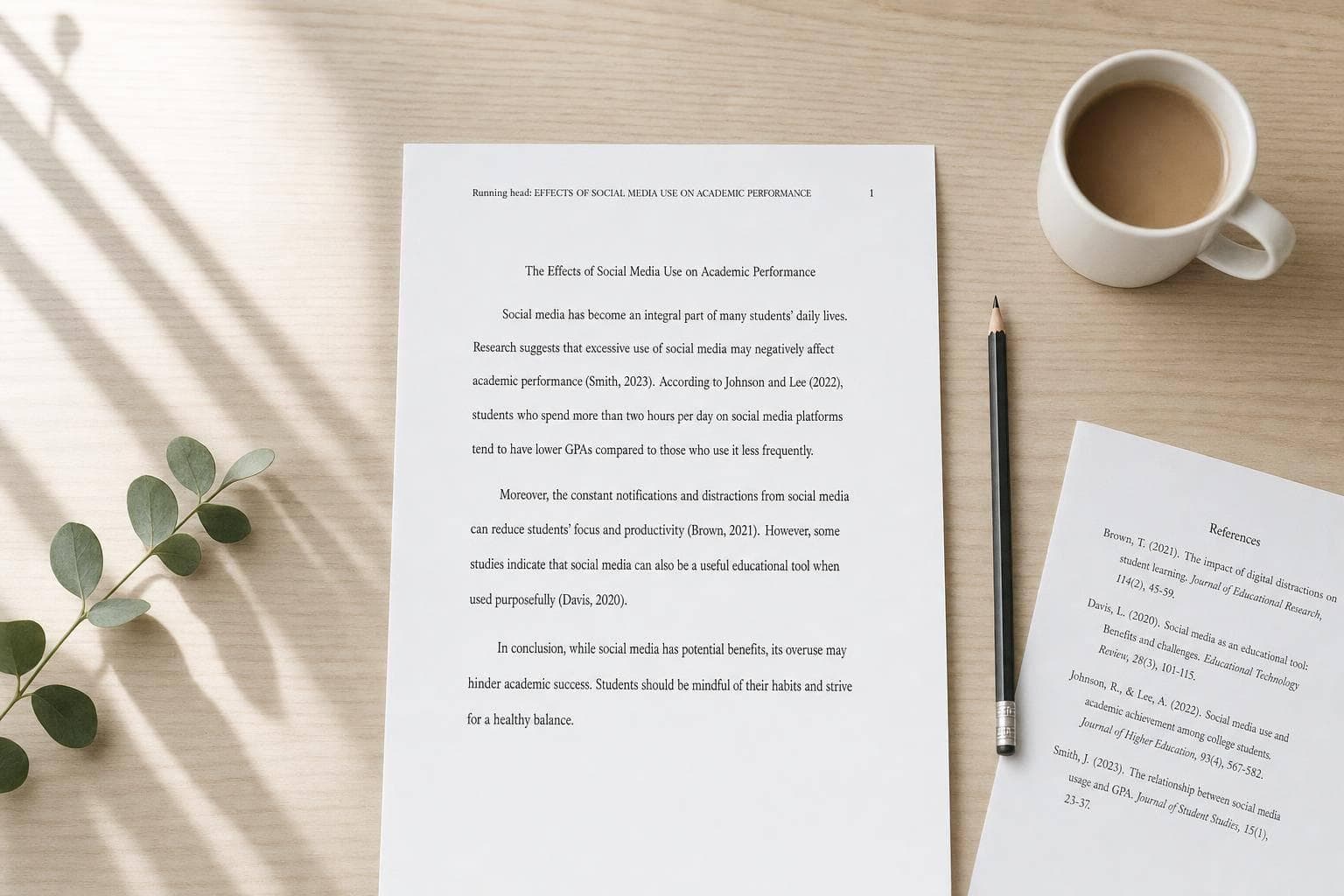
How to Write a Discussion Post in APA Format (Template + Examples)
If your instructor asks for APA in a discussion board, you usually only need 3 things: in-text citations, a reference list under the post, and a formal tone.
I’d keep it simple:
- Answer the prompt right away
- Use APA in-text citations for any source-based idea
- Put
Referencesat the bottom of the post - Skip title pages, abstracts, running heads, and page numbers in most LMS posts
- Write replies that add a new point, question, or source
In most classes, a discussion post is much shorter than a paper. That means I would focus less on full-paper setup and more on clear paragraphs, proper citations, and following the rubric. The article also covers both parts of the assignment: the initial post and the classmate reply, plus a copy-ready template and sample posts dated July 23, 2026.
A fast way to think about it: APA discussion posts use some APA rules, not all of them.
| Part | Usually needed? | What I’d do |
|---|---|---|
| In-text citations | Yes | Cite paraphrases and quotes |
| References list | Yes | Place it right below the post |
| Formal tone | Yes | Use full sentences and clean paragraphs |
| Title page | No | Skip unless your instructor asks |
| Abstract | No | Skip |
| Running head | No | Skip |
| Page numbers | No | Skip in most LMS platforms |
One point stands out: the article says the biggest APA rule for discussion boards is citation use. So if I borrowed an idea, I’d cite it. If I quoted directly, I’d also add a page or paragraph number. It also notes a small but common rule people miss: use & in parenthetical citations, but write and in narrative citations.
You’ll also see a short guide for source entries, including journals, books, and websites, which you can manage using an APA citation manager, plus a plain template you can paste into Canvas, Blackboard, or Moodle and fill in line by line.
APA Discussion Posts
sbb-itb-1831901
APA Requirements for Discussion Posts
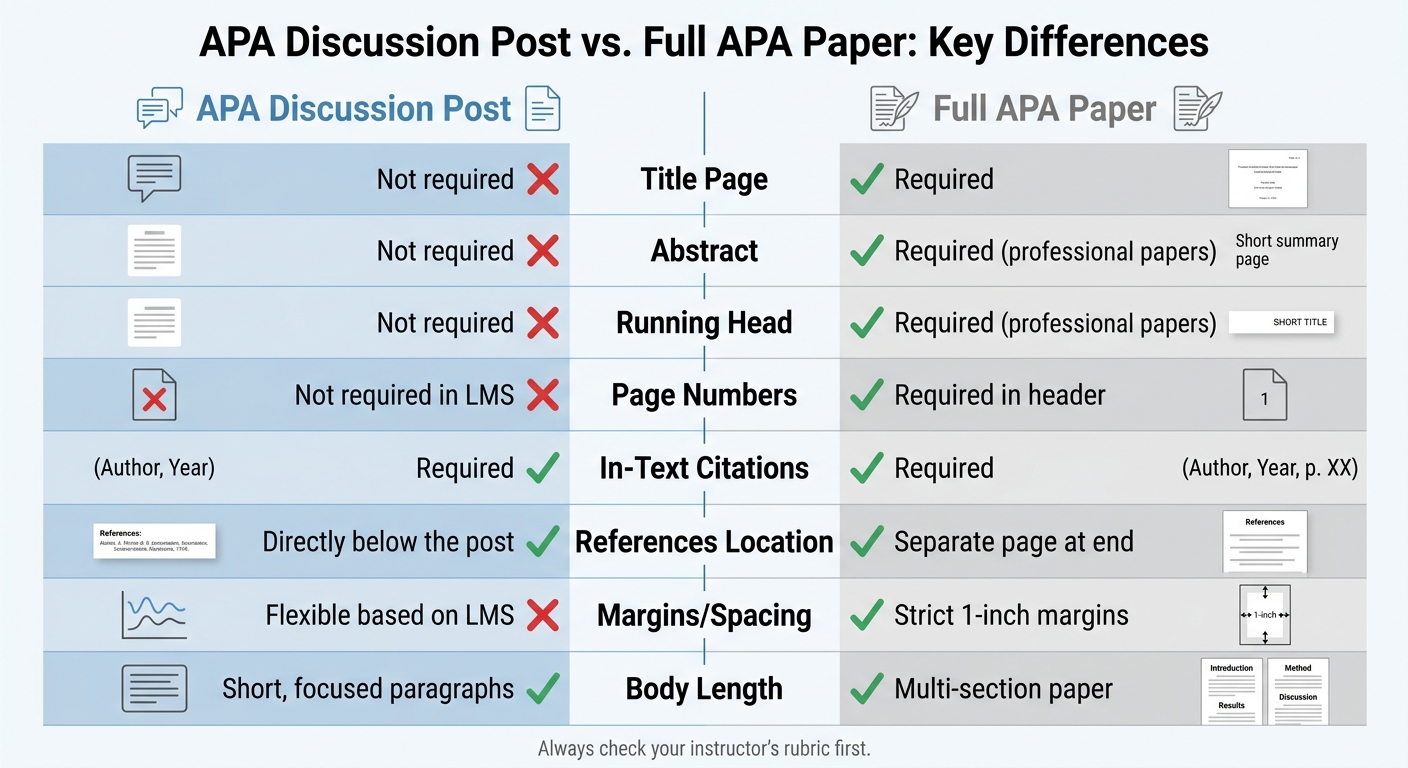
APA Discussion Post vs. Full APA Paper: Key Differences
Now that the scope is clear, it helps to zero in on the APA rules that actually matter for discussion-board posts.
Not every APA rule carries over to a discussion board. The format is much leaner than a full paper, but a few core pieces still matter. Before you write anything, check your course rubric - your instructor's directions come first over general APA guidance.
APA Rules That Apply to Discussion Boards
Use a formal academic tone, write in complete sentences, and break your ideas into clear paragraphs. If you use an idea from a source, include an APA in-text citation.
The biggest requirement is APA in-text citations. Any point you borrow from a source - whether you quote it word for word or restate it in your own language - needs a citation. Your post should also end with a References section placed directly below your response, not on a separate page. Use course readings, scholarly articles, or other credible sources.
APA Elements That Are Usually Not Required
Most parts of a full APA paper do not apply in LMS discussion boards. In most cases, you do not need a title page, abstract, running head, or page numbers.
Still, check your rubric every time. Some instructors want a formatted header or ask for a set number of scholarly sources, so it’s smart to confirm before you post.
Discussion Post vs. Full APA Paper
The day-to-day difference mostly comes down to structure and length. A full APA paper includes a title page, abstract, body sections, and a references page at the end. A discussion post is much more focused - usually a few paragraphs - with citations worked into the writing and references listed right below the response.
| Feature | APA Discussion Post | Full APA Paper |
|---|---|---|
| Title Page | Usually not required | Required |
| Abstract | Not required | Required for professional papers |
| Running Head | Not required | Required for professional papers |
| Page Numbers | Not required in LMS | Required in header |
| In-Text Citations | Required | Required |
| References Location | Directly below the post | Separate page at the end |
| Margins/Spacing | Flexible based on LMS | Strict 1-inch margins |
| Body paragraphs | Short, focused response | Multi-section paper |
Next, look at how to format in-text citations and the References list in a discussion post.
APA In-Text Citations and References for Discussion Posts
Use author-date citations in every sentence that draws on a source. In a discussion post, citations should back up your point without making the writing feel stiff. Once you know the basic rules, the next step is using them in a short, smooth response.
Parenthetical and Narrative Citations
You can place a citation in a sentence in two main ways. A parenthetical citation puts the author and year at the end of the sentence in parentheses: (Smith, 2023). A narrative citation works the author's name into the sentence, with the year right after it: Smith (2023) found that...
The number of authors changes the format a bit:
| Number of Authors | Parenthetical | Narrative |
|---|---|---|
| 1 Author | (Smith, 2023) | Smith (2023) |
| 2 Authors | (Smith & Johnson, 2023) | Smith and Johnson (2023) |
| 3+ Authors | (Smith et al., 2023) | Smith et al. (2023) |
| Organization | (World Health Organization, 2023) | World Health Organization (2023) |
One small detail matters here: use an ampersand (&) inside parentheses, but write "and" when the names appear in the sentence.
How to Cite Direct Quotes
Direct quotes need the author, year, and a page or paragraph number. For example: Felix (2023) described the approach as "a method that prioritizes clarity over convention" (p. 12).
In most discussion posts, paraphrasing is the better default. Save direct quotes for definitions, exact wording that matters, or cases where legal or technical precision is needed.
How to Format the References Section
For discussion posts, the references list is usually short and goes right below your response. End the post with the heading References - not "Works Cited", which is used in MLA style. Include every source you cited, and list them in alphabetical order by the author's last name.
If your LMS doesn't support hanging indents, leave a blank line between entries. Use the source type below to check what each entry needs:
| Source Type | Key Elements |
|---|---|
| Journal Article | Author, Year, Article Title, Journal Name (italicized), Volume (italicized), Issue (in parentheses), Page range, DOI as full URL |
| Website | Author, Date (Year, Month Day), Page Title, Website Name (italicized), URL |
| Book / E-book | Author, Year, Book Title (italicized), Publisher |
For article and book titles, use sentence case. That means you capitalize only the first word, the first word after a subtitle, and any proper nouns. Journal titles use title case. If a source doesn't list a publication date, use (n.d.) in place of the year.
With the citation rules set, the next section moves into how to structure the post itself.
How to Structure and Format an APA Discussion Post
Once your citations are in place, turn to the shape of the post itself. An APA discussion post should make one clear point, back it up with evidence, and stay easy to read.
Structure for the Initial Post
Open by answering the prompt right away. State your main point early so your reader doesn't have to hunt for it. Then use one or two body paragraphs to support that claim with evidence. End with a sentence or question that gives classmates something to respond to.
Short paragraphs work well here, but each paragraph still needs to do a full job. That means a clear topic sentence, supporting evidence, and a brief explanation of how that evidence fits your point. It keeps the post focused and makes grading much easier.
How to Write an APA-Style Reply to a Classmate
A good reply moves the conversation forward. It doesn't just restate what your classmate already said.
Add something new:
- a different idea
- a useful question
- a source that adds context
You can also point out another side of the topic or connect your classmate's post to something they didn't mention. If you bring in a new source, cite it right after the idea it supports. The aim is to build on the discussion, not echo it.
Formatting That Works in Most LMS Platforms
After you finish the writing and citations, tidy up the layout so it's easy to follow. Use left alignment and leave a blank line between paragraphs. Keep the tone professional and academic.
Also, stick to your instructor's word count and submission rules.
APA Discussion Post Template and Examples
Copy-and-Paste Template for the Initial Post
Now that the rules are set, you can use this simple template to write a post that's clear, properly cited, and easy for your instructor to review. Just swap in your own assignment details where the brackets appear.
[Opening sentence that directly answers the prompt. State your main argument here.]
[Body paragraph: Present your first supporting point. Cite evidence with either format shown above. Explain how the evidence connects to your argument.]
[Optional second body paragraph: Add a second piece of evidence or a contrasting perspective. If citing multiple sources for one claim, list them alphabetically within one set of parentheses, separated by semicolons - e.g., (Smith, 2023; Williams, 2024).]
[Closing sentence: Summarize your main point and leave a question or idea for classmates to respond to.]
References
Author, A. A. (Year). Title of work: Sentence case only. Publisher.
Author, A. A. (Year, Month Day). Title of webpage. Website Name. URL
Each in-text citation should line up with a matching entry in the reference list. Also, make sure your post fits your LMS formatting rules.
Example APA-Formatted Initial Post and Reply
Below is what the template looks like in an actual discussion post and reply. These models give you a short, practical pattern to follow for your own work.
Model: Initial Post
PSYC 201 | July 23, 2026 | Week 4 Discussion: Stress and Academic Performance
Stress management should be treated as an academic skill because it can affect how well students focus and organize their assignments (Johnson, 2023). This suggests that supporting students with practical coping strategies can help them stay engaged in class. What strategies have worked for you when stress starts affecting your focus?
References
Johnson, M. B. (2023). Stress and academic outcomes in undergraduate students. Journal Name.
Model: Classmate Reply
Your point about focus is well taken. Rivera (2022) adds that brief mindfulness practices can support concentration. That supports your argument that stress management can have academic benefits, not just personal ones. I'd be curious whether you think this kind of practice belongs in the syllabus itself or in student support services.
References
Rivera, T. L. (2022). Mindfulness micro-practices and student focus. Journal Name.
Notice what happens in the reply: it brings in a new source and adds a new angle. The initial post answers the prompt. The reply keeps the discussion moving instead of just saying, "I agree."
Using Yomu AI to Draft, Cite, and Check Your Post
Once your draft is written, do one last pass to tighten the wording and check the citations. You can use Yomu AI to improve sentence clarity, format APA in-text citations and reference entries, and run a plagiarism check before submitting.
Be sure to check your instructor's AI policy before using any drafting tool.
Conclusion
Now that the rules and template are set, the goal is pretty simple: keep your discussion post short, cited, and aligned with the course rules. Most APA discussion posts do not need a title page, abstract, or running head. But they do need in-text citations, a short reference list, and a formal academic tone.
Use the template and examples above as your weekly guide. A simple structure makes your post faster to write and easier to grade. While writing, pay attention to a few APA basics:
- Use sentence case for reference titles
- Use et al. for sources with three or more authors
- Place citations right after the ideas they support
APA citation format gives your sources a clear and consistent structure that’s easy to follow.
Before you submit, check the prompt so your post matches the required length, source count, and format. Then check your syllabus for source rules, citation rules, and AI policies. If anything seems unclear, follow your instructor’s directions first.
FAQs
How long should an APA discussion post be?
APA style does not set a required word count for discussion posts. That’s because discussion assignments can look very different from one course to the next.
So instead of chasing a certain length, aim for depth and clarity.
A solid starting point is to write full paragraphs that include:
- your analysis
- supporting examples
- any required citations
The main thing is to say enough to answer the prompt well without padding your response. And if your instructor gives a length target, follow that first.
Do I need citations in every reply post?
Not always. You should include a citation any time you use someone else’s work, ideas, or data. The need for a citation depends on what’s in your reply, not the type of post you’re writing.
If you use a source, include:
- an in-text citation
- a matching reference list entry
Every source you cite in the text should appear in the reference list. And every item in the reference list should be cited in the text.
What if my source has no author or date?
If a source has no date, use n.d. instead of the year. In the text, write it like this: (Author, n.d.).
If the source also has no author, use the title in its place. Put short titles in quotation marks. Italicize longer works, such as books or reports.