
How to Make an Essay Longer Without Fluff: 12 Techniques That Add Substance
To make an essay longer, I start with its weakest claim - not its word count. I check what’s missing: support, an explanation, or a clear link to the thesis. That gives me something worth adding. This approach is especially helpful for overcoming writer's block when a draft feels stuck.
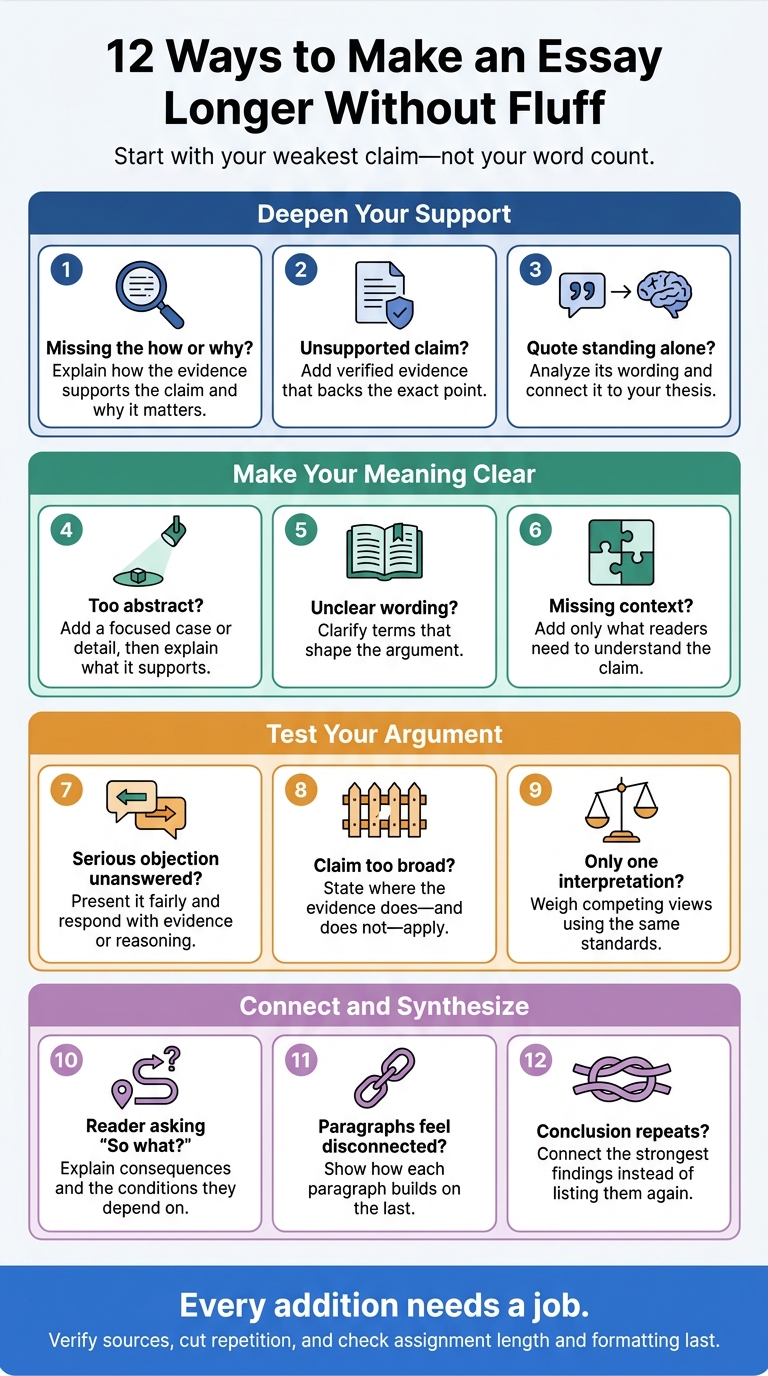
Here are the 12 ways I build out a short draft:
- Explain my reasoning: Show how and why a claim holds up.
- Support claims with sources: Use research, data, or text that backs the exact point.
- Explain quotations: Analyze the wording instead of letting a quote stand alone.
- Add specific examples: Replace vague statements with a focused case or detail.
- Define key terms: Clarify words that shape the argument.
- Provide background: Add only the context readers need.
- Address counterarguments: Answer a serious objection.
- Explain limits: State where the argument does - and doesn’t - apply.
- Compare perspectives: Weigh competing views using the same standards.
- Discuss what follows: Explain what a finding could change and under what conditions.
- Connect ideas: Show how each paragraph builds on the last.
- Bring findings together: Use the conclusion to connect points, not list them again.
My rule: <u>every addition needs a job</u>. I verify sources, cut repetition, and check the assignment’s length and formatting rules last. If I use AI writing assistants, I follow my instructor’s policy and review every suggestion - more words aren’t the goal; a better-supported argument is.
12 Ways to Make an Essay Longer Without Fluff
2-Minute Writer: Making Essays Longer (without adding fluff!)
sbb-itb-1831901
Before You Expand: Find Gaps in Your Draft
Build a reverse outline: write down each paragraph’s main claim, then compare it with your thesis and rubric. Label its job: problem, evidence, cause, comparison, or recommendation. If a required task has no matching paragraph, you’re missing content. If two paragraphs do the same job, you may be repeating yourself. Once you’ve mapped the gaps, check each paragraph’s depth.
Look for four parts: claim, evidence, explanation, and significance. Adding a source isn’t enough - you need to explain what it means. A quick source check can show where your analysis stops too soon.
Campus food-waste case: A Portland State University case-study summary reported that educational signage was associated with a 20% decrease in student food waste during its pilot. The program also donated 830 pounds of food over 8 weeks, equivalent to nearly 700 meals. In an essay, distinguish these outcomes: the signage finding concerns student waste, while the donation total concerns food recovery. Neither establishes that another campus would achieve the same results.
Flag claims that sound absolute but lack support, including reduces, causes, always, proves, most, and effective. Introduce each quotation and explain its key wording. After filling evidence gaps, check how your paragraphs connect.
Read each paragraph’s last sentence alongside the next paragraph’s first. Name the connection: cause, contrast, sequence, qualification, or consequence. Adding furthermore won’t fix weak logic. Address thesis gaps first, then work on context and transitions. Expand a short paragraph only if it hasn’t finished its job.
1. Explain Your Reasoning
Signs of Missing Analysis
Once you’ve added evidence, explain how it supports your claim. Evidence alone isn’t analysis. Add reasoning rather than more summary. After each piece of evidence, underline the sentences that answer how, why, or so what. If there aren’t any, add the missing link.
Before-and-After Revision
State your claim, identify the supporting detail, and explain how they connect. Note any assumptions, and don’t treat a possible cause as a proven fact.
Link the Reasoning to Your Thesis
Check every sentence you add: does it explain why this evidence matters for your thesis? Keep only what moves the argument forward.
Support New Claims With Sources
Make a clear distinction between what the source shows and what you infer. A plausible explanation of how something could happen doesn’t prove it caused the result you observed.
Select the underdeveloped passage in Yomu AI and use this prompt:
“Expand this paragraph by explaining how the evidence supports the claim, why the relationship exists, and what it means for my thesis. Add no new topic, repetition, or unsupported facts. Preserve my tone and mark any claims that need sources.”
Review each suggestion yourself. Keep only additions that deepen the reasoning without adding unsupported claims. Then move to the next underdeveloped passage.
2. Support Claims With Evidence
Find Unsupported Claims
Once you spot an unsupported claim, add evidence that directly backs it up. Match the evidence to the claim: use a study for a research finding, official data for a measurable trend, or a primary source for textual analysis.
Before-and-After Revision
Turn broad claims into precise statements your evidence can support. Name the researcher or organization, include the publication date, and describe the relevant method or population. Report only the finding your paragraph needs, then explain what it proves.
Link the Evidence to Your Thesis
Choose evidence that supports your thesis’s specific claim, not just its topic. A source showing that a policy exists doesn’t prove the policy works. Explain which part of your argument the finding supports, and keep your claim within the limits of the source.
Find and Verify Source Support
Use Yomu AI’s citation tool to gather references. Then check that each source exists, its publication details are correct, and its quoted text supports your claim. Clean formatting won’t make weak evidence relevant. Once you’ve verified the source, move to the next step: explaining the quotation or data.
3. Explain Your Quotations
Spot Unexplained Quotations
Once you’ve added evidence, explain the exact words you quote. Check what comes after each quotation. Analyze a specific word, assumption, or suggested meaning rather than simply restating the passage.
Before-and-After Revision
Before: The paragraph quotes the Yomu Team’s advice about evidence, then ends without explaining how writers should apply it.
After: In How to Write an Analytical Essay, the Yomu Team advises writers not to drop in evidence without interpretation: explain what the number means or what the wording does. That turns a quotation into analysis.
Link the Quotation to Your Thesis
Introduce the source, quote it, and explain what it means. Show exactly how the quotation supports your thesis or places limits on it. Then cut any filler opener.
Paraphrase Without Changing Meaning
Paraphrase when the idea matters more than the wording. Read the passage, write it in your own words based on your understanding, then check that you’ve kept the same meaning, scope, and citation.
Yomu AI’s paraphrasing and summarization tools can help you draft wording, but the result must preserve meaning and attribution. These tools don’t replace reading the source. After the paraphrase, explain what the source means.
Apply the same approach to examples and data: quote only what you can explain.
4. Add Specific Examples
When a paragraph feels abstract, one concrete example can say more than several vague sentences.
Find Abstract Passages
Look for claims built around words like important, harmful, or effective. Then name a specific case, event, or detail from the text that shows what you mean. Explain how that example supports the claim.
Before-and-After Revision
Before: Victor Frankenstein’s education shapes his development.
After: Victor’s father dismisses his interest in Cornelius Agrippa without explaining why those writings are outdated. Without that explanation, Victor continues pursuing them. This episode shows how inadequate guidance shapes his early education - not just what he learns, but how he judges knowledge.
Once you’ve named the example, explain what it proves about your argument.
Link the Example to Your Thesis
Show exactly how the example supports your thesis. In the Frankenstein passage, link Victor’s father’s response to your argument about Victor’s development. Don’t drift into summarizing the whole novel.
Support Examples With Sources
One example can clarify a claim, but it can’t prove a general pattern. Use hypothetical scenarios to explain how a process works, not as evidence of actual results. General claims need broader evidence.
Choose examples that add depth to the claim, rather than length to the paragraph.
5. Define Key Terms
Find Unclear Terms
Define terms that could leave readers guessing or change the meaning of your claim. Check your thesis and topic sentences for technical, abstract, ambiguous, or overused language. Clarify each term when it first matters to your argument. Then build on that meaning without adding filler.
Before-and-After Revision
Before: “Carbon pricing is the most effective way to reduce emissions because it changes behavior at the source.”
After: Carbon pricing is a policy that charges for greenhouse gas emissions at the point of production and consumption, changing economic incentives across supply chains.
The revision explains how the policy works and where it applies. That helps readers understand the mechanism, but the claim that it’s the most effective approach still needs evidence.
Link the Definition to Your Thesis
Show how your definition shapes what you need to prove. Separate related concepts when their differences affect your claim. If later evidence requires a narrower meaning, explain that change rather than quietly shifting how you use the term. A precise definition gives the next paragraph a sharper claim to prove.
Support Definitions With Sources
Cite an authoritative source when a term has a field-specific meaning, competing scholarly definitions, legal consequences, or disputed boundaries. Explain why your chosen definition fits the essay, then return to your analysis. When a short clarifying phrase does the job, use it. Skip dictionary-style definitions that add no new meaning.
6. Provide Needed Background
Find the Missing Context
Read each paragraph as if you’re new to the topic. Flag any name, event, term, policy, statistic, or assumption readers may not know. Ask: What must readers know before this claim makes sense? Add one or two sentences right before the claim or evidence that needs that context. Skip the full history - give readers only what they need to follow your point.
Before-and-After Revision
Before: “Misinformation did not affect all Americans in the same way.”
After: During the 2020 U.S. election and the COVID-19 pandemic, Pew Research Center found that Americans’ exposure to and belief in misinformation varied according to the news sources and channels they used. These differences show that any argument about misinformation must account for how people encountered it, not assume the same effect everywhere.
Link the Background to Your Thesis
The revision supplies context without proving causation. Background prepares readers for your analysis; it doesn’t prove your thesis. Cut details that don’t change the claim.
Support Factual Context With Sources
Cite factual, historical, statistical, technical, or disputed context where you use it. Turn to original studies for research findings, government records for policy details, and reputable archives for historical context.
When introducing a source or study, include the author, purpose, population, or number of participants if those details affect how readers should interpret the evidence. Put the citation immediately after the borrowed information. Once readers have the context, move to your argument’s objections or limits.
7. Address Counterarguments
A strong rebuttal adds length by answering the toughest objection in full.
Start With the Unanswered Objection
Think about what a well-informed reader would challenge in your thesis or reasoning. Pick one serious objection and explain it on its own terms. Give it a separate paragraph if it challenges your thesis, needs several pieces of evidence, or takes more than two or three sentences to answer properly. Address smaller concerns briefly. Let that objection guide the next paragraph.
Before and After: Turn a Dismissal Into a Rebuttal
Instead of brushing an objection aside, state a specific counterclaim. Explain why it seems reasonable, acknowledge the valid concern, and respond with evidence or reasoning. Narrow your claim if the objection reveals a genuine weakness. The goal is to test your thesis, not just present another side.
Tie the Response Back to Your Thesis
Close the rebuttal by stating what the objection changes and what it does not. Does it challenge your thesis or only how it would work in practice? Spell out the connection so readers don't have to guess why your response supports your thesis.
Use Sources to Test the Objection
Before responding, read a reliable source that presents the opposing view. Match your evidence to the dispute: use research for factual disagreements and primary documents for policy or historical disagreements. If newer evidence challenges an older finding, explain why it matters - not just that it came later.
8. Explain the Limits of Your Argument
Some objections point to weaknesses. Others show where an argument stops applying. After addressing objections, explain where your evidence is strongest and where it stops.
Find Overbroad Claims
Look for “always,” “never,” “all,” “in every situation,” and “proves.” Does your evidence support a universal claim, or only a narrower one? Focus on limits that affect the claim’s scope or certainty. A clear limit adds substance by showing what your argument can and cannot prove.
Before and After: Revise the Claim’s Scope
If the evidence doesn’t establish causation or apply broadly, use suggests and explain the limit. Swapping the verb isn’t enough; readers need to know why you’ve qualified the claim.
An observational method may leave cause and effect unresolved; a narrow sample may limit how far the finding can be applied.
Then restate the claim at the scale the evidence supports.
Connect the Limit to Your Thesis
End the added discussion with what the evidence does support. Narrow the population, setting, timeframe, or outcome as needed. A limitation should make your thesis more precise, not weaken it. Give the most space to the one or two limits that could change how readers interpret the findings.
Support the Limit With Source Details
Check the source’s methods and limitations: who participated, how the researchers collected data, and what they measured. Use those details to support your qualification instead of assuming the source is weak.
Keep certainty separate from scope. A finding can be reliable for the group studied without applying broadly. That narrower claim sets up the next step: weighing different perspectives on the same issue.
9. Compare Different Perspectives
Once you’ve narrowed your claim, compare the main interpretations side by side. Show readers why your argument holds up better.
Find One-Sided Discussion
Find a paragraph that offers only one explanation. Choose a competing interpretation that directly addresses your thesis - not an unrelated objection. Give both views a fair reading before deciding which is stronger.
Focus on assumptions, evidence, and predictions. The added length should come from weighing the views, not covering more topics.
Before and After: Revise Around Shared Criteria
Before revision: A paragraph summarizes one position and briefly dismisses another.
After revision: It compares both positions point by point: what each assumes, what evidence supports it, and what results it predicts.
For each question a view leaves open, add one sentence that addresses the gap. This moves your paragraph from summary to analysis.
Link the Comparison to Your Thesis
Explain which view best supports your thesis and why. Name the deciding factor: stronger evidence, a better explanation, or a closer fit to the prompt. Recognize useful parts of the other view without suggesting that both have equal support.
Support Both Views With Sources
Keep measured findings separate from interpretations and predictions. Judge findings by what was measured, interpretations by how well they explain the evidence, and predictions by their assumptions and supporting data.
A fair comparison applies the same standards to comparable claims. It doesn’t give every claim equal weight.
Use prose for simple comparisons. Add a compact table only when several views or criteria become hard to track, then explain the deciding difference.
Show what follows from the stronger perspective and how it shapes the next step in your argument.
10. Discuss What Follows From Your Argument
Identify the Unexplained Consequences
Find a supported claim that leaves the reader asking, “So what?” Explain who it affects and what happens first. Then separate that immediate effect from longer-term outcomes in practice. Include only consequences that change how the reader understands the claim.
Revise a Flat Statement Into Analysis
Before revision: The paragraph ends after reporting a result.
After revision: It shows how that result could affect a later decision and what conditions would need to hold.
Explain the link between the result and why it matters. Don’t just add a sentence saying it matters. Show what the consequence changes in your argument.
Link the Implication to the Thesis
State whether the implication strengthens, narrows, or qualifies your thesis. Cut sentences that introduce a separate issue rather than explain why the claim matters.
Support the Implication With Sources
Cite sources for factual consequences, and separate measured results from your inferences. A short-term result does not prove a lasting effect. Use “may” or “could” when a consequence is uncertain, and name the specific condition that would make it more likely. A qualifier is not evidence.
Use the implication to lead into the next paragraph without shifting to a new topic.
11. Connect Your Ideas
Once you have the right evidence and scope, check that each paragraph leads smoothly into the next.
Find Weak Transitions
Read only your topic sentences. Summarize each paragraph in 5–7 words, then check the order. If two summaries overlap, combine the paragraphs or sharpen their focus. If one summary doesn’t flow into the next, rewrite the bridge or change the paragraph order. Use feedback to spot unsupported claims, repeated ideas, and paragraphs with an unclear purpose.
A weak transition often points to an unfinished idea - not just a missing connecting word.
Revise the Connection
Before revision: Two paragraphs cover related topics, linked only by a weak transition word.
After revision: The bridge explains whether the second point shows a cause, offers a contrast, follows a sequence, or adds a condition.
Name the relationship first. Then choose a transition word that fits it. Use that relationship to guide how you develop the next paragraph.
Make the Thesis Link Clear
Make each topic sentence state a claim, not just a subject, and show how it supports the thesis. Use the opening to explain how the new point builds on the previous one.
Repeat a key term only when it serves a new role: definition, evidence, interpretation, or qualification. Repeating a term can help readers follow your thinking; repeating the same claim adds nothing.
Support New Connections When Needed
If your bridge introduces a factual relationship, back it up with a source. A transition alone cannot prove causation.
12. Bring Your Findings Together in the Conclusion
Spot a Repetitive Ending
Once your body paragraphs are in place, bring their strongest findings together into one answer. Underline sentences that simply repeat your thesis or list points from the body. Connect your findings instead of repeating them. This adds length through deeper reasoning, not another recap.
Revise From Summary to Synthesis
Before revision: Your ending lists findings separately.
After revision: It connects your two or three strongest findings, explains how they answer the objection already addressed in the body, and states a consequence.
Build around claim, support, limit, consequence rather than summarizing every paragraph again.
Return to the Thesis With a More Precise Answer
Restate your thesis only as broadly as your evidence allows. Ask what your draft proved, complicated, or left uncertain. Specify the population, period, or conditions your argument covers. Then explain how readers should change their view.
Use Yomu AI’s summary tool to pull out the draft’s main ideas. Compare that summary with your thesis, keeping only findings that support or qualify one another.
Add Source Support When Needed
Connect source-based claims to evidence already discussed in the body. Your own synthesis may not need a new citation, but it must follow from that evidence. If your conclusion needs new evidence, move it to the body. Point readers back to the evidence you’ve developed rather than introducing a new line of proof.
Final Revision: Cut What Does Not Support Your Essay
Check relevance and evidence. Once you’ve developed your ideas, cut anything that doesn’t support your argument. Write your thesis in one sentence, then map each paragraph’s claim, evidence, and connection to that thesis. Remove anything that doesn’t serve that connection. Follow every quotation, statistic, example, and paraphrase with an explanation of what it supports - not just a citation. Then check that your sources and wording still fit the argument.
Check citations and meaning. Match every in-text citation to the reference list. Verify names, dates, page numbers, and wording against the source. Compare paraphrases with the originals and read them within your paragraph. Keep qualifications, timeframes, and levels of certainty intact. Reworded ideas still need attribution, and borrowed phrases with recognizable wording need quotation marks. Once those checks are done, remove anything that adds nothing to the argument.
Check for filler and unsupported claims. Flag broad statements you can’t verify, then support, qualify, or delete them. Cut repetition, empty transitions, and wordy phrasing.
Use editing tools only as optional aids. Yomu AI’s paraphrasing, shortening, citation, and plagiarism-checking tools can help, but you must review every change and source yourself. Once the draft is clean, check its length and formatting against the assignment.
Verify length and formatting last. Review the assignment’s word-count rules, including whether headings, quotations, footnotes, and references count. Check the required font, margins, spacing, and submission format. Don’t use formatting to fake length. If cutting filler leaves you short, add evidence or analysis to a claim that needs more development.
Conclusion: Let Better Reasoning Add Length
After using the techniques above, give your draft one last pass to find its weakest point. Make your essay longer by answering unresolved questions, not stretching sentences. Look for missing explanations, evidence, or limits on a claim. Check whether your conclusion needs to do more to connect your ideas.
Start with your least-developed paragraph. Fill gaps in the reasoning, cut repetition, or explain where a claim stops applying. Keep additions only if they move your thesis forward by making the argument clearer, better supported, or more precise. Use the word-count requirement as a prompt to develop your thinking - not pad your wording.
FAQs
How can I add 200 words without introducing a new topic?
To add 200 words without introducing a new topic, build on the points you’ve already made. Give readers more context about your evidence: where it came from, who produced it, and why the source deserves their trust. You can also look at a point from another angle to show how it supports your argument.
Don’t let quotations stand alone. Explain what each quote means, why it matters, and how it connects to your thesis. That explanation helps readers follow your reasoning instead of having to make the connection themselves.
You can also expand your definitions of key terms or add transitions that show how one idea leads to the next.
What if my thesis is too narrow to meet the word count?
You don’t need to expand your essay’s scope to add depth. Instead, address counterarguments, consider what your claim means in a larger context, or examine it from different perspectives.
If new evidence or viewpoints change your argument, revise your thesis to match. Make sure every addition supports your thesis and keeps your essay focused.
How do I balance evidence and analysis when expanding?
Use evidence to support your ideas, not do the thinking for you. Build each paragraph around a claim, evidence, and analysis. After every quote, number, or example, explain how it supports your topic sentence and why it matters.
Try removing your commentary. If the paragraph still feels complete, you’re summarizing rather than analyzing. To make the link to your thesis clear, ask:
“so what?”