

9 Ways to Refine Academic Writing Style
Academic writing is about clarity and professionalism, not impressing readers with complex words. To refine your style, focus on making your ideas clear, concise, and easy to follow. Here’s a quick summary of the nine strategies covered:
- Use active voice: Keeps sentences direct and engaging.
- Vary sentence length: Mix short and long sentences for better flow.
- Avoid repetition: Replace overused words with precise alternatives.
- Cut unnecessary words: Be concise and eliminate filler phrases.
- Choose specific vocabulary: Use precise terms to strengthen arguments.
- Maintain formality: Avoid contractions and casual language.
- Smooth transitions: Connect ideas logically with transition words.
- Leverage writing tools: Use tools like Yomu AI to refine grammar and clarity.
- Proofread thoroughly: Catch errors and polish your work by reading aloud.
These tips help you write clearly and professionally, ensuring your research is taken seriously. Start small - like reducing wordiness or using active voice - and build on these techniques over time.
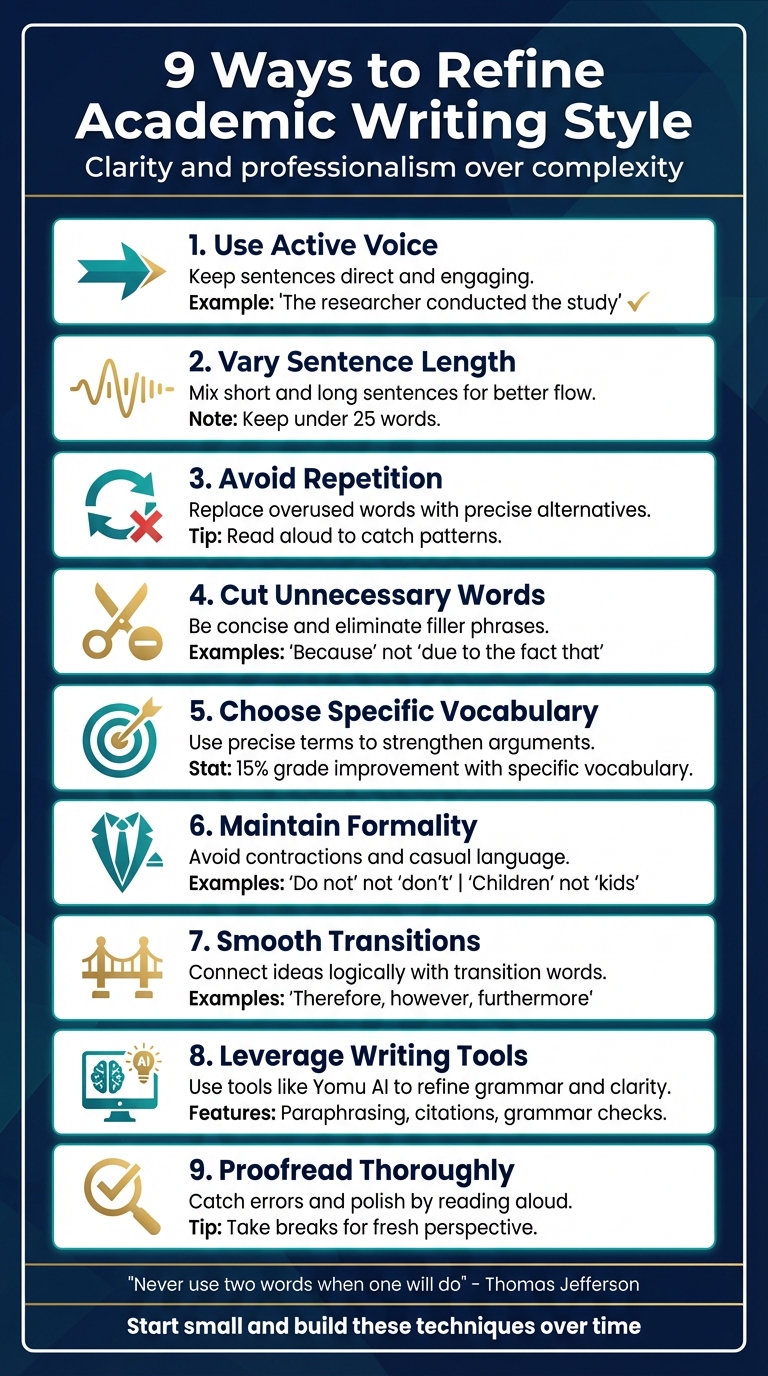
9 Essential Strategies to Refine Academic Writing Style
How to Improve Your Academic Writing | 5 Tips
1. Write in Active Voice
Active voice puts the focus on the subject performing the action, making your sentences clearer and more concise. For example, instead of saying, "The study was conducted by the researcher", you would say, "The researcher conducted the study."
Why is this important? Active voice is direct and engaging. Lindsay Kramer from Grammarly explains, "Active voice typically makes writing more engaging and dynamic". By writing actively, you ensure readers immediately understand who is taking action, which keeps your message straightforward. The Purdue OWL agrees: "Using active voice for the majority of your sentences makes your meaning clear for readers, and keeps the sentences from becoming too complicated or wordy".
To identify passive voice, look for a form of "to be" (is, am, are, was, were, be, been, being) paired with a past participle, often an -ed verb like analyzed or tested. Passive sentences often include a "by" phrase, such as, "The data was analyzed by the team". To switch to active voice, bring the subject to the front: "The team analyzed the data."
While passive voice can be useful - especially in scientific writing when the actor is unknown or irrelevant - overusing it can cloud your meaning. It adds extra words and can hide who’s responsible for the action. A simple tip: read your sentences aloud and ask, "Who is doing this?" If the answer is unclear or buried, rearrange the sentence to spotlight the actor. By making the subject the focus, your writing will become clearer and more persuasive.
Mastering active voice is a key step toward sharpening your academic style.
2. Mix Up Sentence Length
Switching up your sentence length keeps your writing lively and engaging. As Amber Carini from the University of California, Berkeley's Student Learning Center puts it:
"Variance promotes good 'flow' and is more interesting for your reader".
Beyond engagement, sentence length plays a big role in controlling the pace of your writing.
Think of it this way: longer sentences are great for detailed explanations and connecting ideas, while short sentences pack a punch. They emphasize key points and give readers a breather after complex information. Candy H from Ponder explains:
"Rhythm in your writing not only makes it more engaging but also helps in pacing the flow of information, ensuring that your readers can follow your arguments without feeling overwhelmed or losing interest".
Striking the right balance is crucial. Academic sentences should generally stay under 25 words, as overly lengthy sentences can confuse readers. The University of Leeds cautions:
"Long, complex sentences can be difficult to understand and this may distract the reader from your point".
But don’t overdo it with short sentences either. Too many in a row can make your writing feel disjointed and overly simplistic.
A great way to check your sentence flow is by reading your work out loud. If you find yourself gasping for air or stumbling over repetitive patterns, it’s time to adjust. Combine related short sentences using semicolons, colons, or dashes. After a detailed explanation, follow up with a concise sentence to drive the point home. This rhythm not only improves clarity but also makes your academic writing more engaging and easier to follow.
3. Avoid Repeating Words
Choosing your words carefully and varying your sentence structure can keep your readers engaged and your writing polished. Repeating the same words too often can make your work feel monotonous and less professional. Overusing certain terms might also weaken your arguments, making it harder for readers to stay interested.
It’s important to recognize when repetition serves a purpose and when it doesn’t. For instance, repeating technical terms or key concepts can help ensure clarity and consistency. However, overusing generic words like "important", "shows", or "many" can undermine the strength of your writing and dilute its impact.
When you catch yourself using the same word repeatedly, try swapping it out for a more specific or nuanced alternative. For example, instead of saying "important" multiple times, you might use "crucial", "essential", or "key", depending on the context. As Purdue OWL explains:
"Concise writing does not always have the fewest words, but it always uses the strongest ones".
Reading your work aloud can be a great way to identify repetitive patterns. Another helpful trick is the slash technique: jot down several alternative words or phrases (e.g., "vague/inaccurate/questionable") and pick the one that best fits your meaning.
For a more tech-savvy approach, tools like Yomu AI can scan your document for overused words and suggest precise replacements. This not only helps you vary your vocabulary but also ensures your writing stays sharp and engaging as you refine your academic style.
4. Cut Unnecessary Words
When it comes to academic writing, precision and efficiency are your best friends. Every word should earn its place. Extra words? They only cloud your message and weaken your argument.
Start by targeting bulky phrases that can be replaced with shorter, clearer alternatives. For example, swap "due to the fact that" with "because." Replace "at this point in time" with "now", and use "if" instead of "in the event that." These small changes streamline your sentences without losing meaning.
Another tip: avoid nominalizations - those pesky noun forms of verbs. Instead of saying "conduct an analysis", just say "analyze." Why write "give consideration to" when "consider" works perfectly? And "reach a conclusion"? Simplify it to "conclude." These edits not only save space but also make your writing more direct and impactful.
As Purdue OWL wisely puts it:
"Like bad employees, words that don't accomplish enough should be fired".
Redundancy is another trap to watch out for. Phrases like "past history" or "final outcome" are repetitive - cut the extra word and stick to "history" or "outcome." The meaning stays intact, and your writing becomes sharper.
When revising, scrutinize every word. Does it add something essential? If not, it’s time to let it go. Tools like Yomu AI can also lend a hand by spotting wordy phrases and suggesting more concise options, helping you maintain a clear and professional tone.
5. Use Specific Vocabulary
Vague language can dilute your arguments and leave readers scratching their heads. Instead of saying something like "a lot of data", opt for clearer phrases such as "extensive data" or "a large dataset." This kind of precision not only strengthens your credibility but also makes your writing much easier to understand.
In academic writing, specificity is key. Choosing precise words shows you have a solid grasp of your topic. For example, rather than saying "things that affect the outcome", go with "factors that influence the outcome." This shift instantly elevates your tone from casual to professional.
A study by the University of North Carolina revealed that students who incorporated specific vocabulary saw a 15% improvement in their grades. This improvement was directly tied to the enhanced clarity in their arguments. As the University of North Carolina Writing Center explains:
"Using specific, precise words is essential in academic writing to convey ideas clearly and effectively".
Here’s a practical tip: Replace vague adjectives with concrete figures. For instance, instead of saying "high production rate", specify it as "produced 16,000 units per week". Similarly, swap informal phrases like "go up" for more formal terms like "increase." This focus on precision complements earlier strategies for writing that is both concise and clear.
To build your vocabulary, immerse yourself in texts from your field and pay attention to commonly used terms. Learning these words and their precise meanings will not only sharpen your arguments but also demonstrate your expertise. Make it a habit to review definitions and incorporate these terms into your writing.
That said, avoid using overly complex words just to sound impressive. As Brandeis University aptly puts it:
"The most important goal of academic writing is not to sound smart - it is to communicate an argument or information clearly and convincingly".
sbb-itb-1831901
6. Keep Language Formal
Refining your writing style with formal language enhances its academic tone and credibility.
Academic writing demands a formal approach. This means avoiding contractions - write "do not" instead of "don't" - and opting for precise terms. For instance, use "children" instead of "kids" and replace vague expressions like "lots of" with "many" or "numerous." Such adjustments align with the focus on clarity and precision discussed earlier.
Phrasal verbs, such as "find out" or "set up", can dilute the formality of your writing. Instead, use single-word alternatives like "discover" or "establish." For example, instead of saying "look into the data", write "investigate the data." These changes lend a more professional and polished tone to your work.
However, formality doesn’t mean overcomplicating your writing. As the University of York Writing Centre notes:
"Academic writing isn't about impressing people with 'big words' or being overly formal. The main aim is to be clear, concise and objective." – University of York Writing Centre
For instance, instead of phrasing a question like, "What does this mean for future research?" reframe it as, "This has implications for future research." This approach maintains professionalism while ensuring clarity.
George Mason University highlights the importance of formality in academic work:
"If these characteristics [formal, concise, precise, and neutral] fail to appear in writing, even the most innovative and intelligent ideas might be perceived as simplistic or even be disregarded by a scholarly community." – George Mason University
Consistency in maintaining a formal tone throughout your writing not only reflects your respect for the academic audience but also demonstrates a serious and thoughtful approach to your research.
7. Connect Ideas Smoothly
To make your arguments easier to follow, focus on crafting smooth transitions between sentences and paragraphs. These transitions act like bridges, guiding readers seamlessly from one idea to the next. Without them, your thoughts can feel disjointed, leaving readers struggling to see how everything connects.
The Writing Center at the University of North Carolina at Chapel Hill captures this perfectly:
"Transitions provide the reader with directions for how to piece together your ideas into a logically coherent argument."
Using clear transitions not only improves flow but also reinforces earlier principles of clarity and brevity. The key is to choose transition words that match the relationship between your ideas. For example:
- When showing cause and effect, use terms like "therefore," "consequently," or "thus."
- To contrast ideas, try "however," "nevertheless," or "in contrast."
- Adding extra evidence? Use "furthermore," "moreover," or "in addition."
That said, avoid using transition words as mere fillers. The Harvard College Writing Center offers this caution:
"Novice writers tend to add therefore and hence when they aren't sure how to transition; you should reserve these words for when they accurately signal the progression of your ideas."
A practical way to ensure smooth transitions is the "old-to-new" technique. Start a sentence by referencing a previous point before introducing new information. For instance, instead of abruptly diving into a new topic, tie it back to what you just discussed. This approach naturally connects ideas without overloading your writing with explicit transition words. It helps readers see the bigger picture and keeps your argument cohesive.
8. Use Writing Enhancement Tools
Even the most meticulous writers can benefit from advanced tools. Writing enhancement software identifies common issues - like overly wordy phrases or passive voice - and helps maintain the polished tone expected in academic work. Tools such as Yomu AI demonstrate how technology can simplify and refine the revision process.
Yomu AI, for example, offers features like a paraphrasing tool to eliminate repetitive language, a summarization option to break down complex ideas, and citation formatting to ensure academic integrity. This last point is especially important, as the University of Reading emphasizes:
"In academic writing you are responsible for the writing you produce. If you are using research or ideas based on work by others... you must reference everything fully and in the correct way for your assignment."
These tools can also highlight filler phrases (e.g., swapping "due to the fact that" for "because"), weak verbs, passive voice, and redundant expressions, making your writing more concise and effective.
As the University of North Carolina at Chapel Hill's Writing Center puts it:
"Your goal in academic writing is not to sound intelligent, but to get your intelligent point across."
By removing unnecessary complexity, enhancement tools help you communicate your ideas with precision and clarity.
While these tools provide valuable support, they’re not a substitute for your judgment. Always evaluate AI-generated suggestions critically to ensure your work aligns with your intentions. Think of these tools as a way to fine-tune your writing, not a replacement for your expertise.
9. Proofread Your Work
Proofreading is the last step where you catch grammar mistakes, style inconsistencies, and spelling errors before wrapping up your work. To do this effectively, try stepping into the reader's shoes - it helps you spot issues you might otherwise miss.
Read your work aloud. This simple but powerful technique highlights clunky sentences, awkward phrasing, and unnecessary words. As Purdue OWL suggests:
"Read your paper out loud and listen for awkward pauses and unclear ideas".
If you stumble over a sentence while reading, it’s probably too complicated and needs to be simplified.
Keep track of your common mistakes, like misused homophones, punctuation errors, or phrases you tend to overuse. This habit not only saves time but also makes your proofreading process sharper and more efficient over time. These personalized strategies are a great foundation for using specialized tools.
For example, Yomu AI can be a helpful partner in your editing process. It identifies grammar issues, improves sentence flow, and checks spelling and punctuation in real time. Plus, its citation assistant ensures your references are formatted correctly, whether you’re working with APA, MLA, or another style.
Finally, give yourself a break before the final proofread. Stepping away for a while gives you fresh eyes to catch errors you might have overlooked earlier.
Conclusion
Academic writing isn't about using elaborate language - it's about communicating your ideas clearly and effectively. As the University of North Carolina at Chapel Hill aptly states:
"Your goal in academic writing is not to sound intelligent, but to get your intelligent point across".
Using the strategies outlined here can sharpen your academic writing by refining your message and bolstering your credibility. These nine techniques work together to create writing that is clear, concise, and easy to follow, helping readers understand complex ideas more efficiently. By maintaining a formal tone, choosing precise vocabulary, and ensuring smooth transitions between ideas, you establish the professionalism that academic work requires.
Think of these strategies as the foundation of effective writing. Start small - perhaps by focusing on reducing unnecessary words or improving the objectivity of your tone - and gradually integrate the rest into your editing routine. Thomas Jefferson’s timeless advice is a perfect reminder:
"Never use two words when one will do".
Editing tools like Yomu AI can be valuable for catching grammar mistakes, improving flow, and formatting citations. However, these tools should complement your critical thinking and creativity - not replace them. A thoughtful, step-by-step approach is key to building strong academic communication.
With regular practice, these techniques will become second nature. Each paper you write is an opportunity to refine your academic voice further. By consistently applying these methods, you’ll develop a writing style that is both professional and impactful - leaving a lasting impression on your readers.
FAQs
How can I spot and fix passive voice in my academic writing?
To spot and fix passive voice, start by identifying sentences where the subject is on the receiving end of the action instead of performing it. Passive sentences often include a form of to be (like was, were, is) paired with a past participle (such as analyzed or conducted). For instance, instead of saying, "The experiment was conducted by the team", you could make it more direct: "The team conducted the experiment."
Another way to catch passive voice is to look for phrases that include by, which typically reveal the doer of the action. Shift this agent to the subject position and use a straightforward active verb. For added convenience, tools like Yomu AI can quickly pinpoint passive sentences and suggest active alternatives, streamlining the editing process.
Switching from passive to active voice not only sharpens clarity but also trims unnecessary words, making your academic writing more concise and impactful.
What tools can help enhance academic writing style?
Improving your academic writing style becomes much simpler when you have the right tools. Yomu AI is a specialized writing assistant tailored for academic purposes. It provides a range of features, including AI-driven sentence and paragraph suggestions, paraphrasing options, summarization tools, citation formatting, and a highly advanced plagiarism checker to uphold originality and maintain academic integrity.
With tools like Yomu AI, you can enhance your writing by achieving greater clarity, precision, and conciseness - perfectly aligning with the strategies shared in the "9 Ways to Refine Academic Writing Style" guide.
Why should you vary sentence length in academic writing?
Varying the length of your sentences is a simple yet powerful way to make academic writing more engaging and effective. It breaks up monotony, introduces rhythm, and keeps readers interested. Short sentences work well to highlight key points, while longer ones are better suited for diving into detailed explanations or unpacking complex ideas.
When you mix sentence lengths thoughtfully, your writing flows more naturally. This makes it easier for readers to follow your arguments and fully grasp the information you're presenting. Striking this balance not only improves clarity but also keeps your work dynamic and polished.