

How to Introduce a Thesis: 15 Ways to Lead Into Your Thesis Statement
Your introduction only needs to do one thing: lead the reader to your main claim. In most U.S. essays, that means a short hook, a bridge, and a thesis at the end of the first paragraph.
I’d sum up the article like this: if your thesis feels abrupt, your lead-in is the problem. The fix is to pick the shortest opening that gives your reader enough setup. This article walks through 15 ways to do that, from a surprising fact to a thesis-first opening, and shows when each one fits best.
Here’s the full list covered in the article:
- Yomu AI-assisted drafting
- Surprising fact
- Brief contrast
- Focused question
- Definition or key term
- Concise problem statement
- Contextual background
- Anecdote or narrative
- Quotation
- Comparison or analogy
- Historical snapshot
- Common belief vs. reality
- Classification or category
- Direct thesis-first
- Combined lead-in
A few core takeaways stand out:
- Your opening should be relevant, specific, and move in a straight line toward the thesis.
- In many U.S. essays, the thesis usually appears at the end of the first paragraph.
- One strong fact often works better than a pile of statistics.
- Openers like “Since the dawn of time…” or “In today’s society…” usually weaken the start.
- Essay type matters: argument papers often need tension or a clear problem, while analysis papers often need context, terms, or a text-based setup.
Quick Comparison
| Lead-in method | Best use | Main idea |
|---|---|---|
| Surprising fact | Argument, research, expository | Start with one data point, then explain it |
| Brief contrast | Argument, analysis | Show a tension, then state your claim |
| Focused question | Argument, evaluation | Ask one narrow question the thesis answers |
| Definition | Analysis, concept-based essays | Define one key term before the claim |
| Problem statement | Policy, cause/effect, argument | Name the issue first, then give the answer |
| Contextual background | Research, analysis | Give 1–3 lines of setup, then narrow |
| Anecdote | Personal or less formal essays | Use a short scene, then shift to the claim |
| Quotation | Source-based writing | Start with a short quote and explain it |
| Analogy | Expository, abstract topics | Compare the topic to something familiar |
| Historical snapshot | History, policy, tech topics | Use one past event to frame the issue |
| Belief vs. reality | Argument | Challenge a common assumption |
| Classification | Compare/contrast, analysis | Sort the topic into groups, then argue |
| Thesis-first | Timed essays, STEM, short papers | State the claim first, then add context |
| Combined | Longer essays | Mix two methods when one is not enough |
If I were using this guide, I’d choose my lead-in based on the assignment, the subject, and the reader - then make sure every sentence points to the thesis.
How to Write a STRONG Thesis Statement | Scribbr 🎓

sbb-itb-1831901
What Makes a Thesis Lead-In Work
A thesis lead-in works when each sentence moves the reader closer to your main claim. It doesn't just sound good on the page. It does a job. As the UNC Writing Center puts it, introductions are "bridges that transport your readers from their own lives into your analysis". That bridge has to lead somewhere clear: your thesis.
Four traits separate a strong lead-in from a weak one: relevance, specificity, logical narrowing, and the right academic tone.
- Relevance means your opening connects straight to your thesis topic. Not to technology in general. Not to "society." To the exact issue your essay takes on.
- Specificity means using concrete detail, such as a time frame, a focused setting, or one clear concept. If your first line could fit almost any paper on the subject, it's too broad.
- Logical narrowing means the introduction works like a funnel. It starts a bit broad, but still on-topic, then moves step by step toward your claim. By the time the thesis appears, it should feel earned.
- Tone matters too. In U.S. academic writing, instructors usually want language that is clear and moderately formal. Not stiff. Not chatty. Slang, hype, and melodrama can hurt your credibility before your argument even begins.
Here's a simple test: ask a classmate to read only your introduction and predict your thesis. If they can't do it, the lead-in is probably too vague. That's often the clearest sign that the opening needs tighter focus.
The kind of essay you are writing also changes what the lead-in should do. A good opening for one essay may fall flat in another.
| Essay Type | Lead-In Focus |
|---|---|
| Argumentative | Controversy, stakes, writer's position |
| Analytical | Text/artifact, context, element under examination |
| Research-based | Background, key terms, knowledge gap |
| Descriptive | Sensory context, controlling impression |
In argumentative essays, the lead-in should name the dispute and hint at your stance. In analytical essays, such as literary or rhetorical analysis, it often introduces the text, gives context, and points to the part you'll study. Research-based essays usually begin with source-based background, define key terms, and point to the gap the paper will address. Descriptive essays can use sensory detail, but they still need to narrow toward one controlling idea. There isn't one opening formula that works for every assignment.
Some openings miss the mark almost every time. Phrases like "Since the dawn of time…," "In today's society…," and "According to Merriam-Webster…" tend to stall the paper before it starts. They push your real point further down the page, sound unfocused, and rarely connect to a sharp thesis. A better move is to start with a concrete detail, a tight bit of context, or brief background that links straight to your topic.
When that opening fits neatly into a hook, a bridge, and a thesis, the whole introduction starts to do what it should: guide the reader, not wander.
Hook, Bridge, and Thesis: The 3 Parts of an Introduction
A typical U.S. academic essay introduction has three parts: a hook, a bridge, and a thesis. Once you see how those parts work together, the 15 lead-in methods become much easier to use. Each one plugs into this same basic pattern in its own way.
The hook gets the reader’s attention and points toward the topic. It can’t just sound interesting for the sake of it. It needs to connect straight to the argument.
After that, the bridge takes over. It moves the reader from the opening idea into the essay’s main focus. In plain terms, the bridge gives a bit of context and starts narrowing the discussion toward the thesis. Without it, the jump from opening line to main claim can feel too sudden.
Then comes the thesis. This is the essay’s main claim, and it should feel like a natural next step after the bridge. In most academic essays, the thesis appears at the end of the introduction, often in the final sentence.
One easy way to picture all of this is as a funnel: broad at the top, tighter in the middle, and pointed at the end. The 15 methods below shape the hook and the bridge. The thesis is still where the introduction needs to land.
1. Yomu AI-Assisted Lead-In Drafting
Use Yomu AI to draft and test lead-ins faster. Since the hook and bridge handle most of the setup, Yomu works well for that part of the introduction first. It lets writers try a few opening angles before picking one.
Think of Yomu as a drafting aid. You bring the thesis, and it helps produce lead-ins that match it. For example, if your thesis is "Part-time work of up to 15 hours per week can benefit U.S. college students by teaching time management, but heavier workloads often harm academic performance," ask Yomu to write three short introductions:
- one built around a surprising fact
- one built around a focused question
- one built around a brief contrast
Then take the best one and rewrite it in your own words.
You can also draft a rough introduction, ask Yomu where the hook starts to drift from the thesis, and then ask for two tighter bridge options. That way, you can check whether the introduction narrows cleanly to the thesis instead of wandering off course.
Rewrite any AI-generated text in your own voice, check facts against your sources, and follow your institution's AI policy.
This is the only tool-based method in the list. With that workflow set, the next section moves to the first specific lead-in style: a surprising fact.
2. Surprising Fact Lead-In
A surprising fact lead-in starts with a credible, unexpected detail that connects straight to your thesis. The surprise isn't there just for show. It should help prove your point.
In an introduction, the fact works as the hook. Then your explanation starts building the bridge to the main claim.
A good fact shows what's at stake, such as:
- scale
- risk
- importance
Use this pattern: fact → interpretation → thesis.
For example, in an essay arguing that U.S. high schools should start later:
"Nearly 70% of U.S. high school students report getting less than the recommended 8 hours of sleep on school nights. This chronic shortfall affects memory, emotional regulation, and the ability to focus during class. Because sleep deprivation directly undermines learning, U.S. schools should delay high school start times to at least 8:30 a.m."
The fact shows the scale of the problem. The interpretation explains why it matters. The thesis gives the response.
Stick to one fact in the introduction. If you pile in more than one statistic, the opening can feel crowded before the reader even gets to your main point. Pick one strong fact, explain it well, and save the rest of your data for the body paragraphs.
This kind of lead-in fits best in argumentative, analytical, and research essays. If the essay calls for story instead of data, use another kind of opening.
And if a fact doesn't fit your topic, a brief contrast can narrow the focus in much the same way.
3. Brief Contrast Lead-In
A brief contrast lead-in puts two opposing ideas next to each other, then shifts to the one your thesis will answer. It works because readers naturally want to see how that tension plays out.
Here’s a simple example for an essay that pushes back on a common belief about exercise:
"Exercise is often discussed as a way to improve physical health, but its strongest benefits may be cognitive."
This example pairs a familiar point with a less expected claim, which gives the thesis a clear way in.
Keep the contrast tight. One sentence, or at most two short ones, is plenty. You’re setting up the thesis fast, not arguing both sides before the essay even starts.
Skip broad, vague contrasts like "Throughout history, people have disagreed about many things." That kind of opening says almost nothing. Instead, name the exact tension your essay takes on.
This approach works best for argumentative, analytical, and expository essays that push against a familiar assumption.
If the contrast feels a bit flat, a focused question can move the reader into the thesis with more force.
4. Focused Question Lead-In
Some topics are easier to frame as a problem than as a plain fact. In that case, a focused question lead-in does the job well. It opens with one direct question that names the main problem, tension, or choice your thesis will deal with. That works because the question gives readers one clear issue to think about, and the thesis can then answer it.
Here’s a clean example for an essay on teen sleep habits:
"How does nighttime phone use affect sleep quality among teenagers?"
A thesis might say that blue light, notifications, and later bedtimes each disrupt sleep. The question is the hook. The thesis is the answer.
The question needs to be narrow enough that one thesis sentence can answer it. “What causes stress?” is too broad. “Why do exam weeks increase stress for first-year college students?” is focused enough to lead into a specific, arguable claim. A simple test helps here: if one thesis sentence can’t answer the question, the question is too broad.
Using more than one question can pull the reader in too many directions before the thesis shows up. Stick with one question, add a short one- or two-sentence bridge to show why the issue matters, and then give the thesis as the direct answer.
This approach works best for argumentative, analytical, and evaluative essays - the kind that ask why, how, or which option works best. In a formal research paper, it often makes more sense to turn the question into a statement or an indirect question so the tone stays academic.
If the question still feels too open, adding a definition or key term can narrow the introduction faster.
5. Definition or Key Term Lead-In
Some theses hinge on a single term. If your claim depends on a word people may read in different ways - like freedom, success, digital privacy, or college readiness - define it up front so no one gets lost. When that term needs a clear shape before the argument begins, a definition lead-in handles it fast.
The University of Hull recommends defining key terms in the introduction. That gives readers the context they need before they get to the thesis.
A simple pattern works well here: term, short definition, context, then thesis. For example: "Climate resilience - a community's ability to prepare for and recover from climate-related events - is still underdeveloped in most U.S. coastal cities, which is why federal investment in flood defenses and updated zoning laws is now essential." The definition narrows the topic and makes the thesis feel exact.
A common misstep is starting with a dictionary definition. That kind of opening can sound stiff and overused. It’s better to define the term in your own words and connect it straight to the point of your essay. Keep it to one or two sentences. The goal is to frame the argument, not just explain the word.
This style fits best in argumentative, analytical, and compare-and-contrast essays where the meaning of a central concept shapes the claim. If the issue is already plain, the next approach is often a short problem statement.
6. Concise Problem Statement Lead-In
When your thesis responds to a problem or a clear question, a problem statement lead-in gets you there fast. You state the issue first, then let the thesis respond to it. That order gives the essay a clear purpose right away. The structure is simple: context, problem, stakes, then thesis.
Start with a sentence or two that sets common ground. Then shift to what’s wrong or missing. For example: "Campus counseling centers are overwhelmed, leaving many students without timely support. This shortage is why universities should expand telehealth counseling services." That kind of clarity matters. Readers need to see the problem before they meet the answer. In this setup, the thesis has a clear role: it responds to a specific problem.
A common slip-up is being too broad. Phrases like "the world faces many challenges today" don’t tell the reader much, and they don’t set up the thesis in any useful way. Instead, name who is affected and what exactly goes wrong in one or two sentences. If your thesis can be framed as “the solution is” or “the best response is,” this lead-in is probably a good match.
This approach works especially well in:
- argumentative essays
- analytical essays
- cause-and-effect essays
- policy essays
- solution-based essays
If the problem is less concrete, the next method usually works better: context or background.
7. Contextual Background Lead-In
Some topics need a little setup before the main point clicks. That’s where a contextual background lead-in helps. It gives the reader just enough context to follow your argument, then moves straight into the thesis. Think of it as a short bridge: long enough to get the reader across, not so long that it slows everything down.
The goal is simple. Give only the context the thesis needs. Don’t try to explain the whole topic in the introduction. Instead, narrow the focus step by step.
A simple way to do it:
- Start with 1–3 sentences of context
- Move from the broad topic to the specific issue
- End with a clear thesis
Here’s what that looks like in practice for an argumentative essay on food access:
"In the United States, more than 34 million people live in food-insecure households. Despite decades of federal nutrition programs, access to fresh, healthy food still depends heavily on ZIP code and income level. Urban neighborhoods have seen a rapid growth of low-cost fast-food chains, while full-service grocery stores remain scarce. Cities should prioritize community-based food infrastructure over expanding conventional food assistance programs, because local initiatives more effectively address long-term health outcomes and neighborhood economic stability."
The mistake people make most often is starting too far back. Big historical openings may sound serious, but they usually stall the argument instead of setting it up. The reader is still waiting for the point.
A simple fix is to write your thesis first. Then ask: What one to three sentences would make this claim feel obvious to the reader? Those sentences are your background.
This kind of lead-in fits argumentative, research-based, and analytical essays well. If plain background feels a bit stiff, the next method shifts into a short story instead.
8. Anecdotal or Narrative Lead-In
An anecdotal lead-in starts with a short scene, then moves fast to the main point. The idea is simple: use one clear moment to pull the reader in before you state the thesis.
Keep the anecdote to 2–4 sentences. That way, it supports the thesis instead of taking over the opening.
You can think of the structure in three parts:
- Open with a specific scene
- Show the key moment
- Shift straight to the thesis
Here’s what that looks like in practice for an argumentative essay on school start times:
- Anecdote: Last winter, my alarm went off at 5:30 a.m., and I stumbled out of bed in the dark, head pounding and eyes burning. By the time I sat down in my 7:00 a.m. math class, I could barely keep my eyes open, let alone solve equations.
- Bridge: That scene reflects a broader problem for many U.S. high school students.
- Thesis: Because early start times contribute to chronic sleep deprivation and lower academic performance, U.S. high schools should move the first bell to at least 8:30 a.m.
The main risk with this method is a slow buildup. If the story takes too long to get going, the opening loses force. So don’t warm up too much - start in the middle of the action.
A strong anecdote makes the thesis feel concrete and relevant, not like extra decoration.
If a personal story feels too informal for the assignment, a quotation can work as a more formal lead-in.
9. Quotation Lead-In
A quotation lead-in starts with a short, relevant quote from a credible source, like a scholar, expert, or primary text, and then moves into your thesis. It places your claim in a larger conversation and shows the reader that your topic has already been discussed from another angle. Use this approach only when the quote adds authority or makes your point sharper.
Here’s the basic flow:
- Quote: Introduce the source with a signal phrase that names the author and, if it helps, their credentials. Example: "Psychologist Jean Twenge argues that 'the rise of smartphones has fundamentally changed the way adolescents spend their time, and perhaps the way they feel.'"
- Bridge: Add a brief sentence or two that explains why the quote matters and ties it straight to your topic. The example works because the quote is interpreted right away and linked to the claim.
- Thesis: End with a focused claim that responds to the idea raised by the quote. For example: "Because smartphone use has become central to adolescent social life, schools should adopt structured device-free periods during the day to protect students' mental health and improve learning outcomes."
The most common mistake is dropping in a quote with no setup and no follow-up. That weakens the introduction fast. A strong opening frames the quote on both sides, so your voice stays in control of the paragraph.
Keep quotes short, usually one or two sentences. Then explain their relevance in the next sentence or two. Skip clichés. Pick a quote that connects straight to your argument, comes from a reliable source, and fits the tone of your essay. Your signal verb matters too. Words like argues, observes, contends, explains, and questions can shape how readers hear the source.
If you want a lead-in that builds a similar kind of connection without using a direct quote, comparison or analogy is the next option.
10. Comparison or Analogy Lead-In
If a direct quote feels too removed, a comparison or analogy can build that same sense of connection in your own voice. This kind of opening links your topic to something familiar, then uses that shared point of reference to guide the reader into the thesis. It helps the reader move from a clear image they already know to the main idea you want to prove.
For example, in an essay on academic writing: "Training for a marathon starts slowly, with short runs that build endurance over time. In the same way, mastering academic writing requires gradual practice with short assignments that build toward longer, more complex research papers."
Don’t expect readers to make the jump by themselves. Use a bridge phrase like "In the same way…" or "Similarly…" to mark the move from the familiar example to your actual topic. Then close with a thesis that grows naturally from the comparison. A simple test helps here: if you remove the thesis and the analogy suddenly feels unfinished, that usually means the analogy is doing its job.
This approach fits best when your thesis deals with abstract topics like policies, theories, social trends, or complex processes. It works less well in very formal technical reports or essays on sensitive subjects, where a casual comparison can feel off or too loose.
Keep the analogy to two to four sentences, choose a familiar example, and make clear where the analogy stops. If your topic calls for a different opening, the next method uses a historical snapshot.
11. Historical Snapshot Lead-In
A historical snapshot lead-in starts with one clear moment from the past - a date, event, or choice - and uses it to set up your thesis. It works best when a single past event gives your argument its clearest starting point.
Use this lead-in when a past event directly shapes the issue your thesis takes on.
Keep the moment precise. Then add only the context the reader needs in 2–3 relevant sentences before moving into the thesis. For example:
When Edward Snowden leaked classified NSA documents in 2013, Americans learned that their phone records and online activity were being collected on a massive scale. The revelations sparked a national debate about surveillance, security, and privacy.
A thesis on government surveillance or data privacy reform can grow naturally from that opening.
Don’t reach for a historical moment just because it sounds interesting. Use one only if it caused, showed, or intensified the issue at the heart of your claim. This lead-in fits especially well in history, public policy, social justice, technology, and science essays.
If your topic needs tension rather than historical context, the next lead-in shifts to a common belief vs. reality contrast.
12. Common Belief vs. Reality Lead-In
Use this lead-in when your thesis pushes back on a common assumption. Start with a belief your reader will probably recognize, then show why that belief is incomplete or off base. Use a shift word like however, yet, or in reality, then move into your thesis. The point here is simple: you set up your claim by challenging what the reader expects, not by laying out a problem that needs fixing.
The pattern is straightforward: state the common belief, signal the correction, present the evidence, then give the thesis. Here’s a clean example from an economics and public policy essay:
"It is commonly assumed that raising the federal minimum wage inevitably costs jobs. Yet research shows mixed employment effects and gains in worker income. This essay argues that moderate increases in the minimum wage, paired with targeted tax credits for small businesses, can improve living standards without severe job loss."
The thesis corrects the assumption and makes the claim clear.
Be careful not to overstate the belief or turn it into a straw man. Phrases like many people assume or it is widely believed work well. Just make sure the belief you’re challenging is one your audience would actually know and recognize.
This lead-in tends to fit argumentative essays on policy, ethics, science, education, and technology. If your topic is less about correcting a belief and more about sorting ideas into categories, the next lead-in uses classification.
13. Classification or Category Lead-In
Use this lead-in when your topic breaks into clear categories. Start by naming those groups, then narrow to one claim. That way, readers know the structure before they reach the main point.
Here’s the basic pattern: list a few categories, then use the thesis to argue for one position inside that setup. This example from an education policy essay shows how it works:
"High school phone policies usually fall into three categories: total bans, unrestricted access, or moderated use. While each approach has proponents, high schools should adopt moderated phone-free classroom policies because they improve academic focus, strengthen in-person discussion, and reduce cyberbullying."
The categories set the stage. The thesis makes the case.
This approach helps the introduction stay tight because it sorts the topic before the thesis narrows it down. In most cases, three clear categories work best. More than that, and the opening can start to feel cluttered. Each category should tie straight to the claim in your thesis.
This lead-in works well for analytical essays and compare-and-contrast essays, where breaking a topic into parts helps support the argument.
If your topic doesn’t split neatly into categories, the next option is a direct thesis-first lead-in.
14. Direct Thesis-First Lead-In
When your topic is already narrow, skip the setup and lead with the thesis. Put the main claim first, then add a short bridge that tightens the focus. This is the most compressed form of the intro funnel.
This style fits best in short argumentative essays, timed in-class or standardized test essays, concise response papers, and scientific or technical writing, where readers expect the main claim or purpose right away.
What matters most is what follows the thesis. If you stop there, the opening can feel abrupt. Add two or three sentences of context to define key terms, narrow the scope, or preview the main points. That small move makes the intro feel smooth and easy to follow. Here's what that looks like:
School districts should adopt later start times for high schools because early schedules harm student health, reduce academic performance, and increase safety risks. Recent research shows that adolescents need more morning sleep than younger children, yet many high schools begin classes before 8:00 a.m. That evidence supports later start times.
The thesis appears first, and the bridge explains the scope and relevance. That mix keeps the opening direct without sounding robotic.
Don't announce the thesis. Phrases like "In this essay, I will argue..." weaken the opening. State the claim itself. Make it specific and arguable, and let it carry the paragraph. As Daniel Felix puts it: "The clearer your thesis is, the easier it will be for readers to follow your argument."
15. Combined Lead-In
Use a combined lead-in when a single method doesn't give your thesis enough setup. If your topic needs both proof and background, mixing two lead-in types can make the opening feel more natural. The thesis still goes at the end. The combination just gives you a stronger runway.
This approach works best in longer, more complex essays that need context and forward motion at the same time. The most useful pairings are:
- Fact + Question: A striking statistic followed by a direct question the thesis will answer. This works well for argumentative essays, persuasive speeches, and research papers on current issues.
- Anecdote + Problem Statement: A short story that shows a situation, followed by a sentence that names the larger issue. This fits personal essays, reflective writing, and social-issue argument essays.
- Definition + Common Belief vs. Reality: Define a key concept, then contrast what people tend to assume about it with evidence or expert views. This fits analytical and explanatory writing.
Keep the combined lead-in to two or three sentences, then move straight to the thesis.
Here’s a fact + question example in practice:
While 90% of drugs fail in human trials after passing animal tests, the scientific community continues to rely on outdated models. Why does the regulatory framework persist in prioritizing inhumane methods over more accurate synthetic alternatives?
The statistic sets the scope. The question points to the main issue. The thesis then answers it head-on. Each sentence has a job, and together they lead the reader straight into the argument.
Only combine methods when each one adds something new. The next section compares all 15 lead-in methods side by side.
Quick Comparison of All 15 Lead-In Methods
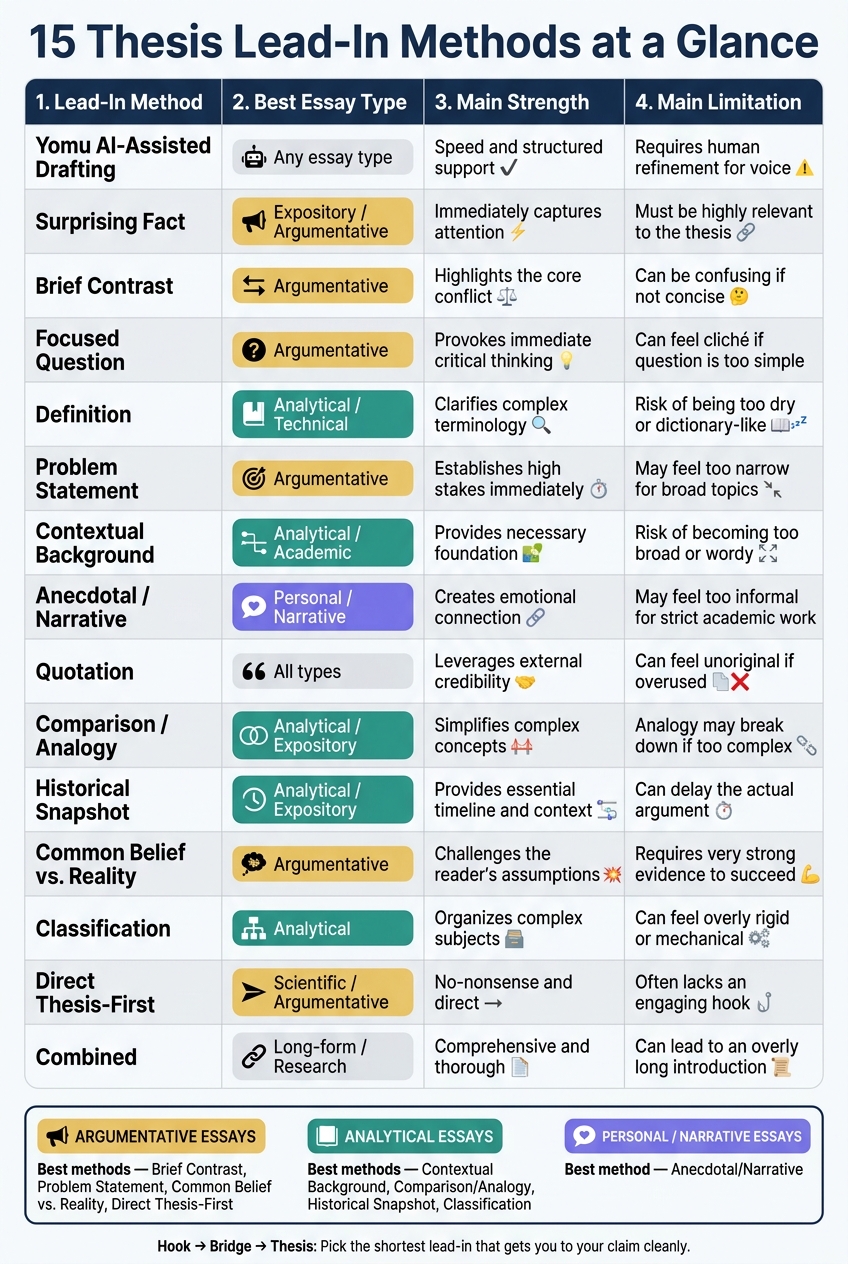
15 Thesis Lead-In Methods: Quick Comparison Guide
The table below gives you a quick side-by-side view of all 15 methods. Scan it first, then pick the one that fits your essay best.
| Lead-In Method | Best Essay Type | Tone | Main Strength | Main Limitation |
|---|---|---|---|---|
| 1. Yomu AI-Assisted Drafting | Any essay type | Variable | Speed and structured support | Requires human refinement for voice |
| 2. Surprising Fact | Expository / Argumentative | Engaging | Immediately captures attention | Must be highly relevant to the thesis |
| 3. Brief Contrast | Argumentative | Analytical | Highlights the core conflict | Can be confusing if not concise |
| 4. Focused Question | Argumentative | Engaging | Provokes immediate critical thinking | Can feel cliché if the question is too simple |
| 5. Definition | Analytical / Technical | Formal | Clarifies complex terminology | Risk of being too dry or "dictionary-like" |
| 6. Problem Statement | Argumentative | Serious | Establishes high stakes immediately | May feel too narrow for broad topics |
| 7. Contextual Background | Analytical / Academic | Informative | Provides necessary foundation | Risk of becoming too broad or wordy |
| 8. Anecdotal / Narrative | Personal / Narrative | Authentic | Creates emotional connection | May feel too informal for strict academic work |
| 9. Quotation | All types | Authoritative | Leverages external credibility | Can feel unoriginal if overused |
| 10. Comparison / Analogy | Analytical / Expository | Explanatory | Simplifies complex concepts | The analogy may break down if too complex |
| 11. Historical Snapshot | Analytical / Expository | Academic | Provides essential timeline and context | Can delay the actual argument |
| 12. Common Belief vs. Reality | Argumentative | Provocative | Challenges the reader's assumptions | Requires very strong evidence to succeed |
| 13. Classification | Analytical | Systematic | Organizes complex subjects | Can feel overly rigid or mechanical |
| 14. Direct Thesis-First | Scientific / Argumentative | Bold | No-nonsense and direct | Often lacks an engaging hook |
| 15. Combined | Long-form / Research | Balanced | Comprehensive and thorough | Can lead to an overly long introduction |
A few patterns stand out right away. Argumentative essays usually work best with methods 3, 6, 12, and 14 because they get to an arguable claim fast. Analytical writing tends to fit 7, 10, 11, and 13 since those methods put clarity and specificity first.
Method 8 works best for personal and narrative essays because it brings in emotion and a human touch. That can pull readers in fast, though it may not fit stricter academic writing.
The main trade-off here is engagement vs. efficiency. A direct thesis-first lead-in is the fastest route, but it usually gives the reader less to latch onto. Combined lead-ins can add depth and range, but they also make it easier for an introduction to drift and get too long.
Next, use these comparisons to choose the lead-in that best fits your essay, audience, and thesis.
How to Pick the Right Lead-In for Your Essay
Pick your lead-in with three filters: the assignment, the discipline, and the reader. That simple check can narrow your options fast.
Start with your assignment prompt. The prompt usually tells you more than people think. If it says "argue" or "persuade," go with an opener that sets up a claim people could disagree with. If it says "analyze" or "examine," background, a definition, or brief history usually fits better. And if the assignment calls for clarity, APA style, or a research paper, keep the lead-in direct and formal.
Let your discipline shape the tone. If the prompt doesn't make the choice obvious, your field often will. In STEM, readers usually want efficiency and precision. That means concise problem statements, definitions, and context-heavy lead-ins are the norm. In humanities courses like English, history, and philosophy, instructors often allow more rhetorical range. An anecdote, quotation, or analogy can work well there, as long as it connects cleanly to your thesis. Social sciences often mix background context with a problem statement. Business writing usually leans toward clear problem statements or classification lead-ins, sometimes backed by a short case example.
A good habit? Read two or three published papers or strong student essays in your field and study how their introductions are built. You'll start to see patterns pretty fast.
Think about what your reader already knows. A professor, a general reader, and a skeptical reader do not need the same setup. A professor who specializes in your topic probably doesn't need a long definition lead-in. In that case, a more direct path to the argument is often the better move. A general or skeptical reader may need more of a reason to care, so a surprising fact or a common-belief-vs.-reality opener can help draw them in.
If one method feels too light, you can combine two. Just make sure each one adds something new. In most cases, that means a hook followed by a short bridge.
Use these three filters to choose the shortest lead-in that gets you to your thesis cleanly.
Conclusion
A strong introduction doesn’t need to be flashy. It has one job: guide the reader straight to the thesis.
The best lead-in is the one that fits your topic, your assignment, and your tone. Nothing more, nothing less.
A thesis lead-in only works if it narrows cleanly toward the main claim. Pick the shortest lead-in that still fits your thesis, and use the approach that gets there fast without feeling forced. These lead-ins are tools, not formulas.
Hook, bridge, thesis: broad to specific to claim. In U.S. academic writing, keep the opening concise, place the thesis clearly, and make sure every sentence points back to the claim.
FAQs
How long should a thesis introduction be?
It depends on how much you’re writing.
For a short essay, a good introduction is usually 3 to 5 sentences. That’s often enough to set up the topic, give a bit of context, and move straight to the thesis statement.
For a formal Master’s or PhD thesis, the introduction is usually about 10% of the total word count. In practice, that’s roughly 1,500 to 2,000 words for a Master’s thesis and 8,000 to 10,000 words for a doctoral dissertation.
No matter the length, each sentence should move the reader one step closer to the thesis statement.
Can I use more than one lead-in method?
Yes. You can combine lead-in methods. For example, a surprising statistic followed by a thought-provoking question can make the introduction more engaging.
The key is flow. Each part should connect in a natural way and stay brief. You want to give the reader just enough context to guide them to your thesis, not bury them in extra detail.
Where should the thesis statement go?
Put your thesis statement at the end of the introduction, usually in the last sentence.
After your hook and a bit of context, that sentence should state your main argument or claim in clear terms. It should also lead into the body of the essay, so readers can see where you’re headed and how the paper will unfold.