
Essay Formats Explained: APA, MLA, and Chicago Side by Side
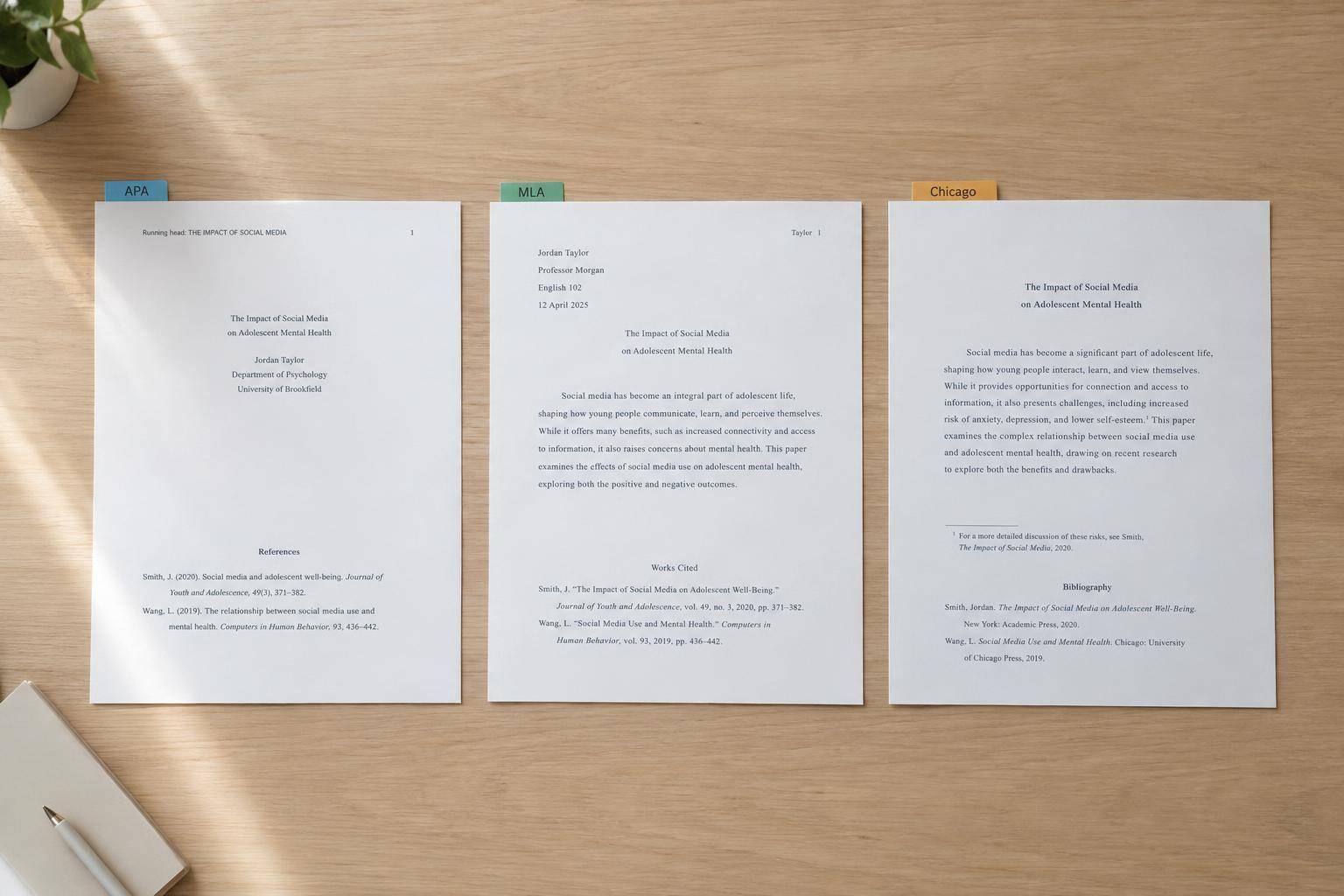
Follow the assigned style first: APA uses author-date citations, MLA uses author-page citations, and Chicago offers notes or author-date citations. All three generally use 1-inch margins, double-spaced body text, and 0.5-inch paragraph indents. The main differences are the title page, page header, citation format, and final source list.
This guide compares APA 7th, MLA 9th, and Chicago 18th, with matching book examples that show how names, dates, titles, and punctuation change.
Quick Comparison
| Style | Title page or first page | Page header | Citations | Source list |
|---|---|---|---|---|
| APA | Student title page | Page number | Author and year; page for quotes | References |
| MLA | First-page heading; title page only if assigned | Surname and page number | Author and page | Works Cited |
| Chicago notes-bibliography | Title page if assigned | Page number; placement varies | Numbered footnotes or endnotes | Bibliography |
| Chicago author-date | Title page if assigned | Page number; placement varies | Author and year; page for quotes | References |
Check the syllabus before setting up the paper. Instructor rules take priority. If the assignment says only “Chicago,” confirm which citation system to use.
APA vs. MLA vs. Chicago: Essay Formatting Guide
Master Academic Writing: APA, MLA, & Chicago Styles Simplified!
sbb-itb-1831901
Essay Formatting Rules by Style
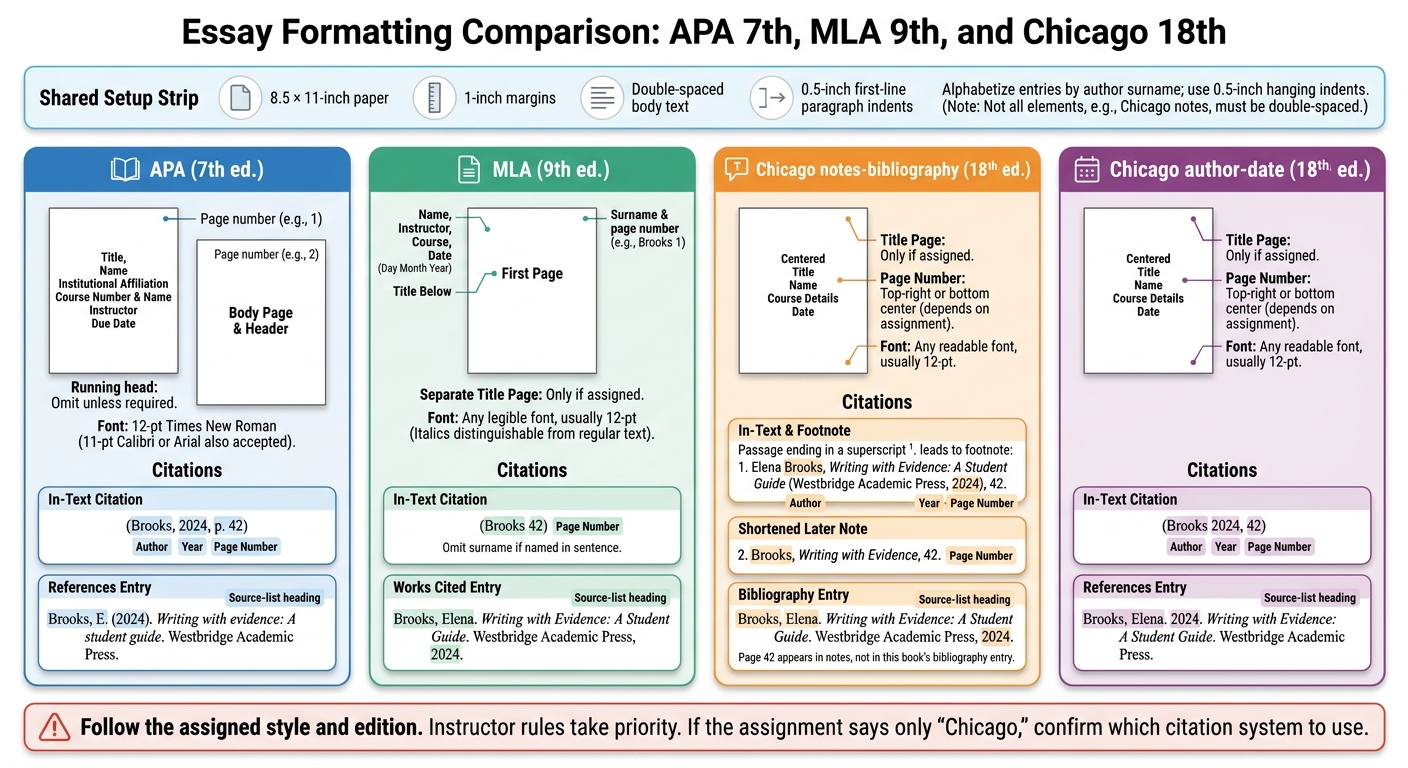
APA, MLA, and Chicago share a basic page setup: 8.5 × 11-inch paper, 1-inch margins, and double spacing. Where they differ is in title pages, citations, and source lists.
APA: Title Page and Author-Date Citations
Use a readable 12-point font and 0.5-inch first-line paragraph indents. Put a page number in the upper-right corner of every page, including the student title page. That page should include your title, name, institutional affiliation, course number and name, instructor, and due date. Leave out the running head unless your instructor requires it.
For paraphrases, cite the author and year. For direct quotes, add the page number. Begin References on a new page with a centered heading. Alphabetize entries by author surname, use 0.5-inch hanging indents, and double-space the list.
MLA: First-Page Heading and Author-Page Citations
Use a readable 12-point font and 0.5-inch paragraph indents. Put your surname and page number in the upper-right header. At the upper left of the first page, list your name, instructor, course, and date, then add a centered title below. Write the date in day month year order. You don’t need a separate title page unless one is assigned.
Use author-page citations without a comma. If you name the author in your sentence, leave the surname out of the parentheses. Start a separate Works Cited page, alphabetize the entries, and use double spacing with 0.5-inch hanging indents. If you include explanatory endnotes, put them on a separate page before Works Cited.
Chicago: Notes-Bibliography and Author-Date Citations
Use a readable 12-point font and 0.5-inch first-line paragraph indents. Include a separate title page only if assigned, with a centered title, your name, course details, and date. Page numbers usually go in the top-right header.
Chicago offers two citation systems. In notes-bibliography, superscript numbers link passages to footnotes or endnotes. Provide full source details in the first note, then use shortened notes for later references. Include an alphabetized Bibliography with hanging indents, and place explanatory endnotes on a separate page before it.
In author-date, parenthetical citations include the surname and year, with a comma before a page number. Source entries go in an alphabetized References list. Your instructor assigns the Chicago system and tells you where to place notes.
The next section shows the differences side by side.
APA, MLA, and Chicago Compared
Layout and Citation Rules at a Glance
Compare the rules that affect your paper’s setup below. Assignment-specific choices are noted in the table.
| Comparison point | APA (7th ed.) | MLA (9th ed.) | Chicago notes-bibliography (18th ed.) | Chicago author-date (18th ed.) |
|---|---|---|---|---|
| Margins | 1 inch | 1 inch | 1 inch | 1 inch |
| Font | 12-point Times New Roman; 11-point Calibri or Arial also accepted | Any legible font, usually 12-point; italics must look different from regular text | Any readable font, usually 12-point | Any readable font, usually 12-point |
| Main-text spacing | Double-spaced | Double-spaced | Double-spaced | Double-spaced |
| First-line paragraph indent | 0.5 inch | 0.5 inch | 0.5 inch | 0.5 inch |
| Title page or heading | Title page; instructor-specific exceptions may apply to student papers | First-page heading; title page only if assigned | Title page optional or instructor-dependent | Title page optional or instructor-dependent |
| Page numbers | Top-right; page number only | Top-right; last name and page number | Top-right or bottom center, depending on assignment | Top-right or bottom center, depending on assignment |
| Citation system | Author-date; page number required for direct quotes | Author-page; page number required for quotes and paraphrases | Superscript numbers linked to footnotes or endnotes | Author-date; page number required for direct quotes |
| Source-list name | References | Works Cited | Bibliography | References |
With the layout rules in place, check which citation system your assignment requires.
Strengths and Limits of Each Style
Each style handles source details a little differently. Here’s what that means for your writing.
| Style | Strength | Limit |
|---|---|---|
| APA | Keeps publication dates visible. | Dates make in-text citations longer. |
| MLA | Short citations cause fewer interruptions in the text. | Dates usually appear only in Works Cited entries. |
| Chicago notes-bibliography | Footnotes give you room for source commentary without interrupting the text. | Notes take more tracking and often accompany a bibliography. |
| Chicago author-date | Short citations keep authors and years visible. | Offers less room for commentary than notes-bibliography. |
Use the assigned style, even if another looks easier. If your assignment says only Chicago, ask which citation system it requires before you start.
The Same Source Cited in Each Style
These examples all cite page 42 of the fictional book Writing with Evidence: A Student Guide by Elena Brooks (Westbridge Academic Press, 2024). Keeping the source the same makes it easier to compare author order, year placement, punctuation, and source-list format.
APA: citation and References entry. APA pairs the author’s last name with the year in the citation and uses sentence case for the book title.
Citation: (Brooks, 2024, p. 42)
References
Brooks, E. (2024). Writing with evidence: A student guide.
Westbridge Academic Press.
MLA: citation and Works Cited entry. MLA pairs the author’s last name with the page number in the citation and uses title case for the book title.
Citation: (Brooks 42)
Works Cited
Brooks, Elena. Writing with Evidence: A Student Guide.
Westbridge Academic Press, 2024.
Chicago has two versions: notes-bibliography and author-date.
Chicago notes-bibliography: first note, shortened note, and Bibliography entry. Start with a full note, then use a shortened note for later citations. Page 42 belongs in the notes, not the bibliography.
First note:
- Elena Brooks, Writing with Evidence: A Student Guide (Westbridge Academic Press, 2024), 42.
Shortened note:- Brooks, Writing with Evidence, 42.
Bibliography
Brooks, Elena. Writing with Evidence: A Student Guide.
Westbridge Academic Press, 2024.
Chicago author-date: citation and References entry. This version uses an author-date citation, as APA does, but the punctuation and References entry follow different rules.
Citation: (Brooks 2024, 42)
References
Brooks, Elena. 2024. Writing with Evidence: A Student Guide.
Westbridge Academic Press.
Conclusion: Follow the Assigned Style
Use one style - APA, MLA, or Chicago - for your paper’s layout, citations, and source list.
Confirm the Required Style and Edition
After comparing the formats, follow the style your instructor assigned. Check the edition, too: APA 7th, MLA 9th, or Chicago 18th. If the assignment says only “Chicago,” ask which citation system to use.
Each style handles citations differently:
- APA: Author-date citations.
- MLA: Author-page citations.
- Chicago notes-bibliography: Notes, which can include commentary on sources.
- Chicago author-date: Parenthetical author-year citations.
Check Layout, Citations, and Source Entries
Review your paper in the same order each time: margins and spacing → title page or first-page heading → page numbers → citations or notes → final source list.
Start with 1-inch margins and double-spaced body text. Then check the style’s formatting rules for notes and source entries. Make sure citations match the final source list and direct quotes include page numbers.
Before submitting, double-check author names, publication details, page numbers, and any instructor rules.
FAQs
Which style should I use if none is assigned?
If your assignment doesn’t name a citation style, let your subject guide your choice:
- APA for social sciences, including psychology, education, business, and health. Use author-date in-text citations and a References list.
- MLA for humanities, including literature and languages. Use author-page citations and a Works Cited list.
- Chicago for history, arts, or classes that allow notes. Choose Notes-Bibliography or Author-Date, and stick with that system throughout.
How do I cite sources without page numbers?
When a source has no page numbers - as is common with websites and digital documents - generally leave out page information.
In APA and Chicago author-date styles, include the author and publication year. In MLA, include the author’s name in the text or parentheses, and use paragraph or section numbers if available.
Provide complete source details in your reference list, bibliography, or Works Cited page so readers can find the source.
How do I format block quotes in each style?
Start block quotes on a new line, indent them 0.5 inches from the left margin, and leave out quotation marks.
The length and spacing rules depend on the style:
- APA: Use a block quote for 40 or more words, with double spacing.
- MLA: Use a block quote for prose longer than four lines or poetry longer than three lines, with double spacing.
- Chicago: Use a block quote for five or more lines (roughly 100 words) or two or more paragraphs. Typically, use single spacing with blank lines between paragraphs.
Place citations after the final punctuation. APA adds no period after the citation. Chicago’s notes-bibliography system uses a superscript footnote number.