

Common App Essay Prompts: How to Choose and Answer Each One
The best Common App essay prompt is the one that fits your strongest story - not the one that sounds most impressive. For 2026–2027, the essay is still 250–650 words and the same 7 prompts are in place. If I were starting, I’d first list 3–5 moments from high school, write the “so what?” for each one, and then pick the prompt that gives me the most room to show how I think.
Here’s the short version:
- Prompt 1: Best for identity, background, or a long-term interest
- Prompt 2: Best for a setback, mistake, or hard moment that led to change
- Prompt 3: Best for questioning a belief or idea and showing how your view shifted
- Prompt 4: Best for an unexpected act of kindness that changed you
- Prompt 5: Best for personal growth with a clear before-and-after
- Prompt 6: Best for deep curiosity about a specific topic
- Prompt 7: Best for a focused story that doesn’t fit the other six
What matters most to admissions readers is usually simple:
- Reflection: not just what happened, but what it meant
- Voice: details and phrasing that sound like a real student
- Structure: a clear beginning, middle, and end
- Fit: an essay that adds something new beyond grades, roles, and awards
A few numbers help keep this practical:
- Minimum length: 250 words
- Maximum length: 650 words
- Good first-draft range: about 800–900 words, then cut down
- Good brainstorm time: 10–15 minutes
- Good number of story ideas to list first: 3–5
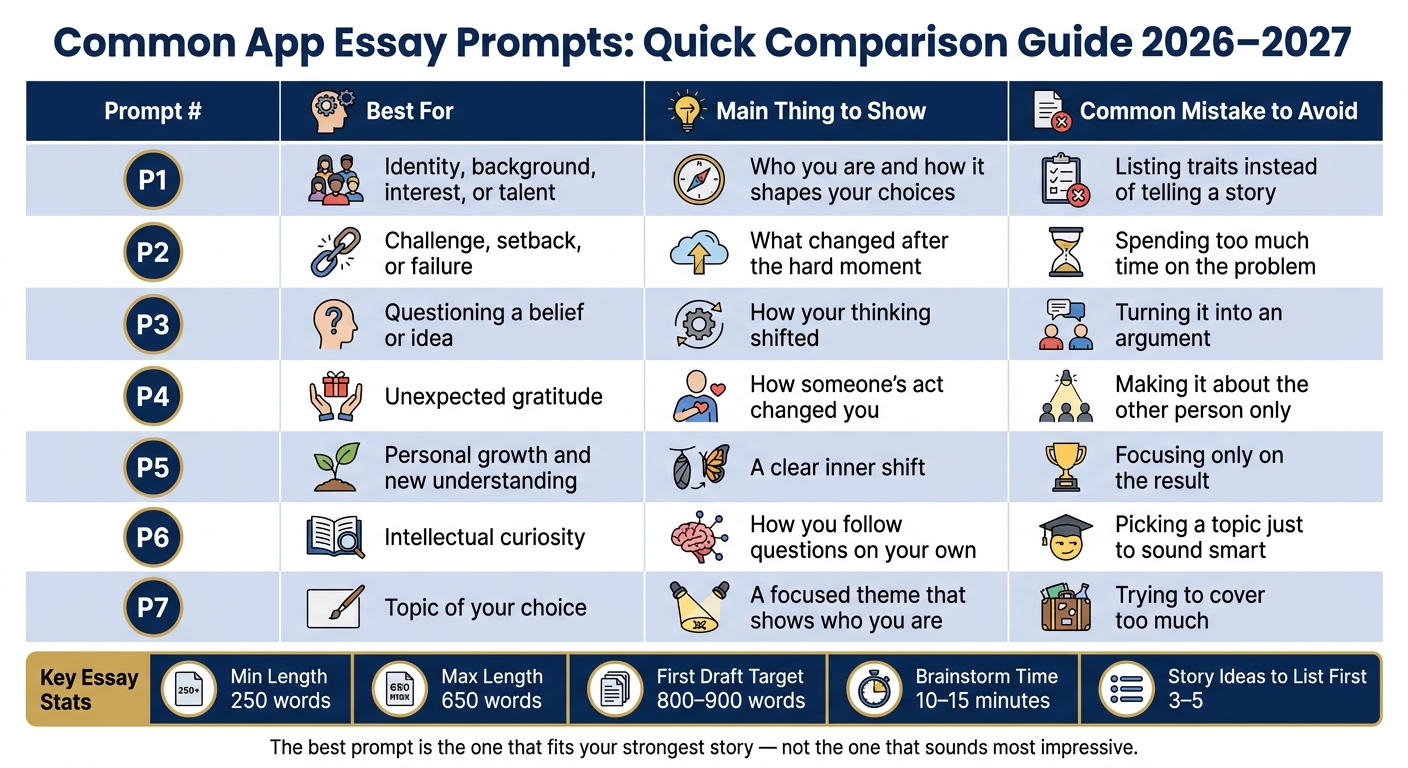
Common App Essay Prompts: Quick Comparison Guide 2026–2027
Breaking down all 7 Common App essay prompts | Common App

sbb-itb-1831901
Quick Comparison
| Prompt | Best for | Main thing to show | Common problem |
|---|---|---|---|
| 1 | Identity, background, interest, talent | Who you are and how it shapes your choices | Listing traits instead of telling a story |
| 2 | Challenge, setback, failure | What changed after the hard moment | Spending too much time on the problem |
| 3 | Questioning a belief or idea | How your thinking shifted | Turning it into an argument |
| 4 | Unexpected gratitude | How someone’s act changed you | Making it about the other person only |
| 5 | Growth and new understanding | A clear inner shift | Focusing only on the result |
| 6 | Intellectual curiosity | How you follow questions on your own | Picking a topic just to sound smart |
| 7 | Topic of your choice | A focused theme that shows who you are | Trying to cover too much |
My rule of thumb: if I have to force a story into a prompt, it’s the wrong prompt.
Below, the article walks through how to match each prompt to the right kind of story, what mistakes to avoid, and how to draft and revise an essay that sounds like you.
How to choose the right prompt before you start writing
Use those reflection and authenticity standards to pick the prompt that fits your strongest story.
Start with your strongest story, then find the right prompt
Set a 10–15 minute timer and jot down 3–5 moments from high school that changed how you think, feel, or act. Don't just look for big, dramatic events. Ordinary moments can work just as well if they led to a real shift inside you.
For each moment, write one sentence answering the "so what": What does this moment show about who you are now? Do that first. Then open the prompt list and ask: which prompt gives me the most room to dig into this insight?
If you have to bend the story to make it fit, that's usually a bad sign. Pick the prompt where reflection comes naturally.
How to match your story to the right prompt
Every story has a main theme. Maybe it's identity, resilience, curiosity, gratitude, growth, or independent thinking. Once you know that theme, it's much easier to see which prompt fits best.
The simplest approach is to match the story's main theme to the prompt's core question.
| Prompt | Best-Use Scenario | Strongest Admissions Signal | Common Mismatch Risk |
|---|---|---|---|
| 1. Background, identity, interest, or talent | A defining part of who you are, rooted in culture, values, or a long-term passion | Identity, uniqueness, authenticity | Becomes a résumé summary instead of a meaningful story |
| 2. Challenge, setback, or failure | A specific obstacle where your response shows growth | Resilience, capacity to learn from mistakes | Focuses on the failure without showing what changed |
| 3. Questioning a belief or idea | A moment where your views genuinely shifted | Open-mindedness, independent thinking | A debate with no personal stakes or real perspective change |
| 4. Unexpected gratitude | A surprising act of recognition that changed your outlook | Humility, relational insight | Tells someone else's story more than your own |
| 5. Personal growth and new understanding | A clear before/after transformation in maturity or perspective | Emotional maturity, self-awareness | Recounts an achievement with little inner change |
| 6. Intellectual curiosity | A topic you pursued well beyond what was required | Passion, initiative, sustained curiosity | Chooses a topic that sounds "smart" but lacks genuine interest |
| 7. Topic of your choice | A powerful story that doesn't fit the language of the other six prompts | Flexibility and originality | Picked only because the other prompts feel hard |
If your story could fit two or three prompts, go with the one where the main theme and reflection line up most clearly. Admissions officers don't favor one prompt over another. They respond to clarity, authenticity, and insight.
Mistakes to avoid when choosing a prompt
Don't choose a prompt before you have a real story. That's the biggest mistake. Right behind it is forcing a weak fit - reshaping an experience to match a prompt you think colleges want.
If the story doesn't naturally answer the prompt's main question, step back and rethink the match.
Another common mistake is using the essay to repeat what's already in your activities list or honors section. Your personal statement should add something new. It should show a side of you the rest of the application doesn't already spell out.
Once you have the prompt that fits best, use the next section to shape the essay itself.
How to answer prompts 1 through 3
These three prompts get into some of the most personal parts of the Common App. Each one is asking for something different: who you are, how you deal with hard things, and how you examine ideas on your own. If you know what the prompt is actually asking, your essay has a much better shot of landing. A simple check helps: does your draft show who you are, how you handled difficulty, or how your thinking changed?
Prompt 1 - Background, identity, interest, or talent
Start with the prompt that fits the story you’ve already picked. Prompt 1 works best when the heart of your essay is a defining part of your identity. That could be family context, culture, language, or a long-term practice that shapes how you think and make decisions.
A good Prompt 1 essay doesn’t describe identity from a distance. It shows that identity in motion. One clear scene, like translating for a parent at a clinic, can do more work than three paragraphs of general background. Here’s the test: does this story show how this part of my life affects my values, choices, or relationships? If the answer is yes, you’re probably in the right place.
The mistake students make most often is turning the essay into a list instead of a story. Labels like first-generation, Hispanic, introverted, or musician tell admissions officers what you are, but not much about how you live. Another common problem is using the essay to stretch out an activity already covered somewhere else in the application. Prompt 1 should add new insight, not repeat what the reader can already see. Ask yourself: would my application feel incomplete without this essay? If not, the angle may need work.
Prompt 2 - Challenge, setback, or failure
Prompt 2 asks you to recount a time you faced a challenge, setback, or failure and explain how it affected you and what you learned from the experience. Admissions officers use this prompt to look for resilience, reflection, and maturity. More plainly, they want to see whether you can think through a hard situation, take responsibility where it makes sense, and show what changed afterward.
Structure matters here more than many students think. Spend more time on your response and what changed than on the setback itself. If the essay stays focused on how painful or unfair the experience was, but never shows what you understood or did next, the reader has little proof of growth. Specific details matter a lot. Saying you began going to office hours twice a week and asked your teacher to review your outlines before you drafted says much more than simply saying you learned to ask for help.
Try not to frame yourself as having no control at all. Even when the situation was hard in a real way, admissions officers still want to see agency. They want to find the moment when you saw that something had to change and took a step toward that change.
Prompt 3 - Questioning a belief or idea
Prompt 3 asks you to reflect on a time when you questioned or challenged a belief or idea, what caused you to question it, and what the outcome was. This prompt is about intellectual honesty, not about delivering a winning argument. The center of the essay should be your inner process, not proving that someone else was wrong.
Strong essays for this prompt often grow from one lived moment: a class discussion that shook a long-held assumption, a friendship that pushed against a stereotype, or a service experience that complicated a belief about fairness or opportunity. The essay should feel like a story about changing thought, not a debate transcript. Stay in first person from start to finish. This prompt is about how you think, not about what is objectively true. Then connect that shift in perspective to something concrete, like how you now handle conversations or approach learning. That link helps show that the questioning was not just an abstract exercise. It changed something in your life.
One of the clearest red flags in a Prompt 3 essay is acting too certain. A line like “I now see the issue as more complex” can work well. But writing as if you’re morally ahead of everyone else usually comes off as arrogance, not growth. The strongest version of this essay shows a student arriving at a more nuanced understanding, not a simpler one.
If your story fits better under gratitude, growth, curiosity, or free choice, move to prompts 4 through 7.
How to answer prompts 4 through 7
These prompts ask for different kinds of reflection: gratitude, growth, curiosity, or a theme that doesn't fit anywhere else. The same rule still applies: pick the prompt that lets your best story sound specific, reflective, and alive on the page.
Prompt 4 - Unexpected gratitude and Prompt 5 - Personal growth and new understanding
Prompt 4 is about a kind act that caught you off guard and changed something in how you think or act. Don't turn the essay into a thank-you note. The point isn't just what someone did for you. The point is what changed in you afterward.
A strong response uses the kind act as the starting point, then spends most of the essay on the shift it caused. Maybe you see a value differently now. Maybe you changed a habit. Maybe you let go of an assumption you used to carry around without noticing. If your ending could work in almost any gratitude essay, that's a sign the reflection still needs more depth. Use this prompt when the inner change matters more than the event itself.
Prompt 5 works best when you can show a clear before-and-after. The achievement gives the story shape, but the growth should stay at the center. For example, a student who led a cultural club and learned to work through internal disagreements about representation has the bones of a strong Prompt 5 essay. The growth is in the shift in judgment, patience, or self-awareness, not just in holding the role.
One of the most common mistakes here is saving all the reflection for the last paragraph. That usually feels pasted on. Instead, thread the insight through the story so the growth feels earned. Use this prompt when your essay is less about what you did and more about how the experience changed the way you think.
Prompt 6 - Intellectual curiosity
Prompt 6 moves away from personal change and toward sustained curiosity. It asks you to write about a topic or idea that pulls you in on its own - something you return to because you can't help it.
Don't give a broad overview of a subject. Show what your curiosity looks like in motion. Strong essays name something specific, like urban tree canopies, game theory, or bilingual language acquisition, and then trace the habits that came from that interest. That might mean reading technical reports, running informal experiments, emailing researchers, or following one question until it splits into three more.
Include at least one moment when things got confusing or difficult. That's what makes intellectual engagement feel lived-in instead of staged. Broad topics usually flatten out fast, so stay narrow. Show the habits your curiosity built and how those habits shape the way you learn. Maybe you ask sharper questions. Maybe you sit with uncertainty longer. Maybe you keep chasing ideas long after class ends. Use this prompt when a specific intellectual obsession has shaped the way you think and work.
Prompt 7 - Topic of your choice
Use Prompt 7 only when your story doesn't fit prompts 1–6 in a clean way. Don't treat it like a chance to cram in everything about yourself. It works best when you have a focused theme that doesn't sit neatly under another prompt - maybe a braided narrative, a long identity journey, or a subject like humor, language, or family culture that would feel awkward under another prompt's frame.
A good self-check is to finish this sentence:
This essay shows how [theme] has shaped the way I [think/act/relate].
If you can't finish that sentence clearly, the essay probably needs a tighter center. Build the piece around two or three moments that show the theme at work, and cut anything that doesn't help answer the real question: What does this say about me? If a teacher or counselor finishes reading and still can't describe you in a few clear words, the theme needs sharper focus.
Drafting and revising your Common App essay
A step-by-step approach to drafting
Once you’ve picked the right prompt, turn it into one clear story. Start with a single sentence that states the main insight your essay should show. Think of that sentence as your filter: if a detail doesn’t support it, cut it. Every paragraph should point back to that idea.
Next, brainstorm 5–10 specific moments that connect to that message. Then choose the one that shows it most clearly in action.
From there, freewrite 800–900 words. Don’t worry about polish yet. Just get the story on the page. Then shape that draft into 3–5 paragraphs. Start in the middle of a scene, add the background your reader needs, move toward the turning point, and end with reflection. Aim for 500–650 words. 650 is the limit, not the target.
Revision checks for clarity and focus
After you finish a full draft, do a quick paragraph purpose check. In the margin, label each paragraph with a 3–5 word note that explains its job, like sets up the conflict or shows the shift. If you can’t label a paragraph clearly, or if it doesn’t connect straight to your main message, cut it or rewrite it.
Then do a résumé repetition pass. Keep your activities list next to the essay. If a sentence just repeats a role, award, or number that already appears there, it needs to do more work. It should show something deeper, like your motivation, your uncertainty, or how you made a choice. If it doesn’t, replace it with a specific moment or inner detail that only you can give.
Tools like Yomu AI can help at this stage by pointing out vague sentences, spotting holes in the structure, and suggesting tighter wording. But use those suggestions with care. Keep the changes that still sound like you, and ignore anything that makes the essay feel flat. After any AI-assisted pass, read the whole essay out loud and rewrite any line that doesn’t sound natural in your own voice.
Conclusion: Choose the story that shows who you are
After you cut and polish the draft, read it the way an admissions reader would. The prompts stay the same for everyone, so the hard part isn’t picking a question. It’s choosing the right story and making the reflection sharp. Write one focused story around a single moment. Fix the structure before you fuss over sentence-level edits. Then, before you submit, ask someone you trust to read it once and tell you in one sentence what they took away. If their answer matches what you meant to say, you’re done.
FAQs
How do I know which prompt fits my story best?
Start by jotting down your experiences, strengths, and goals. Then group related ideas into a few themes so you can spot the main story running through them.
Next, compare that story with the Common App prompts and pick the one that feels like the best fit. Go with the prompt that gives you the most room to show how you think, what you’ve learned, and how you see the world. That part matters more than the prompt itself.
Can I reuse a topic from my activities list?
Yes - but don’t just recycle your activity list in paragraph form.
Use the essay to go a layer deeper. This is your chance to reflect, not just report. Admissions officers already have the basic facts: your role, your hours, your awards, your titles. What they want here is the meaning behind the activity. Why did it matter to you? What changed because you did it? How did it shape the way you think, learn, work, or relate to other people?
That shift matters. A student can list debate, robotics, or a part-time job on an application. But an essay can show what those experiences did to the person behind the résumé. Maybe debate taught you how to stay calm when your ideas are challenged. Maybe robotics showed you that you love solving messy problems, not just getting the right answer. Maybe working after school made you more disciplined, more aware of your family’s needs, or more certain about what you want to study.
The strongest essays usually don’t try to sound impressive at every line. They sound honest. They show a real person thinking through an experience and making sense of it. That kind of reflection tells an admissions reader much more than a polished summary ever could.
So instead of asking, “How can I make this activity sound big?” ask, “What did this experience do to me?” That’s often where the essay starts to come alive.
What if my essay fits more than one prompt?
Choose the prompt that lets you show your story and your strengths in the clearest way. Go with the one that makes your main point, examples, and reflection feel natural on the page.
If you’re stuck, sketch a short outline for each option. Then compare them and pick the prompt where your essay feels strongest and easiest to build.