
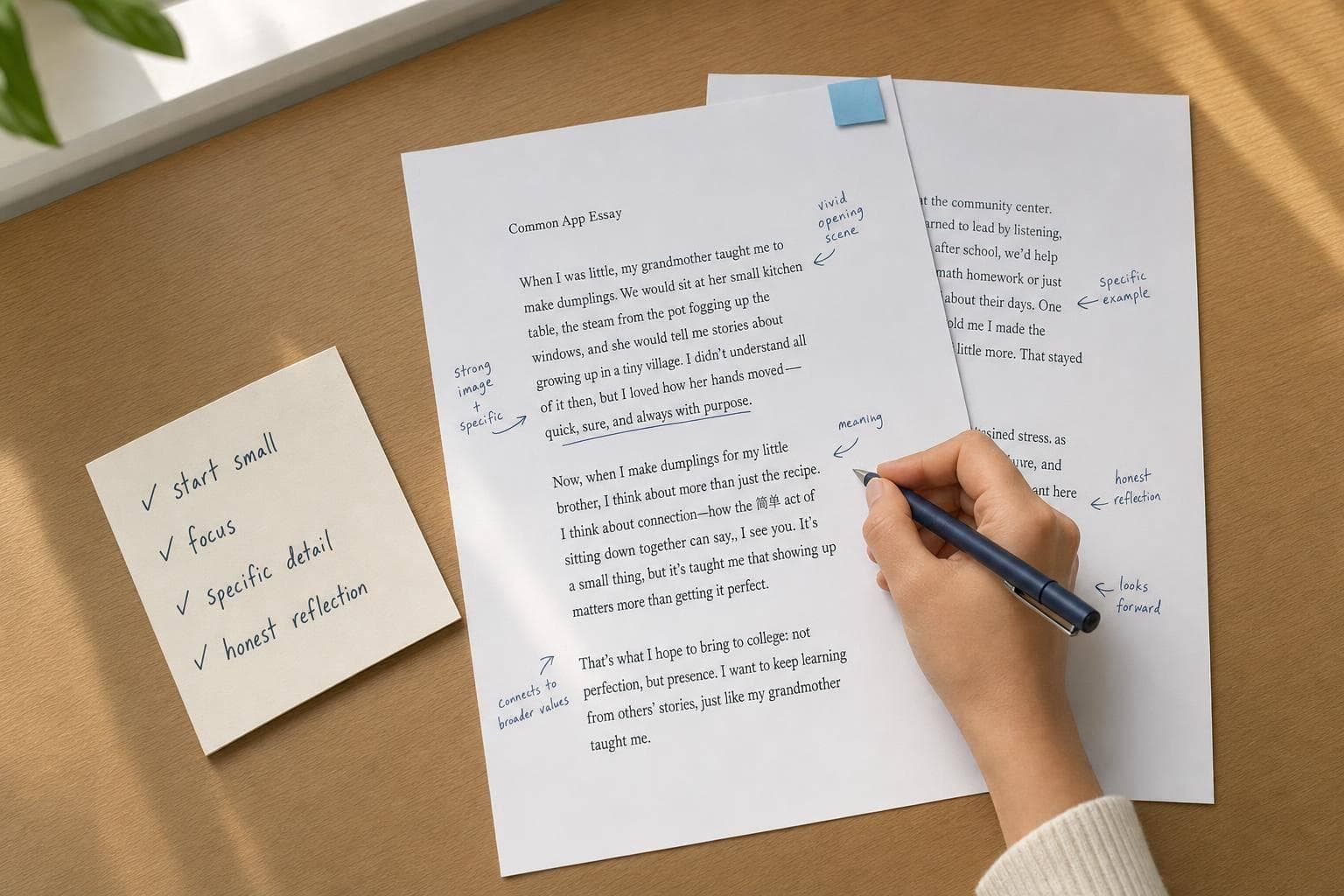
Common App Essay Examples That Worked (Annotated)
A strong Common App essay is usually simple: one clear moment, specific detail, honest reflection, and a voice that sounds like a person - not an application. In this piece, I’d take the main lessons from the examples and boil them down to what you can use right away. The article’s core point is clear: essays work when they show how you think, not just what happened. And that matters because about 75% of colleges say essays have moderate or high importance in admissions decisions.
Here’s the short version:
- Start with a small, concrete moment. An everyday object, a line of dialogue, or one tense scene can do more work than a big life summary.
- Keep one main thread. The best essays don’t jump all over the place or turn into a résumé in paragraph form.
- Move from story to meaning. Words like realized, understood, and recognized help show the shift from event to lesson.
- Let your voice stay personal. Precise details and natural phrasing matter more than sounding polished.
- End with present-day thinking. The last lines should show who you are now, not just what you plan to do next.
The article also breaks strong essays into three common paths:
| Essay type | Best focus | What can go wrong |
|---|---|---|
| Identity | Background, family, daily life, or personal perspective | Too much description, not enough reflection |
| Challenge | A setback, mistake, or hard moment | Spending too much time on the problem |
| Intellectual/Community | Curiosity, learning, service, or group experience | Sounding distant or losing the personal angle |
If I were using this article to revise my own draft, I’d check four things first: Does it sound like me? Is there one clear focus? Are the details specific? Does the ending show how I think now? That’s the article in plain English.
This Common App Essay Got Him Into Yale and Featured on the NY Times

sbb-itb-1831901
What Makes a Common App Essay Work
A strong Common App essay shows who the student is beyond grades and activities. It gives admissions readers a direct view of character, thinking, and voice - something grades, test scores, and activity lists can't provide on their own. The annotated examples below show how that looks on the page.
Admissions readers want more than a description of what happened. They want reflection. The essays that land make that shift clear, so the reader can follow not just the story, but the student's thought process too.
Traits Admissions Readers Notice
In the examples below, you'll see three qualities that show up again and again in essays that work:
- Opening: They start with a strong moment that pulls the reader in right away.
- Structure: They move through a clear arc with smooth transitions.
- Reflection: They use reflection words like realized, understood, and recognized to show insight instead of staying at the level of simple storytelling.
Voice matters just as much. Strong writing uses varied sentence length, precise word choice, and details only that student would know. That's what makes the voice feel like a real person, not a template. And when those details are missing, the weak spots stand out fast.
What the Essay Should Not Do
The opposite of a strong essay isn't one without drama. It's one without focus. In many cases, focus is the main issue, not style. Essays that read like résumés, lists of achievements, or forced lessons often fall flat. A challenge essay that spends time on a hard situation but never explains why it mattered can feel unfinished. Clichés and generic takeaways usually mean the reflection didn't go far enough. Writing can also miss the mark when it's so polished that it feels distant from the student.
Each example below avoids those traps by staying centered on one clear moment, one clear insight, and one clear voice.
Annotated Common App Essay Examples
These examples show specific detail, reflection, and growth on the page. Read the excerpt first, then the annotation below it. Each case study pairs a short passage with one clear takeaway.
Identity Essay Built Around an Everyday Detail
Every morning, my grandmother hands me a cup of tea I don't want. It's too sweet, too milky, and always slightly too hot. I drink it anyway - standing at the kitchen counter, watching her watch me, both of us pretending this is just tea.
Opening Move and Voice: This detail does more than set the scene. It gives the essay a voice right away. The writing is specific in a way that feels personal: the heat, the sweetness, the quiet routine. Those are the kinds of details only this student would pick out. When an essay comes back to the same image later, it gives the piece a clear arc and helps it move from observation to insight. The strongest version of this kind of essay uses an ordinary object or moment to point to something larger without stating the lesson too early. The detail does part of the work, and the reflection does the rest.
Challenge Essay With Specific Reflection
I told myself I had failed the audition because the panel wasn't listening. It took me three weeks to admit they were listening closely - and that what they heard wasn't ready.
Reflection: A challenge essay works when the writer thinks through what happened, what they got wrong, and how their view changed. That balance keeps the piece from feeling flat or generic. Strong essays in this lane often use thinking words such as realized, understood, and recognized to show a shift in perspective. Instead of racing toward a big, polished ending, the essay stays with the learning process. That helps the writer show grit and growth without sounding like they're patting themselves on the back. Admissions readers usually care less about the setback itself than about how the student made sense of it. A strong ending gives them a sharper picture of how the student thinks now, not just what issue got fixed.
Intellectual or Community Essay That Shows Perspective
She corrected my Spanish before I could finish the sentence. I had been tutoring her for six weeks. I laughed, wrote down her version, and kept it.
Structure and Conclusion: This essay stays focused on one clear interaction instead of making a big claim about leadership or service. That choice matters. The writer notices something small, responds with care, and learns from the other person. That kind of close attention adds depth and shows character without forcing it. When the essay ends with a shift in perspective instead of a recap of achievements, it feels grounded, reflective, and easy to remember. It also moves the reader straight into the kind of thinking the next section examines.
How to Apply These Patterns to Your Own Essay
Use the patterns from the examples above to check your own draft: a specific opening, one clear thread, deeper reflection, and an ending that shows how you think now. Treat those moves like a revision checklist, not a formula.
Admissions readers already know what happened. What they need to see is how you make sense of it.
A Revision Checklist Based on the Examples
The fastest way to revise is to hold each draft up against four simple questions:
- Does it sound like you? Read it out loud and cut anything that sounds like a report or a résumé.
- Is there one clear focus? Sum up the essay’s single thread in one sentence.
- Are the details specific? Swap broad claims for one actual object, conversation, or moment.
- Does the ending show how you think now? End with a present insight, not a future plan.
Using Yomu AI to Draft and Revise Without Losing Your Voice
Once the essay has a clear shape, use drafting tools to refine your ideas, not replace them. During drafting and revision, Yomu AI can help you organize your thoughts, tighten structure, and clean up mechanics without sanding down your voice.
AI can help with clarity and grammar. It can’t provide the personal insight that gives an essay weight.
Let Yomu handle the technical layer - clarity, grammar, structure - then bring in human feedback to check whether the emotional core still sounds like you. Save each draft version as you go, so you can see how your thinking changed from one stage to the next.
Choosing the Right Essay Strategy and Final Takeaways
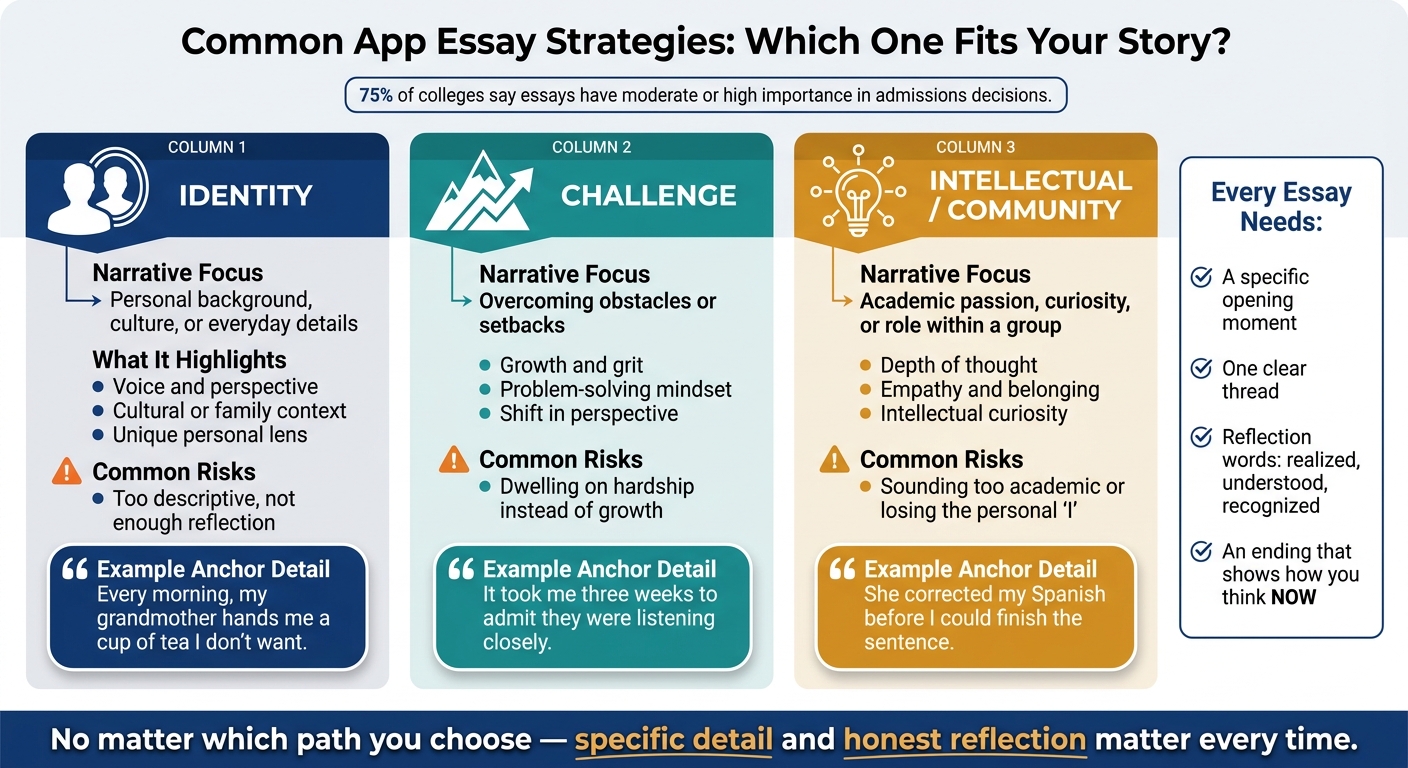
Common App Essay Types: Identity vs. Challenge vs. Intellectual
The examples above make one thing clear: the best strategy is the one that fits your strongest material. In plain English, pick the frame that matches the story you already have instead of forcing your experience into a shape that doesn't fit.
Comparison of Essay Approaches
Use the comparison below to match your strongest material to the frame that shows it fastest.
| Essay Strategy | Narrative Focus | What It Highlights | Common Risks |
|---|---|---|---|
| Identity | Personal background, culture, or everyday details | Voice and perspective | Being too descriptive without reflection |
| Challenge | Overcoming obstacles or setbacks | Growth, grit, and problem-solving | Dwelling on the hardship instead of the growth |
| Intellectual/Community | Academic passion, curiosity, or role within a group | Depth of thought, empathy, and belonging | Sounding too academic, or losing the "I" in the "we" |
No matter which path you choose, the same idea holds up: specific detail and honest reflection matter every time.
Key Points to Remember Before You Draft
Once you pick the right frame, two rules still do most of the heavy lifting: keep it specific and keep the reflection honest.
The annotated examples across this article point back to the same core lessons. Choose a story only you can tell. Ground it in a concrete detail. Then explain, clearly, what that experience showed you about how you think.
That last part is where many drafts slip. A story isn't strong just because something happened. It works because you show what the experience meant. Strong essays lean on specificity - concrete nouns, sensory detail, and reflection markers like "I realized" or "I understood" - to signal genuine insight.
Voice matters more than polish, and specificity is what makes that voice believable. Use Yomu AI for structure and mechanics, then check that the draft still sounds like you.
FAQs
How long should a Common App essay be?
The Common App essay has a 650-word maximum.
How personal is too personal for a Common App essay?
Your essay should feel honest and sound like you. Personal stories can help people connect with your writing, but balance matters.
If the writing feels forced, too polished, or missing the small details and vulnerability that show real life, readers can feel that distance right away.
Can I write about a small moment if nothing dramatic happened?
Yes. Admissions officers care more about personal insight than drama.
A strong essay can come from an ordinary moment if it shows your character, values, or point of view. What matters most is clear reflection, a genuine voice, and why that moment stayed with you.