
Argumentative Essay Outline: Template, Format, and 3 Filled-In Examples
I start an argumentative essay outline with a clear position, supporting claims, and a response to the strongest objection. For each claim, I note a source and explain how it supports my point - and where its limits are.
Here’s what I use to turn that plan into a draft:
- A copy-ready template for the introduction, claims, counterargument, conclusion, and bibliography.
- 3 filled-in examples: school uniforms, social media age restrictions, and free college tuition.
- A final check for sources, citations, assignment rules, and any AI-assisted work.
My rule: <u>test the argument before writing the essay</u>. I follow the assignment’s requirements - not a fixed paragraph count - and treat AI output as drafting help, not proof.
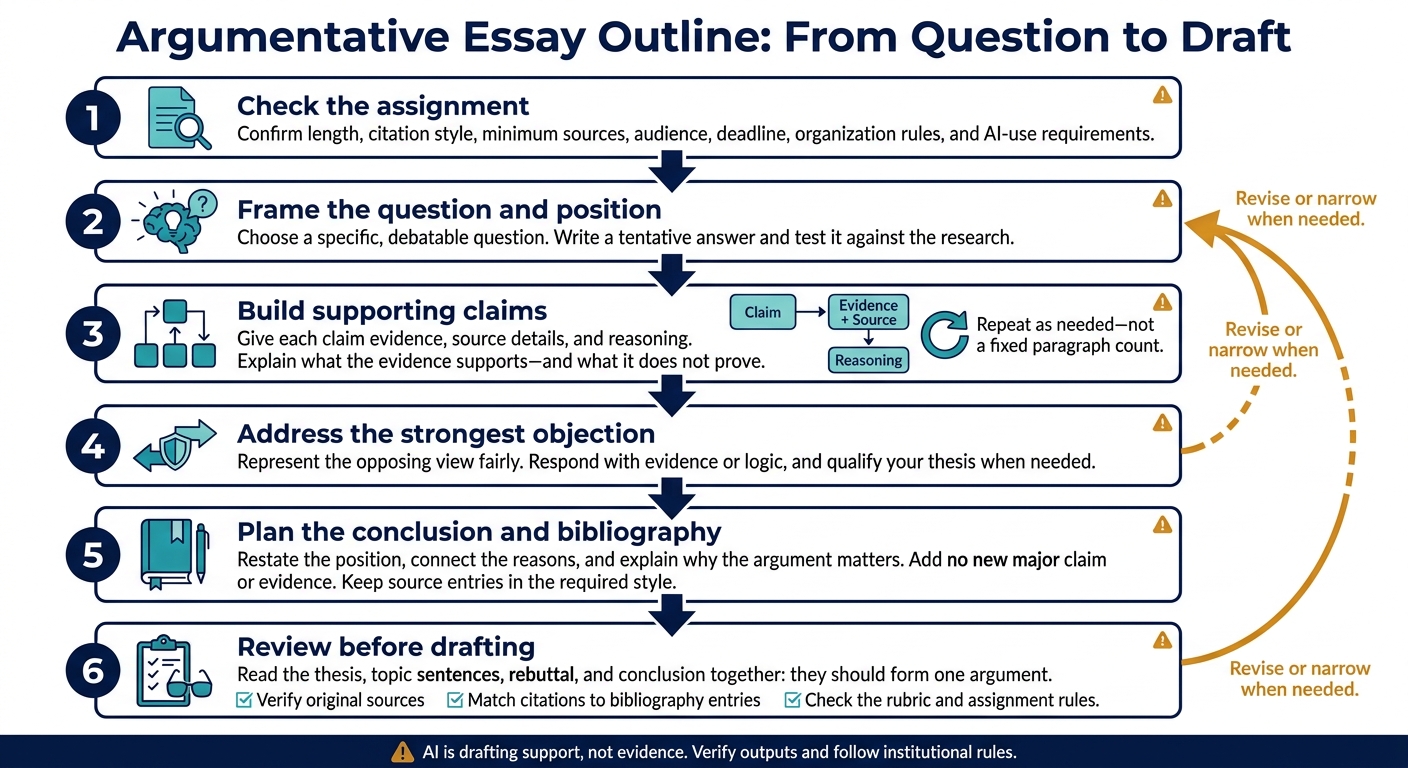
Argumentative Essay Outline: From Question to Draft
How to Write a Clever Argumentative Essay | PDF Download
sbb-itb-1831901
Argumentative Essay Format and Planning
Let the assignment - not a paragraph count - shape your outline.
Choose Your Question, Position, and Sources
Start by checking the required length, citation style and tools, minimum number of sources, audience, deadline, and rules for organizing your argument. Narrow the topic to a question about a specific decision and the group it affects. Write a tentative answer, then see whether the research supports it.
For each source, record the author or organization, title, date, and URL or database details. Keep direct evidence separate from your interpretation. Before using a statistic, check it against the original publication.
With your question in place, map each claim to the evidence you'll need.
Build Claims With Evidence and Reasoning
Give readers just enough background to understand your thesis. For each body section, draft a topic sentence, then identify the evidence needed to support it. Facts provide evidence; your explanation shows how that evidence supports your claim. If several sources address the same claim, compare them instead of giving each source its own paragraph.
Put your claims in an order that helps readers follow the argument. Use in addition to introduce another reason, however to signal a limitation, and therefore to draw a conclusion - not just to dress up paragraph openings. Read your thesis and topic sentences together. They should make a complete argument on their own.
Once you've mapped the support, leave room for the strongest objection and your rebuttal.
Address Opposing Views and Write a Conclusion
Explain the objection accurately, then respond with evidence or logic. Unless your instructor says otherwise, place it after your supporting claims or beside the claim it challenges. If it reveals a real weakness, qualify your thesis.
Plan a conclusion that restates your position in light of the evidence, ties your reasons together, and explains what your argument means in practice. Don't introduce a new major claim or new evidence.
Copy-Ready Argumentative Essay Outline Template
Build your outline in one document using this fill-in template. Replace each bracketed prompt with a complete phrase or sentence. Add or remove supporting claim sections as needed, then update the numbering and the reasons in your thesis.
Introduction and Thesis
Start with your research question. Then write a thesis that answers the question and names your supporting reasons.
Working Title: [Topic and scope]
Research Question: [The debatable question this essay will answer]
Position: [Your direct answer]
Required Citation Style: [MLA, APA, Chicago, or assigned style]

1. Introduction
1.1 Opening Context: [Why this issue matters]
1.2 Background: [Key definitions, scope, and context]
1.3 Thesis: [Position] because [reason one], [reason two], and [reason three].
Supporting Claims
Write each claim as a complete sentence. Put source details directly below the evidence they support. When a claim draws on multiple sources, repeat the evidence-source pair. In your reasoning, explain what the evidence supports - and what it doesn't.
2. Supporting Claim One
2.1 Claim: [First reason supporting the thesis]
2.2 Evidence: [Verified finding, quotation, or paraphrase; label its type]
2.3 Source: [Author/organization, title, date, page/table/section,
     URL or database details, and planned in-text citation]
2.4 Reasoning: [Explain how the evidence supports the claim and
     what it does not prove]
2.5 Transition: [Connect to the next claim]

3. Supporting Claim Two
3.1 Claim: [Second distinct reason supporting the thesis]
3.2 Evidence: [Verified finding, quotation, or paraphrase; label its type]
3.3 Source: [Author/organization, title, date, page/table/section,
     URL or database details, and planned in-text citation]
3.4 Reasoning: [Explain how the evidence supports the claim and
     what it does not prove]
3.5 Transition: [Connect to the next claim]

4. Supporting Claim Three
4.1 Claim: [Third distinct reason supporting the thesis]
4.2 Evidence: [Verified finding, quotation, or paraphrase; label its type]
4.3 Source: [Author/organization, title, date, page/table/section,
     URL or database details, and planned in-text citation]
4.4 Reasoning: [Explain how the evidence supports the claim and
     what it does not prove]
4.5 Transition: [Introduce the strongest objection]
Counterargument, Conclusion, and Bibliography
Use the limitation field to state any conditions your position depends on. As your evidence changes, update the bibliography and keep every entry in the required citation style.
5. Counterargument and Rebuttal
5.1 Opposing Position: [The strongest reasonable objection]
5.2 Supporting Evidence or Rationale: [Why someone would accept it;
     include source details for any evidence]
5.3 Rebuttal: [Your response and why it holds up]
5.4 Rebuttal Evidence: [Supporting evidence with source details]
5.5 Limitation or Qualification: [Where your position needs a condition,
     exception, or narrower scope]

6. Conclusion
6.1 Restated Thesis: [Your position in different wording]
6.2 Connected Claims: [How the reasons work together to support it]
6.3 Final Takeaway: [Why the argument matters]
6.4 Meaning or Call to Action: [What follows from the argument,
     or a practical next step, if appropriate]

7. Working Bibliography
Source 1: [Full entry in the required citation style]
Source 2: [Full entry in the required citation style]
Source 3: [Full entry in the required citation style]
3 Filled-In Argumentative Essay Outlines
These examples show how to adjust the template for different topics and policy positions.
School Uniforms: Support Only With Student Protections
Question: Should public schools require uniforms?
Thesis: Schools should adopt uniforms only with affordable options, comfortable clothing, religious and disability accommodations, and room for expression.
Claim 1: Uniforms may reduce visible brand comparisons. Evidence: This remains a proposed benefit, not an established outcome. Reasoning: Shared clothing can limit some comparisons without removing all status comparisons.
Claim 2: A shared dress standard may simplify morning choices and school expectations. Research needed: Survey students and staff before claiming time savings.
Claim 3: Student protections must be a condition of adoption. Verified evidence: A nationally representative study of 6,320 elementary students found no overall differences in behavior or attendance between students in schools with and without uniform requirements; low-income students in uniform schools had a small attendance advantage of less than one day per year, and fifth graders reported lower school belonging. These associations do not establish causation.
Counterargument: Uniforms restrict individuality and add costs. Rebuttal: Offer vouchers, secondhand options, sensory-friendly fabrics, religious clothing accommodations, and permitted accessories; avoid removing students from class over clothing.
Conclusion: Support uniforms only as a protected, locally evaluated policy. Research needed: Collect local prices, student feedback, and enforcement data.
Social Media Age Restrictions: Safety Without Blanket Bans
Question: How should platforms restrict younger users without banning all teen access?
Thesis: A defined age threshold should work alongside privacy and design safeguards, rather than a blanket teen ban.
Policy proposal, not current law: Platforms would ban accounts for children under 13, tighten privacy for users ages 13–15, limit default parental access to private messages, and require age-appropriate design.
Claim 1: Private accounts and limits on adult-minor contact can reduce opportunities for unwanted contact. Research needed: Measure actual exposure and reporting outcomes.
Claim 2: Less-personalized feeds and content controls may reduce unsuitable recommendations. Research needed: Compare platform-specific results; do not promise mental-health improvements.
Claim 3: Parental tools can support supervision without routine surveillance. Verified evidence: A qualitative study of 45 parents and teens identified concerns about intrusive or unreliable age checks and support for controls over major account decisions; it measured views, not effectiveness.
Counterargument: A blanket ban may reduce exposure more directly. Rebuttal: Compare that potential benefit with lost access to support, circumvention, and sensitive-data collection. Require minimal data retention, independent audits, and appeals.
Conclusion: Defend measurable safeguards, not an assumption that age checks solve harm. Research needed: Test accuracy, privacy risks, unequal exclusion, and comparative effectiveness; verify current laws and court rulings separately.
Free College Tuition: Targeted Aid With a Funding Plan
Question: Should a state guarantee tuition for students with financial need?
Program: A tuition grant would cover remaining tuition and mandatory fees after other aid for income-eligible in-state students at public community colleges and four-year colleges.
Thesis: Targeted tuition aid deserves support if eligibility is clear, funding is durable, and students receive accurate information about uncovered costs.
Claim 1: A predictable tuition guarantee may reduce uncertainty about the upfront bill. Research needed: Verify tuition, existing aid, and unmet need before estimating savings.
Claim 2: Early eligibility notices and application support may broaden access. Research needed: Compare applications, enrollment, persistence, and completion - not enrollment alone.
Claim 3: Income targeting and progress requirements can focus spending, but neither proves sustainability. Renewal would require the institution’s satisfactory academic progress standard, with an appeal process. Funding would come from a recurring state appropriation, supported by a multiyear budget.
Counterargument: Taxpayers may subsidize families who could pay while poorer students still cannot afford attendance. Rebuttal: Set an evidence-based income limit and assess whether a first-dollar option would better preserve grants for living expenses.
Conclusion: Defend a tuition guarantee, not cost-free college: books, housing, food, transportation, child care, and lost earnings remain separate. Research needed: Set eligibility thresholds; calculate costs under different enrollment and tuition scenarios; identify the administering agency and a shortfall plan.
Working bibliography to assemble: Verified state budget documents, institutional cost-of-attendance reports, and government or peer-reviewed program evaluations.
Conclusion: Review Your Outline Before Drafting
Once your outline is complete, read the thesis, body topic sentences, rebuttal, and conclusion in order. They should read as one argument. If they don’t, revise the structure or narrow your thesis.
Check Your Argument, Sources, and Assignment Requirements
Check the argument: Does your thesis answer the prompt? Does each claim make a separate point backed by strong evidence and reasoning? Does the rebuttal address a fair opposing view? Do transitions show how the points connect? Does the conclusion bring the findings together and explain why they matter, without adding new evidence?
Then check the details.
Check sources and assignment requirements: Verify each source’s author, title, date, and citation details. Make sure every in-text citation matches a bibliography entry. Remove unsupported generalizations, then check the rubric, word count, required sources, citation style, and deadline.
Use Yomu AI With Writer Oversight
Yomu AI can help organize drafts, revise sentences, summarize material, format citations, and check for originality concerns. But treat its output as drafting support, not evidence.
Compare summaries with the original sources, verify citations, and make the final reasoning your own. Follow your institution’s AI and academic-integrity rules, including any disclosure requirements. An originality check alone does not establish compliance.
FAQs
How detailed should my outline be?
Your outline should be a roadmap, not a first draft. Include a working thesis, main points, a topic sentence for each body section, evidence or source notes, and transition cues. The argument should be easy to follow from top to bottom.
If your outline is longer than the essay itself, cut back on sub-bullets. Give each section one clear purpose, and save complete prose for the draft.
What if my sources contradict my thesis?
Treat reliable sources that challenge your thesis as a chance to dig deeper. Compare their context, methods, and sample sizes to see what might explain the conflicting findings.
Give the opposing view a fair hearing. Keep your tone neutral, and use evidence to show why your position still holds more weight. If the evidence points to a major weakness, consider narrowing your thesis or adding a safeguard instead of dismissing the conflicting information.
How do I choose my strongest counterargument?
Choose the strongest reasonable objection to your position - not one you can easily dismiss. Address the weakest point in your case to show confidence and build trust with readers.
Represent the opposing view accurately and on its own terms so you don’t create a straw man argument. Then respond directly with logic or evidence, or narrow your thesis to include the safeguards it needs.