

Where to Get Help With an Essay: 9 Legitimate Options (Free and Paid)
Start with free campus help, and check your course rules before using AI, tutoring, or editing. These 9 options cover planning, research, drafting, and revision. The right choice depends on the task, budget, deadline, and help the instructor allows.
Quick Comparison
| Option | Typical cost | Best use |
|---|---|---|
| Yomu AI | Free and paid plans | Course-permitted AI help with planning, drafting, and revision |
| Campus writing centers | Usually free for enrolled students | Feedback on arguments, structure, and clarity |
| Instructor office hours | Free with enrollment | Questions about the prompt, thesis, and rubric |
| Teaching assistants | Usually free with course enrollment | Course-specific questions and draft feedback |
| Library research services | Usually free for current students | Finding sources and checking citations |
| Peer writing groups | Typically free | Reader feedback on drafts |
| Nonprofit tutoring programs | Free or low-cost; eligibility varies | One-on-one writing instruction |
| Paid writing tutors | Fees vary | Coaching at any writing stage |
| Professional editing services | Fees vary | Permitted edits to a completed draft |
The boundary is simple: help should support the student’s work - not replace it. Confirm availability before relying on a service, verify claims and sources, use a plagiarism checker to maintain integrity, protect private materials, and disclose assistance when required. Keep drafts and version history to document the writing process.
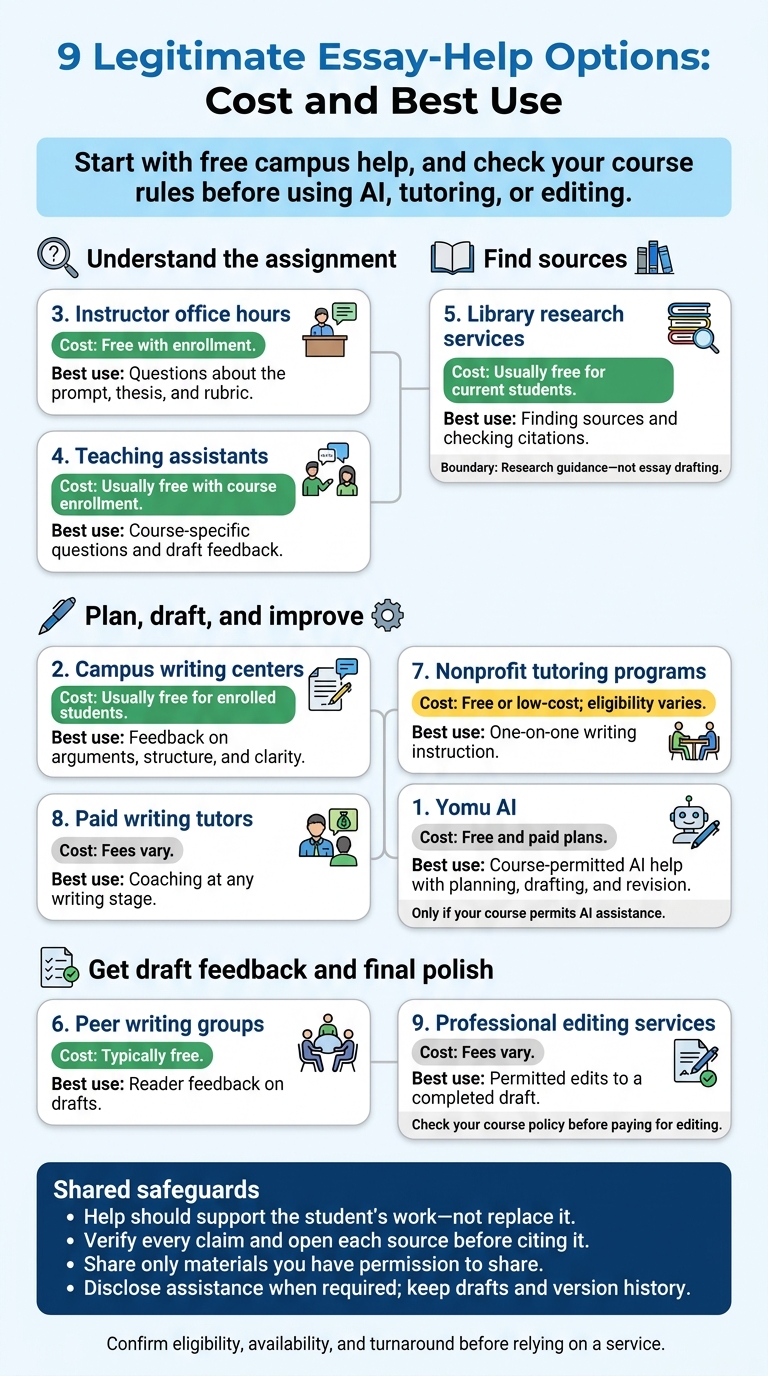
9 Legitimate Essay-Help Options: Cost and Best Use
Check Your Course Rules Before Getting Help
Before getting help, check your assignment’s rules on tutoring, collaboration, and AI writing aids. Permission to brainstorm doesn’t mean permission to rewrite. If the policy is unclear, ask your instructor.
Feedback on your argument, clarity, or grammar can help you learn when the rules allow it. Submitting work someone else wrote for you crosses the line. Rewriting borrowed text doesn’t make the analysis yours.
Disclose help when required, including assistance with outlining or polishing. Save drafts and version history so you can document your process if needed. Verify every claim and open each source before citing it.
Bring the prompt, rubric, draft, notes, and source materials. Explain whether you need help with your argument, organization, research, or sentence-level clarity. Share only materials you have permission to share. Don’t upload unpublished research, confidential data, or restricted course materials without permission.
sbb-itb-1831901
1. AI Writing Assistants: Yomu AI - Free and Paid Access Varies
Yomu AI can help with drafting and revision if your course permits AI assistance.
Cost and eligibility
Yomu AI has a free Basic plan and paid plans for more frequent use. Pro costs about $19–$21 per month, or $10–$11 per month billed annually. Check yomu.ai for current prices and usage limits.
Writing stages and support
Yomu AI’s web editor supports planning, drafting, and revision through document assistance, autocomplete, and note-to-prose conversion. Autocomplete suggests text instantly, which you can accept with the Tab key. When revising, select text to paraphrase, shorten, or summarize it.
The citation tool supports 700+ styles, including APA, MLA, and Chicago. A built-in plagiarism checker for students also flags text matches for review.
Authorship and policy boundaries
Check suggestions for accuracy, supporting evidence, and fit with your voice. Verify claims and citations against original sources, and don’t upload private or restricted materials. Use the tools to support your work - not replace it.
A plagiarism check only flags text matches; it does not prove authorship or rule compliance.
2. Campus Writing Centers - Usually Free for Enrolled Students
Cost and eligibility
Campus writing centers are usually free for currently enrolled students, with tuition and fees typically covering the cost. Check your center’s eligibility rules before you book.
Access and availability
Visit the writing center website, campus library page, or student-support portal to find appointments, drop-in hours, and online sessions. Book early: slots fill up fast during midterms and finals, and some centers limit the number of sessions you can attend.
Writing stages and support
Consultants can help you brainstorm, sharpen your thesis, build an outline, work research into your draft, check citation formatting, and revise for clarity. Bring your assignment prompt, rubric, and draft to keep the session focused.
Authorship and policy boundaries
Consultants guide you; they don’t write your essay. Ask them to point out recurring issues so you can learn to fix them yourself. You get help improving the draft while keeping the writing your own. Check your course rules before sharing your work.
For help from someone closer to your course, the next step is instructor office hours.
3. Instructor Office Hours - Free With Enrollment
Cost and eligibility
Office hours are free for enrolled students. You can speak directly with your instructor to clear up assignment expectations before you start drafting.
Access and availability
Check your syllabus or course site for meeting times, locations, and booking instructions. Confirm whether you can drop in or need an appointment.
Writing stages and support
Use the meeting to discuss the prompt’s scope, rubric criteria, your proposed thesis, or difficult passages in course readings. Bring the passage you want to discuss and your interpretation of it. Short on time? Start with your thesis and the rubric.
Authorship and policy boundaries
Expect guidance - not a completed argument. Office hours aren’t a ghostwriting service. Ask about any assignment-specific disclosure rules, and write down required disclosures or follow-up questions before you leave.
For more course-specific help between meetings, teaching assistants are your next stop.
4. Teaching Assistants - Free With Enrollment
Cost and eligibility
TA support is usually free for students enrolled in the course.
Access and turnaround
Find your TA on the course page, in the syllabus, or through the department directory. Check the syllabus for office hours and expected response times.
Writing stages and support
TAs can answer course-specific questions, help you use sources, and give feedback on drafts. Bring your assignment prompt and draft, and ask about scope, sources, your outline, and the strength of your argument. Check any claim about a source against the original text.
Authorship and policy boundaries
Your TA should guide your thinking - not write the essay or answer the assignment for you. If they also grade your essay, ask what feedback they’re allowed to give. Disclose their help if your course rules require it.
5. Library Research Services - Usually Free for Current Students
When you need sources rather than prose, turn to the library.
Cost and eligibility
Research help is usually free for current students. Check your eligibility before booking.
Access and turnaround
Stop by the reference desk for a quick question, book a research consultation for a complex topic, or get remote help through chat or email. The library’s subject-specific research guides can also direct you to relevant databases.
Check hours, appointment availability, and response times so you have enough time before your deadline.
Writing stages and support
Librarians help with database searches, source evaluation, primary sources, and citations - not essay drafting. They can help you find original datasets or historical documents and check whether a source has been retracted.
Use that support to gather evidence, then write the analysis yourself.
Authorship and policy boundaries
Before using a library tool with AI features, check your course policy. Rules and disclosure requirements vary by institution.
For peer feedback on your draft, the next option is peer writing groups.
6. Peer Writing Groups - Free
If you have a draft, peer feedback can help you spot what’s still unclear.
Peer writing groups are typically free. Connect with classmates, a writing club, or an instructor-led peer-review session. Set a deadline to exchange drafts that leaves time for revision. Access may depend on course enrollment or club membership.
Writing stages and support
Peers can help you brainstorm, test an outline, or revise a draft. Keep each review focused on one or two issues, such as thesis clarity, paragraph order, or evidence.
Authorship and policy boundaries
Before exchanging drafts, check your course rules and confirm you have permission to share the materials. Stick to comments and suggestions - not rewritten passages. Don’t share restricted prompts, private data, or other protected materials. Check any facts or citations before using them.
For more structured one-on-one support, move next to nonprofit tutoring programs.
7. Nonprofit Tutoring Programs - Free or Low-Cost
Nonprofit tutoring bridges the gap between peer review and paid tutoring, giving students guided help without high costs.
Cost and eligibility
Programs are often free or low-cost, and many offer free tutoring to enrolled students or community members.
Access and turnaround
Before counting on a program to meet a deadline, check its appointment availability and cancellation policies.
Writing stages and support
Tutors provide structured, one-on-one coaching to help you brainstorm topics, build a preliminary outline, and review drafts for grammar and clarity. Bring the assignment instructions and choose one clear goal for the session.
Authorship and policy boundaries
Check that your assignment allows third-party tutoring. A tutor should guide your thinking - not write for you. You’re responsible for the final argument and wording. Disclose the help if your course requires it.
If you want more structured one-on-one help and can pay for it, the next option is paid writing tutoring.
8. Writing Tutors - Paid
Cost and eligibility
Ask for a written quote and confirm exactly what the fee covers.
Access and turnaround
Find tutors through college-approved referrals, local education organizations, or professional associations. Before booking, check their credentials, subject expertise, availability, and cancellation or refund policies.
Writing stages and support
Paid tutoring can help with brainstorming, outlining, source use, grammar, and feedback on your argument’s strength and flow. A tutor can review your outline or draft and explain revisions - but shouldn’t rewrite your paper. Check original sources yourself before using any citation help.
Authorship and policy boundaries
Reject essay mills and anyone promising to bypass AI detectors. Agree that the tutor will provide feedback only before you share your work. Disclose their help if your instructor requires it.
If you need sentence-level polish rather than tutoring, the next option is professional editing services.
9. Professional Editing Services - Paid
Cost and eligibility
Check your course policy before paying for editing. Outside editing is appropriate only if your course allows it. Services often charge by word, page, hour, or turnaround speed. This option suits writers who have a draft and need a final polish - not help with ideas or research.
Access and turnaround
Look for providers that clearly explain their services, refund and revision terms, and delivery dates. Before uploading your essay, read the privacy policy. Make sure the provider won’t share or publish your work or use it to train AI models.
Writing stages and support
Professional editing comes in three types: proofreading fixes grammar, spelling, and punctuation; language editing improves clarity, academic tone, and flow; and developmental editing reviews structure and argument. If structure - not wording - is your main concern, developmental editing is the closest fit.
Also, ask what reference checks include. Does the service only format references, or does it check whether cited sources support your claims?
Authorship and policy boundaries
Keep editing to polish only. Don’t ask the editor to provide analysis or draft text. Save both your original draft and the edited version so you have a record of the changes. Use the service only when your draft is complete, the content is yours, and you need sentence-level revisions.
Compare All 9 Essay-Help Options
Use this comparison to find help that fits your budget, deadline, and writing stage.
| Option | Cost | Access point and eligibility | Best writing stage | Primary support | Speed / scheduling | Authorship risk* |
|---|---|---|---|---|---|---|
| 1. Yomu AI | Limited free access; paid plans | Web/app; check your course AI rules and write with integrity | Brainstorming, drafting, revision | Idea development, wording feedback, citation formatting | Instant, on demand | Low for feedback or editing; high if you submit generated work as your own |
| 2. Campus writing centers | Usually $0 for enrolled students | Campus or online; current students | Outline through revision | Coaching on argument and organization | Appointments; some drop-ins | Low for coaching |
| 3. Instructor office hours | $0 for enrolled students | Faculty office; posted office hours | Topic and thesis planning | Assignment expectations and rubric guidance | Posted office hours | Low for direct guidance |
| 4. Teaching assistants | $0 for enrolled students | Course office hours or email | Drafting and review | Help understanding requirements and answers to draft questions | Scheduled hours; email | Low for permitted guidance |
| 5. Library research services | Usually $0 for current students | Library desk, chat, or research appointment | Research and citations | Help finding sources and citing them | Walk-in, chat, or appointment | Low for research guidance |
| 6. Peer writing groups | Free | Student-led campus or online groups | Revision | Reader feedback on clarity and structure | Depends on the group | Low to moderate; follow collaboration rules |
| 7. Nonprofit tutoring programs | Free or low-cost | Community or online programs; age, location, or income limits may apply | Drafting and skill building | Writing instruction and practice | Scheduled sessions | Low for instruction |
| 8. Writing tutors | Paid, usually hourly | Private tutor or tutoring agency | Any stage | One-on-one writing coaching | By appointment | Low for coaching; high for ghostwriting |
| 9. Professional editing services | Paid, often per word or hour | Online provider | Final revision | Grammar, clarity, and flow | Scheduled turnaround | Moderate; risk increases with rewriting |
Costs, access, and turnaround vary by provider. The scheduling labels describe typical booking patterns - not guaranteed response times.
*Authorship risk depends on your course rules and how you use the help. Coaching leaves the thinking and writing with you. Submitting AI-generated text or someone else’s rewriting as your own can violate academic integrity rules.
When using AI help, check every claim against the original source before citing it.
Choose Help Based on Your Budget, Deadline, and Writing Needs
Start with the free support available through enrollment. Consider paid help only when free options don’t meet your needs.
Choose help based on the task. Ask your instructor or TA about assignment requirements, take research questions to a librarian, and visit the writing center for help with planning, drafting, or revising. You can also combine services: start with library research, then bring your notes to a writing-center session to work on your outline.
Pay for tutoring to build skills over time and editing for final polish. Before spending money, check which edits your course allows.
On a tight deadline? Check drop-ins, online appointments, and asynchronous review. Confirm the turnaround time before submitting your work, and leave enough time to make revisions yourself.
For quick, limited help, use Yomu AI only for course-permitted tasks, such as brainstorming or summarizing notes. Follow your course’s disclosure rules and save your draft history as documentation.
Conclusion: Get Help While Keeping the Work Your Own
Across these nine options, legitimate help depends on what the support does and what your course allows - not its price or the provider’s label.
Before you seek help, identify where you’re stuck: overcoming writer's block, finding evidence, or revising.
The final essay is your responsibility. Check that every source supports your claim, and explain your reasoning. When disclosure is required, report the assistance in your instructor’s required format so it’s clear how you used support.
FAQs
Where can I get free essay help if I’m not enrolled?
Even if you’re not enrolled, you can get free essay help from AI tools with free plans or limited free access. Use them for editing, basic checks, brainstorming, outlining, and research. Check each tool’s free-use limits before you begin.
Verify facts and citations yourself to make sure they’re accurate.
What should I do if my course’s essay-help rules are unclear?
Ask your instructor to clarify expectations in writing before you start your assignment. Check your syllabus and your institution’s official policies on academic integrity and AI use.
If you’re unsure whether to disclose assistance, disclose it. Keep a detailed version history of your drafts and notes. These records can help show your independent work if anyone questions your authorship.
How should I disclose essay help to my instructor?
Check your institution’s academic integrity policy to find out whether - and how - you need to acknowledge outside tools or services. Many schools require disclosure when you submit work if AI or other assistance helped with your writing. If disclosure is required, name the tools you used and explain the help you received.
Keep a version history or drafting notes to help show your authorship if your work is questioned.