
Turnitin vs GPTZero vs Copyleaks: Accuracy for Student Essays
In 2026, detecting AI-generated content in student essays is a growing challenge as 92% of students now use generative AI tools. This article compares three leading AI detection platforms - Turnitin, GPTZero, and Copyleaks - focusing on their accuracy, false positive rates, and suitability for academic use. Here's what you need to know:
- Turnitin: Trusted by universities, it integrates well with learning systems and claims 98% accuracy for essays over 300 words. However, it struggles with shorter texts and has a higher false positive rate (up to 18%) for non-native English speakers.
- GPTZero: Known for its speed and free access, it achieves 99.3% accuracy but has issues with heavily edited AI content and a higher false positive rate for ESL students.
- Copyleaks: Excels in multilingual detection with a low false positive rate (0.03%). It's highly reliable for diverse student populations and supports over 100 languages.
Quick Comparison
| Metric | Turnitin | GPTZero | Copyleaks |
|---|---|---|---|
| Accuracy | 98% (>300 words) | 99.3% | 99%+ |
| False Positive Rate | 1%–18% | 0.24%–38% | 0.03%–5% |
| Languages Supported | 30+ | 20+ | 100+ |
| Processing Speed | 15–30 sec | 8–18 sec | 10–20 sec |
| Edited AI Accuracy | ~80% | ~70% | ~85% |
Each platform has strengths and weaknesses. Turnitin is ideal for institutions with existing integrations, GPTZero offers quick and affordable options for individual educators, and Copyleaks stands out for multilingual and edited content detection. Read on for a deeper dive into their features and limitations.
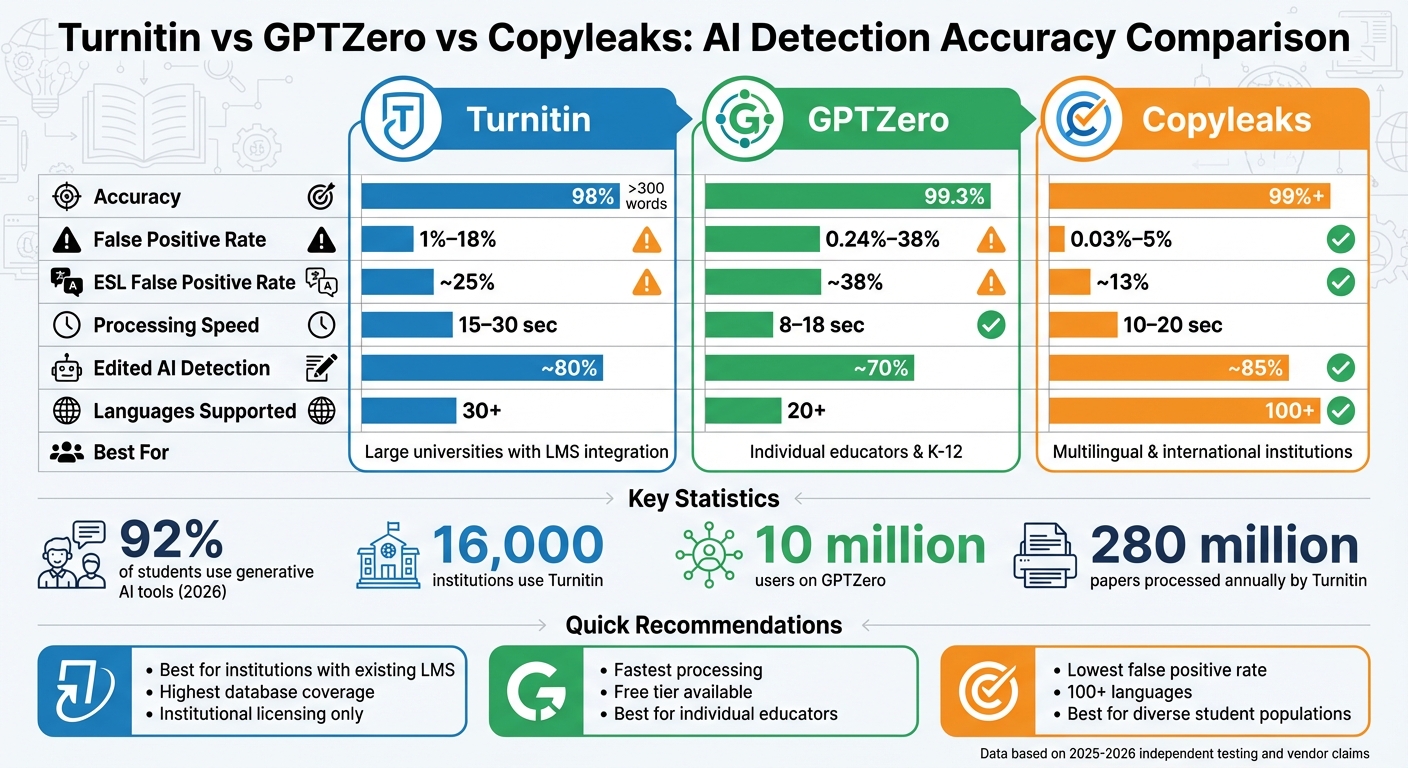
Turnitin vs GPTZero vs Copyleaks: AI Detection Accuracy Comparison 2026
I compared 6 FREE AI detectors to Turnitin New Detection Tool | Shocking Results
sbb-itb-1831901
Turnitin: Detection Accuracy and Academic Use
Turnitin has become a cornerstone for academic integrity, serving over 16,000 institutions and processing 280 million papers annually as of 2026. Its seamless integration with learning management systems allows for real-time assessments, even analyzing a student's prior submissions to detect sudden shifts in writing style.
Its plagiarism detection relies on a massive database that includes 70 billion web pages, 1.8 billion student papers, and 170 million articles. This direct source-matching system helps minimize false positives. However, when it comes to AI detection, the results are more complex. Turnitin claims 98% accuracy for documents over 300 words, but its Chief Product Officer, Annie Chechitelli, has clarified the trade-off:
"We estimate that we find about 85% of AI writing. We let probably 15% go by in order to reduce our false positives to less than 1 percent."
Independent tests in late 2025 showed a 92% detection rate for AI-generated text but only 82% accuracy for human writing, leading to an 18% false positive rate. This prompted elite universities like Vanderbilt, Yale, and Northwestern to disable the AI detection feature. At Vanderbilt, even a 1% false positive rate would incorrectly flag around 750 students out of 75,000 annual submissions. These challenges highlight the complexities of balancing accuracy and fairness in AI detection.
AI Writing Detection Feature
Turnitin's AI detection tool identifies linguistic patterns such as perplexity (how predictable word choices are) and burstiness (variations in sentence structure). It breaks documents into overlapping 250-word segments, scoring each segment from 0 (human) to 1 (AI). These scores are then aggregated into an overall percentage. The platform only displays AI scores above 20%, while scores between 1% and 19% are marked with an asterisk to avoid unreliable conclusions.
The tool performs exceptionally well with outputs from GPT-5 and Google Gemini, achieving 98–100% detection rates. However, it struggles with Claude outputs, where accuracy drops to 53–60%. To address evolving tactics, Turnitin introduced new detection layers between 2024 and 2025. The AIR-1 model, launched in July 2024, focuses on catching content rewritten with paraphrasing tools like QuillBot. An August 2025 update expanded its capabilities to detect text altered by humanizer tools. A study published in January 2025 in the Journal of Applied Learning & Teaching confirmed that Turnitin achieved a 100% detection rate even when text was edited with Grammarly, paraphrased, or manually modified by up to 20%.
Plagiarism Detection Performance
While AI detection relies on identifying patterns, Turnitin's plagiarism detection remains its strong point. Its vast archive of over 900 million student papers allows for precise source matching, providing clear evidence of copied material with minimal false positives. However, AI detection is less reliable for shorter submissions under 300 words. Turnitin also advises educators not to rely solely on its AI indicator for grading or disciplinary actions.
Known Issues and Limitations
Despite its strengths, Turnitin faces several challenges in academic settings. One major issue is bias against non-native English speakers. Research from Stanford revealed that AI detectors misclassified 61.22% of TOEFL essays by non-native speakers as AI-generated. Researcher Weixin Liang explained:
"The design of many GPT detectors inherently discriminates against non-native authors, particularly those exhibiting restricted linguistic diversity and word choice."
This bias can lead to severe consequences. In early 2024, Marley Stevens, a student at the University of North Georgia, was placed on academic probation and lost her scholarship after Turnitin mistakenly flagged her Grammarly-proofread paper as AI-generated.
Additionally, Turnitin's effectiveness declines when students significantly edit AI-generated content. While it can detect basic paraphrasing, advanced tools like TwainGPT and UndetectedGPT can reduce AI detection scores from 92% to 0%. For heavily rewritten text, detection reliability drops to 50–65%.
Finally, Turnitin's pricing model, which is restricted to institutions, makes it inaccessible to individual educators. This contributes to a disparity where access depends heavily on an institution's budget.
GPTZero: Processing Speed and AI Detection Methods
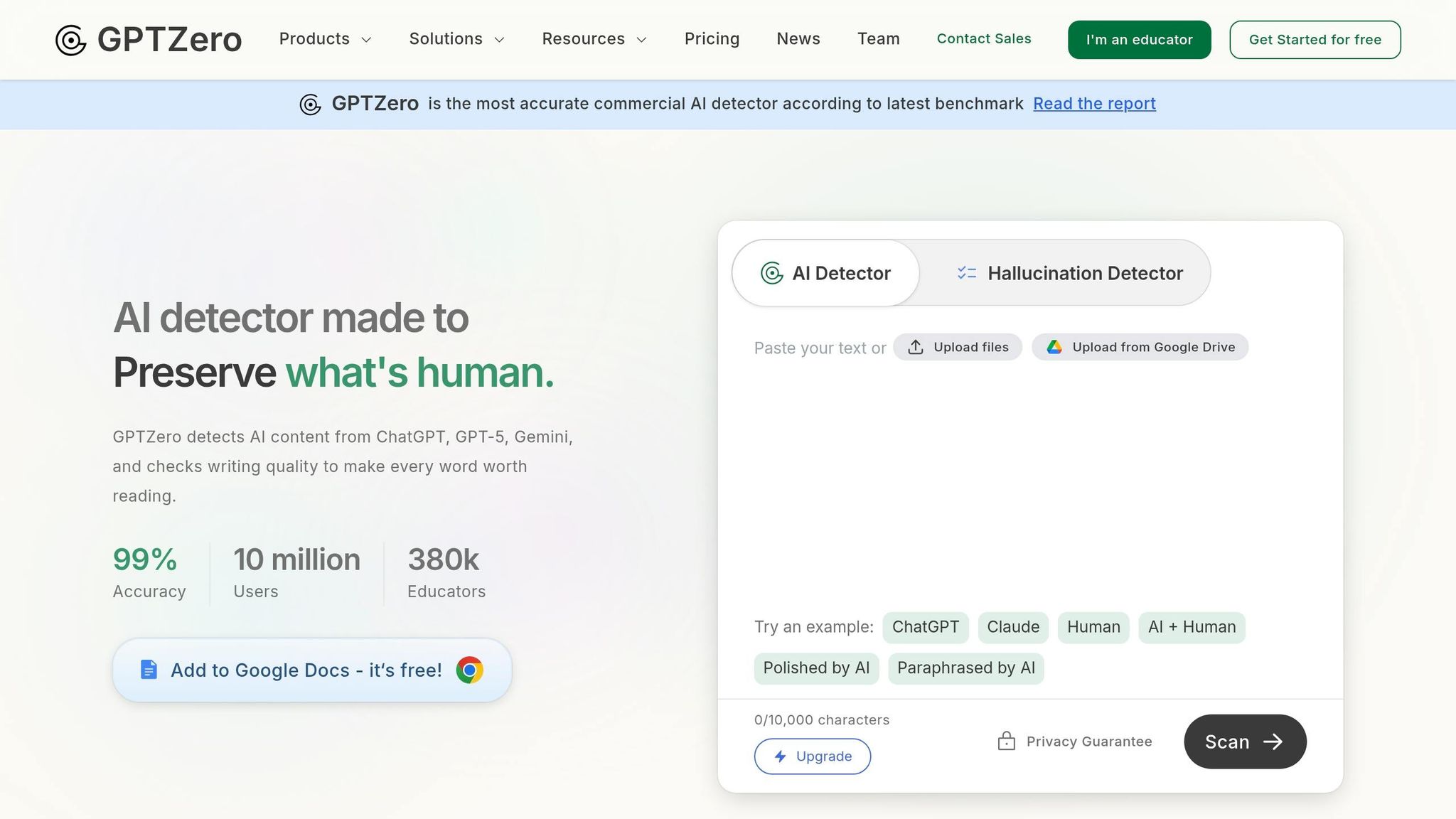
As the use of AI in academic writing grows, tools like GPTZero are playing a key role in preserving academic integrity. With the ability to process essays in just 12–18 seconds, GPTZero provides a free tier allowing up to 10,000 words per month. By 2026, it had already gained traction with 380,000 educators and 10 million users.
How Perplexity and Burstiness Work
GPTZero relies on two main metrics to detect AI-generated text: perplexity and burstiness. Perplexity measures how predictable the text is, while burstiness looks at sentence length variation. AI-generated content tends to score low on perplexity (indicating high predictability) and shows consistent burstiness, unlike human writing, which is more unpredictable and varied.
In addition to these metrics, GPTZero uses a seven-component model that includes deep learning, tone analysis, and text search to identify patterns typical of AI-generated content. In a 2026 benchmark involving 3,000 samples, GPTZero demonstrated an impressive 99.3% accuracy, outperforming Copyleaks' 90.7%. It successfully identified 100% of GPT-5-generated text and 99.0% of content from Claude Sonnet 4. Specifically for academic papers, version 4.1b of GPTZero achieved an accuracy rate of 99.85%. These results highlight its efficiency and precision in AI detection.
Fast Processing and Free Access
One of GPTZero's strengths is its speed and accessibility, making it ideal for quick classroom checks. It features an intuitive dashboard and even offers a Chrome extension for real-time text analysis. Its false positive rate is exceptionally low at just 0.24% - about 1 in 400 documents - compared to Copyleaks' 5.26%. For users needing more, paid plans start at $10–$15 per month, covering up to 150,000 words and providing full AI detection capabilities. However, its effectiveness can be challenged when the content is significantly altered.
Problems with Modified AI Content
While GPTZero excels at identifying raw AI-generated text, its performance drops when the text is heavily modified. For example, its accuracy falls to 60–80% when students paraphrase or manually edit AI content. Independent tests by Scribbr found its overall accuracy to be just 52% when dealing with modified text. A 2024 study by Perkins et al. revealed an even sharper decline, with detection rates dropping from 39.5% to 17.4% after basic adversarial modifications were applied. Additionally, GPTZero has difficulty handling biases in formal writing styles, further limiting its reliability in such cases.
Copyleaks: Language Support and Detection Accuracy
Copyleaks provides AI detection in over 30 languages and plagiarism checks and AI writing aids in more than 100, making it a practical solution for institutions with diverse student populations. In January 2025, Southern Methodist University (SMU) announced it would replace Turnitin with Copyleaks, citing its superior AI detection abilities and seamless integration with the Canvas Learning Management System.
AI Detection in Multiple Languages
Maintaining academic integrity across various linguistic backgrounds can be challenging, but Copyleaks rises to the occasion. A January 2026 study by R. Grillo and colleagues evaluated eight AI detection tools using scientific articles. Copyleaks achieved the highest mean detection score of 99.6/100. Its detection accuracy for specific languages included 95% for Swedish (with 100% specificity), 96.18% for French, and 95.63% for German texts.
"Copyleaks' AI Detector achieved 99.84% accuracy with non-native English texts, outperforming competitors with a <1.0% false positive rate." - Copyleaks Data Science Team
The platform also incorporates an anti-translation loop, which flags text that has been translated multiple times to evade detection.
Plagiarism Detection Results
Copyleaks excels in cross-language plagiarism detection, enabling document checks across different languages. A 2023 Cornell study found Copyleaks to be 99.12% accurate on human-authored data and 95.00% on ChatGPT-generated content. Further independent testing in 2025 revealed a remarkably low false positive rate of just 0.03%, outperforming GPTZero's 1–2% and Turnitin's 1–4%.
The platform uses a combination of techniques, including perplexity scoring, burstiness analysis, and linguistic fingerprinting, to deliver precise results. Researchers at Linnaeus University tested the Copyleaks API during the Spring 2024 semester and successfully identified AI-written Python and Java assignments with over 80% accuracy in programming courses.
These capabilities make Copyleaks especially valuable for educational institutions.
Use Cases for Schools and Universities
Copyleaks is a strong choice for institutions requiring comprehensive coverage across languages and content types. For example, the University of Michigan-Dearborn transitioned to Copyleaks in Fall 2024, citing lower licensing costs and a more robust feature set compared to Turnitin. The platform also supports source code detection in programming languages like Python, Java, JavaScript, and C#, making it particularly useful for computer science departments.
"Copyleaks is the most reliable AI detector for multilingual use, especially in sensitive settings like education. It was the only tool in the study to avoid false accusations of human writers... particularly in under-resourced languages like Swedish." - Adam Landberg
Copyleaks offers flexible pricing, starting at $10.99 per month for individuals, with custom enterprise plans available for institutions. A free tier provides 5 credits for initial testing. While the free version offers basic binary feedback (AI vs. Human), paid plans include detailed similarity reports that highlight specific matches and paraphrasing patterns.
With its multilingual capabilities and advanced features, Copyleaks stands out as a reliable option for schools and universities navigating the complexities of modern plagiarism and AI detection.
Side-by-Side Accuracy Comparison
Real-world testing reveals some notable differences in how these platforms perform. While all three boast accuracy rates above 98%, independent evaluations show meaningful gaps in areas like false positive rates, speed, and reliability when handling various types of content.
Performance Metrics Table
Here's a quick breakdown of the key performance metrics based on independent testing:
| Metric | Turnitin | GPTZero | Copyleaks |
|---|---|---|---|
| Claimed Accuracy | 98% (on >300 words) | 99.3% | 99%+ |
| False Positive Rate | 1%–12% | 0.24%–18% | 0.03%–5% |
| Processing Speed | 15–30 sec | 8–18 sec | 10–20 sec |
| Bypass Rate (Edited AI) | ~20% (80% accuracy) | ~30% (70% accuracy) | ~15% (85% accuracy) |
| ESL False Positive Rate | ~25% | ~38% | ~13% |
| Language Support | 30+ languages | 20+ languages | 100+ languages |
GPTZero leads in speed, completing scans in just 8–18 seconds, compared to Turnitin's 15–30 seconds. But speed isn't everything - accuracy, especially for non-native English speakers or edited AI content, can vary significantly.
Test Results Summary
The table highlights how these tools perform under different conditions, and independent tests provide further insights into their strengths and weaknesses.
Turnitin, for example, struggles with shorter texts. According to the company's Chief Product Officer, the platform is designed to detect about 85% of AI-generated content while keeping false positives under 1%. This calibration prioritizes reliability over catching every instance of AI use.
GPTZero showed impressive recall, detecting 100% of GPT-5-generated text in one test. However, it also had a 38% false positive rate for writing samples from non-native English speakers - the highest among the three tools.
Copyleaks stood out for its low false positive rate, hitting just 0.03% in certain tests. This reliability makes it a strong option for international student populations. In a December 2025 study involving 100 samples, Copyleaks maintained 85% accuracy on edited AI content, outperforming Turnitin (80%) and GPTZero (70%).
All three tools see accuracy drop to 60–80% when analyzing heavily edited AI text. This limitation has led some universities, including Vanderbilt, Yale, and Northwestern, to disable Turnitin's AI detection feature for the 2024–2025 academic year.
For institutions with diverse student populations, consistency across languages and editing styles is key. Copyleaks proves steady across various languages and writing styles. GPTZero excels at identifying text from cutting-edge AI models but has a higher risk of false positives for ESL students. Meanwhile, Turnitin remains the go-to for long-form academic papers, though its results require careful interpretation, especially when scores dip below 40%.
Conclusion: Selecting the Best Detection Tool
Turnitin is the go-to solution for large universities, particularly those already using platforms like Canvas, Blackboard, or Moodle. With a database of over 900 million student papers and seamless integration with learning management systems, it’s built to handle high submission volumes. That said, Turnitin is only available through institutional licensing, costing roughly $2.59 to $3.19 per student annually, which puts it out of reach for individual educators.
GPTZero works well for individual educators and K–12 environments. It features a free tier allowing up to 10,000 words per month, with paid plans starting at $10–$15 per month for up to 150,000 words. Its user-friendly tools, like transparent metrics and a Chrome extension for Google Docs, make it a convenient choice. However, some independent tests have flagged higher false positive rates when analyzing content from non-native English speakers.
Copyleaks stands out in multilingual and international settings. Supporting over 100 languages and boasting an impressively low 0.03% false positive rate in multilingual testing, it’s a strong option for minimizing bias against ESL students. Notably, Southern Methodist University switched from Turnitin to Copyleaks in January 2025, citing better AI detection capabilities and lower licensing costs. Similarly, the University of Michigan-Dearborn made the transition in late 2024. These shifts highlight its appeal for institutions seeking reliable and cost-effective AI detection tools in diverse educational contexts.
FAQs
Can these tools prove a student used AI?
Yes, tools like Turnitin, GPTZero, and Copyleaks can help detect AI-generated content in student work. These platforms examine essays for patterns such as linguistic style and indicators of machine-generated text. While their reliability can differ depending on the AI model and context, they are generally effective at spotting AI usage. That said, their findings should always be considered alongside other evidence and evaluated within the framework of institutional policies to maintain fairness.
How should schools handle false positives for ESL students?
Schools must handle false positives for ESL students thoughtfully, as AI tools can misidentify their essays due to language nuances. To promote fairness, educators can take several steps:
- Double-check AI results with human evaluation: Automated tools can make errors, so combining AI insights with a teacher's judgment ensures better accuracy.
- Avoid overdependence on AI tools: Decisions shouldn't rest entirely on automation. Balancing AI assistance with human expertise is key.
- Train faculty on linguistic diversity and AI's limits: Educators need to understand how language differences might affect AI scoring and learn to spot potential biases.
By adopting these practices, schools can reduce bias and create more balanced assessments for all students.
What’s the best way to check heavily edited AI text?
To spot heavily edited AI-generated text, you can rely on specialized AI detection tools that focus on analyzing patterns like perplexity and burstiness. Tools like GPTZero are great for quick checks, offering fast insights into whether text might be AI-generated. On the other hand, Turnitin works well in academic or institutional settings, though it can sometimes flag paraphrased content as AI-created.
For the best results, consider using a combination of tools. For example, start with GPTZero for an initial scan and then use Turnitin to confirm findings. This layered approach can help you better identify subtle AI edits and minimize errors.