

Sentence Rewriter Guide: How to Rewrite Sentences Without Changing the Meaning
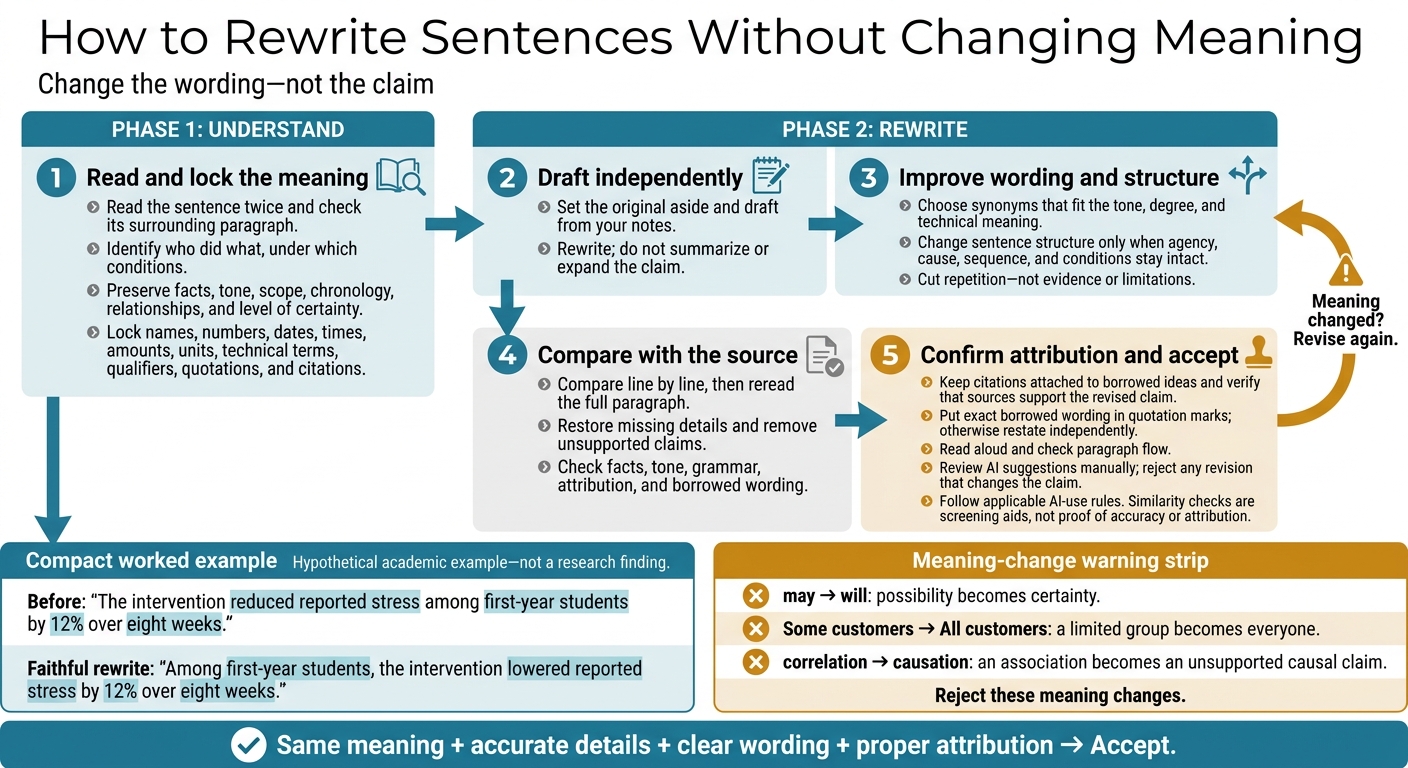
When I rewrite a sentence, I change the wording - not the claim. I keep the facts, tone, and level of certainty fixed. A reported 12% decrease must stay 12%, and may must not become will.
My process comes down to three steps:
- Understand: Identify who did what, under which conditions, and what details must stay.
- Rewrite: Change wording or sentence structure and cut repetition - not facts or limits. Keep rewriting separate from summarizing.
- Verify: Compare the result with the source, check grammar and context, and keep citations and quotation marks where needed.
I can use AI writing tools like Yomu AI to suggest edits, but <u>I check each change before accepting it</u>. A smoother sentence still needs to say the same thing and follow source-credit and AI-use rules.
How to Rewrite Sentences Without Changing Meaning
How to Paraphrase Without Plagiarizing | BC Library
sbb-itb-1831901
Rewrite a Sentence Step by Step
Once the nonnegotiables are set, rewrite with care - without changing meaning, facts, tone, or certainty.
Read the sentence twice and note its key parts before rewriting. Then set the original aside and draft from your notes. Compare the versions line by line: put back missing details and cut any claims the original doesn’t make.
Choose Synonyms That Fit the Context
Hypothetical academic example:
Before: The intervention reduced reported stress among first-year students by 12% over eight weeks.
After: Among first-year students, the intervention lowered reported stress by 12% over eight weeks.
Lowered keeps the same verb form, population, measure, percentage, duration, and study context. But a dictionary match isn’t enough. Check each replacement for tone, degree, and technical meaning.
Keep specialized terms when another word would blur a distinction. For example, don’t change reported stress to self-reported stress unless the source says who reported it.
With the words in place, adjust the sentence structure only if the relationships stay intact.
Change Sentence Structure Without Changing Relationships
You can move introductory phrases, switch between active and passive voice, or combine and split sentences. Just keep agency, emphasis, chronology, conditions, comparisons, and logic accurate.
Before: Because the server failed, the team postponed the product launch.
After: The product launch was postponed by the team because the server failed.
Both versions keep the same cause and sequence.
Meaning-changing edit: The team caused the server to fail before postponing the launch.
This edit changes the cause-and-effect relationship and assigns responsibility without support from the original.
When changing voice, check who did what. Passive wording can hide or reverse responsibility. When splitting a sentence, repeat any shared limitation in both clauses so neither claim becomes broader than the original.
Next, trim repeated wording - not evidence or scope.
Cut Repetition, Not Evidence
Hypothetical research-paper example:
Before: The findings from this study show that the intervention was effective and produced positive effects.
After: The findings indicate that the intervention was effective.
If the original includes the limitation only among participants who completed all sessions, keep it:
The findings indicate that the intervention was effective only among participants who completed all sessions.
Hypothetical small business report:
Before: In the month of June, the store experienced a decrease downward in sales revenue, which declined by 9% compared with the previous month of May.
After: In June, the store’s sales revenue declined 9% from May.
Cut month of and the repeated decrease, but keep the percentage and comparison.
Meaning-changing edit: June sales were weak.
This version drops the evidence and adds a judgment.
Check Meaning, Facts, and Academic Integrity
Once a sentence reads smoothly, check that it still says what the source says. Compare it with the full source paragraph - not just the original sentence. Check the subject, action, qualifiers, scope, chronology, emphasis, and what each pronoun refers to.
Compare Faithful Rewrites With Meaning-Changing Edits
Hypothetical comparisons: Each row shows a small change that can distort meaning.
Original sentence Faithful rewrite Meaning-changing edit Reason The update may reduce processing time. The update might shorten processing time. The update will reduce processing time. Possibility becomes certainty. Some customers reported delivery delays. Several customers said their orders arrived late. All customers experienced delivery delays. A limited group becomes everyone. The study found a correlation between exercise and mood. The study identified an association between exercise and mood. The study found that exercise improves mood. Correlation becomes causation. The report was cautiously optimistic. The report expressed guarded optimism. The report was enthusiastic and confident. The tone becomes stronger. The meeting occurred on March 4, 2025, at 2:00 p.m. The meeting took place at 2:00 p.m. on March 4, 2025. The meeting occurred on April 3, 2025, at 2:00 a.m. The date and time change; U.S. format uses month/day order and a.m./p.m.
For U.S. copy, check formatting separately from meaning:
March 4, 2025, 2:00 p.m., $1,250.50, and 72°F.
Keep the currency, value, unit, and temperature scale unchanged. Convert measurements or temperatures only when explicitly asked. If a numeric date is ambiguous, confirm its meaning before spelling it out.
Once the meaning checks out, look for borrowed phrasing that needs quotation marks or an independent rewrite.
Keep Citations and Mark Borrowed Wording
A citation doesn't fix too-close paraphrasing. Even clearer prose must credit the source and make borrowed language clear. Read the passage, set it aside, and restate the idea in your own words. Then compare your version with the source, keep the citation, and add source and page details.
Quote any wording specific to the source verbatim and include the required citation. Keep necessary technical terms, but write the surrounding explanation independently.
Use originality checks as screening aids, not proof. A low similarity score doesn't confirm accuracy or proper attribution. A high score may include material that's correctly quoted.
Review the Rewrite Before Accepting It
Read the rewrite aloud, then compare it with the source using these five questions.
| Checkpoint | Review question |
|---|---|
| Facts | Are names, figures, dates, times, amounts, units, and temperatures correct? |
| Tone | Does the rewrite preserve the intended register and level of caution? |
| Grammar | Is the sentence correct, clear, and consistent with American English conventions? |
| Attribution | Does the citation support both the wording and the strength of the claim? |
| Borrowed wording | Is borrowed wording either quoted or fully restated in independent language? |
Use the editor’s suggestion review to compare the rewrite with the source before accepting it.
Use Yomu AI to Review Sentence Rewrites
After checking your rewrite manually, use Yomu AI to compare it with the source. Yomu AI’s academic writing workspace supports sentence and paragraph revisions within a document. Its paraphrasing and editing tools can help improve wording and flow without changing the claim.
Give the tool enough context to keep the meaning intact.
Provide Context and Compare the Suggestion
Paste the sentence along with surrounding text - ideally the full paragraph and relevant source details. Ask for a rewrite, not a summary or expansion. Specify what must stay fixed: technical terms, numbers, dates, quotations, citations, and the level of certainty. Treat paraphrasing, shortening, and summarizing as separate tasks.
If a side-by-side preview is available, use it to check that the rewrite keeps the same meaning, scope, and certainty. Reject any revision that changes the claim. Then read the revised sentence in its paragraph before accepting it.
Check Sources and Paragraph Context
Read the revised paragraph as a whole. Does it still connect to the text before and after it?
Use the source library, citation tools, and bibliography tools to manage references as you revise. Open each cited source and confirm that it supports the revised claim. Treat the plagiarism checker only as a flag for review; you remain responsible for sources, attribution, and your institution’s AI-use rules.
Conclusion: Final Sentence-Rewriting Checklist
Finish with a three-part check: understand, rewrite, verify.
- Meaning: Keep the actor, action, conditions, scope, and level of certainty unchanged.
- Detail: Check names, numbers, dates, units, technical terms, and qualifiers. Keep citations attached to borrowed ideas, and put exact borrowed wording in quotation marks.
- Readability: Read the text aloud to catch awkward phrasing, repetition, unclear pronouns, and dense sentence structure. Use natural American English without changing the tone.
FAQs
How much wording should I change when paraphrasing?
Paraphrasing doesn’t require changing a set percentage of words. The goal is to express the same meaning in your own voice, using different sentence patterns and wording. Rearrange ideas where it makes sense, and choose synonyms that fit the context.
If readers can trace your rewrite back to the source line by line, it’s still too similar. Compare your finished version with the original to make sure you’ve kept the meaning intact.
What if the original sentence is ambiguous?
Before rewriting, identify how the sentence’s parts connect. Replace unclear pronouns such as “this,” “it,” or “they” with the nouns those pronouns refer to. Place modifiers next to the words they describe, or rework the sentence to make each connection clear. If a sentence makes several claims, split those claims into separate sentences as needed. Before finalizing the rewrite, compare it with the original context to confirm that the meaning hasn’t changed.
How do I disclose AI-assisted rewriting?
Start by checking your institution’s guidelines or course syllabus. AI policies vary by school and instructor. If AI-assisted editing is allowed, follow any required disclosure steps.
Whatever the policy, keep a record of how you used AI while writing. Be ready to explain your process and take responsibility for the final content as your own work.