
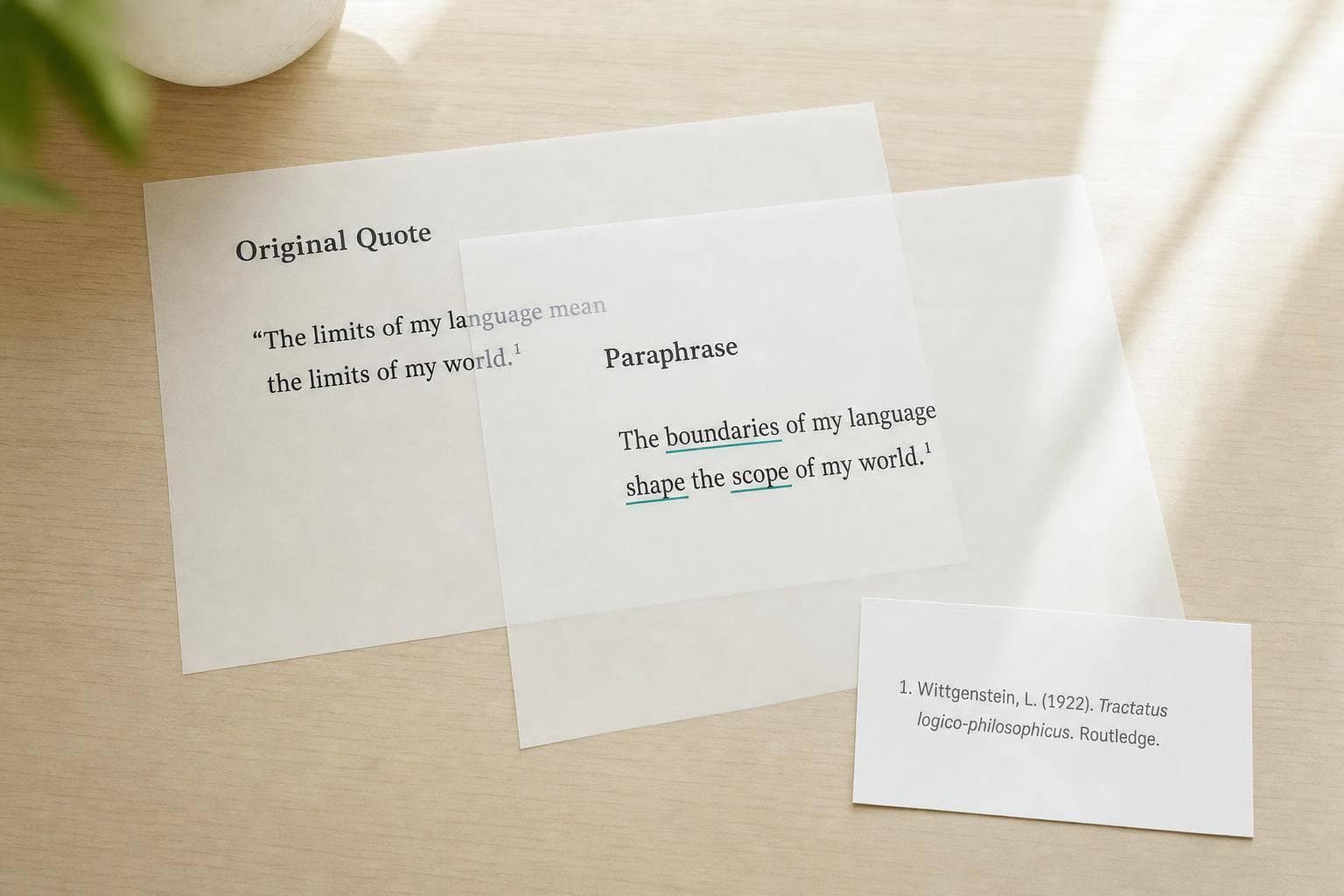
Paraphrasing Quotes: 12 Examples of Doing It Right (and Wrong)
Paraphrasing is not just changing a few words. If you keep the same sentence pattern, twist the meaning, or skip the citation, it can still count as plagiarism.
Here’s the whole point in plain English: when I paraphrase, I need to do 4 things at once:
- Keep the original meaning
- Use my own words
- Build a new sentence structure
- Credit the source
This article walks through 12 common mistakes and shows the fix for each one. It covers:
- Copying sentence structure
- Swapping words only
- Changing the author’s meaning
- Light edits of long quotes
- Leaving out the citation
- Patchwriting
- Using exact phrases without quotation marks
- Replacing technical terms the wrong way
- Removing context or limits
- Paraphrasing sentence by sentence
- Making a paraphrase too long
- Skipping the final check
A few points stand out right away:
- A citation does not fix wording that stays too close
- Some terms should stay exact, especially measured or field-specific terms
- A simple method works well: read, cover, write from memory, then compare
- Even one weak step can turn a paraphrase into plagiarism or a bad summary of the source
Bottom line: if the original writer would not agree with my version, or if a reader can match it line by line to the source, I need to rewrite it.
Quick Comparison
| Issue | What goes wrong | What I should do instead |
|---|---|---|
| Structure | I follow the same sentence shape | Rebuild the sentence from scratch |
| Wording | I swap in synonyms only | Restate the idea in new phrasing |
| Meaning | I make the claim stronger, weaker, or broader | Keep the same scope and point |
| Attribution | I leave out the source | Add in-text citation and clear credit |
If I use this checklist while drafting, I can paraphrase with less risk and write source-based work more cleanly.
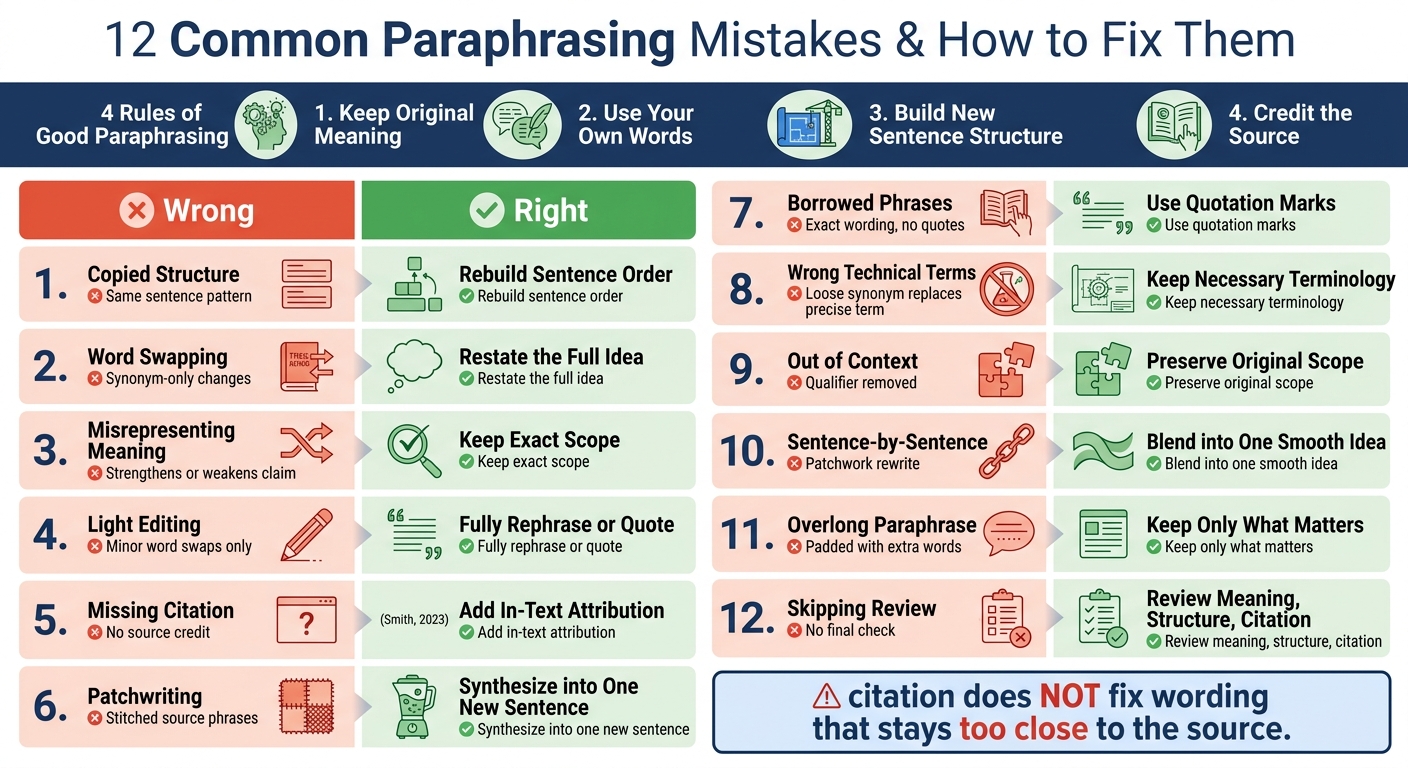
12 Paraphrasing Mistakes: Wrong vs. Right Examples
PARAPHRASING: The Basic Steps, Tips, & Tricks
sbb-itb-1831901
What Makes a Paraphrase Acceptable in U.S. Academic Writing
Before we get to the examples, it helps to lock in the four basics of a strong paraphrase: original wording, a new sentence structure, accurate meaning, and clear attribution.
Here’s the part many students miss: a citation does not fix wording or structure that stays too close to the source.
Some terms should stay as they are. For example, cognitive load or confirmation bias may need to remain in place if changing them would make the meaning less exact. With that starting point, the side-by-side examples are much easier to read.
A simple way to do this: read the source, set it aside, and rewrite the idea from memory. After that, compare your version with the original and fix any structure that still feels too close. The examples below show how these rules play out in practice.
1. Copying Sentence Structure vs. Creating Original Structure
This is one of the easiest mistakes to make. The words may look different, but the sentence still moves in almost the exact same way.
That’s the core problem: changing vocabulary isn’t enough if the structure stays too close to the source. A paraphrase can seem new on the surface while still echoing the original underneath.
Here’s a side-by-side example:
| Text | |
|---|---|
| Original | "Urban green space exposure is associated with lower self-reported depression scores in adults aged 18–65." (Smith, 2022) |
| ❌ Wrong | Exposure to urban green spaces is linked to lower depression scores in adults 18 to 65. (Smith, 2022) |
| ✅ Right | Access to parks and green areas in cities correlates with reduced depression symptoms among working-age adults (Smith, 2022). |
The wrong version mostly swaps terms. The right version does more work. It rebuilds the sentence instead of tracing over it.
A good check is simple: does your paraphrase keep the idea without keeping the original sentence shape? In the stronger version, both the phrasing and the clause order shift, while Smith’s finding stays the same.
2. Word Swapping and Thesaurus Abuse vs. Deep Understanding
Swapping in synonyms is not paraphrasing. The sentence may look different at a glance, but it still follows the source's same wording pattern with only surface-level changes. If Section 1 showed why sentence structure matters, this example shows why simple word replacement falls short.
The point isn't just using different words. It's using different phrasing.
| Text | |
|---|---|
| Original | "Students who engage in regular physical exercise demonstrate improved cognitive function, better memory retention, and enhanced problem-solving abilities compared to their sedentary peers." (Martinez, 2023) |
| ❌ Wrong | Students who participate in regular physical activity show better cognitive function, improved memory, and enhanced problem-solving skills compared to students who don't exercise. |
| ✅ Right | Martinez found that regular exercise improves cognitive function, memory, and problem-solving in students compared to their inactive peers (Martinez, 2023). |
The wrong version mostly swaps words while keeping the source's pattern in place.
The right version changes the grammatical subject and rebuilds the sentence, while still keeping Martinez's claim intact without making it stronger or weaker. In plain English, it keeps the meaning the same without drifting into a new interpretation.
A good habit is simple: read the source, cover it, then write the idea from memory before checking it against the original.
3. Misrepresenting Meaning vs. Preserving the Author's Intent
A paraphrase can still fail even when the wording is different. The problem shows up when the sentence sounds new, but the meaning drifts away from what the source actually said.
Here’s what that looks like in practice:
| Text | |
|---|---|
| Original | "Urban green space exposure is associated with lower self-reported depression scores in adults aged 18–65." (Smith, 2022) |
| ❌ Wrong | Parks cure depression in adults. |
| ✅ Right | Access to urban green space is associated with lower self-reported depression scores among adults ages 18–65 (Smith, 2022). |
The wrong version changes the finding in a few ways. It drops the age range, turns an association into a cure, and swaps a specific measured outcome for a broad claim Smith never made. That’s the trap: the wording may look different, but the idea is no longer the same.
The right version keeps the source’s claim, scope, and measured outcome in place while putting the sentence into new words.
A simple self-check helps here: would the original author still recognize the claim?
"Never strengthen, weaken, or twist a source's claim to fit your thesis." - Daniel Felix, Author
Citation and attribution included
The wrong version has another problem: it leaves out the citation. Even if every word is changed, the idea still belongs to Smith. Leave out the source, and it’s plagiarism no matter how new the phrasing seems.
4. Lightly Editing a Long Quote vs. Paraphrasing It Fully
Lightly editing a long passage is not paraphrasing. It keeps the source’s structure, order, and flow. With longer passages, the rule stays the same: change the structure, not just the words.
Here’s a side-by-side comparison:
| Text | |
|---|---|
| Original | "Regular physical activity in adolescents is linked to improved academic performance, better sleep quality, and reduced symptoms of anxiety. Schools that incorporated structured exercise programs reported a 23% improvement in student focus during classroom instruction." (Johnson, 2021) |
| ❌ Wrong | Consistent physical activity in teenagers is connected to better academic results, improved sleep, and lower anxiety symptoms. Schools that included organized exercise programs saw a 23% increase in student concentration during class. (Johnson, 2021) |
| ✅ Right | According to Johnson (2021), adolescents who exercise regularly tend to do better academically, sleep better, and report fewer anxiety symptoms. Schools that added structured exercise saw student focus rise 23%. |
The wrong version is just a synonym swap. The frame of the original sentence stays in place. “Regular” turns into “consistent,” “linked to” turns into “connected to,” and “reduced symptoms” turns into “lower symptoms.” But the basic sentence pattern doesn’t move. A reader could still match your draft to the source almost line by line.
The structure changes, not just the wording.
The right version does something different. It starts with a signal phrase - “According to Johnson” - then reshapes the list of benefits into a smoother clause. It also turns the school data into a follow-up point instead of copying the same two-sentence pattern.
A simple way to do this is the Cover and Write method: read the passage, hide the source, and write the idea from memory before checking your draft against the original.
That approach helps you keep the meaning while building a new sentence from scratch.
5. Paraphrasing Without Citation vs. Clear Attribution
Even a strong paraphrase falls apart if you leave out the source. You can rewrite a sentence well and still end up with plagiarism when there’s no attribution.
Here’s a simple example from a study by Martinez (2023):
| Text | |
|---|---|
| Original | "Students who engage in regular physical exercise demonstrate improved cognitive function, better memory retention, and enhanced problem-solving abilities compared to their sedentary peers." (Martinez, 2023, p. 78) |
| ❌ Wrong | Students who participate in regular physical activity show better cognitive function, improved memory, and stronger problem-solving skills compared to students who don't exercise. |
| ✅ Right | According to Martinez (2023), students who engage in regular physical activity demonstrate improved cognitive function, better memory retention, and stronger problem-solving abilities compared with their sedentary peers (p. 78). |
The wrong version is rewritten well enough on the surface. That’s not the problem. The problem is that it gives no credit to the source. A reader can’t check the claim or trace it back to Martinez.
The right version does three things at once: it keeps Martinez’s meaning, uses new wording, and credits the source clearly. The claim stays the same, but the attribution is now visible. It starts with a signal phrase - "According to Martinez (2023)" - and ends with the page number - "(p. 78)." Those two parts matter. Leave them out, and the paraphrase is still missing something.
The next example shows the gray area between a full paraphrase and patchwriting.
6. Patchwriting vs. Genuine Paraphrasing
Patchwriting is a kind of plagiarism where someone lifts pieces of a source and swaps in a few new words. On the surface, it can look like paraphrasing. But the source’s sentence pattern and logic are still doing most of the work. And here’s the key point: even if the source is cited, it can still be patchwriting.
So the issue isn’t just whether you named the source. It’s whether too much of the source’s wording and structure stayed in place.
| Text | |
|---|---|
| Original | "Students who engage in regular physical exercise demonstrate improved cognitive function, better memory retention, and enhanced problem-solving abilities..." (Martinez, 2023, p. 78) |
| ❌ Wrong (Patchwriting) | Students who engage in physical exercise demonstrate better cognitive function, stronger memory retention, and improved problem-solving abilities. Those who exercise regularly outperform students who remain sedentary (Martinez, 2023, p. 78). |
| ✅ Right (Genuine Paraphrase) | Research suggests that physical activity supports better learning outcomes. According to Martinez, active students show stronger memory and problem-solving skills than less active students (2023, p. 78). |
The right version works because it rebuilds the idea from scratch. It keeps the meaning, but the phrasing and flow are new. That’s the difference.
As Daniel Felix puts it:
"If a reader could match your sentence to the source line by line, it is too close."
The wrong version copies the source’s wording pattern and spreads it across two sentences. That can make the borrowing less obvious at a glance, but it doesn’t fix the problem. A proper paraphrase should sound like you wrote it on your own, not like you took the source apart and stitched it back together.
The next mistake is using source phrases that require quotation marks.
7. Using Borrowed Phrases Without Quotation Marks vs. Marking Them Correctly
A paraphrase can still go wrong when it keeps exact wording from the source, even if the rest of the sentence has been rewritten. That’s the key point here. You can change the structure, swap in new wording, and still have a problem if a copied phrase stays in the sentence without quotation marks.
This isn’t only about giving source credit. It’s also about showing readers which words are yours and which words came straight from the source. That matters even more when the borrowed wording is a technical term, a definition, or an exact metric that shouldn’t be changed.
"Distinctive phrases, definitions, or memorable wording should stay in quotation marks with a citation. Not everything should be paraphrased."
Here’s what that looks like in practice:
| Text | |
|---|---|
| Original | "Urban green space exposure is associated with lower self-reported depression scores in adults aged 18–65." (Smith, 2022) |
| ❌ Wrong | Urban green space exposure is linked to lower self-reported depression scores in adults aged 18–65 (Smith, 2022). |
| ✅ Right | Access to parks and city greenery correlates with a decrease in "self-reported depression scores" among adults (Smith, 2022). |
The right version keeps the main claim the same, but it clearly marks the exact phrase that stays unchanged. That’s the difference. A citation by itself does not fix borrowed wording that appears without quotation marks.
When exact wording needs to stay as-is, put it in quotation marks. The next mistake shows what happens when writers push synonyms onto technical terms that should stay exact.
8. Replacing Technical Terms Incorrectly vs. Keeping Necessary Terminology
Technical terms need a careful touch. You can't swap them out for loose synonyms and expect the meaning to stay the same. When a writer replaces a precise term or measured concept with casual wording, the paraphrase doesn't just sound off - it changes the claim.
Here’s a simple example of what that looks like in practice:
| Text | |
|---|---|
| Original | "Urban green space exposure is associated with lower self-reported depression scores in adults aged 18–65." (Smith, 2022) |
| ❌ Wrong | Being around parks and trees makes adults feel less sad. |
| ✅ Right | Access to parks and green areas in cities correlates with reduced depression symptoms among working-age adults (Smith, 2022). |
The right version keeps the measured idea in place. And that matters most when the source uses a clinical metric or a field-specific term.
The wrong version drifts in two ways. It turns "urban green space" into "parks and trees," which is much less precise. It also replaces "self-reported depression scores" with "sad," which shifts a clinical measure into an everyday emotion. That's not just casual wording. It's a different statement.
The right version does the opposite. It keeps the measured claim, changes the sentence structure, and leaves the key terminology in place where exact wording matters.
A simple test can help: after you paraphrase, ask yourself whether the original author would still agree with your version. If your word choice blurs the meaning, keep the original term.
9. Paraphrasing Out of Context vs. Respecting the Original Context
Paraphrasing falls apart when it keeps some of the wording but drops the limits around the idea. That’s the main issue here. It’s not just about swapping words. It’s about keeping the conditions that shape the claim.
Here’s what that looks like:
| Text | |
|---|---|
| Original | The effect depends on how people use the platforms. |
| ❌ Wrong | The effect applies the same way in every case. |
| ✅ Right | The effect varies based on how people use the platforms. |
The wrong version removes the condition that narrows the claim and turns a qualified point into a universal one. The right version keeps the scope in place, uses new language, and stays faithful to the source.
As Daniel Felix puts it:
"Never strengthen, weaken, or twist a source's claim to fit your thesis. After paraphrasing, ask: Would the original author agree this is what they said?" - Daniel Felix, Author
A citation doesn’t repair a misreading - it only ties a source’s name to a claim they didn’t make. And the reverse is just as true: citing a source does not make a distorted paraphrase okay.
Read the full passage before you paraphrase. A single sentence, pulled on its own, can hide the qualifier that gives the claim its shape. That problem gets worse when you paraphrase several sentences at once.
10. Stringing Together Multi-Sentence Paraphrases vs. Integrating Them Smoothly
When a source spans several sentences, paraphrase the full passage as one idea instead of rewriting it sentence by sentence. If you handle each line on its own, you usually end up with a patchwork version. The meaning stays the same, but the writing feels stiff and disconnected.
Here’s the difference side by side:
| Text | |
|---|---|
| Original | People rely on mental shortcuts to make decisions. These shortcuts save time but can lead to errors. Awareness of these biases helps people make better choices. |
| ❌ Wrong | Individuals depend on cognitive shortcuts for decision-making. These shortcuts conserve time but may cause mistakes. Knowing about these biases assists people in choosing better. |
| ✅ Right | While mental shortcuts allow people to make faster decisions, they also introduce predictable errors in judgment. Recognizing those patterns makes it easier to correct them. |
The wrong version sticks too closely to the source. It swaps in near-synonyms, but it keeps the same sentence-by-sentence rhythm and the same order of ideas. That’s why it still sounds like the original with a light costume change.
The right version does something different. It keeps all three ideas, but it blends them into a smoother thought with a new sentence shape. It also shifts the order a bit and uses new wording, while still giving credit to the source.
A simple way to do this: read the passage, look away, and rewrite it from memory. Then compare your version with the source to spot any copied structure. Put the attribution after the paraphrase so readers can trace where the ideas came from.
Once you’ve changed the structure, make one more pass and check that the paraphrase is still concise.
11. Writing an Overlong Paraphrase vs. Paraphrasing for Concision
A paraphrase can sound smooth and still miss the mark if it gets bloated. A paraphrase should stay lean. A summary should be even shorter. When extra words creep in, they often cover up a simple problem: the writer is still leaning too hard on the source.
Here’s a side-by-side comparison:
| Text | |
|---|---|
| Original | "The rise of artificial intelligence in education presents both opportunities and challenges." |
| ❌ Wrong | The increasing and rapid emergence of artificial intelligence-based technologies within the field of educational learning environments brings with it a wide variety of potential positive opportunities as well as a number of significant and difficult challenges that must be addressed. |
| ✅ Right | AI in education opens new possibilities but also raises real concerns that educators must navigate (Johnson). |
The wrong version almost triples the length and says nothing new. It’s just synonym padding. The sentence gets longer, but not better.
The right version keeps the same two-part idea - opportunity and challenge - without warping the meaning. It also changes the sentence structure and uses new wording from start to finish. That’s the test. Does the shorter version keep both claims? If yes, the paraphrase works. And yes, the citation stays with the paraphrase.
A final review can catch padding before it sneaks into your draft.
12. Skipping Review vs. Checking Paraphrases With Tools and a Checklist
A final check before you submit can catch changed meaning and missing citations that might slip by. This step helps you spot the same issues shown in the examples above.
Here’s how that looks in practice:
| Text | |
|---|---|
| Original | "Students who engage in hands-on learning demonstrate 40% better retention rates than those in traditional lecture-based classes." - Martinez, Researcher |
| ❌ Wrong | Students who participate in hands-on learning show 40% better retention than those in lecture-based classes. |
| ✅ Right | According to Martinez, hands-on learning leads to about 40% higher retention than lecture classes. |
The wrong version changes only a few words, but it stays far too close to the source. The right version does more than swap terms. It checks the source, then makes sure four things are in place.
- Meaning preserved: Would the original author agree that this paraphrase reflects what they said?
- Sentence structure transformed: A good paraphrase changes the sentence pattern, not just the words.
- Wording substantially original: Write from memory first, then compare your draft with the source to catch phrasing that’s too close.
- Citation and attribution included: Make sure the source appears in the paraphrase and in the reference list.
If even one of these checks falls short, revise the paraphrase before moving on to the quick reference table.
Quick Reference Table: Why Each Wrong Example Fails
Use this table as a final check before you turn anything in. Each row lines up with one of the 12 examples above, so you can scan your draft and catch the same problems before they slip through.
| Example | Main Problem | Why It Risks Plagiarism or Inaccuracy | What the Correct Version Does Better |
|---|---|---|---|
| 1. Copied Structure | Copied sentence structure | Follows the source's sentence pattern too closely | Changes the sentence order |
| 2. Word Swapping | Synonym swapping | Uses the source's structure with only a few word changes | Rewrites based on the idea, not the phrasing |
| 3. Misrepresenting Meaning | Changed meaning | Turns the source into a claim it didn't make | Stays faithful to the original meaning |
| 4. Lightly Editing | Too-close wording | Minor edits still leave the source too close | Rephrases fully or quotes the exact words |
| 5. Missing Citation | Unattributed idea | Uses someone else's idea without giving credit | Adds clear in-text attribution |
| 6. Patchwriting | Patchwriting | Pulls source phrasing across several sentences | Combines the idea into a new sentence |
| 7. Borrowed Phrases | Too-close wording | Keeps exact source wording without quotation marks | Puts exact wording in quotation marks |
| 8. Technical Terms | Changed meaning | Replaces precise terms with loose substitutes | Keeps the needed technical terms |
| 9. Out of Context | Changed meaning | Leaves out the qualifier that limits the claim | Keeps the source's scope intact |
| 10. Stringing Paraphrases | Copied structure | Rewrites sentence by sentence without synthesis | Blends sources into one smooth claim by naming the source, citing it, and then explaining the point |
| 11. Overlong Paraphrase | Padding | Adds extra words without adding meaning | Keeps only what matters |
| 12. Skipping Review | Missing citation or changed meaning | Lets mistakes stay in the draft | Reviews for accuracy before submission |
Use this checklist to find weak paraphrases, then apply the tools in the next section.
Tools That Can Help You Revise Paraphrases Responsibly
After you check a paraphrase against the checklist, tools can help with cleanup. Daniel Felix says it well:
"AI paraphrasers can speed up clarity work if you treat them as assistants, not authors."
That rule matters. Read first. Then use the tool.
For this article, the main point is revision after you’ve already written the idea in your own draft. Use writing tools to work on text you already understand: paraphrase it, summarize it, format citations, and check for close matches. Yomu AI supports this kind of workflow with paraphrasing, summarization, citation formatting, editor support, and plagiarism checks for close matches.
That can save time during structural revision. But there’s a catch: it only works if you already understand the source. Think of it like sanding wood after you’ve built the table. The tool can smooth rough spots, but it can’t do the thinking for you.
The writer still has to decide when a technical term needs to stay exact. The same call applies to the examples in the quick reference table below.
Use these tools only after the checklist above. The table below shows the same mistakes in a faster reference format.
Conclusion
A paraphrase belongs in academic writing only if it does four things at once: it keeps the original meaning, uses your own wording, changes the sentence structure, and gives credit to the source. If even one part slips, the paraphrase no longer meets academic integrity standards. The 12 examples above make that plain by showing exactly what can go wrong when one part falls apart.
Use those 12 examples as a last review for patchwriting, meaning drift, and missing attribution.
Write the idea again from memory. Then compare your version with the source and fix any problems with structure, meaning, or citation.
Paraphrasing gets better with practice. Keep these examples nearby as a revision guide and use them each time you revise a source-based sentence.
FAQs
When should I quote instead of paraphrase?
Use a quote when the original wording is especially distinctive, memorable, or precise. That often applies to a formal definition, legal language, or technical wording where every word matters.
Paraphrase when you can restate the idea accurately in your own words. But if the author’s exact voice or terminology is part of the point, put it in quotation marks and include a citation.
How different does a paraphrase need to be to avoid plagiarism?
There’s no fixed percentage that makes a paraphrase acceptable. The main idea is simple: to avoid plagiarism, you need to use your own sentence structure and word choice, not phrasing someone can trace line by line back to the source.
Swapping out a few words won’t cut it. You also need to reorganize the ideas, vary your sentence length, and shift the order of points where it makes sense. Even then, you should still include an in-text citation when the ideas came from that source.
Do I need page numbers when I paraphrase?
Yes. Adding page numbers when you paraphrase helps protect academic integrity, gives exact credit, and shows readers where the idea came from.
You should still check your citation style guide, because rules can vary. But in many cases, page numbers are a smart way to make attribution more exact.