

How to Write a Literature Review Conclusion (With Examples)
A literature review conclusion should do 4 things: restate the focus, synthesize the main patterns, point out gaps, and say what research should come next.
If your conclusion only repeats source summaries, it will feel weak. A strong ending shows that you understand the field as a whole, not just each study on its own. It should also make clear where the research is thin, mixed, or missing.
Here’s the short version:
- Restate the main topic or research question
- Synthesize the main themes, patterns, or debates
- Point out limits in the research, such as small samples or short study periods
- End with clear next steps, not just “more research is needed”
One key difference matters: a general paper conclusion wraps up your argument, while a literature review conclusion wraps up the field’s current state and shows what still needs work.
A simple way I’d write it is this: What does the research show overall? Where does it fall short? What should happen next?
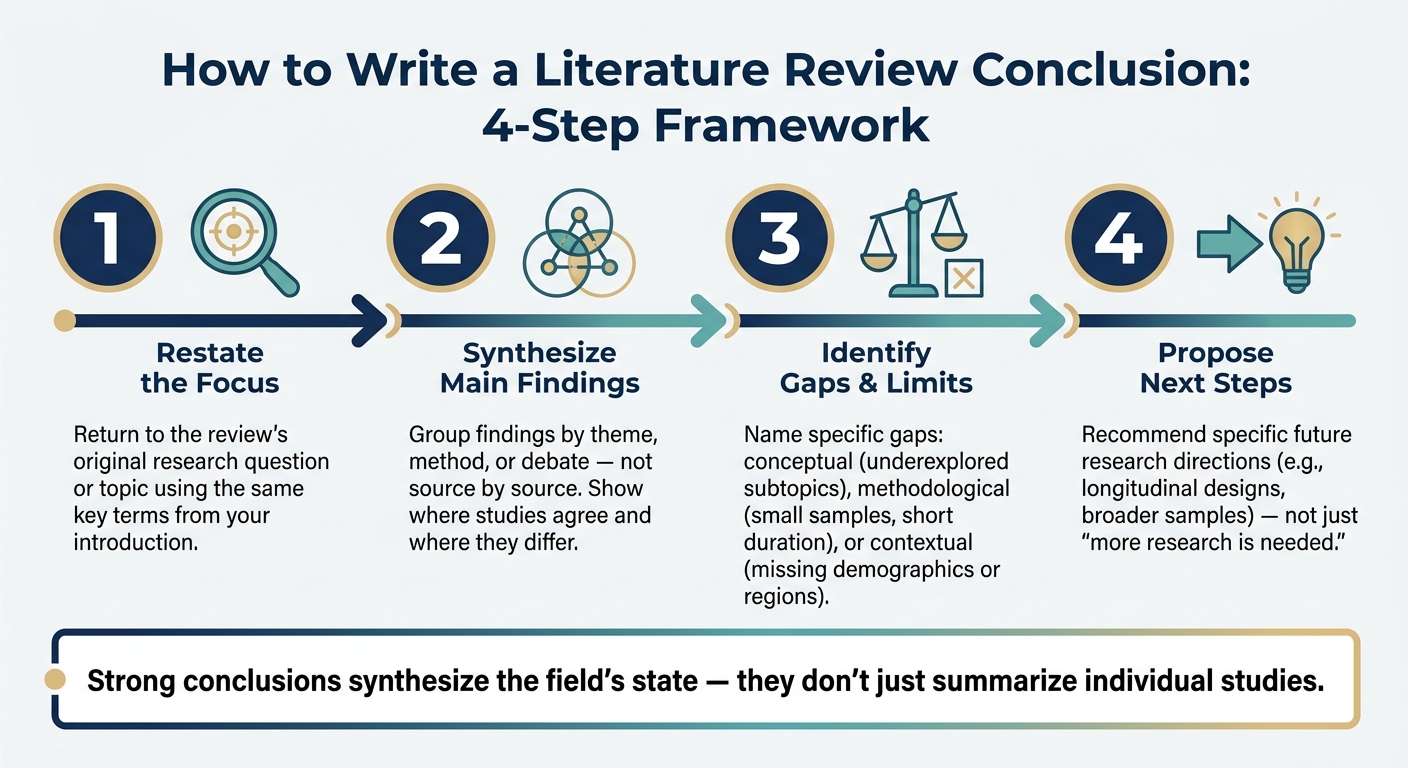
How to Write a Literature Review Conclusion: 4-Step Framework
Structuring a literature review: Conclusion
sbb-itb-1831901
Quick comparison
| Part | General paper conclusion | Literature review conclusion |
|---|---|---|
| Main focus | Your thesis | The state of the research |
| Main job | Sum up your argument | Pull studies together and show gaps |
| Final move | Close the discussion | Point to the next research question |
I’d use a simple 4-step flow:
- Restate the review’s focus
- Synthesize the main findings by theme, not source-by-source
- Evaluate limits, gaps, and mixed results
- Suggest specific next steps for future studies
The article also shows sample conclusions, common mistakes to avoid, and a short editing checklist so your ending feels clear, focused, and complete.
Core Elements of an Effective Literature Review Conclusion
A strong conclusion brings the review back to its main focus, pulls the literature together, and points out what still isn't settled. The next three subsections show what that looks like in practice.
Restate the Central Focus and Synthesize the Main Findings
Start by restating the review's main question or focus based on what the literature shows. Then pull the findings together by theme, method, or debate, instead of walking through each source all over again.
Synthesis is about showing how studies connect. Where do they line up, and where do they split? Good synthesis points to recurring themes, trends, and key arguments across multiple publications, rather than turning the conclusion into another source-by-source summary. Think of it as mapping the field by theme, not by individual paper.
That synthesis sets up the next step: spotting the gaps.
Highlight Gaps, Limitations, and Unresolved Debates
After you've pulled the main findings together, show where the literature falls short. Name the type of gap clearly: conceptual, methodological, or contextual.
| Gap Type | What to Look For | Example |
|---|---|---|
| Conceptual | Sub-topics that are underexplored compared to the broader area | Mindfulness for specific anxiety types vs. general stress |
| Methodological | Issues with sample size, study duration, or inconsistent tools | Short-term interventions with no longitudinal follow-up |
| Contextual | Missing geographic, cultural, or demographic coverage | Leadership research focused almost entirely on Western organizations |
These gaps show why the review matters and what it leaves open for the next study.
Use measured academic language here. Phrases like "the literature has not addressed" or "findings remain inconsistent across" show critical thinking without pushing the claim too far. Keep the language precise and controlled.
End with Future Research Directions and a Clear Final Takeaway
Once the gap is clear, show how the field can move forward. End by naming specific next steps and the review's importance. Instead of writing "more research is needed," say what kind. For example: "Future studies should use longitudinal designs, broader samples, or different frameworks." That kind of detail shows you know the field well enough to see what it's missing.
For a thesis or dissertation, tie those next steps back to your study's purpose.
The next section turns these ideas into a step-by-step process.
How to Write a Literature Review Conclusion Step by Step
Knowing what should go into a conclusion is one thing. Writing it on the page is where many people get stuck. These three steps give you a clear process to follow, whether you're starting from a blank page or cleaning up a draft you already have.
Step 1: Revisit Your Outline and Main Argument
Before you write anything, go back to your introduction and review structure. Check your original research question, your inclusion criteria, and the themes that shaped the body of the review. Your conclusion should return to those same terms and ideas, not bring in new ones.
If your review body was built around three themes, carry those same three threads into the conclusion. That way, the ending lines up with the rest of the paper instead of feeling tacked on. With those threads in front of you, draft the conclusion in the same order as the main themes in the review.
Step 2: Draft Using a Restate-Synthesize-Evaluate-Suggest Structure
A simple four-part pattern can make this much easier:
- Restate the review's central focus.
- Synthesize the main patterns across the literature, including where studies agree, where they differ, and what those patterns say about the field.
- Evaluate the state of the research by pointing out specific gaps or limits in method.
- Suggest clear next steps, such as longitudinal studies or localized solutions for specific communities.
The key move here is synthesis. Don't just repeat study findings one by one. Show how the studies connect, overlap, and differ. Once you have a draft that follows this pattern, tighten the wording in your final pass.
Step 3: Revise for Academic Tone, Flow, and Concision
After the draft is written, read it again with a critical eye. Cut anything that simply repeats a point already covered in the body. The conclusion should close the discussion, not open up new ground.
Use the same key terms from the introduction. That steady wording helps the review feel unified.
Also, check every source claim by hand. Fabricated or distorted citations can weaken an otherwise strong conclusion.
Next, compare your draft with the examples below.
Examples and Common Mistakes
Example Literature Review Conclusions You Can Adapt
Examples make the structure easier to see than explanation on its own. The ones below show what that structure looks like in finished writing. Each follows the same four-part pattern.
Thematic review (e.g., mindfulness in K–12 education):
"This review examined mindfulness-based interventions in K–12 settings across three themes: outcomes, implementation, and context. Overall, the literature suggests that program design and measurement choices shape the conclusions researchers can draw. However, the evidence base is limited by short follow-up periods and narrow samples, which weakens the strength of the evidence. Future research should use longitudinal designs and more diverse school settings."
Review with conflicting findings (e.g., social media and adolescent mental health):
"The literature on social media use and adolescent mental health is difficult to synthesize because studies define and measure use in different ways. As a result, the findings do not always point in the same direction, and the field remains divided by methodological choices. A consistent framework for distinguishing types of engagement would make the evidence easier to compare and interpret."
Review leading into an original study (e.g., food insecurity and academic performance):
"Existing research establishes a relationship between food insecurity and academic performance, but the literature still leaves key questions unresolved. In particular, the mechanisms linking the two and the contexts in which the relationship is strongest remain underexplored. Future studies should examine a broader range of settings and populations to clarify how this relationship operates."
Each example does a few things well. It points to a clear gap, avoids adding new sources, and ends with a direct next step. Just as important, each one shows synthesis, names what the literature still misses, and points ahead to future research. That’s the job of a good conclusion. To use this structure for your own topic, swap in your themes, populations, and method-related notes.
Weak vs. Strong Conclusion Choices
Weak conclusions tend to fall apart in a few familiar ways. The table below shows the most common differences side by side.
| Feature | Weak Conclusion | Strong Conclusion |
|---|---|---|
| Approach | Summarizes sources one by one | Synthesizes sources into overarching themes |
| Gap identification | Vague ("more research is needed") | Specific ("lack of longitudinal data on patient outcomes") |
| Criticality | Descriptive and accepting of all findings | Evaluative; identifies methodological flaws or biases |
| Ending | Ends abruptly after the last summary | Provides a clear transition to future research or the current study |
| Source accuracy | Potential for misattributed or fabricated citations | Rigorously verified and credible academic sources |
Use this comparison to cut vague or repetitive wording from your draft. If your ending sounds like a string of mini summaries, that’s usually a sign the conclusion needs more synthesis.
Mistakes That Make a Conclusion Feel Incomplete
The most common issue is source-by-source summary. It reads like a pile of abstracts instead of a review. A reader shouldn’t walk away with isolated findings. They should see how those findings connect.
Another common mistake is introducing new material. If a study didn’t appear in the body, it doesn’t belong in the conclusion. Dropping in a new source at the end often creates more confusion than clarity.
Skipping limitations can also weaken a conclusion fast. Reviewers and committee members notice when a writer slides past the weak spots in the literature. Pointing out limits like small sample sizes, limited population diversity, or short follow-up periods shows you’re not just repeating claims at face value.
Then there’s scope creep. This happens when the conclusion drifts into side topics that don’t support the main review. Once that happens, the ending starts to feel loose and unfinished. Every sentence should push the main rationale forward.
The next section shows how Yomu AI can tighten those sentences.
Using Yomu AI to Strengthen Your Final Draft

If your draft still feels repetitive or unclear, Yomu AI can help clean up the final wording. Once you've pinned down your themes and gaps, use it to turn rough notes into concise academic prose. It works well for sharpening synthesis, gap statements, and final takeaways.
After you draft your main points, use the tool to tighten syntax and phrasing. If the first version feels weak, Yomu AI can polish the language without flattening your academic voice. The key is simple: use Yomu AI to refine ideas you've already worked through, not to do the synthesis for you.
It can also help you check for consistent terminology and repeated themes so your conclusion lines up with your introduction. That's especially helpful for the issues covered in the previous section: vague synthesis, weak gap statements, and inconsistent terminology. You can use the citation tool to standardize formatting, but you should still verify every reference by hand and run a final originality check before you submit.
The goal is a cleaner conclusion, not more text.
FAQs
How long should a literature review conclusion be?
A literature review conclusion should be short and focused on pulling ideas together, not turning into a long wrap-up. In most cases, three to five sentences is enough.
That gives you enough space to sum up the main findings, reinforce the core themes, point out research gaps, and show why your study matters without repeating yourself. Put clear thinking and analysis ahead of word count.
Can I use the same conclusion structure for a thesis or dissertation review?
Yes. You can use a similar structure for both.
In each case, the conclusion should pull together the main findings, point out research gaps, and show why the work matters.
A thesis or dissertation conclusion also needs to answer your specific research question and point to practical applications. But the main goals stay the same: connect your work to the broader field, acknowledge limitations, and suggest future research.
How do I know if I’m synthesizing instead of just summarizing?
You’re synthesizing when you do more than list studies. You build a clear narrative that shows how sources connect to each other.
A good way to do that is to group studies by themes, methods, or trends, then compare and contrast what they found. Where do they agree? Where do they split? That’s where the review starts to feel less like a stack of summaries and more like an argument.
Then go one step further. Explain why the conclusions line up or differ, and show what the research says as a whole: the main patterns, the gaps, and the reason your own work needs to be there.